RAG AI Platform: Enterprise Evaluation Guide
Most RAG projects don't fail because the model is weak. They fail because the retrieval stack is sloppy, untested, and nowhere near production-ready. That's...

Most RAG projects don't fail because the model is weak. They fail because the retrieval stack is sloppy, untested, and nowhere near production-ready.
That's the part too many teams miss when they shop for an enterprise RAG AI platform. They compare chatbot demos, ask about model support, and call it diligence. Bad idea. According to a 2026 VentureBeat Pulse survey, 22% of qualified enterprise respondents still had no production RAG systems at all, and 15.6% didn't expect large-scale deployment by year-end.
This guide gets practical fast. You'll see what actually matters in a five-part evaluation: retrieval quality, governance, observability, production readiness, and side-by-side comparison criteria you can use before your team burns another quarter.
What Is a RAG AI Platform?
Picture this. Tuesday morning, 9:12 a.m. A sales rep is on a live call, asks the internal bot about a refund-policy exception for a legacy product bundle, and gets an answer that sounds polished enough to trust. Problem is, it’s wrong. The actual exception was buried across a 2024 policy update, a pile of support tickets, and an old product manual nobody had touched in months. I’ve watched teams hit that exact wall after showing off a slick PDF chatbot demo the week before.
That’s usually where the fairy tale dies.
People say they have RAG because they’ve got retrieval plus generation wired together and a nice chat box on top. I don’t buy that. An enterprise RAG AI platform is the layer doing the hard, boring, failure-prone work between company data and the AI tool employees or customers actually touch.
The model gets blamed all the time. Half the time, unfairly. I’d argue the bigger mistake is pretending retrieval augmented generation is just search, then prompt, then answer — as if nothing serious happens in between.
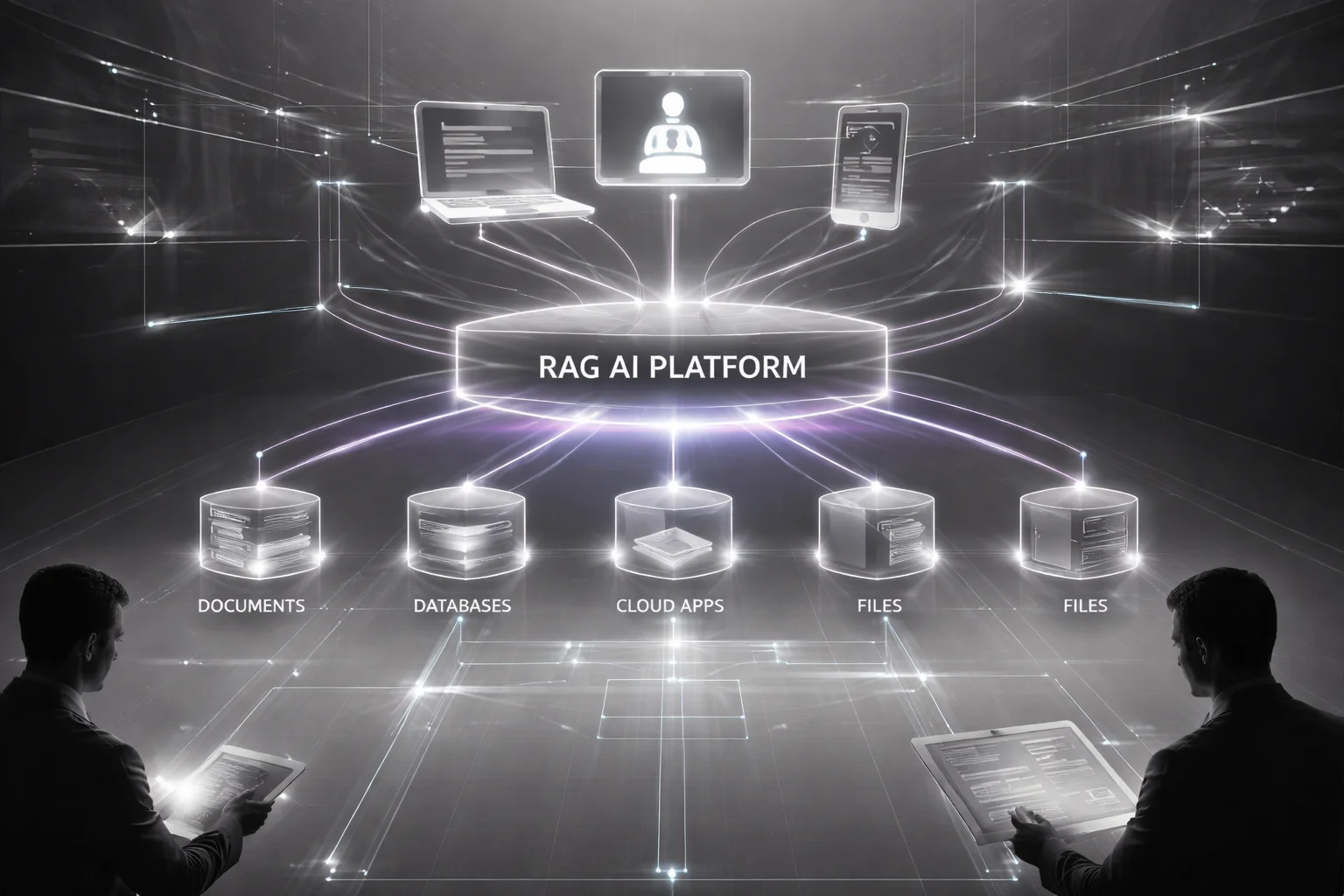
A lot happens in between. Messy stuff. The real platform has to connect source systems, parse files correctly, build indexes, decide how to chunk documents without slicing context into useless scraps, choose embedding models, store vectors in a vector database, run hybrid retrieval with BM25 plus embeddings, rerank results, assemble grounded context, and only then hand it off for answer delivery. Skip one piece and things get strange fast. I’ve seen bad chunking alone turn a 40-page policy document into pure nonsense.
And yes, any one of those stages can fail.
Maxim AI says it straight: RAG evaluation is multi-stage. A query can break at embedding, vector search, context retrieval, reranking, prompt assembly, or generation. That matters because any serious RAG platform evaluation framework has to inspect the whole chain, not just grade whatever final answer pops out on screen. If the answer looks dumb, the bug may have started five steps earlier.
You can see buyers catching on. VentureBeat’s 2026 Pulse survey found that respondents who didn’t expect large-scale RAG deployments by year-end jumped from 3.4% to 15.6%. That’s not some dramatic collapse. It looks more like reality setting in after Q1 demos made everything seem easier than it is.
Squirro calls RAG a cornerstone of enterprise AI architecture. Fair enough. I think that only holds up if we stop using “RAG” to mean “our bot answered from company docs once.” In practice, the platform sits between enterprise knowledge management for RAG and whatever shows up on the front end — copilots, agents, search tools, support assistants.
If you’re evaluating one of these systems, don’t get hypnotized by the UI first. Start with four connected layers: sources, indexing, retrieval, and answer orchestration. Ask what systems it connects to. Ask how documents are parsed and chunked. Ask what retrieval method it uses and how answers are grounded before they reach users. That framing can save months of wasted testing and false confidence. If you want the deeper architecture view, start with enterprise RAG architecture decision framework.
The funny part is the better this gets, the less magical it looks. It starts to resemble disciplined knowledge plumbing instead of AI theater. Isn’t that usually the giveaway that the tech might actually work?
Why Retrieval-Only Demos Mislead Buyers
What exactly are you buying when a vendor answers the perfect question from the perfect pile of files?
I’ve sat in those meetings. Twelve slides in, somebody shows a tidy little retrieval flow over half a dozen handpicked documents, the citations look clean, the answer sounds smart, and everyone in the room starts mentally fast-forwarding to rollout. Then somebody from operations or legal says the annoying thing out loud. Not “Can it summarize this?” The other thing. “What happens when our SharePoint folder changes 4,000 times a day?”
No one likes that question because it ruins the theater. I remember one demo where the rep actually stopped talking for maybe four seconds — which is forever in a sales call — and glanced at the solutions engineer like maybe eye contact could invent an ingestion strategy on the spot. That silence told the truth before the product did.
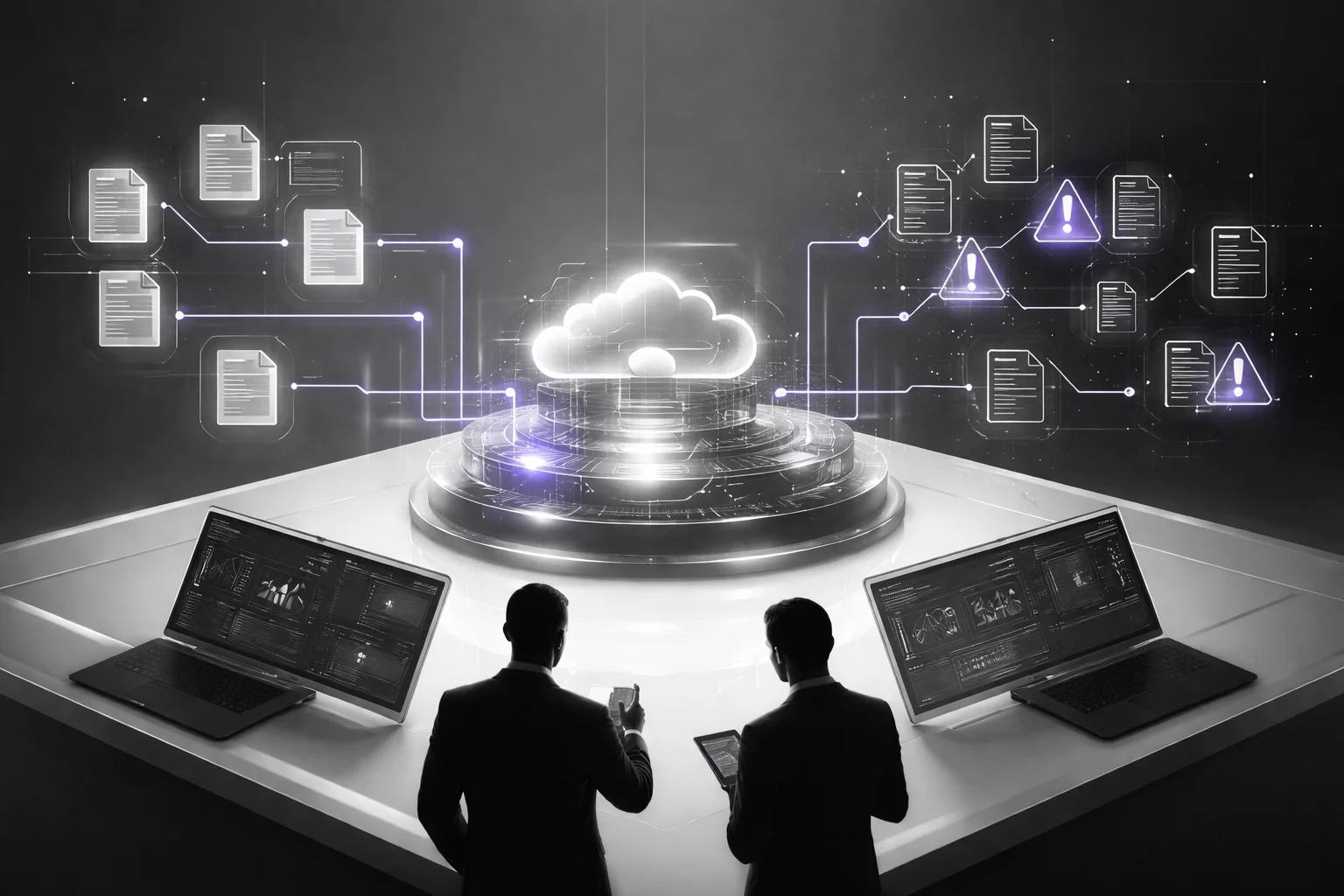
You can probably guess where I land on this. I think buyers get seduced by an enterprise RAG AI platform demo that proves one narrow thing: retrieval works on a frozen corpus. Great. Fine. But live enterprise systems aren’t frozen. Files move. Permissions flip at noon. Duplicate records show up from three systems nobody fully trusts. A legal PDF exported from some ancient tool turns into OCR soup. Parsing breaks. Policies get replaced and nobody updates the old version sitting two folders over.
So what are you really buying?
You’re buying the gap between demo retrieval and production retrieval.
And that gap is where projects get expensive.
Google Research got quoted all over 2024 sales decks for good reason: retrieval augmented generation can reduce hallucinations versus using a static LLM alone. Galileo AI pointed to that work and said hallucinations dropped by as much as 30%. I’m not arguing with that number. RAG absolutely helps. But people stretch that stat until it means things it never meant. A lower hallucination rate doesn’t tell you whether your connectors stay current, whether an index job dies quietly at 2:13 a.m., or whether answers drift three weeks after launch because Confluence pages changed and nobody noticed.
That’s production. Nice stories go there to die.
FloTorch made the part explicit that too many teams learn late: RAG success depends on the retrieval pipeline, not just the model. That’s not some minor implementation detail. It’s most of the risk. If chunking slices a policy right through an exception clause, meaning gets mangled. If embeddings miss domain vocabulary — NDC drug codes, payer abbreviations, internal product names — retrieval degrades fast. If your vector database is tuned badly, you can get answers that sound polished enough to survive a steering committee meeting and wrong enough to create a compliance cleanup that drags on for two months.
That’s why I don’t trust flashy RAG side-by-side comparison decks very much. They judge outputs like they’re scoring headshots in a casting call. Meanwhile, the real questions stay off-screen: ingestion lag measured in hours, reindex frequency under load, hybrid search behavior with BM25 plus embeddings on ugly enterprise queries, and what each retrieval augmented generation platform does when source churn never stops.
The market has already moved past toy examples anyway. Maxim AI cited the 2026 LangChain State of AI Agents report saying 57% of organizations now have agents in production. That number shouldn’t calm you down. It should make you tougher to impress, because more companies in production means more companies have already discovered where these systems actually crack: sync jobs, stale knowledge, access controls, monitoring blind spots.
If I were evaluating vendors, I wouldn’t start with answer polish. I’d start with freshness. How often do connectors sync? What happens after a failed crawl in SharePoint or Confluence? How is stale knowledge detected, and does the user see that warning or just get an answer delivered with fake confidence?
Then permissions. What breaks when access changes at 12:00 p.m. and someone asks at 12:01? Are inherited ACLs preserved across indexing and retrieval, or are you relying on hand-wavy assurances from somebody who hasn’t touched enterprise permission models since 2022?
Then ingestion quality, because ugly data is normal data. Ask how they handle duplicate records, malformed PDFs, scanned docs with OCR errors, giant tables, and policy files colliding across versions.
Then stress behavior. Don’t ask for ideal queries; ask for messy ones — acronyms spelled wrong, half-remembered titles, internal jargon no outsider would guess correctly. Ask to see hybrid search in action and ask for reindex timing after bulk updates with logs, not promises.
Then observability. Show me failed sync logs. Show me monitoring in week six instead of minute six. Show me which alerts fire when pipelines fall behind or documents stop parsing correctly.
That’s what belongs on a real RAG production readiness checklist: source freshness first, observability second, polished answers after that. If you want a better structural lens before vendor selection starts eating your calendar alive, read enterprise RAG solution knowledge fabric.
Demos don’t fail in production.
Platforms do.
So when the room goes quiet after the hard question, are you hearing confidence — or just latency before trouble?
RAG Platform Enterprise Evaluation Framework
What actually breaks first in an enterprise RAG rollout?

Most teams answer that question too fast. They’ll say model quality, or hallucinations, or cost per query, because those are the things everybody can see in a demo. I’ve sat in those meetings. Nice interface. Clean citations. A vendor rep typing like they’re on stage at AWS re:Invent. Everyone impressed.
Then a boring thing happens. A folder moves. An ACL changes after lunch. A SharePoint permission gets tightened at 2:17 p.m. and the index doesn’t catch up until hours later, if it catches up at all. Two weeks after the applause, the system starts handing employees an outdated HR policy from the wrong location, and suddenly that polished answer doesn’t look so polished.
AWS has been clear enough about why companies keep buying retrieval augmented generation in the first place: you can improve outputs without retraining, connect models to internal and external knowledge bases, and show source attribution. Sure. That’s the pitch, and it’s a good one. But the ugly part shows up after procurement signs off. The 2026 LangChain State of AI Agents report, cited by Maxim AI, says quality is still the top deployment barrier for 32% of respondents. Not model access. Not vendor sprawl. Quality.
So here’s the answer: operating reality breaks first.
But not just that. I think buyers make it worse by scoring RAG platforms like they’re judging a conference-room bakeoff instead of a live system that has to survive random Tuesday chaos. The best enterprise RAG AI platform isn’t the one with the slickest synthesis answer at 10:00 a.m. It’s the one still retrieving the right knowledge, with the right permissions, from the right systems, after your environment changes before anyone files a ticket.
That’s why my RAG platform evaluation framework weights six criteria on purpose, not evenly, and definitely not around demo sparkle.
Source coverage — 25%
If a platform can’t reach your real knowledge estate, stop there.
I don’t mean a slide with SharePoint, Confluence, Google Drive, Jira, Slack, Salesforce, file shares, web content, and ticketing logos lined up like trophies. I mean actual ingestion that preserves metadata, document hierarchy, tables, ACLs, version history, and citations in a way that still matters once users start asking messy questions. I’ve seen “10+ connectors” turn into four decent ones and six glorified text scrapers that flatten everything into plain text. That’s not coverage. It’s theater.
A retrieval augmented generation platform with four dependable connectors is often better than one with ten shallow ones. I’d argue that point all day because I’ve watched buyers learn it the expensive way.
Update synchronization — 20%
Freshness is correctness wearing work boots.
Ask for numbers. Real ones. How fast do source changes appear in results for SharePoint versus Slack versus Salesforce? What happens when records are deleted, moved, or re-permissioned mid-day? Do incremental syncs keep working under load, or do they quietly fail until somebody notices bad answers in production?
This is where enterprise knowledge management for RAG either holds up or betrays you quietly. Reindexing after permission changes isn’t some edge case; it’s normal business life.
Retrieval performance — 20%
This is where vendors love to perform.
Let them perform. Just don’t confuse performance with proof.
Test hybrid search: BM25 plus embeddings, not embeddings alone. Look at chunking by content type because a 60-page policy PDF shouldn’t be chunked like a product FAQ or a Jira ticket thread with 19 comments and three pasted stack traces. Push on embedding model choice if your world includes legal terms, SKU codes, or clinical abbreviations. Ask whether reranking is configurable or locked down behind “trust our defaults.”
Your test set should include lookup questions, ambiguous questions, cross-document synthesis questions, and permission-sensitive questions. If a vendor can’t explain why result three outranked result one, I treat that as a warning sign every time.
Governance and security — 15%
If access control is shaky, don’t buy it.
You want role-based access control, source-level permission inheritance, audit trails, encryption standards, policy enforcement, prompt-injection defenses, and support for regulated environments. The vector database setup matters too. Weak separation between tenants or indexes gets risky fast once real enterprise data starts flowing through it.
Observability — 10%
You can’t repair what you can’t see.
The platform should expose ingestion failures, sync lag, retrieval hit rates, citation coverage, latency by pipeline stage, and evaluation metrics such as precision, recall, and faithfulness. RAG failures are usually chained failures. Sometimes generation isn’t broken at all; retrieval never had a fair shot because indexing failed six hours earlier and nobody noticed.
Operational ownership — 10%
This is my favorite ugly question: who keeps this alive on Monday morning?
Score implementation effort, admin workflow quality, index tuning burden, model override controls, testing workflow maturity, and escalation paths when connectors fail. Most RAG side-by-side comparison sheets barely touch this even though this is exactly where post-launch costs start piling up.
If you want a cleaner structure before vendor selection turns political—and it always turns political—use this enterprise RAG architecture decision framework.
I use one blunt rule of thumb: if two vendors tie on retrieval quality, pick the one that makes stale knowledge obvious instead of hiding it well. Pretty wrong answers are dangerous. Honest systems are fixable. So what are you actually buying here—the best demo answer or the system you’ll still trust after your environment shifts?
Knowledge Management Features That Decide Production Success
What actually breaks first in production?

Not the thing vendors love to show. Not the polished retrieval demo with SharePoint on one side, Confluence on the other, a neat answer in the middle, and citations that look crisp enough to calm down a buying committee for an afternoon. I've watched teams run ten test questions, get eight or nine right, and act like the hard part is over.
Then you wait.
Monday morning is where the truth shows up. At 8:17 a.m., a support lead asks an internal assistant for policy guidance. The assistant answers confidently. It cites a real-looking source. The source was replaced three days earlier. Now compliance's week is wrecked because the system sounded certain while being wrong.
So what broke first?
The knowledge layer. That's the answer. But I'd argue even that undersells it, because people still hear "knowledge management" and think janitorial work. It's not. In an enterprise RAG AI platform, it's the part that decides whether trust compounds or collapses after thousands of files change, permissions shift, folders get renamed, and nobody can tell you who last touched the source system.
Enterprise knowledge management for RAG gets ugly fast. Stale chunks. Duplicate records. Broken access rules. Indexing drift so quiet nobody notices until an executive gets a bad answer in a meeting and suddenly everyone wants logs, timelines, and names.
Source lifecycle management is where this usually starts going sideways. Documents don't sit still. They get updated, deleted, split into smaller docs, merged into bigger ones, moved between repositories, renamed by someone trying to be helpful, then moved again six weeks later by someone cleaning up a folder tree. If your platform can't track those changes cleanly, your vector database fills up with ghosts. Hybrid search using BM25 plus embeddings will happily retrieve passages that should've disappeared last Tuesday because the index never caught up.
Ask one hard question in a vendor call and watch the energy change: if a SharePoint document changes five times in one day, what exactly gets reprocessed? The entire file all five times? Only changed sections? Do old embeddings vanish immediately or linger until a nightly sync job runs? That's not some edge-case gotcha. That's cost, latency, and risk packed into one operational detail.
I've seen this play out with overnight queues too. Full reindexing sounds fine on slides because slides never have jobs backing up at 2:00 a.m. Production does. You want delta-based ingestion. You want refresh logic that understands dependencies between sources. You want visibility into sync queues when they start stacking up instead of finding out from users that content is four hours behind.
Versioning matters for a boring reason right up until legal asks questions two weeks later. Your retrieval augmented generation platform should preserve document history and show which version answered which prompt. If legal asks why the assistant said what it said on March 14 and your team says, "we assume it used the latest index," that's just a polished way of admitting nobody knows.
Bad chunks do their damage earlier than most teams expect. Vendors talk endlessly about model quality. Fewer want to talk about malformed tables, duplicate content, parser failures, or low-information chunks flooding retrieval with junk. Good platforms run pre-index validation before any of that enters the system. If chunking is sloppy, retrieval will be sloppy too, no matter how impressive the embedding model choice looks in procurement documents.
The teams that survive this stuff put humans back where humans matter most. They create approval paths for sensitive content. They keep exception queues for parsing failures. They let subject matter experts fix bad citations or mark sources as low trust without filing an engineering ticket and waiting two sprints. That's basic RAG production readiness checklist material, even if plenty of vendors hide it behind shinier feature pages.
Drift is nastier because it doesn't announce itself. Content drifts. Taxonomies drift. Query behavior drifts too. A 2026 VentureBeat Pulse survey reported enterprise intent to adopt hybrid retrieval jumping from 10.3% to 33.3% in one quarter. More hybrid search means more moving parts affecting ranking behavior, freshness, and relevance decay. If you aren't measuring drift across those systems, you're guessing with better branding.
Security isn't off to the side of any of this. It's sitting right in the middle of it whether buyers enjoy that fact or not. Trantor has been right to emphasize audit trails, role-based access control, policy enforcement, encryption, and prompt-injection mitigation inside any serious RAG platform evaluation framework. Permission inheritance breaks during updates more often than people admit. Once that happens, your answer-quality problem becomes a governance problem fast.
I think buyers make this harder than it needs to be because they keep rewarding demos built around one-time uploads dressed up as product maturity. Don't buy that version of the story. Buy the platform that treats knowledge as a living system under constant change — files changing hourly, indexes updating unevenly, permissions mutating quietly in the background — because that's what your environment actually is.
Keep this next to your enterprise RAG solution knowledge fabric work before you make any final RAG side-by-side comparison. If the demo looks clean but the knowledge layer rots in production, what did you really buy?
How to Compare RAG AI Platforms Side by Side
22%. That's the number that sticks with me. In VentureBeat Pulse's 2026 survey, 22% of qualified enterprise respondents said they had no production RAG systems running at all.
I don't find that shocking. I find it honest. Getting a demo to sing for 20 minutes isn't hard. Getting an enterprise RAG AI platform to stay reliable six months after rollout, with broken permissions, duplicate policies, messy ticket threads, and some executive asking why the answer is crisp, fast, and dead wrong? That's the real exam.
That's also why most RAG side-by-side comparison projects are weaker than teams think. They're grading theater. Nice prompts. Nice documents. Nice benchmark outputs. I've seen buyers nod through those sessions and then get blindsided later because nobody forced the vendor to work through ugly business data under real constraints.
I'd argue the middle of the evaluation matters more than the shiny start or the confident finish: your RAG platform evaluation framework can't be a discussion guide. It needs to be a scorecard.
Use weighted scoring. Same test pack for every vendor. No exceptions.
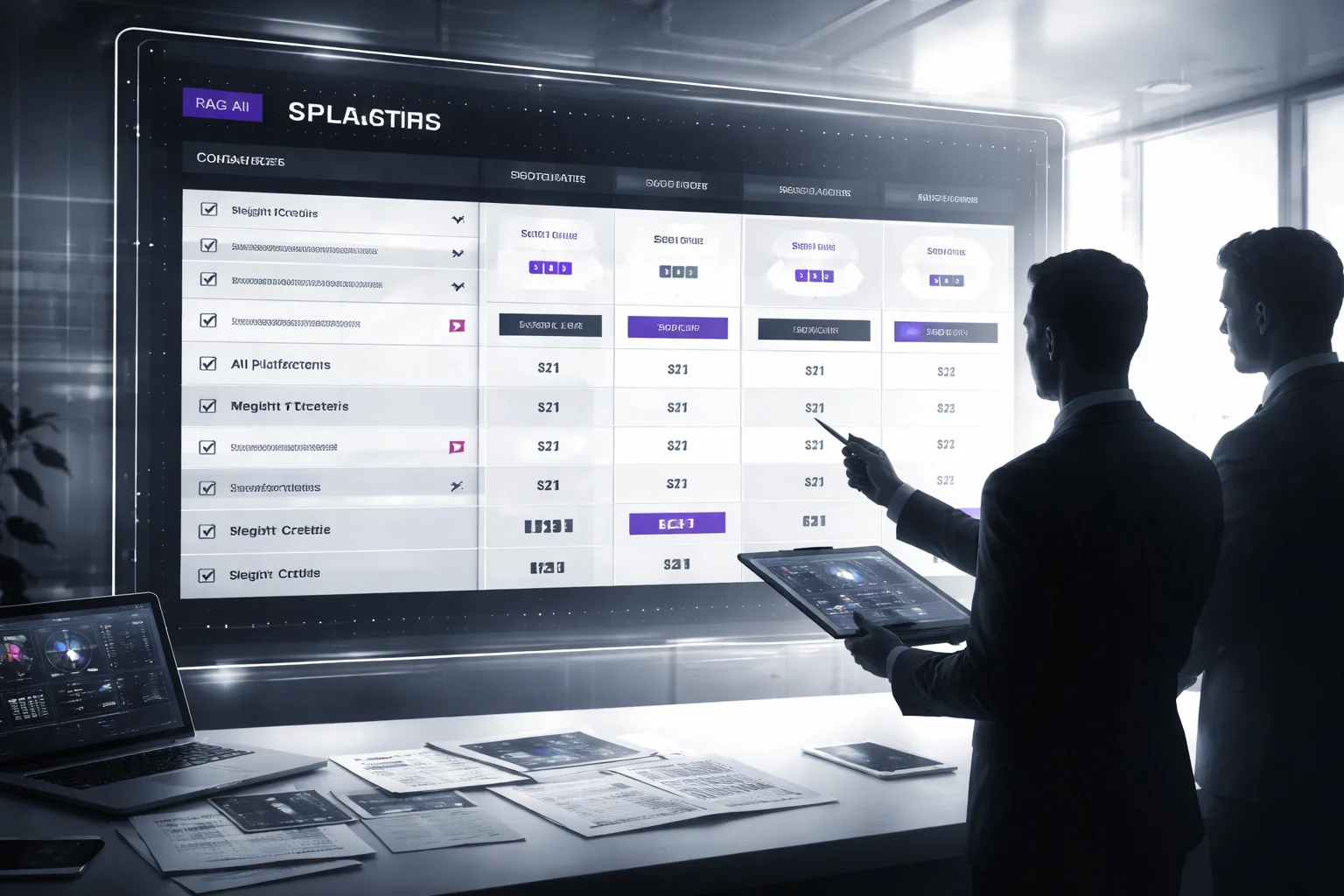
A 100-point model is a solid way to do it: 30 points for retrieval quality, 25 for groundedness and citations, 20 for answer relevance, 15 for overall answer accuracy, and 10 for operational fit. That's close to Sprinklr's advice too—they recommend measuring retrieval quality, answer relevance, groundedness, and overall accuracy instead of making decisions off loose manual testing and vibes.
Still, even a decent model can mislead you if the scenarios are too clean. That's where teams get fooled.
- Use case 1: policy Q&A with permission-sensitive content
- Use case 2: support troubleshooting across product docs and tickets
- Use case 3: sales or account research using CRM notes and knowledge articles
- Use case 4: cross-document synthesis where no single file contains the full answer
Run all four against every vendor. Same data shape. Same prompts. Same limits.
A few years ago I watched two platforms come out nearly tied on a canned benchmark, then separate fast on a 40-query internal test. One handled polished documentation just fine. The other survived account notes packed with abbreviations, fragments, and half-written sales shorthand from three different reps. Guess which one people trusted later.
Don't just score the final paragraph. Score the retrieval augmented generation pipeline itself. Did hybrid search using BM25 plus embeddings bring back the right evidence? Did chunking keep enough context intact? Was the embedding model actually suitable for your domain terms? Did the vector database return relevant results without blowing past latency limits?
The polished answer isn't the interesting part anyway. The failure is.
- "Show us a failed query and walk us through why it failed."
- "What changes by content type in your chunking strategy?"
- "How do you prove citations are grounded rather than adjacent?"
- "What breaks first when permissions change mid-day?"
I think buyers are sometimes too polite here. They ask vendors to present strengths instead of explain weaknesses. Bad move. If two platforms land in roughly the same scoring range, I'd take the one that can clearly explain bad outputs over the one that keeps repeating that accuracy is high. Strange rule, maybe, but I've found it's usually safer. A vendor who can name failure modes probably understands their system better than one hiding behind summary metrics. If you want more structure before final scoring, see enterprise RAG architecture decision framework.
So what should you do with all this? Build one ugly test pack, force every vendor through it, weight the results, inspect retrieval instead of just answers, and make them explain where things break—because if a platform only looks good when everything's clean, what exactly happens on Tuesday afternoon when nothing is?
Where this leaves us
The right enterprise RAG AI platform wins or loses on retrieval quality, permissions, freshness, and operational control, not on a polished demo answer.
So if you're evaluating vendors, test the full retrieval pipeline under real conditions: messy documents, changing sources, hybrid search (BM25 + embeddings), broken metadata, and actual access control rules. Measure precision, recall, faithfulness, grounding and citations, not just whether an answer sounds good. And watch for the boring stuff that breaks production first, like document parsing and indexing, chunking strategy, observability and monitoring, and data governance and compliance.
Most people get this topic wrong by treating RAG like a model feature. The better way to think about it is as a knowledge system with an answer layer on top.
FAQ: RAG AI Platform
What is an enterprise RAG AI platform?
An enterprise RAG AI platform connects a language model to your company’s documents, apps, and knowledge bases so answers come from real business data, not just model memory. The good ones also handle ingestion, document parsing and indexing, hybrid search, grounding and citations, permissions, and monitoring, because that’s what turns a demo into a production system.
How do you evaluate an enterprise RAG AI platform?
Use a RAG platform evaluation framework that checks the full pipeline: ingestion, chunking strategy, embedding model selection, retrieval, reranking, prompt assembly, generation quality, and governance. According to Sprinklr, you should measure retrieval quality, answer relevance, groundedness, and overall answer accuracy instead of relying on ad hoc manual testing.
Why do retrieval-only demos mislead buyers?
Because a clean retrieval demo can hide the parts that usually fail in production: bad chunking, weak reranking, stale indexes, prompt assembly issues, and missing access controls. Maxim AI points out that RAG evaluation is multi-stage, so a query can break at embedding, vector search, context retrieval, reranking, or generation even if the search screen looks impressive.
What knowledge management features matter most for production RAG?
Look for strong knowledge base ingestion, document parsing and indexing, versioning, sync schedules, metadata handling, and support for messy enterprise content like PDFs, wikis, tickets, and cloud drives. Honestly, if the platform can’t keep content fresh and structured, your retrieval augmented generation platform will drift fast and users will stop trusting it.
Can a RAG platform enforce access control, PII handling, and compliance rules?
Yes, and if it can’t, it’s not ready for enterprise use. Trantor recommends checking for role-based access control, audit trails, policy enforcement, encryption, and prompt-injection mitigation, along with proof that document-level permissions carry through retrieval and answer generation.
Does a RAG AI platform actually reduce hallucinations?
It can, if retrieval quality is high and answers are grounded in cited source material. According to Galileo AI citing Google Research, RAG systems have reduced hallucinations by up to 30% versus static LLMs alone, but that benefit disappears when the system retrieves the wrong context or incomplete documents.
What metrics and test sets are best for enterprise RAG evaluation?
Use a fixed test set built from real business questions, then score precision, recall, faithfulness, answer relevance, citation accuracy, latency, and cost per answer. You’ll also want failure slices, like policy questions, long PDFs, duplicate documents, and permission-restricted content, because average scores can hide ugly retrieval pipeline problems.
What should a side-by-side RAG platform comparison include?
A useful RAG side-by-side comparison covers retrieval quality, grounding and citations, hybrid search support, latency, observability, admin controls, deployment model, and total cost, not just model quality. According to the 2026 VentureBeat Pulse survey, enterprise intent to adopt hybrid retrieval jumped from 10.3% to 33.3% in one quarter, which tells you buyers are finally comparing retrieval architecture instead of getting distracted by chatbot polish.