Enterprise RAG Architecture Decision Framework
Most enterprise AI failures aren't model failures. They're retrieval failures dressed up as model problems. That's blunt, but the evidence is getting hard to...

Most enterprise AI failures aren't model failures. They're retrieval failures dressed up as model problems. That's blunt, but the evidence is getting hard to ignore: according to Vectara, enterprises are choosing RAG for 30-60% of their use cases, and a 2026 empirical study found that trust came down to concrete engineering choices in the corpus, retrieval module, and pipeline operations.
That's why enterprise RAG architecture isn't a side decision for your AI team. It's the decision. Actually, that's not quite right. The real issue is that most teams treat architecture like plumbing, then act surprised when relevance, security, and cost all break at once. In this guide, you'll get a seven-part framework to make those tradeoffs clearly, before they make them for you.
What Retrieval Augmented Generation Enterprise Architecture Is
I watched a team blow this in a way that looked minor at first. Friday afternoon. 4:47 p.m. A lawyer needed the indemnity clause from a vendor agreement before a board call. The assistant answered in seconds, sounded sure of itself, cited the wrong section from the wrong contract, and everybody in the room wanted to blame “the model.” I wouldn’t. I think that excuse lets bad system design off the hook.
The miss usually starts earlier. Chunking broke the clause apart. Metadata was thin. Ranking pulled a near-match that looked close enough. Permissions weren’t clean. Retrieval grabbed something fast instead of something right.
That’s the whole reason 30% to 60% of enterprise AI use cases are ending up on RAG, according to Vectara. Not because executives like acronyms. Because companies need answers tied to their own contracts, policies, tickets, and manuals — answers with sources attached, answers someone can defend in legal, finance, or audit without shrugging.
A lot of demos make this look almost insulting in its simplicity: connect an LLM to a vector database, pull a few chunks, send them into the prompt, done. Real enterprise architecture is the messy part people skip in slide decks. It’s retrieval plus access controls, indexing rules, ranking logic, latency budgets, audit trails, source traceability, and proof that the system only saw what it was allowed to see.
So here’s the framework I’d use: boundary, findability, trust.
Boundary: decide what the system is allowed to know before you ask it anything clever. Draw hard lines around the corpus. Contracts aren’t HR files. Board materials aren’t support tickets. Permissions have to survive ingestion and retrieval, not get patched on later after someone notices cross-team leakage in testing.
Findability: make sure the right passage can actually be found. Legal work exposes weak design fast. If your RAG index design chunking metadata is sloppy, an indemnity clause gets split across three fragments and the obligation language lands in one chunk while the exceptions land somewhere else. The model loses context and starts guessing around edges it should never guess around. If your embedding model doesn’t understand domain phrasing, retrieval misses the exact paragraph that matters. If you rely only on vectors, BM25-style exact references like clause numbers can disappear. If you skip re-ranking, irrelevant passages float upward because they sound vaguely similar.
Trust: prove where the answer came from and prove that refusal works when retrieval fails. That means visible citations, test cases for refusal-correctness, latency profiling so slow lookups don’t push teams into bad shortcuts, and logs good enough for audit review six months later when someone asks why the system answered what it did on March 12.
People love calling those “small implementation details.” I don’t buy it. They’re foundation decisions. Early ones. Give them six weeks and they harden into dashboards, prompts, training docs, approval workflows, maybe even procurement decisions built on top of retrieval plumbing that was shaky from day one.
Enterprise RAG isn’t really “retrieve then generate.” It’s deciding what can be known, how it gets found, and how you show your work.
Enterprise RAG security governance belongs in version one. Same for RAG retrieval strategy search hybrid rerank, document permissions, and visible sourcing. A 2026 empirical study from the Universal Library of Innovative Research and Studies put trustworthy enterprise RAG on much less glamorous footing than most vendor pitches do: semantic document segmentation, dense semantic retrieval, explicit refusal-correctness testing, latency profiling, and user-facing citations. Not model magic. Engineering discipline.
You want scaling production RAG? Don’t start with vendor shopping. I’ve seen teams waste three weeks comparing logos before they’ve even agreed on required metadata fields. Start with corpus boundaries. Decide which metadata is mandatory and who owns keeping it clean. Choose embedding models based on the language your documents actually use — legal clauses, insurance forms, SAP notes, field service manuals — not whatever got applause at a conference last month. Define hybrid retrieval before somebody hardcodes vector-only search into every workflow. Add re-ranking where precision matters most. Layer governance onto that structure so permissions and source visibility are built in instead of bolted on after launch.
If you need a practical place to begin, this Ai Enterprise Document Search Rag Design Guide is a solid next read.
Why Enterprise RAG Architecture Decisions Matter
What actually blows up an enterprise RAG system?

Most teams answer too fast. They point at the model. Hallucinations. Weak citations. Maybe security around company data. That's the sales-deck version, and yes, those things are real. Vectara says as much. Squirro goes further and argues RAG can beat fine-tuned models on enterprise accuracy and reliability.
I've never thought that was the part people miss first. I think they miss the bill.
You won't see it in a pilot. A neat little retriever-reader setup with 50 users and a controlled dataset can look great in a demo room on a Tuesday afternoon. Everyone nods. Latency seems fine. Answers look clean. Nobody's sweating.
Six months later, the same system has 150 or 200 users, documents are updating constantly, the vector database starts dragging under write load, every query kicks off dense retrieval plus an expensive re-ranker, latency climbs, and answer quality somehow gets worse instead of better. I watched a team hit this wall on a support knowledge base with about 1.2 million documents. They blamed the LLM first. Wrong target.
The answer is architecture.
But not in the abstract, not in the fluffy "good foundations matter" way people use when they don't want to name the bad decision.
A lot of these failures come from choices nobody really chose. Somebody stuck with pure vector search because it was the default. Nobody added hybrid search with BM25 plus vectors. The embedding model didn't fit domain-heavy text. Relevance got treated like magic dust you sprinkle on top later. It doesn't work that way. Weak RAG retrieval strategy search hybrid rerank decisions made early keep charging interest every week after launch.
Same mess with RAG index design chunking metadata. Bad chunking mangles context before the model ever touches it. Thin metadata turns filtering into guesswork. I've seen teams chunk policy PDFs into tiny fragments because it made ingestion easier, then wonder why answers stitched together half a paragraph from page 4 and one stray sentence from an appendix. That's not intelligence. That's self-inflicted noise.
Enterprise RAG security governance gets uglier faster than people expect. A demo can survive weak document permissions because demos are fake life. Production isn't fake life. Legal, HR, and finance can share infrastructure, sure. They cannot share retrieval space like roommates splitting a studio apartment in San Francisco.
People talk about security as risk management. Too narrow. I'd argue the bigger pain is rework under pressure. Auditors don't care that permissions were planned for phase two. Once real users are live, access control stops being optional and starts becoming evidence.
This compounds hard while scaling production RAG. A central proof of concept can limp along with shortcuts all over the place. Spread that same pattern across regions, business units, or regulated datasets and it breaks in very boring, very predictable ways: ingestion pipelines need rebuilding, index partitions need redesign, tenant isolation suddenly matters, hybrid retrieval has to be revisited, re-ranking gets reevaluated from scratch.
Start somewhere less glamorous. Set query economics before traffic shows up. Decide what each question is allowed to cost before somebody asks 20,000 of them in a week. Draw permission boundaries before legal asks harder questions than your product team did. Build indexes for retrieval quality, not ingestion convenience. Worry about model choice after that, not before.
Ai Document Retrieval Rag Citation Architecture covers one slice of that problem well.
The flashy model everybody obsesses over might be the cheapest mistake in your stack.
The Enterprise RAG Architecture Decision Framework
I watched a team make the kind of mistake that feels smart right up until legal walks into the room. Six weeks. Gone. They'd tuned embeddings, compared vector databases, polished the demo, and argued about retrieval quality like it was the whole game. Then someone from legal asked, “Can you show why this user got this document instead of another one?” Nobody had an answer. Not a bad one. No answer at all.
That's how this usually fails. Not with broken code. With the wrong order of operations.
By 2025, 73.34% of RAG platform implementations were happening in large organizations, according to Firecrawl. Big companies. Real budgets. Audit trails. Procurement people. The sort of environment where a cute prototype dies the second it meets HR records, customer contracts, or a compliance review on a Thursday afternoon.
I think teams obsess over the shiny parts because they're easy to show in a meeting. Search quality looks good on a slide. Model choice sounds sophisticated. Response polish gets head nods from executives who've spent exactly nine minutes using the system. Meanwhile the ugly production stuff sits offscreen: permissions, refresh timing, latency ceilings, and what happens when one department wants access to data another department can't legally share.
Here's the lesson I'd turn into a rule: before anyone picks tools, force five decisions and write them down where people can argue over them in public — business fit, data sensitivity, latency budget, accuracy target, and expansion path. Score each one. Assign an owner. If nobody owns the tradeoff, it'll come back later wearing a much more expensive costume.
Business fit first. Always first. An internal policy assistant can be a little slow and occasionally say “I don't know” without causing much damage. A claims support workflow can't. If a claims rep is on a live customer call and your system takes 12 seconds to answer, that's not some minor UX blemish. That's dead air on the phone, rising handle time, and managers asking why they approved this thing in the first place. I've seen teams define success as “the chatbot sounds helpful.” That's how you ship something that crushes in demos and falls apart by Tuesday morning.
Then data sensitivity narrows your options fast, or it should if you're being honest with yourself. HR files aren't forgiving. Contracts aren't forgiving. Regulated customer records definitely aren't forgiving. Your enterprise RAG security governance setup needs document-level permissions, audit trails, controls over what gets stuffed into prompts, and sometimes clean separation between retrieval and generation layers. Pre-built platforms can move faster here because some already include those controls. Custom stacks give you more freedom, sure. They also give you more ways to leak something embarrassing at 4:47 p.m. on release day.
Atlan says RAG architecture is the backbone of enterprise AI. Fine. I'd push it one step further: the part that actually decides whether your system helps or hurts is the context layer — the mechanism that determines if the model is merely fluent or actually right for your business.
Retrieval design comes after that, not before. And this is where vendor defaults quietly wreck relevance while everyone pretends they're saving time. Your RAG retrieval strategy search hybrid rerank choice has to match real user behavior, not benchmark theater. Exact policy IDs mixed with fuzzy conceptual questions? Use hybrid search with BM25 plus vector search together. Top-k results are noisy? Add re-ranking models instead of dumping even more documents into context and hoping for mercy. Heavy domain language in insurance, law, pharma? Test embedding models on your own corpus, not whatever happened to top a public leaderboard last quarter.
Same deal with RAG index design chunking metadata. Chunk by semantic unit if you can. Split a benefits policy halfway through an exception clause and you'll get answers that are technically plausible and operationally useless — my least favorite category of failure because it fools people for just long enough to do damage. Keep metadata that lets you filter by source system, owner, region, confidentiality tier, and freshness. Pick your vector database based on update patterns and access control needs, not hype or somebody's LinkedIn victory lap about Pinecone versus Weaviate.
The funny part is model quality often isn't what breaks first in production anyway. Scaling production RAG usually cracks at refresh cadence, permission inheritance, and cross-business-unit expansion long before anyone has exhausted optimization on generation quality. A retail company might survive stale internal help content for 24 hours without much drama. Try that in finance or healthcare and trust evaporates before lunch.
So here's the framework I'd actually use as a review scorecard every single time: use case criticality, security class, latency ceiling, retrieval method, index plan, expansion risk. Same checklist every time. Less guesswork. Fewer expensive detours disguised as technical exploration. If you're planning past one assistant and into something broader across systems and teams, this enterprise RAG solution knowledge fabric piece is worth your time.
You can debate rerankers versus larger context windows all week if you want; I've seen plenty of teams do exactly that while ignoring the real problem sitting in plain sight — but if an answer is wrong in your environment, what breaks first?
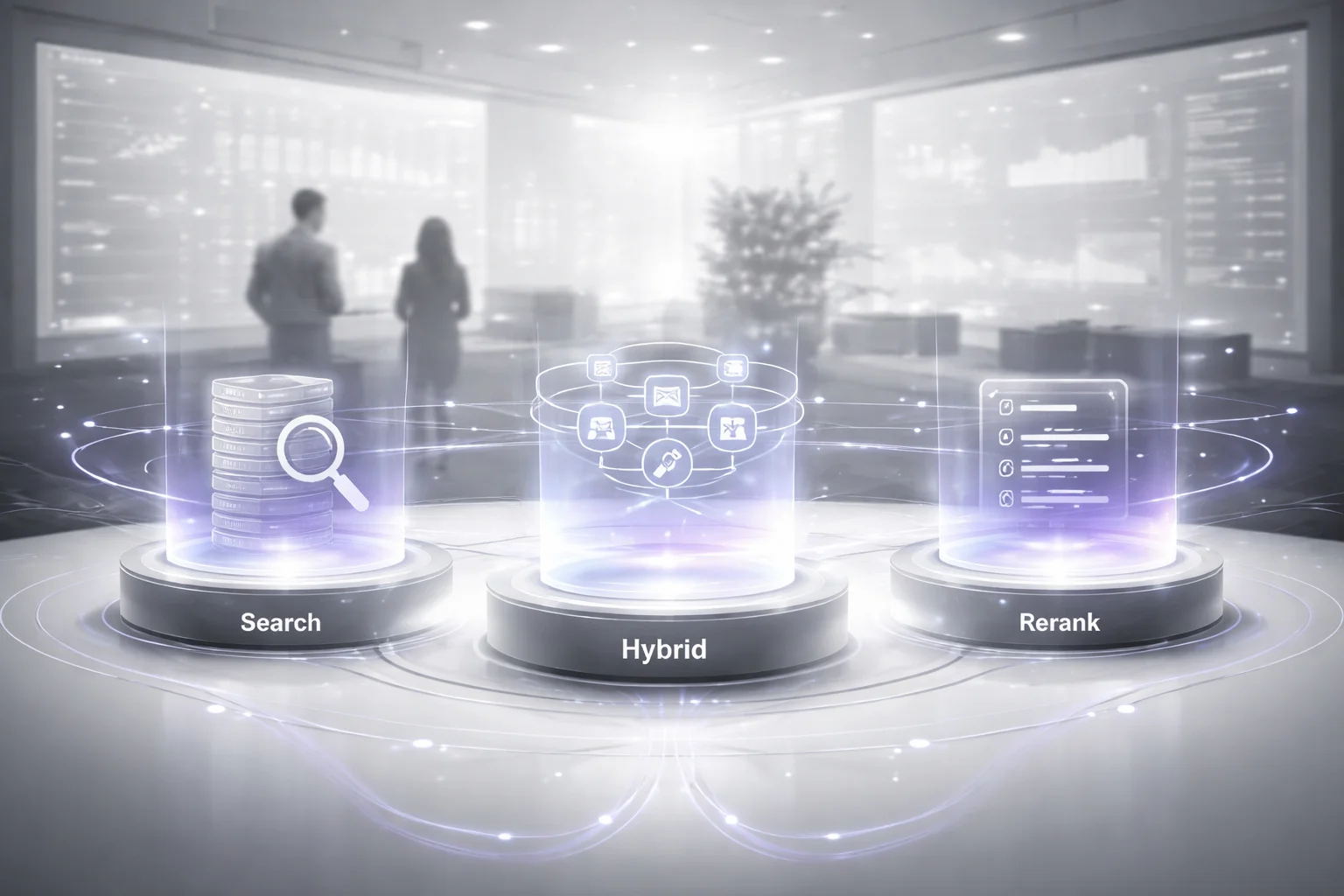
Retrieval Strategy Choices: Search, Hybrid, or Rerank
At 8:40 on a Monday morning, a support lead typed POL-4821 into an internal assistant and got back a beautifully written answer that was flat-out wrong. Not vague-wrong. Dangerous-wrong. The system had pulled policy text that sounded related, skipped the one file with the exact code, and then the room did what rooms always do: blamed the model.
I think that's backwards.
The mistake usually happens before the model writes a single token. Retrieval made the call. Retrieval decided what truth was even available. If the right document never makes it into the candidate set, the LLM can't magically redeem your architecture just because the answer sounds polished.
That's the part people keep dressing up as a model issue. It's not. It's a retrieval problem wearing a model costume.
Tredence gets this right: modern RAG systems need to be treated like enterprise systems, not hacked-together demos that somehow survived procurement. Retrieval sits next to governance, observability, cost control, and auditability now. And Vectara has projected that enterprises will use RAG for roughly 30% to 60% of use cases. If that range is anywhere close to reality, picking one retrieval mode and acting like you've solved it is asking for pain.
Keyword search
Let's start with the least glamorous option. The one people roll their eyes at right before it saves them.
Keyword search wins when exact wording is the job. Policy IDs. Contract clause numbers like 7.3(b). SKU references. Invoice fields. Searches such as “POL-4821” or “Clause 7.3(b)” are usually better served by BM25-style retrieval than by anything dressed up as smarter, because BM25 does the obvious thing fast: it finds the literal text.
Cheap helps. Fresh helps more. Easy debugging helps most of all once legal asks why document A appeared above document B. Keyword search gives you an answer you can actually explain without waving your hands around embeddings and similarity scores.
It misses things too, sometimes badly. Ask for “termination rights” while the source document says “right to cancel,” and lexical search may completely miss it. That's not a tiny flaw. That's the tradeoff.
Vector search
This is where teams get hypnotized.
Vector retrieval is useful when people search like humans instead of librarians. Messy phrasing. Indirect wording. Three half-formed ideas stuffed into one sentence by a customer who's in a hurry. Employees don't always know the official term, and customers almost never care what your taxonomy committee approved last quarter.
Vectors help because they can catch meaning rather than exact wording across large corpora. A retriever-reader setup gets more flexible fast. That's real value.
The bill comes later.
Opacity is the problem nobody wants to talk about honestly enough. Embedding model choice matters more than vendors admit. Vector database behavior matters too. Freshness can bite you if embeddings lag behind source updates; I've watched teams re-embed nightly at 2:00 a.m. and then act surprised when a same-day policy change made at 9:15 a.m. doesn't appear in answers before lunch.
You can absolutely build strong semantic recall this way. You just can't pretend it's self-explanatory or instantly fresh by default.
Hybrid plus rerank
The answer most enterprise teams land on isn't elegant. It's practical.
Hybrid retrieval — BM25 plus vector search — with reranking layered on top is usually the sane default for enterprise RAG. Not always. I wouldn't pretend otherwise. But often enough that I'd start there unless there's a clear reason not to.
You get exact-match candidates from keyword search and conceptually relevant candidates from vectors, then use reranking to separate weak hits from strong ones inside that combined pool. That's usually the best answer to the search-versus-hybrid-versus-rerank question people keep trying to reduce to a vendor checkbox.
I disagree with how casually people recommend reranking, though. It's not free wisdom sprinkled on top of bad retrieval. It adds latency, operational overhead, and another component that can fail quietly while everyone assumes “the stack” is working fine.
If you're dealing with regulated content or high-stakes outputs, start hybrid first. Add reranking where precision actually pays for itself. An insurance claims workflow? Yes, probably worth it. Internal lunch-menu search? Come on. Don't add another 150 to 300 milliseconds per query and another thing to monitor just so someone can find taco Tuesday with marginally better relevance scores.
This also ties straight into chunking and metadata design inside your index. Bad chunks make good retrieval look dumb. Bad metadata makes rerankers look worse than they are. If you want more on source-grounded retrieval choices, see Ai Document Retrieval Rag Citation Architecture.
The blunt version for production RAG is simple enough: use keyword search for exactness, vector retrieval for semantic recall, hybrid for enterprise reality, and reranking for expensive precision where it earns its keep.
Measure actual query patterns before you commit to anything. Don't let a slick demo choose your architecture for you.
The funny part is that the fanciest system in the room still loses embarrassingly often to plain old keyword search when somebody types the exact code and just wants the one document you already had all along. So what are you really optimizing for — prettier relevance math, or getting Tuesday morning right?
Index Design, Chunking, and Metadata for RAG
73.34%. That's the share of RAG platform implementations Firecrawl said were happening in large organizations by 2025. I don't find that comforting. I find it revealing, because big companies are exactly where retrieval falls apart: duplicated files, stale policies, access rules nobody documented cleanly, and ten near-identical documents that all look right for about five seconds.
I've seen teams respond to bad answers the expensive way. New model. Bigger bill. Same bad result. Not because the model was weak, but because the system had already mangled the evidence before generation even started. A definition got separated from its exception. A policy chunk lost its effective date. A contract clause went into the index without the business unit or confidentiality tag that would've ruled out the wrong match.
I think this is the part people keep dodging: answer quality lives or dies on three boring things working together — storing the right unit of meaning, attaching context that retrieval can actually use, and keeping an index flexible enough to change over time. Miss one and the other two won't save you. Good chunking can't bail out empty metadata. Nice metadata won't rescue a retriever-reader setup that's fetching the wrong kind of evidence.
800 tokens is tidy. It's also how you break a policy.
Fixed splits look clean in a dashboard and messy in production.
Policies usually want section-level chunks. Contracts usually want clause-level chunks. Product docs usually want chunks built around tasks, workflows, or procedures. Slice all of them at some neat character or token threshold and you'll split the instruction from the warning, or the rule from the exception, and then you'll get an answer that sounds polished while being completely wrong.
The 2026 United Nations University C3 Research Report points toward adaptive, multi-stage RAG with dynamic chunking and hybrid search using BM25 plus vector retrieval. I'd argue that's exactly right. A legal archive shouldn't be chopped up like a troubleshooting knowledge base. I learned that the hard way on a support corpus with about 40,000 articles; one tiny “before you begin” note kept landing in a different chunk from the actual fix, and that one line changed the answer every time.
Metadata isn't paperwork
If it can't improve ranking, filtering, or governance, it's not metadata doing work. It's decoration.
Store source system, document type, owner, business unit, region, confidentiality tier, effective date, version, and citation path. Real fields. Useful fields. The kind a re-ranker can use to push stronger candidates up and weaker ones down. The kind security teams need if you want enterprise RAG rules enforced without tearing apart your pipeline six months later.
This is where corners get cut because ingestion deadlines are loud and boring infrastructure work isn't fun to demo. Then someone asks for something painfully specific — say, “latest approved APAC policy version only” — and suddenly everybody remembers metadata mattered after all.
Your index has to survive change
If one content update triggers full reprocessing of everything, you're not ready for production.
Use index partitions and refresh policies that let you update one slice of the corpus without touching the rest. In practice that means separate collections in your vector database by sensitivity or domain, explicit embedding-model rules for each corpus family, and refresh schedules tied to source volatility instead of whatever looked simple on an architecture slide.
HR policies might change monthly. Support tickets might change hourly. Those two shouldn't share one blunt refresh strategy just because it's easier to explain in a meeting.
This is where RAG index design chunking metadata stops sounding like implementation trivia and starts looking like operations reality. If you're serious about scaling production RAG inside a retrieval augmented generation framework, build knowledge sources as modular layers you can re-index independently. The enterprise RAG solution knowledge fabric piece gets this part right.
The funny part is the best systems often look less impressive in demos. They obsess over clause boundaries, version fields, partition rules, refresh cadence — all the stuff nobody claps for. Then they quietly beat flashier systems once real users show up. So what are you fixing first next time: the model everyone notices, or the index that's been sabotaging it all along?
Security, Governance, and Scaling in Enterprise RAG
Tuesday morning. Support asks a perfectly normal question, the system answers fast, and buried in the retrieved context is a compensation-policy chunk they never should've seen. I've watched rooms go quiet over stuff like that. Nobody claps for low latency after an access mistake.

That's why I don't buy the usual excuse that governance slows enterprise RAG down. Sloppy retrieval does more damage than the model ever gets blamed for. The United Nations University C3 Research Report found advanced approaches beat naive RAG on precision by 15% to 40%. That gap isn't magic. A lot of it comes from discipline: cleaner retrieval, tighter controls, better structure.
If your enterprise RAG architecture can't decide who is allowed to retrieve which documents, show why an answer appeared, and keep working under production load, it isn't enterprise-ready. It's a polished demo with legal exposure attached.
I keep seeing the same bad idea dressed up as efficiency: one shared retriever for HR, finance, legal, and support. Looks neat on a slide. Falls apart in real life. Access control has to happen before retrieval, not after generation. Query-time RBAC or ABAC filters. Metadata-based document entitlements. Separate indexes inside the vector database when sensitivity tiers need hard isolation.
The real cost isn't only exposure. It's trust collapse. One bad retrieval incident can kill adoption across departments faster than a 900-millisecond latency spike ever will. I've seen pilots stall for six weeks over a single permissions scare while teams happily tolerated slower response times every day.
Auditability has to be built into the retrieval augmented generation framework itself. Not added later because compliance finally showed up. Your logs need user identity, query text, retrieved sources, applied filters, prompt assembly steps, and final output. March 12 lands on the calendar, compliance asks why a claims answer cited an outdated policy, and you need an exact trace of what happened.
Scaling gets oversimplified too. More queries per second? Fine. That's the easy part. Keeping permissions intact while indexes refresh, embeddings change, and three new business units get onboarded in the same quarter — that's where messy systems crack. Picture hybrid search with BM25 plus vector retrieval across mixed corpora. Re-ranking boosts relevance scores on paper while quietly jumping metadata boundaries between legal and support content. People call that sophistication. I'd argue it's just risk wearing nicer clothes.
The fix is boring. Good. Boring wins here. Isolate sensitive domains where needed. Standardize metadata entitlements across corpora. Test embedding model selection by corpus class instead of pretending one model will behave well everywhere. Treat RAG index design chunking metadata as governance work every bit as much as retrieval work. If you want a practical pattern for source-aware controls and citations, read Ai Document Retrieval Rag Citation Architecture.
Do this early: make access control, auditability, compliance review, and capacity planning actual design gates in your enterprise RAG architecture. Before pilot success. Before the launch deck. Before procurement asks for cross-team access “just temporarily.” Temporary access has a weird habit of becoming permanent by Friday.
The funny part is the teams that seem slower in week 2 usually move faster by month 5. They spend their early time arguing about entitlements instead of spending week 20 explaining an avoidable incident to legal.
How to Plan for RAG Evolution Without Rearchitecture
Tuesday, 9:12 a.m. The team thinks the hard part is over. The pilot works, leadership's happy, somebody's already saying “built for scale” like they earned a medal. Then Legal shows up after an audit and locks down entitlements. Ten minutes later, IT announces a fresh SharePoint estate is getting added. By lunch, your model vendor has put the embedding family you chose six months ago on the retirement path. I've seen that day. It's never traffic that makes people sweat first.
The easy answer is user growth. More seats, bigger prompts, higher inference bills. Nice whiteboard story. Usually wrong.
The real break point is replacement. Not whether the system runs today, but whether you can swap parts tomorrow without opening the patient up on the table.
That's the whole bet with enterprise RAG: plan for component replacement, not system replacement. If retrieval, indexing, and model layers can move independently, you keep shipping. If they can't, one vendor change turns into surgery.
And yeah, lots of teams say they're modular. Then they try to replace one piece and find out citations collapse, permissions drift, or reindexing 40 million documents eats an entire weekend and half of next week too.
I think too many RAG roadmaps get hypnotized by the LLM and call that strategy. I don't buy it. A 2026 study from the Universal Library of Innovative Research and Studies, across five experimental series, pointed somewhere less glamorous: trustworthy enterprise RAG came down to engineering choices in the corpus, retrieval module, and pipeline operations, not vague model traits. That matches what fails in production anyway—ingestion, retrieval quality, permissions, operational glue.
So build for the places change actually hits first.
Keep document ingestion source-agnostic. If adding another repository means rebuilding the pipeline around one connector decision you made in month one, you've already boxed yourself in. Treat your vector database like infrastructure you may replace later, not sacred architecture you must defend forever.
Do the same with embedding model selection. Version it by corpus class. Product manuals might move to a newer encoder while legal archives stay where they are. That's a lot better than forcing one giant synchronized reindex because someone wanted neatness on a diagram.
Retrieval deserves the same practical attitude. Start with hybrid search (BM25 + vector) if queries are mixed. They are mixed. At 9:00 somebody searches an exact part number; at 9:03 somebody types “what's our policy on contractor device access in Germany?” Same interface, completely different retrieval behavior.
Add re-ranking models only where precision actually pays for itself. I'd argue that's the grown-up answer to RAG retrieval strategy search hybrid rerank. Not elegance. Not purity. Just putting extra computation where it changes outcomes.
Your RAG index design chunking metadata needs enough structure to handle future filters like region, business unit, confidentiality tier, and workflow state—even if some of those sit idle for months.
No, that doesn't mean dumping every field you can think of into metadata right now. Bad idea. That's how teams end up with junk tags nobody trusts by Q2. What you need now is a schema process. Different thing entirely. If metadata grows wild early on, enterprise RAG security governance gets ugly fast—usually around the exact moment someone asks why restricted HR content was discoverable through a sales assistant.
If you're choosing a retrieval augmented generation framework, ask four blunt questions and don't let anybody dance around them:
Can you add new data sources without rebuilding indexes?
Can you change models without breaking citations?
Can you isolate sensitive corpora as usage grows?
Can you extend from Q&A into agentic workflows without rewriting permissions?
If two or more answers are no, stop.
The sane path for most teams working on scaling production RAG isn't dramatic anyway. Start narrow: one domain, one governed corpus, hybrid retrieval, clear citations. Add re-rankers where query quality matters enough to justify them. Split indexes by sensitivity and refresh cadence after that. Move into multi-step workflows only once retrieval quality and controls are boringly reliable.
Boring wins. Every time.
Boring means no emergency rearchitecture because one vendor changed direction and Legal dropped a restricted corpus into scope in the same week.
If you want a practical reference for designing that growth path across connected knowledge sources, read enterprise RAG solution knowledge fabric. Or skip it and answer the harder question instead: if your embedding vendor changed next month and Legal added new restrictions that same Tuesday morning, would your system bend or break?
FAQ: Enterprise RAG Architecture Decision Framework
What is an enterprise RAG architecture?
An enterprise RAG architecture is the system design that connects your document ingestion pipeline, indexing layer, retriever-reader architecture, security controls, and LLM response layer so the model answers with company-approved context. In plain English, it’s how you make retrieval augmented generation framework choices that work with your data, your permissions, and your uptime requirements, not just a demo notebook.
Why do enterprise RAG architecture decisions matter so much for accuracy and cost?
Because most failures come from bad retrieval, weak chunking strategy, and sloppy context window management, not from the model alone. According to the Universal Library of Innovative Research and Studies (2026), the decisive factors are engineering choices in the corpus, retrieval module, and pipeline operations, which is exactly why a good enterprise RAG architecture cuts hallucinations and wasted token spend at the same time.
How do you choose between search, hybrid, and rerank retrieval strategies for enterprise RAG?
Start with your query mix. If users ask exact-match questions about SKUs, policy IDs, or legal clauses, keyword search helps. If they ask fuzzy semantic questions, vector retrieval helps. Most teams end up with RAG retrieval strategy search hybrid rerank, meaning BM25 plus vector search plus a re-ranking model, because advanced approaches can improve precision by 15-40% over naive methods, according to the United Nations University C3 Research Report (2026).
How should you design chunking and metadata for enterprise RAG?
Use chunks that preserve meaning, not arbitrary character counts. Actually, that’s not quite right. The real issue is whether each chunk contains one coherent idea plus enough metadata to filter and rank it later. Your RAG index design chunking metadata should include source, owner, document type, timestamps, access labels, product or business unit tags, and section-level context so retrieval stays relevant and permission-aware.
What chunk size and overlap approach works best in production?
There isn’t one magic number, and anyone who gives you one is overselling it. Start with semantic document segmentation, then test chunk sizes that match document structure, like policy sections, product specs, or support articles, with light overlap only where context breaks across boundaries. The best production setup comes from offline testing on your corpus, not blog-post folklore.
How should metadata be structured to support filtering, permissions, and retrieval quality?
Keep metadata schema design boring and strict. You want stable fields for tenant, department, sensitivity level, jurisdiction, document status, effective date, source system, and ACL references, plus optional business tags for retrieval tuning. If your metadata is inconsistent, your filters, access control, and ranking logic will all drift in ways that are expensive to debug.
What security and governance controls are required for enterprise RAG deployments?
At minimum, you need enterprise RAG security governance that covers RBAC or ABAC, tenant isolation, encryption, secrets management, audit logging, data lineage, retention rules, and approval workflows for index refreshes and model changes. You also need source visibility in the user experience, because explainability without traceable citations isn’t much use in regulated environments.
How do you select an embedding model and vector index for enterprise RAG?
Pick the embedding model based on your language coverage, domain vocabulary, latency budget, and whether you need on-prem or region-specific deployment for compliance. Then choose a vector database or index that supports your scale, filtering needs, refresh cadence, and hybrid search patterns. If metadata filtering is weak or update latency is high, the fanciest embeddings won’t save you.
Can enterprise RAG scale to large document collections and high query volumes?
Yes, but scaling production RAG means planning for ingestion throughput, incremental indexing, cache layers, query routing, and observability from day one. According to Firecrawl (2025), 73.34% of RAG platform implementations were happening in large organizations, which tells you this is already an enterprise systems problem, not just an LLM experiment.
What evaluation metrics and test harness should you use to validate enterprise RAG quality?
Track retrieval precision, recall at k, citation accuracy, answer correctness, refusal correctness, latency, cost per query, and failure rates by document class and user segment. Your test harness should include offline evaluation and offline testing on labeled queries, adversarial permission tests, regression suites for index and embedding changes, and human review for the cases metrics still miss. That last part matters more than people admit.
How do you plan for RAG evolution without re-architecting the whole system?
Design loose coupling between ingestion, chunking, embedding model selection, retrieval, re-ranking models, and generation so you can swap one layer without rewriting the rest. In practice, that means versioned indexes, pluggable retrievers, model registries, and clear contracts for metadata and context payloads. If your enterprise RAG architecture can’t absorb a new reranker or hybrid search policy, it’s too rigid for production.