WhatsApp AI Chatbot Integration Guide
Most WhatsApp chatbot projects fail before the first message goes live. Not because the AI is weak. Because the integration choice is wrong from day one, and...

Most WhatsApp chatbot projects fail before the first message goes live. Not because the AI is weak. Because the integration choice is wrong from day one, and the usual advice around WhatsApp AI chatbot integration barely touches the part that actually decides cost, speed, compliance, and whether your team can scale without rebuilding six months later.
I keep seeing the same oversimplified take: just pick the WhatsApp API, connect an LLM, and ship. That's incomplete. In this guide's 7 sections, I'll show you where Meta Business API WhatsApp chatbot decisions get messy, how WhatsApp Cloud API vs Business API changes your architecture, and why BSP, direct, or on-premise choices matter a lot more than most vendors admit.
What WhatsApp AI Chatbot Integration Actually Means
Everybody says the same thing: “We need a WhatsApp bot.” Clean. Simple. Sounds like buying one tool and moving on. Then someone waves around a stat like 28% average lead conversion from WhatsApp chatbot campaigns, which YCloud says teams are hitting in 2026, and suddenly the room gets very confident for all the wrong reasons.
That confidence is usually misplaced. I think the phrase itself causes half the mess. “WhatsApp AI chatbot integration” sounds like one decision. It isn’t. It’s several decisions piled on top of each other, and if you treat them like one purchase, you end up with a setup nobody fully owns by Q3.
I’ve seen this go sideways over embarrassingly small stuff. One company got stuck for three weeks because the wrong person was listed as admin on the Meta account, so number approval stalled, template access was blocked, and everyone kept blaming the bot vendor instead of the account structure.
The missing piece is the stack.
Not the flashy demo. Not the promise that support will feel “personal.” The stack: access layer, account setup, delivery path, and AI layer. When people say they want a WhatsApp bot, they’re usually choosing all four without realizing it. That’s how you get template approvals living in one dashboard, message logic in another system, rate limits controlled somewhere else, and ops asking who actually owns what.
At the base of all of it sits the Meta WhatsApp Business Platform. That’s the actual foundation. From there, most teams go one of three ways: through the WhatsApp Cloud API, through an older-style WhatsApp Business API setup, or through a Business Solution Provider (BSP). And before any of that works cleanly, you need a Meta Business Account (MBA). No MBA means no tidy path for identity, number approval, templates, or permissions. People love to skip that detail because it isn’t exciting. It still kills launches.
Cloud API usually gives you more direct access on Meta-hosted infrastructure. If you’re building a Meta Business API WhatsApp chatbot this way, your team typically gets more say over webhooks, CRM connections, session handling, and whatever custom orchestration sits around the conversations. A WhatsApp BSP partner integration, on the other hand, is often faster to launch. That speed is real. So are the rails that come with it: extra pricing layers, platform restrictions, and less freedom in how customer data moves between systems later on.
This is why the whole “WhatsApp Cloud API vs Business API” debate gets so muddy. People fixate on old labels instead of asking the questions that actually matter. Who’s hosting what? Who owns message flow? Who controls templates? Who sets or exposes rate limits? Where does the AI sit?
Usually not inside WhatsApp.
The AI lives above the messaging layer. Your LLM or conversational engine gets webhook events, checks your CRM or backend systems, decides what should happen next, and sends an approved response back through WhatsApp infrastructure. That’s also why companies like Hello Charles keep talking about centralized customer history and personalized support through integrations. Because chat flows by themselves aren’t enough. A nice screenshot won’t show that weakness. The architecture will.
The plumbing matters more than people want to admit. Chatarmin points to Meta’s 12-million-message test in India, where MM Lite delivery rates were reportedly up to 9% higher than standard Cloud API delivery. Nine percent sounds minor until you run it against a send of 500,000 messages. That’s tens of thousands more messages landing properly just because of an infrastructure choice most buyers barely discuss in vendor calls.
If you’re making a WhatsApp AI chatbot architecture decision, don’t start with feature checklists. Start with control boundaries. Decide whether you want direct integration control, BSP speed with guardrails, or one of the rarer on-premise WhatsApp chatbot deployment setups when compliance rules are strict enough to force it.
I’d argue one ugly whiteboard sketch beats ten polished demos here. Put Meta at the bottom. Connect your MBA to it. Add your API path next. Put your AI layer above that. Drop your CRM beside it. Fifteen minutes doing that now can save months of cleanup after launch.
If you want a broader setup view before getting into tradeoffs, Buzzi has a useful breakdown here: WhatsApp business AI chatbot integration guide.
The real risk usually isn’t model quality at all. It’s choosing an access path that makes every later change expensive and annoying. So before some vendor quietly makes those decisions for you—who controls what?
Why WhatsApp Integration Choices Affect Cost and Capability
I watched a team save two weeks and buy themselves a six-month headache.

Thursday. 4:17 p.m. Demo looked clean. Flow builder humming along, vendor smiling like they'd solved gravity, everyone a little too relieved. Then somebody asked the questions that wreck nice demos: can this write back to Salesforce without duct tape, can we actually control webhook behavior, where does the conversation data live when legal starts poking around? Room went quiet fast.
That's the mistake. Picking the integration path that feels fast before you've figured out what kind of control you'll need once the bot stops being a toy.
The expensive part usually shows up early.
Not the AI model. Not prompt tuning. I'd argue those get blamed because they're easier to talk about in meetings. The real cost lands when a company chooses a setup because it looks easy in week one, then learns that "easy" meant somebody else owns the parts you now need to change.
Teams rush for a reason. YCloud says WhatsApp chatbot usage is up 92% since 2019. When numbers move like that, people get twitchy. I've seen companies spend three weeks arguing over model parameters and maybe 20 minutes on architecture. That's upside down if you care about what this thing costs after launch.
Here's the framework I'd use.
Start with constraint. Then trace control. Then price the rework.
Constraint means day 90, not day 1. What has to connect once this bot is doing real work? CRM writebacks? Analytics? Authentication? Internal approval logic? Session handling? Audit trails? A bot without context is just a fancy autoresponder, and nobody gets excited about those after month two.
Control is where the BSP versus direct access choice gets real.
A Business Solution Provider (BSP) can get you onto the Meta WhatsApp Business Platform with less pain at the start. That's why WhatsApp BSP partner integration keeps winning early conversations: onboarding is easier, hosted tools are ready, template handling is cleaner, operations are lighter on day one. Sometimes that's absolutely the right call. Sometimes you need speed and don't need much else yet.
Then your business stops being generic.
Markup fees show up. Data models feel stiff. Webhook behavior isn't as flexible as you assumed. Exports get ugly when you try to leave. I once saw a migration estimate jump by 38% because conversation records had to be remapped by hand after a provider switch. Nobody mentioned that in the sales deck.
Direct access flips the trade-off.
With WhatsApp Cloud API connected straight to your Meta Business Account (MBA), a Meta Business API WhatsApp chatbot can plug into your CRM, analytics stack, auth layer, and AI orchestration without waiting for another company to bless every change request. More freedom. More plumbing too, and plumbing always sends an invoice eventually.
This is why I think the whole WhatsApp Cloud API vs Business API debate gets flattened into nonsense. People talk like hosted means simple and self-managed means painful. Real life doesn't behave that neatly. If data residency matters, if auditability matters, if internal policy controls matter, "simple" can turn into expensive rework right around the time procurement and legal finally read what they approved too casually.
Most companies won't need on-premise WhatsApp chatbot deployment. Some absolutely will. Regulated sectors don't get to shrug and say they'll figure it out later. That's how projects stall out and die in committee.
The middle of this decision is lead quality.
Not dashboard polish. Not launch speed either.
YCloud reports an average 28% lead conversion rate for WhatsApp chatbot campaigns in 2026. You don't get there with a widget floating outside your actual systems. Session rules matter. Customer history matters. Backend logic matters. If your bot can't reach trusted context cleanly, it'll stay shallow no matter how dazzling the model sounds in a conference room.
That's what makes LAQO's GenAI-powered WhatsApp bot interesting. Infobip says it's resolving 30% of customer queries end-to-end. The point isn't just that AI can answer things now. The point is architecture decides whether it can do that reliably—what it can access securely, what it can trigger without breaking, what data it can trust when it has to act instead of just chat.
The checklist is boring. Use it anyway.
If you're choosing between a BSP and direct WhatsApp Cloud API, ask what breaks when requirements get less generic. Ask whether CRM writebacks are native or awkward hacks dressed up as features. Ask who owns templates, exports, webhook events, audit trails, session logic, and provider switching if you outgrow the first setup after launch.
If policy boundaries and control issues are already making people nervous, Buzzi's guide on WhatsApp chatbot development policy-compliant design is worth reading before you lock yourself into something you'll resent later.
I don't trust any recommendation built around "you can launch fast" when lock-in risk gets buried in fine print. So what's actually more expensive for you: waiting now or rebuilding next year?
Meta Business API vs Cloud API: The Core Trade-Offs
Hottest take: most teams don't pick the wrong WhatsApp setup because they misunderstood features. They pick it because they never asked who actually owns the thing.
I saw this blow up on a launch once. Three weeks out. Bot wired, templates approved, internal demo looked sharp, everybody feeling clever — then someone asked the question that should've shown up in week one: if we leave this Business Solution Provider (BSP), who keeps the phone number? Silence. Then more questions. Who controls the Meta Business Account (MBA)? Can we export templates? What about message history? That's when the room got very quiet.
People keep framing WhatsApp Cloud API vs Business API like it's some tidy feature comparison. I don't buy that. I'd argue it's mostly an ownership and operating-model decision wearing a product costume, and that's why so many WhatsApp AI chatbot integration projects look great in a sales demo and feel awful six months later.
The lazy version of the advice is all over the place: Cloud API is newer, direct is better, older setups are old news, done. That's neat. It's also incomplete. The real questions are uglier: who's carrying maintenance, who's sitting closest to the data path, and can your team handle complexity without every release turning into a Friday-night mess?
For most new builds, Cloud API wins. Not because it's trendy. Because inside the Meta WhatsApp Business Platform, Meta hosts the messaging backbone for you. That means fewer servers to think about, fewer hosting headaches, fewer transport-layer problems waking somebody up at 2:07 a.m. I've seen teams save whole weeks in early implementation just by not having to babysit that layer.
A CTO usually feels that first. There's still real work — webhooks, orchestration, CRM integrations, AI logic, human handoff flows, reporting — but you're not dragging around the same backend hosting overhead that came with older WhatsApp Business API patterns or a rare on-premise WhatsApp chatbot deployment. A business owner tends to say it another way: faster launch, lower maintenance in year one.
The classic Business API path gives you more control. Sure. But control has a bill attached to it. People say they want flexibility like it's free candy. It isn't. It comes with access questions, edge cases, vendor dependency risks, invoices, and somebody on your team needing to understand how the plumbing actually works when something breaks on a Tuesday afternoon.
A WhatsApp BSP partner integration can still be exactly right. Managed onboarding helps. Template approval support helps. Packaged tooling helps. If your team needs speed now — not next quarter, now — BSP is often the quickest route from “we should be on WhatsApp” to “customers are already messaging us.” That's real value. Just don't confuse fast setup with long-term freedom, because those aren't the same purchase.
Here's the part people should check before anything else:
- Start with ownership. Cloud API usually means more direct control under your MBA. BSP setups can absolutely be convenient while also putting a layer between you and core assets like numbers, account access, or migration flexibility.
- Be honest about maintenance. Cloud cuts hosting work because Meta runs the messaging backbone. Older or custom-managed routes put more operational burden back on your team.
- Don't expect transport choices to rescue bad architecture. Both options can scale well enough if your AI layer, backend integrations, and orchestration are designed properly. If those are sloppy, neither route will save you.
- Match complexity to the team you've actually got. BSP is often easiest at the beginning. Direct Cloud setups are cleaner long term for plenty of internal teams once they know tighter control matters.
This matters more in 2025 than it did even a few years ago because usage isn't creeping up anymore — it's moving fast. YCloud reports WhatsApp chatbot usage is up 92% since 2019. Infobip points out what businesses now expect from these bots: repetitive support handled 24/7, hard cases handed cleanly to humans, no awkward dead ends in between.
You can fake competence with a FAQ bot for about five minutes. That's easy. Anybody can make “Where's my order?” look good in a polished demo with three canned responses and a smiling account executive on Zoom. The real test shows up when you need sales logic, CRM context, agent handoff, and reporting that still makes sense at month-end. That's when your WhatsApp AI chatbot architecture decision stops being abstract and starts costing money.
The blunt version I give teams is this: pick Cloud API if you want direct control without running the messaging backbone yourself. Pick a BSP if speed matters more than flexibility right now. Go toward older self-managed patterns only if compliance rules or internal policy genuinely force your hand.
The weird part? The biggest outcomes usually don't come from choosing some magical “best API.” They come from making a sane infrastructure choice and then executing well on top of it. Infobip says Unilever's MadameBot delivered 14x higher sales than traditional channels. That's not because somebody won an argument about architecture slides in a conference room. It happened because WhatsApp was used well after the foundation made sense.
If you want the wider decision model before locking this in, Buzzi's Ai Chatbot Integration Whatsapp Business Playbook is worth reading. But before you read another guide, ask yourself one uncomfortable question: if this setup works brilliantly for six months and then you need to change partners, what do you actually own?
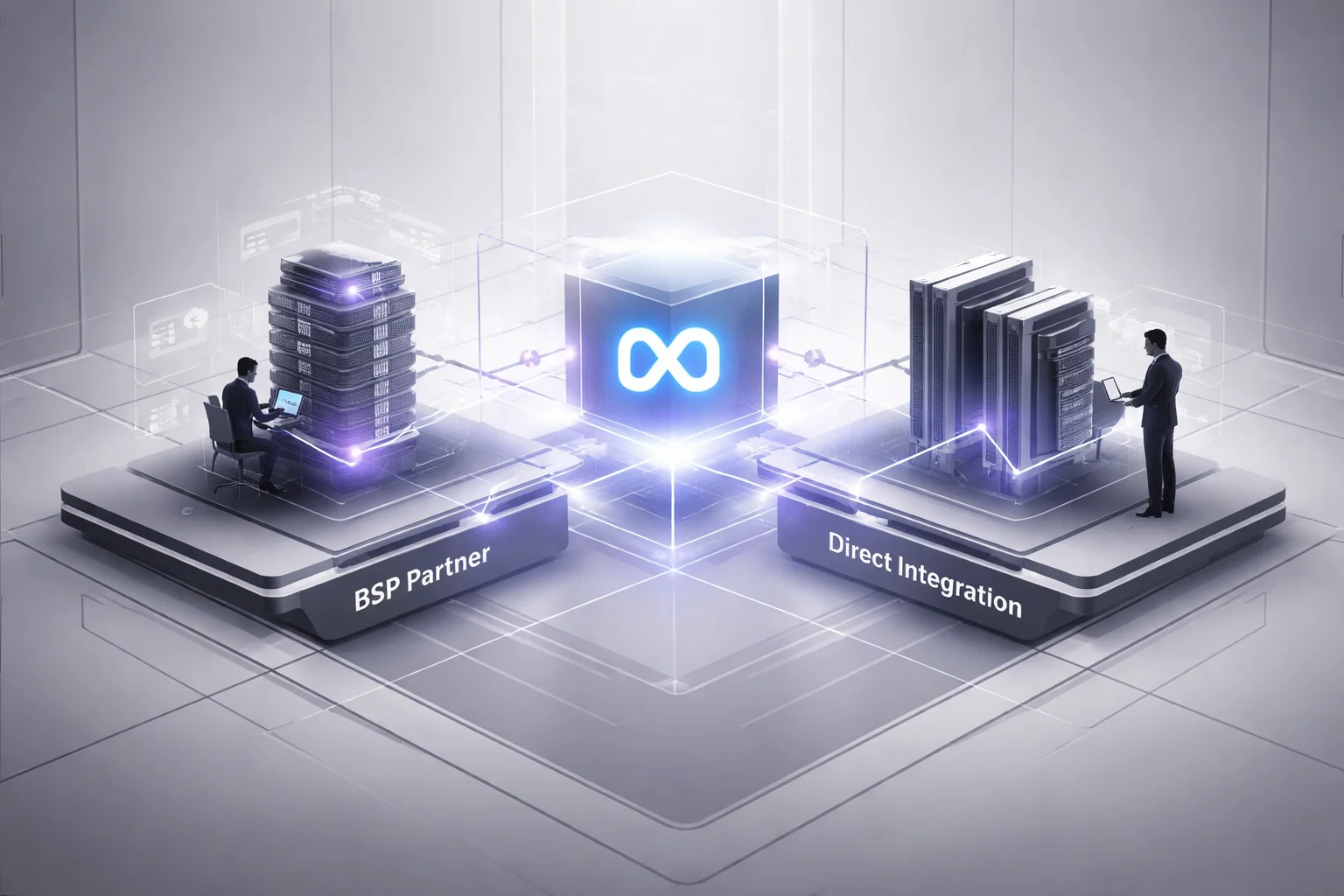
BSP Partner vs Direct Integration: When Each Makes Sense
Hot take: most teams don't pick the wrong WhatsApp setup because they lack features. They pick wrong because they confuse a fast launch with actual control.
I watched that happen on a team that lost three weeks chasing an “easy” setup. The demo looked great. The dashboard was polished. Onboarding calls were warm and reassuring. Then reality showed up: they needed lead data pushed into Salesforce, order status pulled from their own backend, and oddball cases handed to human agents without wiping out conversation context. That’s when every “simple” exception became a support ticket to the provider.
People talk about WhatsApp AI chatbot integration like it's a tooling footnote. It isn't. YCloud says 1.4 billion people are open to chatting with AI on messaging apps. At that size, this isn't some sidebar app decision. It's your support channel. Your sales channel. Sometimes both at once.
A Business Solution Provider (BSP) absolutely can be the right move early on. I'd argue that's true more often than people who love custom builds want to admit. A solid WhatsApp BSP partner integration can get you onto the Meta WhatsApp Business Platform faster, help with templates, handle number provisioning, push support escalations, and give your team dashboards that work on day one instead of week six.
If you're mid-market and nobody on staff wants to touch APIs at 8:30 p.m. on a Thursday, that matters. A lot. For basic lead capture or simple support triage, a BSP is often the sane answer.
The bill shows up later.
You may pay markup you didn't fully notice in the sales process. You may hit workflow limits nobody mentioned in the first three calls. You may end up bending operations around somebody else's roadmap because it felt fast in March and claustrophobic by September. If ownership of your Meta Business Account (MBA), phone numbers, or reporting access feels fuzzy during procurement, I think that's a red flag, not admin trivia. I've seen teams discover after launch that exports were partial and number control lived with the vendor account manager they barely knew.
Direct setup through WhatsApp Cloud API usually wins when WhatsApp needs to behave like part of your system instead of a rented inbox. That's the line I care about most. If your Meta Business API WhatsApp chatbot has to write into a CRM, call internal services, trigger custom workflows, fire webhooks, or hold together more complex session logic outside canned flows, direct integration starts making way more sense.
You can see it in boring use cases. Those are always the truth serum. Order-status checks tied to live backend data. Lead qualification rules based on territory routing. Refund questions that need account lookup before an agent ever joins the thread. The Social Search SG makes basically this same point: integrated chat agents start doing real work when they connect to business systems instead of stopping at autoresponder tricks.
Here's the test I'd use.
Step 1: map the first 30 days. What has to be live immediately? Support triage? Lead capture? Template sends? Basic routing? If that's the real scope and your team doesn't have in-house API depth, a BSP removes actual execution risk.
Step 2: map month six. Not launch week. Month six. Does the bot need order-history checks, writes into HubSpot or Salesforce, calls to internal services, or custom workflow triggers? If yes, direct integration starts looking better very quickly.
Step 3: inspect ownership before pricing. Who owns the MBA? Who controls the phone numbers? Can reporting be exported cleanly? What happens when volume jumps from 50,000 conversations a month to 100,000? Who gets stronger when usage grows—you or the vendor?
Step 4: don't let somebody sell you complexity because they said “enterprise.” The old WhatsApp Cloud API vs Business API debate still gets dragged into rooms like it's 2021. For most new teams, direct Cloud access under your own MBA is cleaner. Older patterns and on-premise WhatsApp chatbot deployment still have a place for strict compliance requirements. Not for habit. Not for nostalgia.
Buzzi's Ai Chatbot Integration Whatsapp Business Playbook lands in roughly the same place, and I think they've got it right: use the BSP route when it reduces real delivery risk—onboarding friction, operational gaps, missing internal talent—not when it just wedges margin between you and Meta.
The unexpected part? This decision usually isn't about architecture first. It's about power. Asset ownership. Exit paths. Who controls the number when things get messy. Ask those questions early and half the glossy pitch decks fall apart on their own.
This WhatsApp AI chatbot architecture decision is simpler than vendors make it sound: buy speed if you truly need speed now. Don't rent constraints you'll resent later.
On-Premise vs Cloud Deployment for WhatsApp AI Chatbots
Picture a Tuesday at 4:17 p.m. The launch checklist is basically done, support has scripts ready, the WhatsApp bot is answering correctly, Salesforce is syncing, handoff rules are firing, and somebody from legal leans forward and asks one annoying question: “Where, exactly, does the conversation data live?” Room goes quiet. Six weeks of work suddenly stops feeling finished.
I’ve seen that happen. More than once. And it’s why I don’t buy the lazy version of this debate.
People love to reduce it to a bumper sticker: cloud is easy, on-prem is safe. Sounds neat. It’s also incomplete. The real decision in any WhatsApp AI chatbot integration isn’t about shiny features first. It’s about control, and whether you actually need the kind of control you’re asking for.
Meta’s Cloud API has become the default path for new builds on the Meta WhatsApp Business Platform. Chatarmin says that outright, and it tracks with what teams are doing in practice. On-premise setups haven’t disappeared, but they’re mostly hanging on in places like banks and government agencies where compliance rules and internal hosting policies aren’t optional suggestions. That matters. So does the part people skip: if you choose on-premise WhatsApp chatbot deployment, your team has to run it well when something breaks at 2 a.m., not just approve it in a meeting at 2 p.m.
The useful question isn’t “Which one sounds more serious?” It’s whether you can answer four very boring questions without hand-waving anything away:
- Security: Are you dealing with regulated conversations or customer identifiers that need tighter internal boundaries than a managed setup can give you?
- Latency: Do extra hops between your AI layer, CRM, and messaging stack slow replies enough to hurt a real support flow?
- Governance: Do you need direct control over logs, retention policies, and access permissions inside your Meta Business Account (MBA)?
- Scaling: Can your engineers own uptime, failover, patching, and throughput if you skip managed infrastructure?
If you can’t answer those cleanly, don’t pretend you’re choosing between WhatsApp Cloud API vs Business API. You’re still stuck at requirements discovery.
A lot of teams aren’t picking pure ownership anyway. They’re working through a Business Solution Provider (BSP), which can soak up some of the operational mess through managed services. That can be fine. A direct WhatsApp Business API or WhatsApp Cloud API setup usually gives you cleaner ownership over time, though. I’d argue a Meta Business API WhatsApp chatbot tied to your own account ages better once WhatsApp stops being some experimental Q3 side project and turns into a core support or sales channel.
The customer impact isn’t theoretical either. YCloud reported that 67% of users trust chatbot-led support experiences on WhatsApp in 2026. That trust is fragile. Governance gets sloppy, retention rules differ across systems, one workflow answers from the CRM while another answers from stale middleware cache, and suddenly customers get different responses depending on which path their message took. I watched one team trigger exactly that kind of inconsistency after adding a second routing layer they swore would be “temporary.” It lasted nine months.
My bias is simple: start cloud-first unless policy clearly blocks it. Not vague fear. Not legal saying “we should probably be careful.” Real requirements — data residency demands, hard compliance obligations, internal rules that say hosting stays in-house. If those are real, then yes, on-prem earns its keep. If they’re not, don’t sign yourself up for extra infrastructure just because “more control” sounds mature in a steering committee deck.
If you’re making a real WhatsApp AI chatbot architecture decision, that’s where I’d start. And if you want another angle while sorting through it, Buzzi’s WhatsApp business AI chatbot integration guide is worth having open next to your notes. So what are you actually solving for here — compliance, speed, ownership, or just everyone’s fear of being blamed later?
A Decision Framework for Choosing the Right Architecture
I watched a team lose six weeks because somebody said, “Let's just use a BSP,” and everybody nodded like the hard part was over. Tuesday afternoon meeting. Support wanted faster response times. Compliance was hung up on audit logs. Engineering said they could “probably” connect it next sprint. Nobody asked the ugly question about ownership until reporting broke and legal started asking where the data actually lived.

That’s the trap. People call it an architecture choice when it’s really a comfort choice. “Use a BSP” sounds safe. “Build direct” sounds serious. I think both are bad answers when they show up too early.
Cloud means you’re modern. Direct means you’ve got standards. On-prem means you must be enterprise. Cute story. Doesn’t help much if your actual use case is claims handling, your legal team gets nervous fast, and your two backend engineers are already babysitting seven other systems.
People throw around automation stats like they settle the argument. YCloud says WhatsApp chatbots are projected to save 2.5 billion hours of business time by 2026. Sure. That proves automation matters. It says nothing about whether your setup belongs with a Business Solution Provider (BSP), the WhatsApp Cloud API, or a more direct Meta Business API WhatsApp chatbot approach inside your own stack.
I’ve seen a team cut support effort by 18% in one quarter and still end up with a reporting mess because nobody made a clean call on data ownership. That’s why the framework I trust is boring in the best way: choose for operational fit, not vendor posture. Score each factor separately. Once teams mash everything into one big “what’s best?” debate, bad decisions sneak through wearing confidence.
- Start with the work itself. Not the architecture fantasy, not the logo slide, not what sounded smart in procurement. If you’re automating FAQs or lead capture, a WhatsApp BSP partner integration is often enough. If you’re handling order updates, claims workflows, or authenticated support, you’ll usually need tighter CRM and backend access through the WhatsApp Cloud API or a more direct Meta Business API WhatsApp chatbot route.
- Do compliance checks before anybody falls in love with features. This part gets ignored right up until it wrecks the timeline. If data residency rules, audit-log requirements, or internal hosting policy are strict, kill weak assumptions early. Chatarmin points out that the WhatsApp Business API path is often chosen for automation plus GDPR-conscious CRM integration at scale, while rarer on-premise WhatsApp chatbot deployment setups still show up in regulated industries.
- Get honest about volume. Painfully honest. A low-volume pilot can survive manual template management and simpler routing for a while. A high-throughput operation can’t. Webhook design, session handling, and ownership inside your Meta Business Account (MBA) stop being side details fast. They become operational survival.
- Look at your team without flattering them. If your engineers can’t really own orchestration, retries, monitoring, and handoff logic, then a BSP may be the safer option on the Meta WhatsApp Business Platform. Not exciting. Still true.
- Add exactly one layer of future-thinking. If today’s bot could become tomorrow’s multilingual agent with LLM grounding and CRM writes, don’t trap yourself in a shallow toolchain just because launch pressure is loud this month.
- BSP: best when speed matters most, engineering capacity is thin, and workflows are standard.
- Direct Cloud: better when you need medium to high customization, stronger ownership, and cleaner flexibility later on.
- On-prem: worth considering only when compliance rules truly require it.
A side note that matters more than people admit: I’ve seen teams spend three meetings debating architecture and zero minutes deciding who owns failed webhook alerts at 7:12 a.m. That’s how projects get approved beautifully and operated badly.
If you want another angle on execution trade-offs, Buzzi’s Ai Chatbot Integration Whatsapp Business Playbook pairs well with this.
The real WhatsApp AI chatbot architecture decision isn’t about picking the fanciest stack. It’s picking the one your team can still run six months after launch when the pilot glow is gone, edge cases pile up, and somebody has to own what breaks. So what are you actually prepared to own?
Implementation Pathways and Common Integration Mistakes
I watched a team burn six weeks on the wrong problem once. They got dazzled by the upside — and to be fair, $11 billion a year in projected chatbot savings across retail, banking, and healthcare would do that to anybody, which is the figure cited by YCloud. So they did what excited teams do: booked vendor demos, compared pricing, argued about providers, and started shopping for a WhatsApp AI chatbot integration before anybody could answer one very plain question. What was the bot actually supposed to do on day one?
Bad start. Predictable ending.
About two months later, they were rebuilding half of it. Not because the model was terrible. Not because AI failed some dramatic test. Because they picked plumbing before purpose.
The Social Search SG spells out what these deployments really include: the WhatsApp Business API, an LLM or conversational AI layer, CRM connections, analytics, and in some cases payments or fulfillment layered on top. That's not a toy. It's not a tidy chat box stuck on the side of the business. It's closer to conversation infrastructure. And I've seen people walk straight into a Business Solution Provider (BSP), go direct with the WhatsApp Cloud API, or even chase an on-premise WhatsApp chatbot deployment without sorting out basics first. Then come the access disputes. Then policy friction. Then rework.
The funny part is the “big decision” usually isn't big at all.
The real one sits right in the middle of the project and gets ignored because it's less fun than a demo: what is this thing's first job?
I'd argue most teams need a stricter framework than they think. Not strategy theater. Just five checks that stop obvious mistakes before they get expensive.
- Nail one use case down until it's almost boring. “Customer service” isn't a use case. Neither is “sales automation.” Pick one job you can test. Lead qualification. Support deflection. Order status. Claims intake. The cleaner version sounds like this: “check shipment status from CRM and escalate damaged-order cases to agents.” That's specific enough to build around. If your team can't say it that clearly in under 15 seconds, you're still guessing.
- Treat policy as product design, not legal cleanup. Template approval matters early. Session windows matter early. Opt-in rules matter early. Message category limits matter early. Ignore that stuff until after flows are designed and you'll end up with a beautiful conversation map that breaks in week one because WhatsApp won't let it run the way you imagined.
- Set ownership before anyone signs anything. This is where projects get weirdly messy. Who controls the Meta Business Account (MBA)? Who owns the phone number? The templates? Webhook endpoints? Reporting access? If those answers get fuzzy during a sales call, stop there. Seriously. I've seen teams lose weeks untangling admin rights that should've been settled on day one.
- Choose the delivery path last. A WhatsApp BSP partner integration makes sense when speed matters most and you want managed operations. Going direct through the Meta WhatsApp Business Platform makes more sense when tighter CRM orchestration and long-term control matter more. And that old WhatsApp Cloud API vs Business API argument? Save it for when compliance actually forces the issue instead of pretending it's step one.
- Design version one like version two is already coming. Because it usually is. Today's FAQ bot becomes tomorrow's authenticated service agent faster than teams expect — sometimes by the next quarterly planning cycle. I once saw a simple support flow turn into account-specific service handling in under 90 days because contact volume jumped after a campaign launch.
This is why so many implementations fail in such dull, avoidable ways. Teams buy into a story before they define the system they need. They lock in a vendor before requirements exist. They treat messaging policy like something legal can mop up later. They let a BSP sit on critical assets without clear ownership terms. They design for today's flowchart and act surprised when tomorrow arrives fast.
If you want the practical move, do an architecture review before signing anything. Buzzi's guide to WhatsApp chatbot development policy-compliant design is a solid place to start. The setups that last tend to look slightly overprepared on day one — tighter access controls, cleaner handoff logic, better data paths, reporting people think is excessive at first glance. That's usually the build still standing 12 months later. So if your customer volume doubled next quarter, what breaks first?
FAQ: WhatsApp AI Chatbot Integration Guide
What does WhatsApp AI chatbot integration actually mean?
WhatsApp AI chatbot integration means connecting WhatsApp messaging to an AI system that can understand, respond, and take action inside your business stack. In practice, that usually includes the Meta WhatsApp Business Platform, webhooks, session management, an LLM or conversational AI layer, and links to tools like your CRM, help desk, or order system.
How do you integrate an AI chatbot with WhatsApp using the Meta Business API?
You start with a Meta Business Account (MBA), a verified phone number, and access to the WhatsApp Business API or WhatsApp Cloud API. Then you configure webhooks for inbound messages, build message routing logic, connect your AI layer, and add business systems like Salesforce, HubSpot, Zendesk, or your internal database so the bot can do more than just chat.
What’s the difference between WhatsApp Cloud API and the Meta Business API?
Most people treat these as totally separate things, but that’s a little sloppy. The WhatsApp Cloud API is Meta-hosted access to the WhatsApp Business API, while “Business API” often refers more broadly to the platform and, in older setups, self-hosted or BSP-managed deployments. For most new builds, Cloud API is the default starting point unless you have unusual compliance, control, or deployment needs.
When should you choose WhatsApp Cloud API vs Business API for an AI chatbot?
Choose WhatsApp Cloud API if you want a faster launch, less infrastructure overhead, and a standard path for most support, sales, and service use cases. Choose a more customized Meta Business API WhatsApp chatbot setup, often through a BSP or special deployment model, if you need tighter control over throughput, data handling, regional hosting, or enterprise workflow design.
Can you use a BSP partner instead of direct WhatsApp integration?
Yes, and plenty of companies do because a WhatsApp BSP partner integration can cut setup time and reduce operational pain. The trade-off is that you may pay extra platform fees, inherit the partner’s feature limits, and have less control over deployment architecture, analytics depth, or how quickly new Meta features reach your stack.
What are the core requirements to start WhatsApp AI chatbot integration?
You’ll usually need a Meta Business Account, a phone number that can be registered for WhatsApp business messaging, admin permissions, webhook endpoints, and approved message templates for outbound use cases. You also need a clear architecture decision early, because CRM integration, authentication, handoff logic, and data residency rules tend to shape the build more than people expect.
Does WhatsApp AI chatbot integration require message templates?
Yes, for business-initiated conversations outside the customer service window, you’ll need approved message templates. Inside active sessions, your bot can respond more freely, but template approval, category selection, and variable formatting still trip teams up all the time and can quietly break outbound flows.
How should you design webhook handling and message routing for WhatsApp conversations?
Your webhook layer should be simple, fast, and idempotent, because duplicate events, retries, and out-of-order messages happen. A good WhatsApp AI chatbot architecture decision usually separates webhook ingestion, conversation state, AI orchestration, and downstream actions so one slow CRM call doesn’t stall the entire customer interaction.
How do on-premise vs cloud deployments affect WhatsApp chatbot performance and compliance?
Cloud deployments are usually easier to run and faster to ship, which is why they fit most teams. On-premise WhatsApp chatbot deployment makes sense when you have strict data residency and compliance requirements, common in banking or government, but you’ll take on more infrastructure work, more operational complexity, and often slower iteration cycles.
What cost drivers matter most in WhatsApp AI chatbot integration?
The big ones are conversation or API usage charges, message template usage, BSP markups if you use a partner, AI model costs, and the engineering needed for monitoring, retries, and human handoff. Throughput and rate limits matter too, because a bot that works fine at 500 conversations a day can get expensive or unstable when you push it to 50,000.
What implementation mistakes commonly break WhatsApp chatbot flows?
The usual culprits are weak session management, poor fallback design, missing template approvals, bad webhook retry handling, and no plan for rate limits and throughput. I’d add one more that gets ignored: teams wire up the bot before defining the business logic, so the AI sounds smart but can’t fetch order status, update records, or route edge cases to a human.
Which security and compliance practices are recommended for WhatsApp chatbot data handling?
Start with least-privilege access, encrypted data in transit and at rest, audit logs, webhook signature validation, and clear retention rules for chat history and customer identifiers. If your use case touches regulated data, your WhatsApp AI chatbot integration should also account for regional hosting, consent handling, redaction, and exactly where LLM prompts and outputs are stored.