RAG Knowledge Base Integration Framework
Most enterprise RAG projects don't fail because the model is weak. They fail because the knowledge base is a mess. That's the part vendors love to blur, and...

Most enterprise RAG projects don't fail because the model is weak. They fail because the knowledge base is a mess.
That's the part vendors love to blur, and it's exactly why RAG knowledge base integration decides whether your system gives grounded answers or polished nonsense. According to Onyx AI citing MIT's 2025 GenAI Divide report, 95% of enterprise GenAI pilots never reach measurable P&L impact. That number doesn't come from bad demos. It comes from bad source mapping, sloppy document ingestion, broken permissions, and retrieval that looks fine until a real customer asks a hard question.
In the next six sections, I'll show you the framework that separates workable systems from expensive science projects. And yes, the architecture matters. But your data decisions matter more.
What RAG Knowledge Base Integration Really Means
I watched a team ship an internal assistant that looked great on Tuesday and lied by Friday.

Same polished demo everybody falls for. Load the docs. Chunk the files. Create embeddings. Add retrieval. Ask a clean question. Get a clean answer. Then somebody asked about PTO at 4:57 p.m., right before payroll closed, and the assistant confidently pulled a six-month-old draft from a forgotten SharePoint folder instead of the live HR policy. Fast answer. Wrong answer. That's the part people keep calling a model issue, and I'd argue it usually isn't.
The stack looked almost identical to another team's setup. Same model class. Same vector database. Similar chunk sizes. One assistant cited the right policy in under two seconds. The other grabbed stale junk with total confidence. That's not magic. That's source control in the real sense of the phrase: what the system is allowed to know, where that knowledge sits, and how retrieval augmented generation reaches it when the question is messy, vague, rushed, or politically loaded.
People still talk about RAG knowledge base integration like it's a storage task. Dump PDFs somewhere. Split them up. Embed everything. Ship it. I think that framing should've expired years ago, but product demos keep it alive because demos don't ask the ugly questions. Enterprise pilots do. They break the minute employees hit conflicting sources, stale versions, or half-labeled records.
Look at what gets attention in the market. Firecrawl's 2026 comparison lists LangChain at 105k GitHub stars, Dify at 90.5k, RAGFlow at 48.5k, and LlamaIndex at 40.8k. Good tools. Useful tools. I've used some of them myself. Popularity pulls teams toward orchestration code because code feels concrete and procurement likes boxes on architecture diagrams.
It still isn't where answer quality gets decided.
That decision happens earlier than most teams want to admit.
RAG knowledge base integration starts before your RAG document processing pipeline begins. The source layer sets the ceiling: contracts with stale versions, internal wikis nobody owns, ticket exports missing metadata, policy documents copied into five folders with five slightly different names, meeting notes saved as if they carry the same authority as approved legal text. If your source layer is chaos, chunking won't save you.
That's the lesson I'd turn into a simple framework.
Step 1: classify what kind of truth each source holds. A signed contract isn't an FAQ page. A published HR policy isn't a Zendesk export. A draft in SharePoint isn't equivalent to an approved document in a controlled repository.
Step 2: map where each source lives and who owns it. If nobody can tell you which folder is canonical, you've already planted a bad answer in your future system.
Step 3: decide how retrieval should treat each category. Some sources deserve priority ranking. Some need freshness rules. Some should only appear with attribution. Some shouldn't be retrievable at all.
Step 4: build controls around messy queries, not demo queries. Real users ask partial questions, combine policies with exceptions, and leave out context because they're busy.
This isn't just opinion dressed up as process. An arXiv survey on knowledge-oriented RAG breaks knowledge integration into input-layer, intermediate-layer, and output-layer approaches. Plain English: your enterprise RAG integration framework should change based on your RAG knowledge source taxonomy, not just whatever model and vector store got approved first.
AWS gets part of this right with Amazon Bedrock Knowledge Bases. AWS describes Bedrock as a managed system for ingestion, retrieval, prompt augmentation, session context management, and source attribution without custom data-flow plumbing. Helpful? Yes. I'd use it in the right environment, especially if a team wants less glue code to maintain over twelve months instead of two sprint reviews. It still can't fix bad classification upstream. RAG retrieval quality controls depend on whether you've sorted sources correctly and figured out how to optimize RAG by data source type.
Treat every file like it's the same kind of truth source and you're already behind on your own project.
For a deeper enterprise view, see Enterprise Rag Solution Knowledge Fabric.
Why Generic Document Processing Fails in RAG
119,000. That's roughly how many GitHub stars LangChain had in Atlan's 2026 report, along with 500+ integrations. I get why teams see that and start wiring connectors like they're making progress. I've done it. It feels productive right up until the system starts answering real questions from real people and you realize you've built a very polished way to lose context.
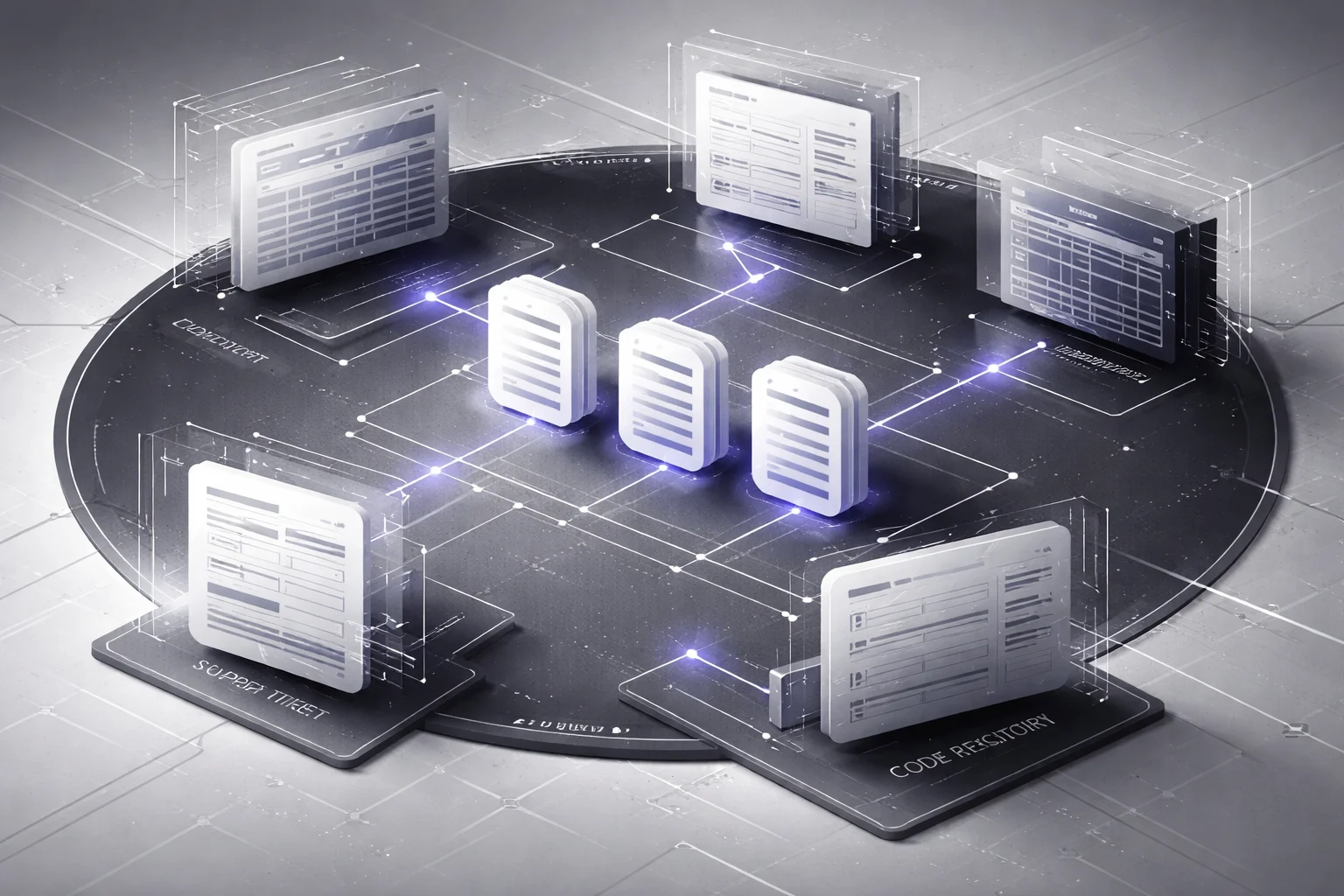
The trap isn't model choice. I'd argue it's earlier than that, and dumber: taking a CRM export, a Confluence space, Zendesk tickets, and internal Markdown docs, then forcing all of them through one parser, one chunker, one metadata schema, as if they're all just slightly different flavors of text.
Looks clean on a slide. In production? Not so much.
IBM is right on the broad point: step one is building a queryable knowledge base, and the inputs can absolutely include PDFs, guides, websites, audio files, and other unstructured content. Fine. True. Where teams go off the rails is the next assumption — that because many repositories can feed one RAG system, they should all be processed the same way. They shouldn't. Not even close.
A wiki page is narrative. A database row is typed data. A support ticket is an event trail with timestamps, status changes, and handoffs. A repo file carries path context, version history, ownership, maybe dependency signals too. Those differences aren't decoration. They're the meaning.
I've watched this break in painfully normal ways. For about two weeks, a single ingestion flow can look efficient. Then a database record stops behaving like a record and turns into a text blob. Account owner. Renewal date. Product tier. Case severity. Still technically present, sure, but buried in prose where retrieval can't treat them like first-class fields anymore.
The worse failure shows up in relationships. A Zendesk ticket links to an incident record and a customer account; after flattening, the index sees three isolated chunks with some overlapping words and no actual binding between them. It's like watching connected records get tossed into separate shoeboxes because they all contain English sentences.
- Lost fields: normalization strips useful attributes, so filtering gets weak fast.
- Broken relationships: parent-child links, issue-to-resolution chains, and joins disappear.
- Noisy retrieval: chunks match surface language instead of business meaning.
- Lower trust: users get half-right answers with shaky citations and stop coming back.
I think people underestimate that last part. One bad answer doesn't just miss; it teaches the team not to trust the system. I've seen someone ask for severe renewal risks tied to Enterprise product-tier accounts opened in the last 30 days and get back a pleasant Confluence paragraph plus two random ticket snippets because the word "renewal" showed up three times. Responsive? Kind of. Useful? Not at all.
And no, more tooling won't rescue bad assumptions. I've seen teams spend six weeks connecting systems before anyone sits down to define source classes or decide which IDs and timestamps must survive ingestion. That's backwards.
- Name the source class. Split transactional systems from collaborative docs, ticketing platforms, repos, and policy libraries.
- Preserve native structure. Keep fields, IDs, links, timestamps, owners, permissions.
- Chunk by source type. Prose by topic; tickets by thread state or resolution unit; code by file and function boundaries.
- Add source-aware retrieval rules. Filter tickets by severity or product line; engineering content by branch or repo.
If you want better results from RAG knowledge base integration, stop pretending every asset belongs in one RAG document processing pipeline. Build a real RAG knowledge source taxonomy. Optimize RAG by data source type before you celebrate another connector demo.
If you're turning this into delivery planning now, Buzzi's RAG development services for enterprise knowledge systems is a practical next step. If your best answer depends on preserving relationships, why start by deleting them?
The RAG Knowledge Source Taxonomy
At 2:13 p.m., an ops lead asks a model why an incident blew up. Ten minutes later, legal wants a contract renewal date. HR jumps in after that and asks for the official policy language. Same assistant. Three totally different questions. I've watched teams expect one retrieval layer to handle all of it like magic, then act surprised when the answer about vacation policy comes back with laptop setup steps from page 27 of a PDF.
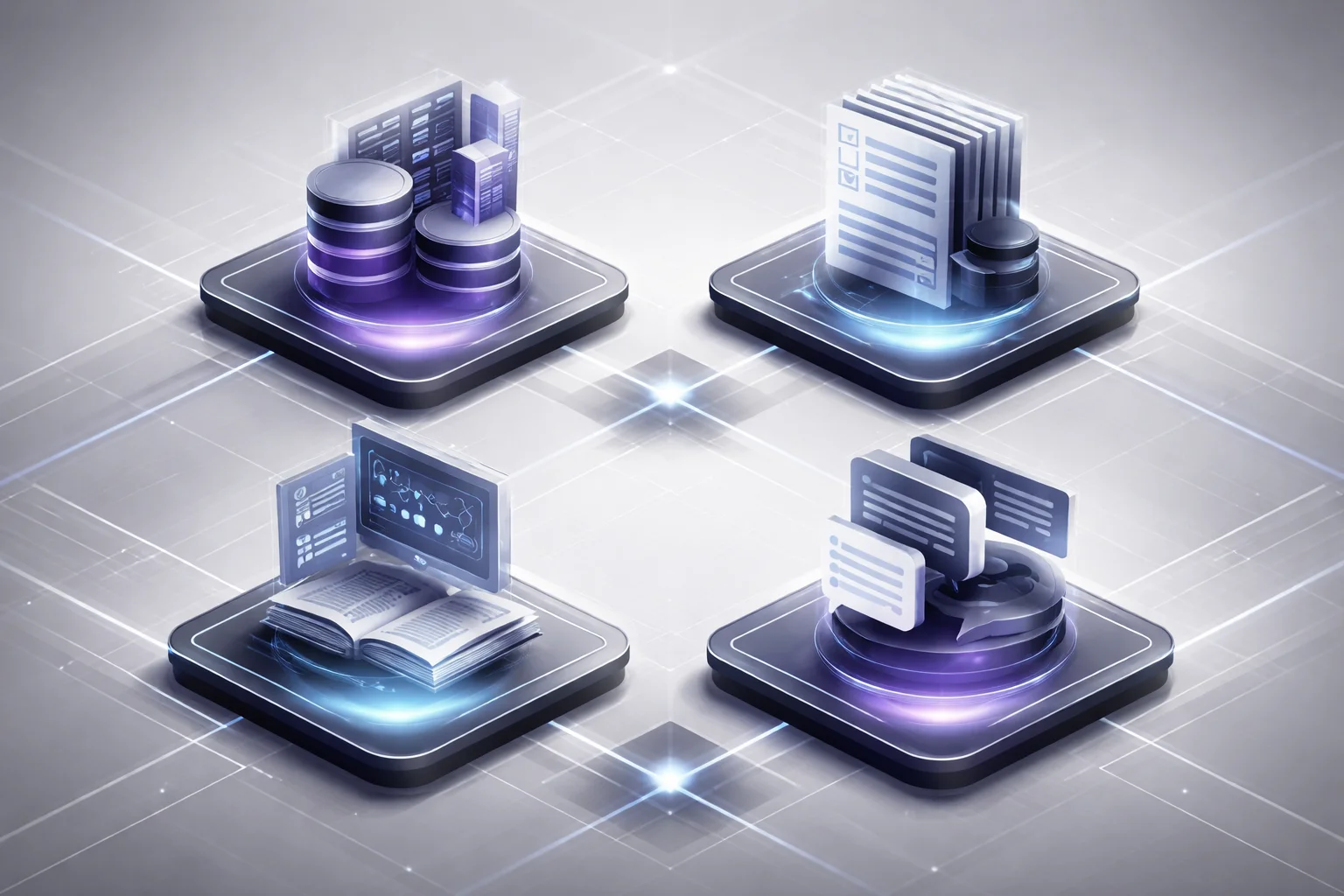
People love to frame retrieval-augmented generation as a tooling race. I get why. LangChain raised $100 million in 2025. Atlan pointed at that number. Money like that makes everyone stare at frameworks. I'd argue that's the distraction. Most teams don't crater because they picked the wrong stack. They crater because they shoved four different kinds of knowledge into one system and hoped embeddings would clean up the mess.
"Knowledge is knowledge" sounds great on a slide. Production doesn't care about your slide. Ask for a renewal date, ask why an incident escalated at 2:13 p.m., ask what policy officially says. Those aren't just different prompts. They're different source types, and the system has to treat them that way.
Here's the split that actually matters: structured data answers exact questions; semi-structured documents explain things; wikis and knowledge bases carry shared operating know-how; conversational records show what happened over time. Mix those together like they're interchangeable and retrieval gets sloppy fast.
Structured data is the easy one to describe and the easiest one to ruin. Salesforce account records. NetSuite order history. Product catalogs with SKUs, prices, inventory flags. Keys, fields, constraints. That's the whole point. A renewal date should remain a date. A contract tier should stay filterable. Incident severity should live in a field where you can query it cleanly. Don't flatten rows into paragraph soup unless you've got no other option. I once saw a team turn 1.2 million CRM rows into text chunks for semantic search. They'd built themselves an expensive way to lose precision.
Semi-structured documents are where laziness usually shows up first. PDFs. Policy docs. Manuals. Quarterly reports. They have headings and sections, but the meaning sits inside paragraphs, examples, footnotes, weird formatting choices someone made in 2019. This is where a real RAG document processing pipeline matters: section-aware parsing, metadata normalization during ingestion, chunking by topic instead of chopping every 800 tokens on autopilot. That 42-page onboarding manual example isn't hypothetical fluff. Teams do this all the time, then wonder why a vacation-policy question gets answered with instructions for setting up Okta on a new laptop.
Knowledge bases and wikis look tidy until you open them up and see the rot. Confluence does this. Notion too. Half the page titles sound authoritative, and then you notice nobody's touched them in months. IBM's been blunt about it: if you want a RAG system to stay relevant, the knowledge base has to be continuously updated. That's not cleanup work for later. That's survival work right now. For RAG knowledge base integration, ownership and recency matter as much as good writing does. A beautifully written article from 14 months ago can still poison answers if the process changed last quarter.
Conversational records need their own handling entirely. Zendesk ticket histories. ServiceNow incidents. Support case threads. Chat transcripts. Escalation notes buried in email chains nobody wants to read twice. These aren't static references; they're timelines with emotional residue attached — sequence, sentiment, escalation history, resolution state, handoff points, reversals, dead ends. You don't retrieve them like a handbook page because they aren't handbook pages. You retrieve for pattern and outcome: what happened before, what changed midway through, how it finally got resolved.
The principle is simple enough that people skip it: classify first, optimize second. Not everything belongs in one index with one ranking strategy and one chunking rule.
The practical move is boring, which usually means it's right. Keep structured data queryable as data. Parse documents by sections and topics, not by arbitrary token counts alone. Track ownership and freshness for wiki content so stale pages stop outranking current ones. Treat conversations as ordered records where sequence matters as much as wording does.
Add source-specific filters. Put RAG retrieval quality controls around each source type instead of pretending one retrieval pattern fits all of them.
If you're building this for real right now, start with RAG development services for enterprise knowledge systems.
RAG Knowledge Source Integration Framework
I watched a team dump Salesforce, Confluence, Zendesk, and a stack of HR PDFs into one index and call it a knowledge base.
Six weeks later, the assistant answered a customer-renewal question with an outdated wiki paragraph. Not the live CRM record. A wiki paragraph. In a roadmap meeting, everybody talked about trying a stronger model next quarter, because that's the visible move. Cleaner story. Wrong fix.
I'd argue this is where a lot of RAG knowledge base integration work goes off the rails. Teams love the part they can announce: model swaps, vendor logos, shiny demos. They avoid the annoying decisions that actually decide whether the system works — like why a Salesforce account record is a different kind of truth than a Confluence page, or why a Zendesk thread from March 2025 can't be treated like a static policy PDF. Run policy docs, CRM rows, ticket threads, and wiki pages through identical retrieval logic and you haven't built retrieval augmented generation. You've built a confusion engine with decent branding.
The market's rewarding that mistake at scale. Onyx AI, citing MarketsandMarkets, said the enterprise RAG market hit $1.94 billion in 2025 and is projected to reach $9.86 billion by 2030, a 38.4% CAGR through 2030. That's not small. It also means companies can spend real money producing bad architecture faster than ever.
AWS says the attractive part out loud: Amazon Bedrock Knowledge Bases can connect proprietary information to generative AI apps so queries search source data and improve generated answers. Sure. That promise collapses fast if nobody has decided how each source gets profiled, normalized, retrieved, and checked once it's live.
The lesson wasn't "buy a better model."
The lesson was operational discipline.
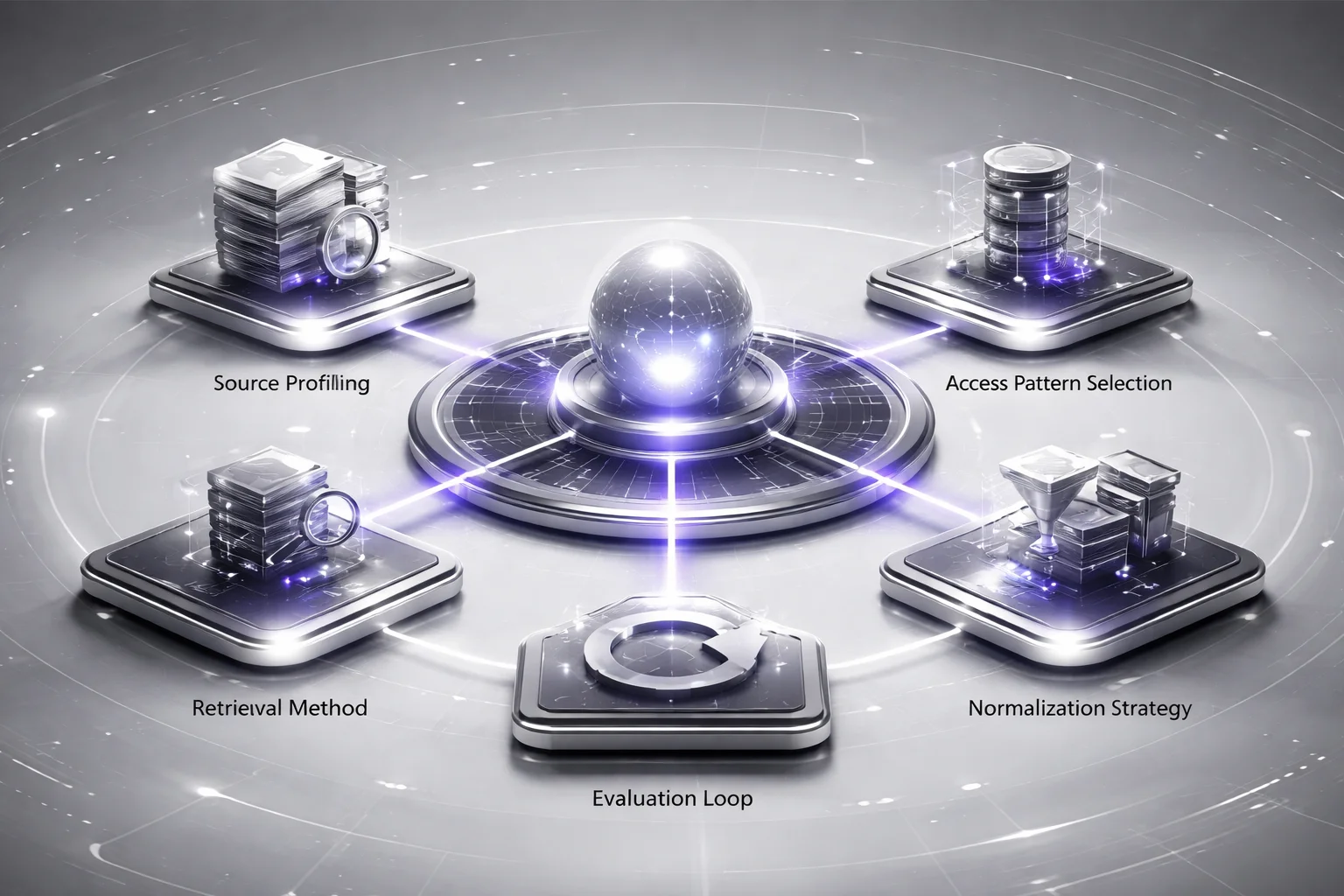
So here's the framework I'd use: profile the source first, pick the access pattern based on how people actually ask questions, normalize only what helps retrieval, match retrieval to source behavior, then keep an evaluation loop running after launch. That's what CTOs need if they want something more durable than an expensive demo nobody trusts by week six.
1. Profile the source before ingestion starts
Don't ingest first and classify later. That's how drift starts.
Call the source what it is before your RAG document processing pipeline touches it. Name the truth type. Name how current it needs to be. Name whether chronology matters. I've seen teams pour everything into one index and act shocked when the system grabs an old internal wiki note instead of the actual system of record.
- System of record: Salesforce accounts, ERP tables, inventory data.
- System of explanation: policy documents, manuals, SOPs.
- System of activity: support tickets, chats, incident logs.
- System of shared memory: Notion pages, Confluence spaces, internal wikis.
A contract table needs field preservation. A handbook needs section-aware parsing. A support thread needs sequence intact so "we fixed it" stays attached to what broke in the first place.
2. Pick the access pattern that matches how people ask
Questions come in different shapes. Retrieval has to respect that.
If somebody asks for an exact renewal date, structured records with filters should win immediately. If they ask how refunds work in Germany, semantic search across policy text is the sensible move. If they ask why a customer escalated in Q4 last year, you need metadata filters plus thread retrieval so chronology survives. That's how you optimize RAG by data source type instead of pretending every question is just "find similar chunks."
3. Normalize only what helps retrieval
This is where people get weirdly destructive.
They flatten everything until useful differences disappear.
Keep IDs. Keep owners. Keep timestamps. Keep jurisdiction tags, product lines, and permissions. Those aren't decorative fields; half the time they're why one answer is correct and another is junk. Set your chunking strategy by source class: prose by section, tickets by issue-resolution unit, records as attribute-rich objects. A 14-page policy manual and a single CRM row shouldn't be chopped up like they're cousins.
4. Match retrieval method to source behavior
Dense vector search alone won't save most enterprise systems.
This is where polished demos start lying.
Use hybrid search for policy libraries. Use metadata-first retrieval for operational systems. Use thread-aware or graph-aware retrieval when relationships matter more than similarity scores. AWS gets this part mostly right in spirit with Bedrock Knowledge Bases because retrieval sits inside the answer path instead of hanging off the side like an afterthought.
5. Close the loop with RAG retrieval quality controls
If measurement stops at "users seemed happy," you're guessing.
Track hit rate by source class, citation accuracy, stale-answer frequency, permission errors, and answer usefulness by task type. One wiki may retrieve constantly yet still produce weak answers because nobody has owned those pages since 2022. One CRM feed may look thin but answer finance questions perfectly because its fields are current and clean. I've seen both in the same company within the same month.
I think this is usually where teams finally admit what happened: the model didn't mysteriously underperform. Governance was broken and wore a model-shaped mask so nobody had to say it out loud.
If you want a deeper architecture view beyond this operating model, read Enterprise Rag Solution Knowledge Fabric. Or here's the better question: do your sources really behave like one knowledge base?
How to Optimize RAG by Source Type
I watched a team ship a support bot that looked sharp in demo and fell apart on a real case two days later. The bot answered from a PDF appendix instead of the escalation record. Same customer name. Same product. Totally wrong source. The reply sounded confident, cited something official-looking, and still missed the actual fix sitting in the ticket history.

That's how trust dies. Quietly.
No big internal memo. No dramatic Slack thread. People just stop clicking the bot because one bad answer is annoying, and three bad answers means it's dead.
I think a lot of teams blame the wrong thing. They stare at the model because that's the expensive, shiny object. Most of the time, retrieval is where the damage starts. Onyx AI cited MIT's 2025 GenAI Divide report and called out a nasty number: 95% of enterprise GenAI pilots never reach measurable P&L impact. I don't buy the idea that this is mostly model failure. A lot of it comes from flattening every source into anonymous chunks and pretending text is text.
AWS talks about Amazon Bedrock's RetrieveAndGenerate API as the core workflow for retrieval augmented generation. Fair enough. It pulls relevant data from a knowledge base and passes that context to the model. The catch is ugly: "relevant" isn't enough if your RAG knowledge base integration threw away the signals that told you whether a source was current, authoritative, complete, or even connected to the right workflow.
That's the lesson. Treat each source like its native shape matters, because it does.
I've seen teams get bigger gains from fixing source handling than from swapping one flagship model for another. Keep document metadata. Respect database schema. Preserve wiki hierarchy. Thread ticket conversations end to end. Do that inside your knowledge base integration, and answer quality usually jumps faster than it does after months of model tinkering.
1. Documents: keep the facts attached to the text
A 42-page policy PDF gets chunked into tidy windows. Version number gone. Effective date gone. Approval status gone. Then someone asks about refunds and gets last year's rule because the wording happened to match better.
For documents, metadata preservation improves citation quality and cuts stale or out-of-scope answers.
Your RAG document processing pipeline should carry title, author, approval status, version, effective date, jurisdiction, product line, and access scope with every chunk. I'd also keep source filename and page range because audits get ugly fast without them; I learned that on a compliance project where one missing page reference cost half a day of backtracking.
Chunk by section boundary, not arbitrary token count. If a refund policy runs across three headings, retrieve it as one unit of policy logic instead of three disconnected scraps. That's better for ranking, grounding, and RAG retrieval quality controls. You can actually inspect which document version produced which answer instead of guessing after the fact.
2. Databases: ask the fields before you ask embeddings
I still see teams turn tables into fake little essays like they're writing bedtime stories for vectors. "Customer account 1847 has ARR of..." No. That's backwards.
For databases, schema-aware retrieval improves precision because fields beat prose for exact business questions.
Keep field names queryable. Map synonyms to canonical columns. "ARR" should resolve to annual recurring revenue. "Open renewals in Q3" should hit status and date filters before vector search gets anywhere near it.
If you're dealing with accounts, orders, contracts, or usage records, preserve structure first and only add semantic retrieval where language ambiguity actually exists. Relationships across tables matter too. If account health depends on incidents tied to renewals tied to product usage, graph-style retrieval patterns can help: Knowledge Graph Qa.
3. Wikis: don't rip child pages away from their parents
This is where plenty of "pretty good" systems go crooked. A child page matches the query terms nicely, so retrieval grabs that section alone. Problem is, the child page only makes sense if you've read the parent overview first.
For wikis, hierarchy handling improves context because parent pages explain what child pages assume.
Store page path, space, parent-child links, heading depth, owner, and last updated date during document ingestion. If someone retrieves a troubleshooting subsection from Confluence or Notion without its surrounding context, you'll often get an answer that's half right in exactly the dangerous way.
Retrieve the target section plus its parent summary when needed. A setup note for Product B inside an internal wiki can look universal if you strip away the page tree above it.
4. Tickets: sequence is meaning
A single support comment almost never means what it looks like by itself. "Same problem again." Fine — same as what? Last reply? Last week? Same root cause after an attempted fix?
For tickets, conversation threading improves resolution accuracy because sequence explains meaning.
Group messages by case ID. Keep status changes, assignee handoffs, timestamps, severity, linked incident IDs, and final resolution notes intact. Retrieve by issue-resolution unit instead of isolated comments.
This matters even more in systems like Zendesk or Salesforce Service Cloud where five people may touch one case over ten days and each message only makes sense in relation to what came before it. If your retriever grabs one orphaned line instead of the full thread history plus resolution state, your answer can sound plausible while missing the actual diagnosis.
That's really the framework:
- Documents: preserve metadata and section logic
- Databases: retrieve through schema and filters first
- Wikis: keep hierarchy and parent context intact
- Tickets: preserve thread order and case history
This is how you optimize RAG by data source type inside an enterprise RAG integration framework. Different knowledge source types, different retrieval tactics, better answers.
Before anybody asks whether you need a stronger model, I'd ask a more useful question: did you preserve what made each source worth retrieving in the first place?
Quality Controls for Enterprise RAG Integration
Why do so many enterprise RAG pilots look solid in demos and then fall apart the minute real employees start using them?

I don't think it's because teams forgot to tweak embeddings or pick a better vector database. That's the story people like to tell because it's neat, technical, and easy to put on a slide. Then Monday shows up, someone asks about a pricing exception, and the assistant confidently answers from a file nobody should've touched after June.
I've seen the polished version of this mess. Nice dashboard. Five retrieved chunks. Green checks all over the eval sheet. Everything looked relevant. Everything looked clean. The answer was still wrong because the policy PDF in play was from March, and Legal had already replaced it in June. Relevant? Sure. Usable? Not even close.
That gap explains a number I can't stop thinking about. Onyx AI cited MIT's 2025 GenAI Divide report: vendor-partner deployments succeed around 67% of the time, while in-house builds land closer to 33%. I'd argue that split isn't hiding some magical retrieval trick vendors won't share. It's discipline around quality control. Freshness. Permissions. Retrieval evaluation metrics that reflect reality instead of similarity scores that merely look convincing.
Retrieval still matters, obviously, but this is where teams usually stop too early. Measure precision@k, recall@k, and mean reciprocal rank by task and by knowledge source types. Don't mash everything into one blended score and call it insight. A policy library can perform well with section-based chunks. A ticketing system can break for a totally different reason if your chunking strategy slices out the issue-resolution sequence that explained why the fix worked in the first place.
That's not theory. A Confluence page and a Jira ticket fail differently. One shared metric can make both look "fine" right up until support agents start getting half-answers because the last three comments in the ticket never made it through chunking. I've watched teams miss that exact problem for weeks because aggregate retrieval scores stayed above 0.80 and everyone assumed they were safe.
The real answer to that opening question? Enterprise RAG isn't just a retrieval problem once it touches actual company data. It's a control problem.
But even that undersells it.
Grounding is where fake confidence gets dangerous fast. Every generated answer should cite evidence that can actually be retrieved, and that citation should resolve to the exact source version used at inference time. If your RAG document processing pipeline can't trace an answer back to versioned content after ingestion, you don't have governance. You have vibes with source links attached.
Freshness gets treated like janitorial work, which is why it bites people so often. Track source update lag, stale-answer rate, and broken ownership paths. IBM's earlier point still holds: knowledge bases decay when nobody keeps them current. I once saw an internal assistant keep serving six-month-old pricing rules after a SharePoint sync died on a Friday night and nobody noticed until sales had already repeated the bad numbers to customers.
Permissions are just as unforgiving. Access control has to survive the whole trip: source system, index, retrieval layer. Miss that handoff once and your RAG knowledge base integration stops being an engineering issue and starts becoming a compliance incident with very polished UX.
People get sloppy with drift too. They talk like drift always means semantics drifting away from user intent. That's too narrow. The PMC research makes a sharper point: traditional retrieval augmented generation depends too heavily on unstructured text, which weakens multi-hop reasoning and relationship-heavy questions more than teams expect. Some source classes need graph-aware checks because documents alone won't preserve how entities connect across systems. If your answers depend on those links, look at Knowledge Graph Qa.
The part people keep resisting is also the plainest part: not every source is just another document. Different sources need different RAG retrieval quality controls. Different failure modes need different tests. That's not a prompting fix, and it definitely isn't solved by re-ranking harder.
So what are you really measuring right now: retrieval quality, or just how convincing your system sounds while it gets the wrong answer for the wrong reasons?
The question worth sitting with
RAG knowledge base integration works when you stop treating knowledge like a blob of text and start designing retrieval around source type, structure, freshness, and permission boundaries.
Your next move isn't to swap models or pile on another framework. Audit your knowledge source taxonomy, fix your RAG document processing pipeline by source type, and put real RAG retrieval quality controls in place so citations, access control, and versioning hold up in production. And keep watching for the quiet failures, stale records, flattened metadata, and confident answers built on the wrong chunk, because that's where expensive demos are born.
If your system can retrieve something, but can't prove why it should trust it, do you actually have intelligence or just fast guesswork?
FAQ: RAG Knowledge Base Integration Framework
How does RAG knowledge base integration work end to end?
RAG knowledge base integration starts with document ingestion, cleanup, metadata normalization, and chunking, then moves into embedding generation and indexing in a vector database or hybrid search system. At query time, the system retrieves relevant chunks, passes them to the model as grounding context, and returns an answer with citations if you’ve set it up correctly. AWS describes this flow clearly in Amazon Bedrock Knowledge Bases, where retrieval and generation are tied together through the RetrieveAndGenerate API.
Why do generic document processing pipelines fail in RAG?
Because RAG isn’t just document storage with extra steps. A generic pipeline usually ignores chunking strategy, source-specific structure, deduplication and versioning, and retrieval quality controls, which means the model gets noisy or incomplete context. That’s how you end up with confident answers pulled from the wrong section, the wrong version, or the wrong file entirely.
What is a RAG knowledge source taxonomy, and why does it matter?
A RAG knowledge source taxonomy is a practical way to group content by source type, structure, update frequency, trust level, and permission model. For example, PDFs, wiki pages, support tickets, product docs, and SQL tables shouldn’t go through the same RAG document processing pipeline. If you treat them as identical, retrieval augmented generation gets sloppy fast.
How should you optimize RAG by data source type?
You should optimize RAG by data source type because each source carries different structure and retrieval signals. PDFs often need layout-aware parsing and careful chunk boundaries, wikis benefit from heading-based chunking and link preservation, tickets need conversation threading and status metadata, and databases often work better with schema mapping or direct query patterns instead of plain embeddings. One-size-fits-all is the advice that sounds efficient and quietly wrecks answer quality.
Can RAG use multiple knowledge sources at once?
Yes, and most enterprise systems need that from day one. IBM notes that a RAG knowledge base can include PDFs, guides, websites, audio files, and other unstructured data, while newer designs also mix in structured systems and knowledge graphs for better multi-hop reasoning, as noted by PMC research. The hard part isn’t connecting more sources. It’s keeping metadata, ranking, and permissions consistent across them.
What quality controls are needed for enterprise RAG integration?
You need checks before ingestion, after indexing, and during live retrieval. That means validation on parsing output, sampling for chunk quality, monitoring retrieval evaluation metrics like precision at k and citation hit rate, and alerts for stale or duplicated content. According to Onyx AI citing MIT’s 2025 GenAI Divide report, 95% of enterprise GenAI pilots fail to reach measurable P&L impact, and weak quality control is a big reason why.
Does enterprise RAG require metadata and access control?
Absolutely. Metadata drives filtering, ranking, freshness, source weighting, and auditability, while access control and permissions make sure users only retrieve what they’re allowed to see. If your retrieval layer ignores ACLs, your chatbot becomes a data leak with a friendly interface.
How can you reduce hallucinations in RAG systems?
You reduce hallucinations by improving retrieval quality before you touch the prompt. Use better chunking, source weighting, hybrid search, grounding and citations, and strict filters for stale or low-trust content so the model has something solid to work from. IBM also points out that knowledge bases need continual updates, because even a well-built system starts drifting the minute your source content changes.