AI Scalability Consulting for Sustainable Growth
Most AI programs don't fail because the models are bad. They fail because the business never built for scale. That's a harsh way to start, but the numbers back...

Most AI programs don't fail because the models are bad. They fail because the business never built for scale. That's a harsh way to start, but the numbers back it up: 91% of companies invested in AI in 2023, yet only 22% scaled it across multiple business functions, according to Tredence.
That's why AI scalability consulting matters more than another flashy demo or one more pilot your team can't operationalize. Worker access to AI jumped 50% in 2025, and the share of companies with at least 40% of projects in production is expected to double, according to Deloitte. In this article, I'll break down the six decisions that separate expensive AI experiments from sustainable growth.
What AI Scalability Consulting Really Means
At 2:17 p.m. on a Thursday, everything looked fine on the dashboard. Green boxes. Healthy pods. “99.9% availability” still sitting pretty on somebody's slide. Then concurrency climbed, response times jumped from 900 milliseconds to 6 seconds, and the team stopped talking about Kubernetes like it was going to save them.
I've seen that movie before. The ugly part doesn't show up first as downtime. It shows up as a bill nobody wants to forward, a data pipeline lagging by 40 minutes, or a model serving stale garbage like nothing's wrong.
That's the tangent people miss because they're staring at uptime.
AI scalability consulting is really about making AI systems work economically and reliably under real demand, not just keeping servers alive. That's the job. Model serving at scale. Inference latency. Throughput optimization. Data pipeline growth. Cost per inference, which is where a lot of “successful” pilots quietly become production disasters.
A pilot with 50 users can look cheap. Then it hits production and turns into a GPU furnace. Traditional software usually gets more expensive in ways you can sketch on a whiteboard. AI doesn't play that nicely, because model serving doesn't behave like web serving and never did. I'd argue this is where teams fool themselves most.
You're not only tracking requests per second. You're fighting memory pressure, GPU utilization, cache hit rates, batching versus real-time inference tradeoffs, and whether your pipelines can keep pace without delaying updates or poisoning outputs. One weak link and the whole system gets weird fast.
I once watched a team celebrate adding more containers while one overloaded GPU node kept choking every high-priority request for nearly 18 minutes. More capacity on paper. Worse experience in reality.
That's why scaling AI like a payments API is such a bad instinct. I've heard that comparison too many times, and I don't buy it. It's closer to a restaurant where the dining room keeps filling up while the grill can only handle six burgers at once and tickets are stacked to the rail. Sure, the front looks busy. The kitchen's where you're bleeding cash.
You need an AI scaling framework, not a hosting checklist. That means an AI model serving architecture built for variable inference loads, fallback paths that won't embarrass you in production, and hard rules about which use cases deserve expensive tokens or premium compute and which ones absolutely don't.
PwC said this plainly: companies get better sustainability results when they approve token usage only where it creates meaningful value and use carbon scheduling to cut emissions and cost. That's not some side project for ops. That's AI scalability economics, whether people like the phrase or not.
The timing matters too. Deloitte reported worker access to AI rose by 50% in 2025, and the share of companies with at least 40% of projects in production is expected to double within six months. Demand is rising faster than most architectures were designed for.
This isn't just one industry having a moment. Grand View Research found North America held 38.0% of the AI inference market in 2024. That's where pressure lands first: production inference workloads. Not demos. Not innovation theater. Real serving.
If you're looking for a practical starting point for scalable AI deployment, read Deployment-first AI model optimization. I think too many enterprise AI scaling strategy conversations skip the obvious move: design around serving cost first, then scale only what deserves to survive. If your architecture got popular tomorrow morning, what breaks first?
Why Traditional Scaling Frameworks Break in AI
What actually breaks first when an AI system starts getting real traffic?

It’s tempting to say replicas. Or Kubernetes. Or the cluster that looked fine on Friday and ugly by Tuesday morning. I’ve seen teams at startups and Fortune 500 shops reach for the same playbook because, in normal software, that playbook usually works.
I made that mistake too. We treated model traffic like app traffic, basically a CRUD service with fancier branding, and for the first 48 hours everybody felt smart because the dashboards looked familiar and nothing had caught fire yet.
Then it got mean. Not dramatic. Mean. GPU queues stretched, latency drifted upward minute by minute, and the cloud bill started outrunning request growth in a way that should make any sane person sweat. I remember seeing one queue jump from under 200 ms to over 1.8 seconds during a mid-morning spike and realizing we weren’t scaling — we were just paying more to feel slower.
The answer is this: traditional scaling frameworks break because AI requests aren’t normal requests.
That’s the whole thing. One extra request in ordinary software is often cheap and predictable enough to reason about. One extra inference request can drag in a larger context window, more output tokens, memory pressure on the machine, or a spillover onto pricier hardware you never meant to touch. Grand View Research reported that GPUs accounted for 52.1% of AI inference compute revenue in 2024. I’d argue that number should scare people more than it does. If GPU use is sloppy, you’re not wasting pennies in some dusty corner of the stack. You’re burning money right where most of the spend already lives.
Deloitte has said a lot of organizations are still stuck between proof of concept and actual scale because the processes and supporting tech are still being worked out. That tracks with what I’ve seen. Teams keep applying app-era instincts to workloads that need something else: cost-aware routing, request shaping, and a brutally honest look at AI scalability economics instead of pretty throughput charts that hide the damage.
Look at two requests that hit your system one minute apart. At 9:02 a.m., somebody sends a short prompt asking for a summary in three bullets. At 9:03 a.m., somebody else drops in a 14-page contract and wants risk analysis with citations. Those aren’t twins. They barely belong in the same category. One takes a sip of compute. The other can swallow half your lunch before you notice.
The old scaling logic assumes demand grows in roughly comparable units. AI breaks that assumption. Badly.
I think the taxi analogy still works, even if it’s a little ridiculous: you think you’re growing a taxi fleet, then realize each new ride wants a private jet pilot instead. More demand doesn’t help when each unit of demand gets structurally more expensive as it arrives.
That’s why an enterprise AI scaling strategy can’t begin with capacity alone. Start somewhere less glamorous and way more useful: what each inference really costs, which latency target users actually care about, and what your throughput optimization does to quality and spend at the same time. Miss even one of those and you’re guessing with expensive hardware.
If a change helps traffic numbers but raises cost per useful output, I don’t call that scale. I call it deferred pain with nicer graphs.
Capgemini’s bigger point is right: scaled AI can be more efficient and more cost-effective than isolated pilots. But only if you design for production from day one. That’s where AI scalability consulting starts earning its keep, which helps explain why the market keeps climbing. Zion Market Research, cited by NMS Consulting, valued the artificial intelligence consulting market at $8.75 billion in 2024 and projects it will reach $58.2 billion by 2034.
If you want a cleaner frame for AI inference cost optimization, start with deployment constraints before model ambition: Deployment-first AI model optimization. Most teams do it backward. Are you sure yours isn’t one of them?
The Hidden Economics of AI Inference
At 4:47 p.m. on a Thursday, right after a polished pilot got shown to leadership, I've seen the mood change in about ten minutes. The team was celebrating because usage had jumped from 5,000 requests a day to 400,000 a week. Then finance asked the only question that mattered: what does each request actually cost now? Room went quiet.

That's the part people skip. In 2023, 91% of companies invested in AI, but only 22% scaled it across multiple business functions, according to Tredence. So no, this wasn't an interest problem. It wasn't executives dragging their feet. Everybody wanted AI. They just didn't want the bill that showed up when the pilot turned into production.
I think people hide behind "the model works" because it's comforting. But a working model that gets more expensive every time adoption rises isn't success. It's a slower failure.
The real issue sits in the middle of all this hype: unit economics. That's where plenty of AI efforts quietly die.
If cost per request rises faster than the value created by the answer, the use case doesn't scale. It just gets louder. That's usually where good AI scalability consulting earns its keep, because someone has to drag the math out into the open before a company burns six months pretending quality alone will save it.
One inference isn't just one inference. It's tokens, GPU time, orchestration overhead, retries, guardrails, and all the fiddly junk teams leave out of early approval decks. Then you compare that number against labor saved, margin protected, or task value created and decide whether the thing deserves to exist at all.
A support summary that costs $0.03 and saves an agent two minutes? Sure, that can work. A low-value classification call costing $0.08 at scale? Usually not worth it. I've watched teams celebrate accuracy gains on systems that lost money every single time they ran. That's not discipline. That's denial.
Throughput bites too. Idle accelerators are expensive, and paying premium GPU rates for hardware that's mostly waiting around is a bad joke with a monthly invoice attached.
Batching helps—until it doesn't. Group requests together and GPU utilization usually improves, so cost per request falls. Great on paper. Then real users show up expecting sub-second responses and your system starts hesitating because it's waiting to fill a batch queue. That's when AI model serving architecture stops being a diagram engineers admire and becomes a product choice customers actually feel.
Caching is one of those unglamorous wins people ignore because it sounds too simple.
If 30% of prompts repeat, memoization or semantic caching can cut spend fast. No wizardry there. Just quit paying twice for the same job. Model routing works the same way. If a smaller model can handle 80% of traffic well enough, send only edge cases to the expensive model. A lot of companies do the opposite and then act shocked when inference costs get ugly. Every prompt gets first-class treatment whether it needs it or not.
Grand View Research said machine learning models made up 36.0% of AI inference application share in 2024. That matters more than people admit because it undercuts this weird habit of treating frontier models like the default answer for every production workload. I'd argue that's backwards for most businesses.
A lot of scalable deployment work is boring on purpose. Inside an AI scaling framework, you're often just choosing the cheapest acceptable path—not the fanciest one, not the most impressive one, acceptable.
You can see why companies keep hiring outside help for this now. AlphaSense says AI is the biggest driver of consulting demand, and Technavio expects strong growth in the AI consulting market through 2029. That tracks with reality. Companies aren't buying another trend deck. They're buying an enterprise AI scaling strategy that turns AI inference cost optimization into numbers somebody can defend in a budget review.
So do the practical stuff first. Measure cost per useful output, not cost per call if the call itself doesn't matter. Set hard latency bands by workflow instead of guessing; I've seen support teams tolerate 2 seconds, while internal search users started complaining at around 800 milliseconds. Test batching where it helps and kill it where it hurts. Route traffic by value tier so premium models only touch work that can justify them.
If you haven't mapped those basics yet, read Large language model development cost economics. It'll give you a cleaner way to think about AI scalability economics before usage-based margin pressure makes the decision for you. And really—do you want finance discovering your unit economics before your team does?
When Traffic Hits, Your AI Stack Tells the Truth
What actually breaks first when traffic spikes?
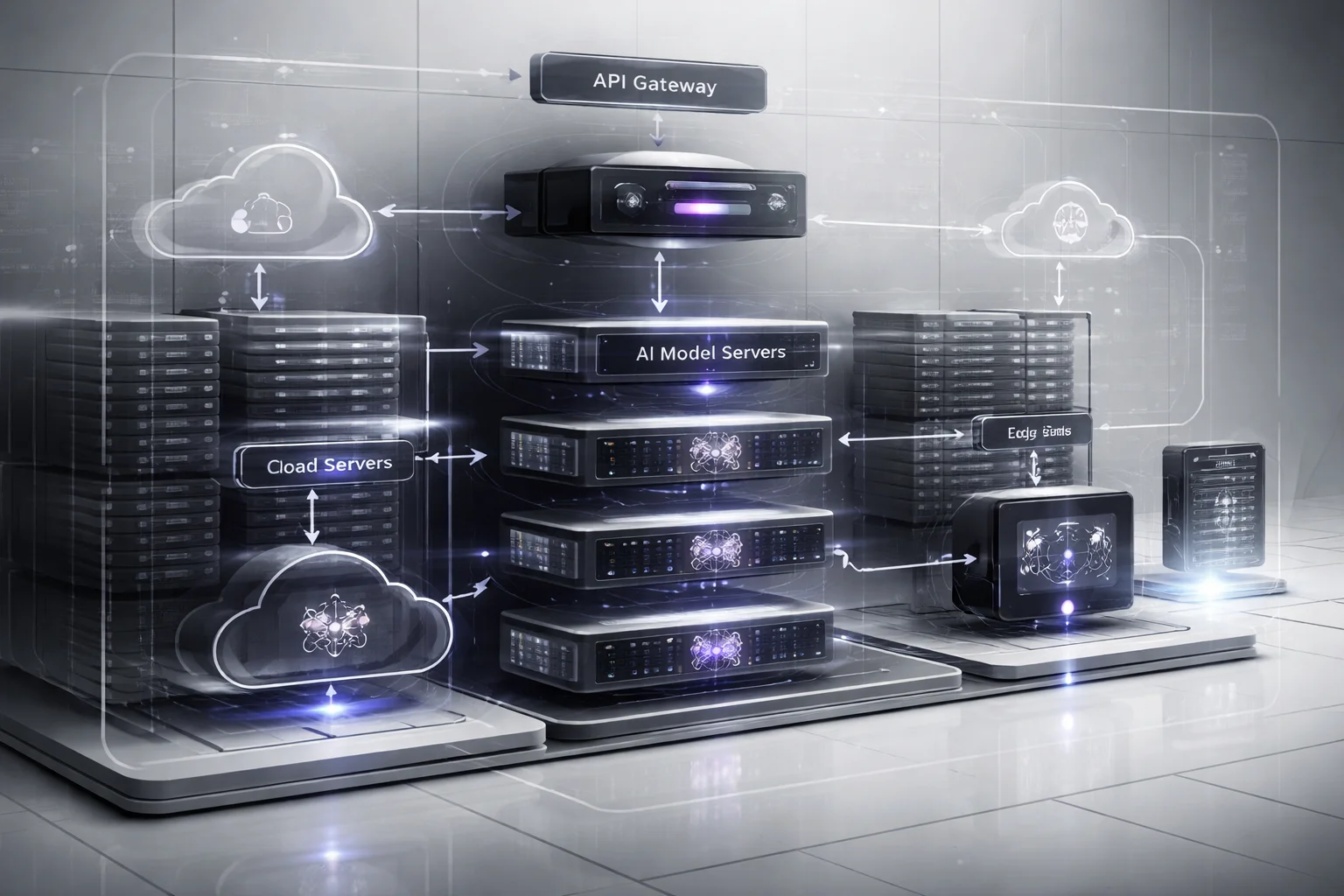
Not the answer people want, either. I've sat in launch rooms where someone says "we just need more capacity" like ordering extra GPUs is the grown-up move, and for about 40 minutes everybody nods because it's cleaner than admitting the system can't tell a VIP request from background noise.
One morning at 9:03 a.m., everything looked normal. By 9:17, support was lit up. Analysts inside the company were pounding one model for summaries. Customers were hitting another for search. A background workflow kept spraying requests like nobody had told it GPUs cost real money. Same stack. Three different jobs. One team needed responses under a second. Another would've been fine waiting 20 seconds and never said so out loud.
The serving layer treated all of it as identical traffic. That's how you end up getting embarrassed in public.
The answer is architecture. But not in the vague conference-talk way people mean it.
Deloitte reported worker access to AI jumped 50% in 2025. That's not some far-off planning assumption anymore. Employees are already in the mix beside customers and internal systems, all calling models at once, all with different latency expectations, and I'd argue a lot of teams still design like there's only one audience on the wire.
Kamiwaza cited a 2025 Forrester survey saying 41% of organizations blame too many disconnected platforms for blocking AI scale. I believe that instantly. I've seen companies running a separate gateway for one team, homegrown routing rules for another, stray model endpoints nobody wanted to own, and a retry policy that turned a brief slowdown into a billable event.
So no, this usually isn't just a capacity story. Bigger clusters help right up until bad request handling eats the extra room you bought.
If reliability matters most, put an API gateway in front of every model service. Every one. Not the customer-facing ones only. Add rate limiting so noisy workloads don't trample everybody else. Add backpressure so queues don't swell quietly and then choke the whole system at once. Use load balancing tied to health checks, because round-robin has this dumb habit of politely sending traffic to instances that are obviously sick just because "it's their turn."
If cost is what keeps finance awake, tune autoscaling around queue depth and GPU utilization. Route lower-risk work to smaller models first or serve cached outputs when they do the job well enough. That's where good AI scalability consulting actually earns money: comparing workload patterns honestly instead of selling one template for every situation.
Versioning is where teams save themselves from their own confidence. Blue-green releases are useful. Shadow testing is better than most people expect because production traffic tells the truth before production consequences arrive. Fallback logic matters most. If your primary model times out, don't keep retrying your way into a fatter invoice. Drop cleanly to an older or cheaper version. That's real AI inference cost optimization. Not a slide with arrows on it.
Edge versus cloud gets butchered into useless advice all the time. Edge deployment can shave latency for factory vision systems or retail devices sitting out in the field where an extra few hundred milliseconds actually hurts operations. Cloud serving gives you easier elasticity when enterprise workloads share centralized resources. Those aren't interchangeable jobs. Trying to run both with one pattern is like using the same kitchen setup for a food truck lunch rush and a hotel banquet at 7 p.m. Looks similar from far away. Total mess up close.
The firms worth hearing from tend to test on themselves first. AlphaSense reported consultants are using a client-zero approach, proving generative AI workflows internally before pushing them to clients. Good. They should have scar tissue before they hand out advice.
Technavio projects $38.16 billion in AI consulting market growth from 2025 to 2029. Companies aren't paying that kind of money because architecture debates are academic. Bad choices show up later as margin loss hiding inside your enterprise AI scaling strategy, your shiny scalable AI deployment, or whatever tidy label got slapped on this quarter's AI scaling framework.
If I were reworking the stack, I'd start with deployment constraints before model ambition: Deployment-first AI model optimization. Not because ambition's wrong. Because physics doesn't care about your roadmap.
So I'll ask it again: when employees, customers, and internal automations all hit at once, will your architecture know who's who?
Common AI Scaling Challenges to Plan For
I made this mistake once with a sales copilot rollout: the demo sang, leadership smiled, and about 10 weeks later reps were getting old pricing, slower answers, and these bloated replies padded with policy boilerplate like the system was trying to hide that it had lost the plot. No outage. No flaming incident channel. The model server looked healthy. The business outcome didn't.

That's why I don't buy the comforting story that AI systems fail at scale because the infrastructure suddenly breaks in some dramatic way. Most of the damage happens in quieter places. A workflow changes in April. Nobody updates the prompt chain in May. Data ownership gets fuzzy by June. IT thinks data owns it, data thinks the business signed off, and the business assumes "production" means stable.
49% of organizations say competing priorities between IT, data, and business teams block AI scale. That's from Kamiwaza, citing Forrester. Nearly half. I'd argue the real number feels worse once you count the teams that are technically aligned in meetings and completely misaligned in practice.
The lesson I took from that failure was simple: stop treating the model like the whole system. When something starts slipping, I check five things in this order: prompt, context, data freshness, observability, pipeline. Not because it's elegant. Because this is where these projects actually go sideways.
Prompt drift gets ignored early because nobody wants to believe a prompt that worked in March can be shaky by June when the foundation model hasn't changed. But it can. I've seen a customer support team roll out a new escalation process and forget to update its prompt chain; quality dropped even while uptime stayed spotless. That's nasty stuff because your dashboards say green while your users quietly stop trusting the answers.
Then comes context bloat. Teams keep adding instructions, preserving full conversation history, attaching tool traces, gluing on policy text, and dumping extra retrieval docs into every request just to be safe. One call turns into a 12,000-token mess. Latency creeps up. GPU behavior gets weird. Any serious AI inference cost optimization effort gets smashed by token sprawl long before anyone bothers naming it.
Stale data is where trust really snaps. A sales assistant quoting last quarter's pricing during a live deal isn't a minor blemish; it's how people decide your system can't be trusted on anything important. Same problem if an operations assistant follows an outdated policy during a live decision. Nature notes that AI can lift EBITDA and enterprise value through higher sales and lower operating expense. True enough. Feed retrieval old information and you can erase both gains in one shot.
A lot of teams also kid themselves on monitoring. Uptime? Response time? Fine. That's the floor, not the standard. You need visibility into token growth, queue depth, cache hit rate, throughput tradeoffs, failure modes by prompt class, and exactly where your AI scaling framework is leaking cost or quality without throwing obvious errors.
The ugly part is that the real bottleneck often isn't the model at all. It's the plumbing around it — retrieval delays, feature generation lag, slow post-processing, overloaded vector stores, orchestration logic held together by one senior engineer and pure superstition. I've watched teams spend weeks tuning model performance while baggage handling underneath was still broken. You don't get scalable AI deployment that way.
Deloitte says the number of companies with at least 40% of projects in production is set to double in six months. More production doesn't solve any of this; it just spreads exposure faster across every weak point at once. That's where AI scalability consulting actually earns its keep: governance, testing cadences, ownership lines, operating rules, and an enterprise AI scaling strategy tied to real AI scalability economics, not slide-deck optimism.
If you're trying to pressure-test this before it gets expensive, start here: Deployment-first AI model optimization. So what's your weak spot right now — the model everyone keeps talking about, or the production mess nobody wants to own?
How Economically Scalable AI Consulting Works
$97.24 billion. That's what Grand View Research estimated for the AI inference market in 2024, and it's projected to hit $253.75 billion by 2030. That number should make people a little uncomfortable. It does for me. Everyone loves talking about training runs and shiny demos. In the real world, inference is the meter that never stops running.
Most teams don't have a model problem. They have a routing problem. I'd argue that's where the money disappears fastest. I've seen teams send a checkout fraud check, an internal document summary, and a nightly forecasting job through basically the same expensive serving path like those tasks are somehow equal. They aren't. A checkout decision can't sit around for 800 milliseconds if revenue is on the line. An internal summary can wait ten minutes in batch and nobody will even notice. A forecast run belongs on cheaper scheduled compute where throughput matters more than instant response and nobody's burning GPU time just to feel modern.
Benchmark bragging doesn't pay the bill. ROI does. A smaller model that gets you 92% of the outcome at half the cost is usually the smarter choice. Full stop. Save premium models for work where quality actually changes revenue, risk, or labor savings in a way finance can point to on a spreadsheet. High-stakes legal review on contracts worth millions? Maybe spend up. Summarizing last week's Zendesk tickets for an ops lead? Probably not. If you want the economics broken out more directly, read Large language model development cost economics.
The boring fixes carry this whole thing. Trim retrieval payloads. Cut duplicate context. Cache the answers people ask for every day at 9:00 a.m. Fix upstream data delays before somebody starts asking for another GPU cluster. I once watched a team cut response costs by roughly 18% after they realized their retrieval layer was stuffing the same policy document into prompts three times in slightly different chunks. No breakthrough model. No fancy architecture diagram. Just less garbage in the prompt.
Chaos always creeps back in if nobody sets rules. Budgets should be assigned by workflow, not tossed into one giant AI line item that nobody can untangle later. Routing rules should decide when premium models fire and when they don't. Track cost per useful inference, not raw request volume, because a million cheap calls that produce nothing useful are still waste. Review drift, utilization, latency bands, and fallback behavior every month if you're serious about governance.
Deloitte says 74% of organizations expect AI to grow revenue, but only 20% say it's doing that today. That's not a small miss. That's a brutal expectation gap. Ivey Business Journal points to another mess: scale AI carelessly and your productivity gains can come with higher energy use, more water demand, and more emissions. So yes, you can automate your way into a bigger infrastructure bill if you're sloppy enough.
What should you do with all this? Segment workloads by business value, latency tolerance, and failure cost before you touch model selection. Pick serving paths that fit the job instead of forcing everything through one architecture because it looks cleaner on a slide for the board meeting. Spend big only where better intelligence changes outcomes in ways finance can actually see.
Scalable AI deployment isn't just about keeping systems alive as traffic grows. It's an enterprise AI scaling strategy that protects margin, cuts waste, and keeps operating efficiency from getting worse as adoption spreads.
The companies that scale best usually have one habit others hate: they say no all the time. No premium model here. No real-time path there. No extra context shoved into prompts just because somebody feels nervous without it.
FAQ: AI Scalability Consulting for Sustainable Growth
What is AI scalability consulting?
AI scalability consulting helps you move from a promising pilot to a production system that can handle real demand without wrecking performance or budget. It usually covers architecture, model serving, infrastructure, governance, and AI inference cost optimization so your team can scale usage in a controlled way.
How do you scale an AI model in production?
You scale an AI model in production by fixing the full path, not just adding more GPUs. That means tuning model serving, reducing inference latency, improving throughput optimization, setting up autoscaling for AI workloads, and using load balancing, caching, or quantization where they actually help.
Why do traditional scaling frameworks fail for AI workloads?
Most traditional web scaling patterns assume stateless requests, predictable compute, and relatively cheap responses. AI workloads don't behave that way, because model serving can be memory-heavy, bursty, and expensive per request, especially when batching vs real-time inference decisions are handled poorly.
What are the hidden costs of AI inference?
The obvious bill is GPU time, but that's rarely the whole story. Hidden costs show up in idle capacity, overprovisioning, data transfer, failed requests, long-tail latency, engineering support, and weak GPU utilization, all of which push up cost per inference and distort your AI scalability economics.
How can AI scalability consulting reduce cloud GPU spend?
Yes, good AI scalability consulting can cut cloud GPU spend, sometimes fast. The usual gains come from better AI model serving architecture, smarter autoscaling, model quantization, right-sizing hardware, and rate limiting or backpressure so expensive inference capacity isn't wasted on low-value traffic.
Does autoscaling work for machine learning inference?
It does, but not in the clean, magical way vendors sometimes imply. Autoscaling for AI workloads works best when it's paired with warm pools, queue-aware policies, and traffic shaping, because cold starts and model load times can make naive scaling feel like trying to pour concrete faster by hiring more architects, which isn't a perfect analogy, but you get the problem.
What common AI scaling challenges should teams plan for?
Expect bottlenecks in inference latency, throughput, observability, and coordination across data, platform, and product teams. According to Forrester data cited by Kamiwaza in 2025, 41% of organizations blamed disconnected platforms and 49% cited competing priorities between IT, data, and business teams as barriers to scaling AI.
What does an AI scalability consulting engagement typically include?
A solid engagement usually starts with workload profiling, architecture review, and a baseline of current unit economics for AI. From there, consultants map an enterprise AI scaling strategy that covers Kubernetes deployment, containerization with Docker, model serving patterns, reliability controls, and a phased plan for scalable AI deployment.
How do consultants measure AI scalability with unit economics and KPIs?
They track metrics that connect technical performance to business value, not vanity dashboards. Common KPIs include cost per inference, latency percentiles, throughput, GPU utilization, cache hit rate, error rate, and revenue or margin impact per workload, which gives you a real AI scaling framework instead of wishful thinking.
What strategies reduce inference latency without increasing costs?
The best options depend on your traffic pattern, but common wins include model quantization, caching and memoization, better request routing, dynamic batching, and choosing the right model size for the job. In practice, AI scalability consulting helps you avoid the lazy answer of just throwing more hardware at latency, because that's expensive and often doesn't fix the actual bottleneck.
How do you forecast AI inference costs as usage grows?
You forecast inference costs by modeling request volume, token or compute intensity, peak traffic, hardware mix, and target service levels. Grand View Research estimated the AI inference market at $97.24 billion in 2024, which tells you the spend is already huge, and growing usage without a cost model is a good way to discover your problem from the invoice instead of the plan.