AI Model Optimization That Works in Production: Start With Constraints
AI model optimization should start with deployment constraints—latency, cost, hardware, reliability. Learn a framework to ship faster, cheaper inference.

If your model is “optimized” but still misses its latency budget in production, you didn’t optimize the model—you optimized the benchmark. That’s the core failure mode we see in ai model optimization: teams win offline, then lose when the model meets real traffic, real hardware, and real budgets. The result is painfully predictable—great accuracy slides on the inside, slow UX and rising GPU bills on the outside.
Deployment-first optimization flips the order. We start with model deployment reality—serving infrastructure, request mix, p95 latency, cold starts, and cost per inference—then choose the smallest set of techniques that reliably hits targets. Sometimes that’s quantization. Often it’s batching, caching, or fixing a preprocessing bottleneck no one profiled.
In this guide, we’ll define constraints, build a scorecard to force tradeoffs, map optimization techniques (quantization, pruning, distillation, architecture/serving changes) to those constraints, and then validate the result with production metrics. At Buzzi.ai, we build and deploy AI agents and production AI systems, and we treat optimization as part of shipping reliably—not a standalone lab exercise.
AI Model Optimization Fails When It Starts From Benchmarks
The benchmark trap: accuracy up, product down
Benchmarks are useful, but they’re also seductive. They give you a single number, a clean comparison, and a sense of progress. The problem is that production doesn’t care about a single number; it cares about whether users get an answer fast enough, reliably enough, at a cost your business can sustain.
It’s common to see offline metrics improve—top-1 accuracy, F1, BLEU, ROC-AUC—while the real-world experience degrades. Why? Because those offline metrics are computed in a controlled environment that strips away the taxes you pay in real-time inference: tokenization, I/O, networking, serialization, queueing, and sometimes entire microservices you forgot were in the critical path.
Here’s an anecdote-style pattern we’ve watched repeat. A team improves an NLP classifier by ~2 F1 points using a larger transformer. Offline, it looks like a clear win. Then they move it to a managed endpoint: p95 latency doubles because the endpoint adds cold start time, tokenization runs on CPU in Python, and the larger model reduces batching efficiency. The “optimized” model increases timeouts and support tickets—accuracy went up, but the product went down.
The hidden taxes usually come from places that don’t show up in notebooks:
- Tokenization and preprocessing that run per-request and scale poorly.
- Cold starts in serverless or scale-to-zero deployments.
- Network hops to feature stores, vector DBs, or post-processing services.
- Serialization and payload size costs when you move tensors around.
- Python overhead (including the GIL) when your serving stack is not actually optimized for concurrency.
And those taxes map directly to business outcomes: churn from slow UX, conversion drops when the UI “hangs”, and margin loss when GPU spend creeps up quietly behind the scenes.
Optimization is a system property, not a model property
We can’t say this enough: optimization is a system property. Your system boundary includes the model, runtime, hardware, batcher, cache, request routing, and the request mix itself. Even the same model can behave very differently depending on whether you run it under ONNX Runtime, TensorRT, PyTorch eager mode, or a managed platform with opinionated defaults.
That’s why “model compression” alone often disappoints. If 40% of your p95 is tokenization time, you can quantize the model all day and still miss your SLO. Likewise, if you’re making a feature store call in the hot path, your model inference may be fast, but your end-to-end latency will still be slow.
Two system components that frequently dominate latency are:
- Preprocessing (tokenization, image resizing, audio feature extraction), especially when it’s single-threaded.
- I/O and network (feature store lookups, object storage fetches, RPC fan-out), especially under load when queueing starts.
Real throughput optimization is often about removing these system-level constraints, not shaving milliseconds off the model’s FLOPs.
Where teams misalign: Data science vs product vs infra
Misalignment is the quiet killer of production ML. Data science optimizes accuracy; product cares about UX and task success; infrastructure cares about SLO and SLA compliance and the cloud bill. Everyone is rational, but they’re optimizing different objective functions.
A typical failure scenario looks like this: data science ships a larger model to improve recall; product approves because “accuracy improved”; infra discovers the new model requires a bigger GPU instance class and breaks budget; then everyone backtracks under pressure, with no shared definition of done.
The fix is not better intentions—it’s a shared artifact: a constraint scorecard and a single, measurable definition of “optimized” that lives inside the MLOps pipeline, not in someone’s head.
Define Deployment Constraints Before You Touch the Model
The four constraints that actually decide success
If you want to learn how to define optimization goals for ai model deployment, start with constraints that are measurable and enforceable. “Faster” and “cheaper” are vibes; constraints are numbers and owners.
In practice, most deployments come down to four constraint families:
- Latency: p50/p95/p99, tail latency, cold-start time, timeouts.
- Cost: $/inference, GPU-hours, CPU-hours, egress, token costs.
- Reliability: error budget, timeout rate, fallback behavior, degradation modes.
- Compliance/security: data residency, PII handling, audit logs, retention.
One useful way to operationalize this is a simple “constraint → metric → owner → measurement location” mapping. For example: latency might be owned by engineering and measured at the client and gateway; cost might be owned by platform and measured in cloud billing and runtime telemetry; reliability might be owned jointly and measured via SLO dashboards and incident reports.
When you do this upfront, optimization becomes a practical engineering exercise instead of a philosophical debate about whether 0.7% accuracy is “worth it.”
Cloud vs edge vs on-device: constraints change the goalposts
Constraints aren’t universal; they’re contextual. Cloud inference has different failure modes than edge deployment or on-device AI, and your optimization targets should reflect that reality.
Three quick snapshots:
- Cloud API: You care about throughput, multi-tenancy noise, autoscaling behavior, and tail latency under bursty traffic. Dynamic batching might be a superpower—or a footgun—depending on request patterns.
- Factory edge box: You care about memory footprint, thermal throttling, intermittent connectivity, and “what happens at 2am when no one is there.” Reliability beats peak benchmark speed.
- Mobile app: You care about battery, model size, and whether hardware acceleration exists on the device. The best model is the one that runs consistently across a messy device matrix.
The same “ai model optimization” technique can be great in one context and useless in another. That’s why we start from the constraints, not the technique.
Turn requirements into numbers: the latency-and-cost ‘budget’
Most teams fail because they don’t budget. They treat end-to-end performance as a single blob, then discover too late that the model itself only gets a small slice.
A practical approach is to create a latency budget and allocate it across the pipeline stages. Suppose your end-to-end budget is 800ms for an interactive workflow. You might allocate:
- 150ms for request handling + auth + routing
- 150ms for preprocessing (tokenization, resizing)
- 250ms for model inference
- 150ms for post-processing + formatting
- 100ms for network variance and headroom
Do the same for cost. If your unit economics require a cap of $0.002 per call (or $2 per 1,000 calls), that’s not negotiable—it’s a product constraint. Now you can ask the right question: what is the best ai model optimization strategy for latency and cost given a 250ms model slice and a $0.002/call cap?
Finally, set guardrails: maximum acceptable accuracy drop, minimum recall, or a minimum task-success rate. Guardrails turn optimization into a controlled trade instead of a blind gamble.

Build a Constraint Scorecard to Prioritize Tradeoffs
Once constraints are numbers, you need a way to decide what to do first. Otherwise, you’ll oscillate between “let’s quantize everything” and “let’s retrain from scratch” while nothing ships.

A simple scorecard: impact, feasibility, risk
We like a 1–5 rubric across three dimensions: impact (how much it helps latency/cost), feasibility (how hard it is to implement in your stack), and risk (accuracy regression, reliability risk, compliance risk). Multiply or weight them based on what matters most.
The scorecard prevents “optimize everything” paralysis because it makes tradeoffs explicit. It also becomes a shared artifact inside the MLOps pipeline: it can live alongside the PRD, the runbook, and the acceptance tests, so everyone aligns on what “done” means.
A narrated example: you need to cut p95 latency by 40% and cost by 30%.
- Caching: Impact 4 (big wins if request repetition is high), Feasibility 4, Risk 2.
- Quantization: Impact 3–5 depending on hardware, Feasibility 3, Risk 3 (needs calibration/testing).
- Architecture change: Impact 5, Feasibility 1–2, Risk 4 (long lead time, retraining risk).
The scorecard will usually push you toward the smallest change that hits the constraint first, and it makes the “why” legible to product and infra.
The core tradeoffs: accuracy vs latency vs throughput vs cost
Tradeoffs in production ML are non-linear. A small accuracy drop can unlock a large cost win by moving from GPU to CPU, or by allowing higher batch sizes without violating the tail latency budget. Conversely, a small architectural change can worsen tail latency if it increases variance.
It’s also important to distinguish between average latency and tail latency. Users feel p95 and p99. Your SLO and SLA should be anchored there, because tail problems turn into timeouts and retries, which then amplify load.
Batching illustrates the tension between throughput optimization and real-time inference. Imagine a service that adds dynamic batching and gets 3× throughput at peak. Great—until low-QPS users now wait for the batch window, and interactive latency slips beyond 500ms. In some products, that’s acceptable; in others, it breaks the experience.
When to stop optimizing the model and fix the system
One of the highest leverage moves is knowing when to stop touching weights. Symptoms that the system, not the model, is the bottleneck include CPU-bound preprocessing, high network time, queueing delays, and low accelerator utilization.
Before you commit to pruning or distillation, run a quick bottleneck triage. The outputs should be boring and concrete:
- Is preprocessing taking >30% of p95? If yes, optimize or move it.
- Is GPU utilization low? If yes, improve batching, concurrency, or runtime settings.
- Is queueing time growing with traffic? If yes, autoscaling or admission control is required.
- Are timeouts driving retries? If yes, you may be in a reliability death spiral.
Your definition of done should be equally concrete: meet SLO at target cost, with monitoring and alerts in place. Anything else is just effort.
Match Optimization Techniques to Deployment Reality
Model compression is not a single technique; it’s a toolkit. The question isn’t “what is best?” It’s “what fits the constraints, hardware, and risk profile of this deployment?” Below is how we map common techniques to real deployment conditions.
Quantization: when latency and memory footprint are the hard limits
Quantization reduces precision (for example FP32 → FP16 or INT8) to lower compute and memory footprint. It can be one of the best levers when hardware acceleration supports it—but it is hardware-dependent and data-dependent.
Where it shines:
- GPUs with tensor cores: FP16 can produce big wins with minimal quality loss.
- Edge CPUs: INT8 can reduce memory bandwidth and improve real-time inference if kernels are optimized.
- Mobile NPUs: quantized models are often the expected format for on-device AI runtimes.
What you should measure isn’t just “model is smaller.” Measure p95 latency, memory usage, throughput, and error rates under realistic traffic. For example: moving FP32 to FP16 on GPU may cut inference time noticeably; INT8 on an edge CPU may reduce memory pressure and stabilize tail latency. But you need calibration data and regression testing, especially for out-of-distribution inputs where numerical error can bite.
For official guidance, see PyTorch quantization documentation and the runtime docs for your target environment.
Pruning: when throughput matters and you can retrain
Pruning removes weights or structures from the model. The key detail is that not all pruning is equal in production. Unstructured pruning can create sparsity that looks great on paper but doesn’t map to speedups unless your runtime and hardware exploit sparsity efficiently.
In many deployments, structured pruning wins because it removes whole channels, heads, or blocks that standard kernels can take advantage of. The trade is that you usually need retraining or at least fine-tuning to recover quality.
The gotcha story is classic: a team achieves 50% sparsity and celebrates—then sees no speedup because their kernels aren’t sparse-optimized. They “optimized” model size, not throughput optimization. If you’re pruning, validate speedups in the actual serving infrastructure, not in a synthetic microbenchmark.
Knowledge distillation: when you need a smaller ‘student’ for reliability
Knowledge distillation takes a large, accurate teacher model and trains a smaller student to mimic it. Distillation is especially attractive when you need a production-ready model that hits SLO on cheaper hardware or reduces tail latency variance.
It’s often a fit for classification, retrieval reranking, and constrained language-model use cases where you want consistent behavior at lower cost. A pragmatic pattern: keep the large model for batch jobs (offline scoring, analysis, periodic refresh) and distill a smaller model for UI calls that require real-time inference.
Distillation also tends to play well with reliability because smaller models can have fewer latency spikes and lower cold-start penalties, which matters when your system is trying to protect an error budget.
Architecture and serving changes: when post-training tricks aren’t enough
Sometimes the model is simply too large, the sequence length is too long, or latency is dominated by attention, joins, or heavy feature work. That’s when architecture and serving changes become the real lever.
Serving tactics that often matter more than another round of compression:
- Dynamic batching tuned to your request mix (not a default guess).
- Caching for repeated prompts/inputs and repeated intermediate results.
- Compilation and kernel optimization (for example via NVIDIA TensorRT), including kernel fusion and optimized execution providers.
- Speculative decoding and other generation-time tricks for LLM-like workloads where applicable.
Architecture decisions are often the most honest form of ai model optimization. Instead of squeezing a huge backbone, you might switch to a smaller backbone plus better features, or redesign the task to reduce sequence length. The goal is not to “win” compression; it’s to win the deployment constraint.
Edge and On-Device Optimization: The Non-Negotiables
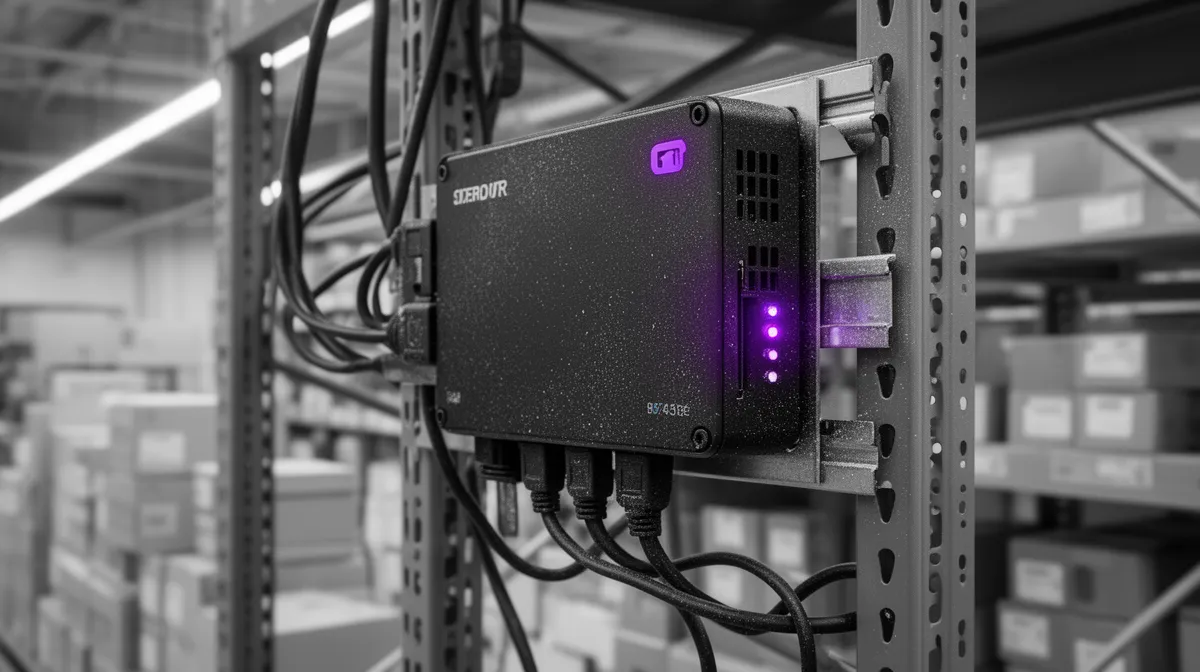
If cloud environments are forgiving, edge deployment is not. Edge and on-device AI tend to surface the constraints you could ignore in the data center: RAM limits, thermals, unreliable networks, and operational realities like “updates must not brick devices.”
Start with the device reality: RAM, thermals, and update mechanics
On edge hardware, memory footprint is often the first blocker. You’re not deploying “just the model.” You’re deploying the model, runtime, buffers, preprocessing libraries, sometimes a camera stack, and often a watchdog process. The total footprint matters.
Consider a plausible edge box with 4GB RAM. After OS overhead and other services, you might have 1–2GB for your AI workload. A “1GB model” is suddenly impossible once you add activation buffers and runtime overhead. That’s why quantization and runtime choice are not optional details; they are the difference between fitting and not fitting.
Thermals matter too. Benchmarks are bursts; production is sustained. Thermal throttling can turn a “fast” model into a slow one after 10 minutes of real use. Sustained p95 is the metric that counts.
Finally, plan updates like a product, not a hack: OTA updates, rollback, compatibility testing, and versioned artifacts. Reliability is part of optimization when devices are distributed in the field.
Latency in the field: networks are unreliable and inputs are messy
Edge deployments live in messy reality. Connectivity drops. Inputs degrade. Users do unexpected things. If your system assumes perfect networks, your p95 is fictional.
That’s why “offline-first” behaviors are often the real optimization: local inference with deferred uploads, and graceful degradation when services are unavailable. You also need to decide where preprocessing happens. Doing everything on-device reduces network dependence but increases CPU and memory pressure. Offloading can reduce device load but increases latency variance and failure modes.
A concrete field scenario: a kiosk loses connectivity but must respond within 300ms locally. That requirement pushes you toward an on-device AI model that is small, quantized, and tested under sustained thermals—plus a fallback behavior when confidence is low.
Choose formats and runtimes that match the ecosystem
Model formats are not just file extensions; they are ecosystem choices. Common targets include ONNX, TensorRT, TensorFlow Lite, and Core ML. Runtime choice often affects achievable speedups more than “model compression” alone, because the runtime determines kernel selection, graph optimizations, and hardware acceleration paths.
Two useful external references:
- ONNX Runtime documentation for inference optimization and execution providers.
- TensorFlow Lite guide for on-device inference and quantization workflows.
A simple selection rationale might be: ONNX for portability across vendors and environments; TFLite for Android footprint and a well-trodden mobile deployment path. Whatever you choose, budget for a testing matrix across OS versions, chipsets, and drivers—because edge is where “works on my machine” goes to die.

Validate Optimization in Production: Metrics That Prove It Worked
Offline wins don’t count until production metrics improve. This is where many optimization efforts quietly fail: the team ships a change, sees no clear production benefit, and can’t explain why because instrumentation is missing or inconsistent.
Offline wins don’t count until p95 and error rates improve
Your success metrics should be anchored in production behavior. At minimum, track p95/p99 inference latency, timeout rate, error rate, CPU/GPU utilization, memory usage, and cost per inference. If you can’t measure it, you can’t optimize it.
Also track quality metrics that reflect task success: human override rate, user satisfaction signals, downstream conversion, or resolution rate. “Accuracy” in isolation is often the wrong proxy for what the business actually values.
Segment metrics by request type and customer tier. Averages hide pain. If 5% of requests take 5× longer because of a particular input shape, that’s exactly the kind of tail event that breaks SLOs.
Instrumentation: where to measure and how to avoid blind spots
Good instrumentation makes optimization feel obvious. Measure latency at the client, gateway, and model server so you can locate where time is spent. Use distributed traces to separate queueing time from compute time. Log model version, hardware type, and runtime configuration alongside requests so regressions become explainable instead of mysterious.
One simple diagnostic narrative: a team ships quantization, expects a speedup, and sees none. Tracing shows compute is faster—but tokenization time spiked due to a new library version. Without traces, you would blame quantization; with traces, you fix the real bottleneck in a day.
Alerts should tie to error budgets, not vanity metrics. If your timeout rate threatens the SLO, page someone. If GPU utilization dips by 3% for an hour, it may not matter.
The ongoing loop: traffic changes, drift happens, costs move
Optimization is not one-and-done. Your traffic mix changes, user behavior shifts, inputs drift, device fleets evolve, and cloud pricing moves. A model that hit targets last quarter can miss them next quarter without any code change.
Set a cadence: monthly cost review, quarterly re-optimization, continuous model monitoring. Use safe rollout practices—canaries, A/B tests, and shadow deployments—so you can measure impact without betting the whole business.
A common example: costs spike because the request mix shifts toward longer sequences. The response might not be “train a new model.” It might be “change batching windows, enforce input limits, and adjust quantization level,” then re-check p95 and quality guardrails.

How Buzzi.ai Delivers Deployment-Targeted AI Model Optimization
Most companies don’t need a hero optimization sprint; they need a repeatable process that turns constraints into measurable improvements. That’s what we aim to deliver with our deployment-focused approach to ai model optimization services for production deployment.
Discovery to constraints: align stakeholders in days, not weeks
We start with a constraint workshop to capture SLO/SLA targets, cost ceilings, compliance requirements, and hardware constraints. This is the step that prevents the classic misalignment between data science, product, and infra.
The output is practical: a constraint scorecard, an optimization backlog, and measurable acceptance tests that define success before engineering begins. You get a shared document that stops debates and accelerates decisions.

Implementation: choose the smallest change that hits the target
Then we sequence work to maximize ROI and minimize risk:
- Serving infrastructure optimizations (profiling, batching, caching, concurrency, runtime tuning)
- Post-training compression (quantization, export/runtime changes)
- Retraining paths (knowledge distillation, pruning with recovery)
- Architecture redesign when the task or model size demands it
Cloud API and edge deployment often need different sequences. Cloud inference might start with GPU utilization and dynamic batching. Edge might start with memory footprint and runtime selection. Either way, we build reproducible pipelines and test harnesses so improvements don’t regress quietly after the next deployment.
If your end goal is shipping production AI agents—not just models—our AI agent development built for production constraints work is the natural place to connect optimization with real workflows.
After go-live: monitoring, tuning, and cost control
After go-live, optimization becomes a discipline: monitor latency, quality, and unit economics continuously. We help set up dashboards and alerts that reflect SLOs, plus operational runbooks so teams know what to do when metrics drift.
We also treat cost as a first-class metric. In many stacks, the fastest path to improving gross margin is not a new model; it’s better batching, smarter routing, and better infrastructure utilization. If you’re pairing AI with business process changes, workflow automation that reduces cost per outcome can compound those gains.
Conclusion
Production-grade ai model optimization is constraint-driven. Start from where the model runs and the SLO it must meet, then choose techniques that map to those constraints—not to a leaderboard. A simple scorecard forces explicit tradeoffs and prevents wasted effort.
Quantization, pruning, knowledge distillation, and architecture/serving changes each have a “right time and place,” and that time and place is determined by your latency budget, cost per inference, hardware constraints, and reliability requirements. Most importantly, “optimized” only counts when production validation shows p95/p99 improvements, error budgets are protected, and unit economics look better.
If you’re ready to reduce latency and cost without sacrificing reliability, talk to Buzzi.ai about deployment-first ai model optimization for your cloud or edge stack.
FAQ
What is AI model optimization in a production deployment context?
In production, AI model optimization means improving the end-to-end system so the model meets real constraints: p95/p99 latency, cost per inference, reliability targets, and compliance requirements. It’s not just shrinking weights or improving an offline metric. The definition of “better” is whether the deployed service hits its SLO at a sustainable cost.
Why do optimized benchmark models still fail latency and cost targets in production?
Because benchmarks ignore the “hidden taxes” of serving: tokenization, preprocessing, serialization, network hops, queueing, and cold starts. A model can be faster in a notebook but slower behind a managed endpoint with different runtimes and batching behavior. Production performance is shaped as much by serving infrastructure as by the model architecture.
How do I define a latency budget and cost per inference target for my model?
Start from the user experience requirement (for example, interactive flows usually need responses in a few hundred milliseconds) and set an end-to-end latency target. Then allocate that latency budget across stages—routing, preprocessing, inference, post-processing—with headroom for network variance. For cost, derive a $/call cap from unit economics (gross margin per transaction) and treat it as a hard constraint.
Which optimization technique should I try first: quantization, pruning, or distillation?
Try the smallest change that your constraints suggest. If memory footprint and hardware acceleration are your limiting factors, quantization is often first. If you need a smaller, more reliable model for real-time inference on cheaper hardware, distillation is usually a better bet than aggressive pruning. If you’re unsure, profile first—many “model” problems are actually preprocessing or queueing problems.
When does model compression reduce size but not improve inference speed?
This happens when the runtime can’t exploit the compression. Unstructured pruning can create sparsity that standard kernels ignore, yielding little to no speedup. It also happens when inference isn’t the bottleneck—if preprocessing or network time dominates, shrinking the model won’t move p95 latency much. Always validate on the real serving stack and hardware.
How do I optimize AI models for edge deployment constraints like RAM and thermals?
Begin with an inventory of true available memory (not device RAM on paper) and include runtime overhead, buffers, and preprocessing libraries. Optimize for sustained performance, not burst benchmarks, because thermals can throttle real throughput. Use a runtime and format that matches the device ecosystem (for example, ONNX Runtime or TensorFlow Lite), and design offline-first behaviors for unreliable networks.
What production metrics should I monitor to confirm optimization improvements?
At minimum: p95/p99 latency, timeout rate, error rate, CPU/GPU utilization, memory usage, and cost per inference. Pair these with quality metrics that reflect real outcomes, like human override rate, task success rate, or business KPIs. If you want a practical way to connect optimization to shipped value, our production-focused AI agent development approach treats these metrics as first-class acceptance criteria.
When should I redesign model architecture instead of applying post-training optimization?
Redesign when post-training techniques can’t hit targets without unacceptable quality loss, or when latency is dominated by architectural factors like sequence length or attention compute. If your model is fundamentally mismatched to the device or the interaction pattern, compression becomes a series of diminishing returns. Architecture changes are slower, but they can be the only path to meeting hard constraints reliably.