AI Program Management That Balances Delivery
Most companies don't fail at AI because their models are weak. They fail because they run AI like a normal software roadmap, and that's a great way to burn...

Most companies don't fail at AI because their models are weak. They fail because they run AI like a normal software roadmap, and that's a great way to burn budget while calling it innovation.
That's the real problem AI program management has to solve. Not just delivery speed. Not just experimentation volume. The hard part is balancing both without letting exploration turn into chaos or forcing uncertain work through a PMO process built for predictable execution.
And yes, the evidence is ugly. According to a 2026 Breeze.pm report, 81% of project professionals expect AI to significantly change their work, while the same research argues the gap isn't tooling at all, it's governance, workflow redesign, and clear accountability for AI outputs. We'll get into what that means across six sections, and why most advice on this topic still gets it backwards.
What AI Program Management Really Means
I made this mistake once. Treated an AI portfolio like plain old software delivery, just louder. Same PMO. Same weekly status call. Same stage gates. Same executive roadmap polished to the point it looked finished before the work even started.

Three months in, it fell apart exactly how these things usually do. One team had a model that scored well in testing and still couldn't get a real user to trust it. Another shipped a thin feature because the date mattered more than the outcome. Every review with leadership circled the same question: are we learning, or are we delivering?
I didn't have an answer. I think that's where most teams get exposed.
AI program management is the discipline of coordinating discovery, experimentation, delivery, and adoption across multiple AI initiatives. Not project tracking with new labels. Not a dashboard upgrade. It's an operating model built around a conflict people keep trying to smooth over: some AI work needs room to test assumptions and fail cheap, some of it needs hard controls because it's headed toward production, customers, regulators, support teams, all of it.
People love blaming tools. Easy target. Buy a platform, wire up a few workflows, tell everyone the machine is now organized. Six weeks later nothing matches. A 2026 Breeze.pm summary said the gap wasn't tooling at all — it was governance, workflow redesign, and clear accountability for what AI can draft versus what humans have to approve. That's the job. The reporting layer isn't the job.
Here's the lesson I pulled out of that mess: run the portfolio in two modes.
Mode one: exploration. Protect learning on purpose. Keep requirements loose early. Make hypotheses explicit. Review fast. If a team can't tell you by Friday which assumption it's testing, it isn't exploring anything — it's just burning time with a demo habit.
Mode two: delivery. Tighten the screws as risk goes up. Risk management matters here. Model lifecycle management matters here. Adoption metrics matter here. Release readiness matters here. Different cadence. Different evidence. Higher bar.
The ugly part is the handoff between those two modes. That's where teams get weirdly sentimental about prototypes and lose entire quarters admiring something that should've been killed early. I've watched teams spend 90 days polishing work that should've been shut down after week two. A prototype isn't owed production funding just because someone likes the demo. A production candidate shouldn't sit in research limbo forever either.
That's portfolio management in real life: deciding what gets explored, what advances through stage-gate decisioning, and what gets killed before it turns into technical debt wearing a fancy interface.
The market's already rewarding teams that understand this split. Fortune Business Insights put North America's share of the AI-in-project-management market at about USD 1.76 billion in 2025 and projected USD 1.99 billion in 2026. Look at platforms getting traction, like Foresight. Not because they make prettier dashboards. Because they connect prediction to systems teams already use to run actual work, like Primavera P6 and Microsoft Project.
If you're rebuilding your operating model, this practical take on enterprise AI automation governance and change management is worth your time.
Why AI Programs Fail Without Balance
Everybody says the same thing first: the model wasn't good enough. The LLM hallucinated, the predictions drifted, the vendor overpromised. Nice story. Clean story. Usually the wrong story.

I think most companies running AI programs in 2026 are breaking something far less glamorous. Not the model. The way they manage the work around it.
Take a Thursday steering committee. I've sat in those. Demo goes well, chatbot nails six polished questions, somebody smiles and says "promising," and instead of making the hard call — own it, integrate it, or kill it — the group funds pilot number three. I've seen one bank do this for nine straight months, complete with green status slides, while business value stayed flat.
Most AI programs don't fail because the models are weak. They fail because leaders force one management style onto two completely different kinds of work.
That's the missing piece people keep dodging. Early exploration and production delivery aren't cousins. They're different jobs. Treat them the same and you usually get one of two outcomes: endless pilots or very expensive nonsense pushed into production.
The pilot trap looks busy, which is why it survives. PMO reports show movement. Prototypes behave well enough in demos. Experiments keep getting airtime. Meanwhile nobody signs up for model lifecycle management, operational ownership, or the ugly integration work that makes a test useful in real life.
The other mess is sneakier because it looks disciplined on paper. Team finds one strong signal. Leadership gets impatient. Budgets lock. Deadlines harden. Rollout plans appear before core assumptions are stable. That's how brittle models get scaled. That's how bad data logic gets wired into downstream systems. That's how risk teams inherit problems they never needed.
People still try to run this through traditional program structures as if AI will politely behave like ordinary software delivery. It won't. Classic delivery assumes requirements get clearer as work moves forward. AI doesn't always do that. In exploration, requirements often show up because an experiment produced something nobody expected. In delivery, ambiguity has to drop fast or your controls are just theater with approval forms.
Inkubit said this outright in its 2026 report: organizations that combine AI in planning and reporting with hybrid delivery models and portfolio management get agile flexibility and strategic control at the same time. That's not consultant wallpaper. It's a warning shot against uniform governance.
And then comes my least favorite move: buy another platform and pretend software will fix indecision. Another dashboard. Another governance layer. Another vendor promising order by subscription fee. Fortune Business Insights projected the U.S. market for AI in project management would hit USD 1.52 billion by 2026. Fine. Big market, real demand, lots of logos chasing budget. Your portfolio governance still won't know the difference between learning-stage work and scaling-stage work unless you define that difference yourself.
I'd argue that's where balance actually lives.
Exploration should reward evidence quality, speed of learning, and kill decisions made early enough to save money and attention. If a team disproves an idea in 14 days instead of dragging it through a quarter of status reviews, that's good management.
Delivery needs a different temperament entirely: stage-gate decisions, clear control points, integration readiness checks, named owners after launch, real accountability once the model leaves the lab and starts touching operations, customers, or compliance exposure.
Agile Seekers put it plainly in 2026: AI doesn't replace project management judgment, it amplifies it. True enough. Bad judgment gets amplified too. Vendors rarely mention that part.
If your AI program management consulting approach can't tell a promising experiment from a production candidate, what exactly are you governing?
The Exploration-Execution Balance Framework
Tuesday morning, 9:07 a.m., somebody in a steering meeting asked the question that wrecks AI programs: “If the prototype worked on Thursday and leadership loved it on Friday, why isn’t it live yet?”
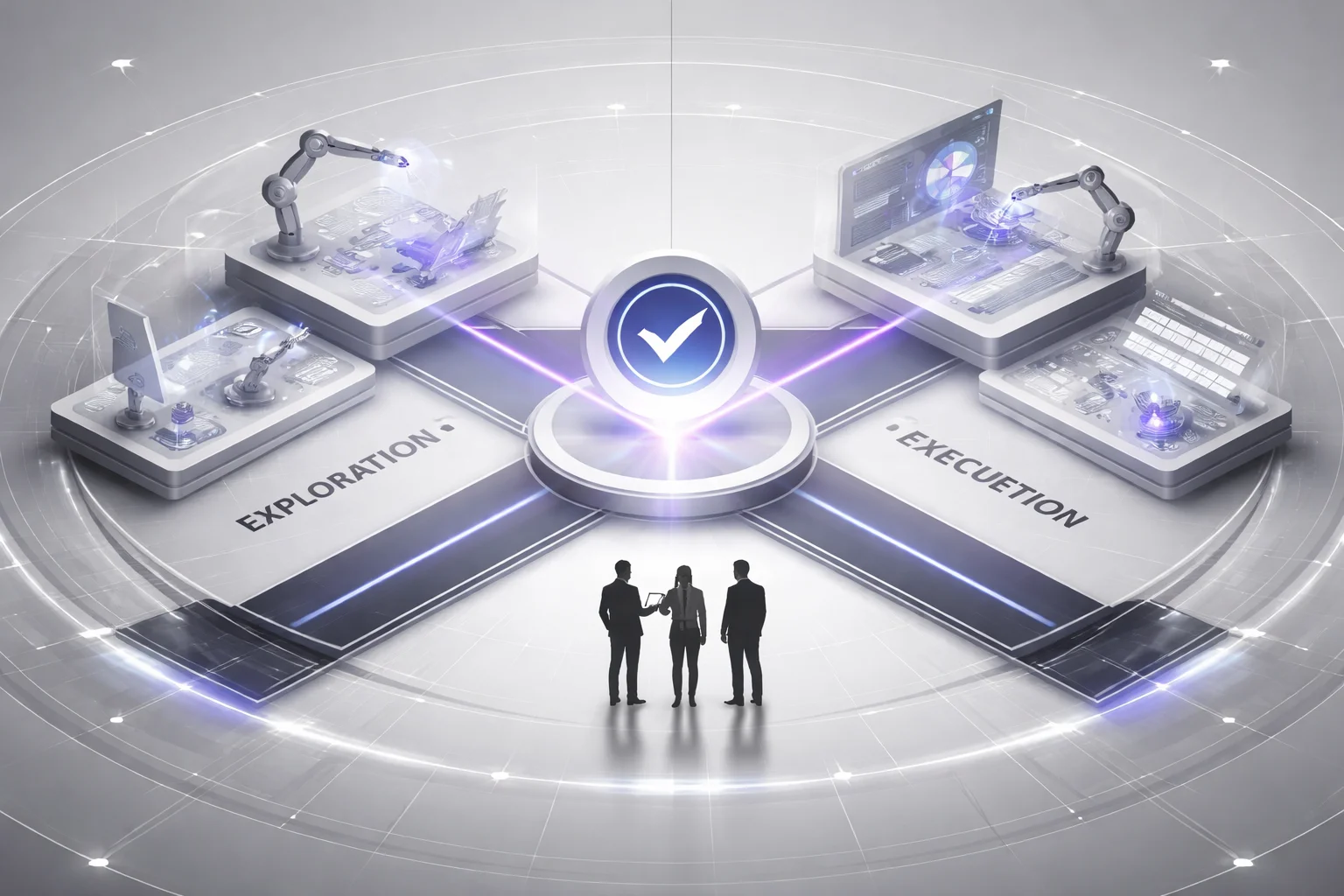
I’ve seen that movie. Discovery was still testing whether the data was even usable. Delivery was irritated because requirements had changed three times in four days. Finance looked at two teams burning money at once and figured progress must be happening because calendars were full. Busy everywhere. Clarity nowhere.
That’s the trap. People still run AI work like a relay race — research hands something over, implementation takes it from there, everybody pretends judgment has been “completed” upstream. I think that model is dead on arrival for AI. The baton keeps getting dropped because AI work doesn’t stop needing human judgment once a prototype exists.
Epicflow said something close to this in a 2026 article: AI is becoming central to project execution, but it’s still an assistant working alongside human intelligence, not a replacement for it. That’s the part leaders keep trying to wish away. You can’t remove judgment from the system, so your operating model has to get painfully clear about where judgment sits, what evidence is enough, and when a team should stop instead of bluffing its way into false confidence.
So no, exploration and execution aren’t neat back-to-back phases. They’re two operating modes running at the same time.
Two lanes. Same week.
You need one lane for learning and another for scaling, in parallel.
The discovery lane exists to cut uncertainty down to size. Teams test hypotheses, inspect whether the data is fit for purpose, prove feasibility, and decide whether a use case deserves another dollar. Winning here doesn’t mean polished software. It means evidence. Fast learning. Something solid enough that adults can make decisions without kidding themselves.
The delivery lane has a different job: reduce operational risk. That’s where teams harden pipelines, lock requirement traceability, assign service ownership, and deal with model lifecycle management in production like it actually matters — because it does. Success here looks boring, which is usually a good sign: reliability, adoption, controls, measurable business impact.
This isn’t some abstract PMO theory exercise either. Breeze.pm reported in 2026 that 81% of project professionals expect AI to significantly affect their work within three years. IIL reported in 2024 that 72% of project managers said AI was very or extremely likely to change their roles. With numbers like that, a PMO can’t just count milestones and call itself modern. It has to separate work intended to learn from work intended to scale.
Budget tells the truth faster than strategy decks do
If delivery urgency grabs all your best people, discovery starves. If endless exploration keeps winning because leaders like optionality, nothing ships.
A sane portfolio starting point usually looks like this:
- Discovery: 15% to 25% of AI budget for experiments, data investigation, experiment design, and proof-of-value work
- Delivery: 60% to 70% for scaling validated use cases into products or workflows
- Shared platform and controls: 10% to 20% for MLOps, governance tooling, security reviews, evaluation standards, and reusable assets
Your exact percentages will move around depending on maturity. Fine. The logic shouldn’t. If every dollar needs near-term ROI proof before exploration starts, you kill future value before it gets a chance to show itself. If leadership keeps everything in “learning mode” because nobody wants to commit — and yes, that happens all the time — you end up with slick demos and almost no repeatable outcomes.
I once watched a team spend four months tuning prompts and model settings for a customer-support use case and never assign an operating owner. Four months. Great demo day. Zero production path. Budget wasn’t following intent, so the whole thing drifted.
The questions should change because the job changed
Good stage gates aren’t there to slow teams down. They’re there to stop people from asking delivery questions during discovery and discovery questions during delivery.
In discovery, ask: Is this problem important enough to matter? Is the data actually usable? Did the experiment beat the baseline? What did we learn that changes our confidence?
In delivery, ask something else entirely: Can this integrate with production systems? Are controls defined? Who owns ongoing monitoring? What triggers intervention if performance drifts?
That’s governance worth having. Not more approvals piled on top of weak thinking. Better approvals tied to the mode you’re in.
Name the switch
A prototype shouldn’t slide into production just because senior leadership clapped after one demo.
You need explicit switching criteria inside portfolio management: minimum validation threshold met, business sponsor assigned, operating owner identified, deployment architecture approved by portfolio governance.
If those conditions aren’t met, the use case stays in discovery or gets shut down. Sounds harsh? Maybe. Still cheaper than forcing shaky evidence through a deadline and acting stunned when it breaks two weeks after launch.
One leadership layer or you’ll get organized blame
The same leadership layer needs visibility into both learning flow and delivery flow.
If discovery reports into an innovation group while execution lives somewhere else, incentive conflict shows up fast. One side optimizes novelty. The other optimizes certainty. Both feel righteous about it too. Your PMO or central AI leadership function has to reconcile those tensions inside one operating model or you’re not building alignment — you’re building a blame machine.
If you want more depth on how governance can support this split without slowing teams down, this guide on AI risk management frameworks is worth your time.
I’d argue the real lesson here is brutally simple: balance in AI program management isn’t soft thinking at all. It’s resource discipline with better timing. So what are you actually funding right now — learning and scaling as two distinct jobs, or one messy handoff that everybody already knows won’t hold?
Mode Design: How to Structure AI Work
Hottest take? Most teams don't have a production AI system. They have a pilot that stayed online long enough to get called “production” in a steering committee deck.
I watched that happen. Customers could touch the thing, so leadership started using the word like it meant something settled. It wasn't settled. No clear owner. No retraining trigger. No operating plan after 6 p.m. Just a Slack channel full of nervous people and two exhausted experts carrying the whole mess in their heads.
Ask the room two questions — what mode is this in, and what does success look like right now — and you can feel the air change. Silence usually means the operating model never got designed.
The 28% number gets abused all the time. A 2024 IIL summary says 28% of a project manager's skill set can be augmented by GenAI, including methodology and life-cycle-driven tasks. People hear that and make a lazy leap: if AI can help across the life cycle, one management approach should cover discovery, rollout, enterprise operations, all of it. I think that's dead wrong.
A 2026 Epicflow overview makes the familiar pitch: AI improves planning, execution, and monitoring through prediction, automation, and data-driven insight. Sure. I buy the upside. I don't buy the fantasy that those gains appear if you run every AI effort exactly the same way.
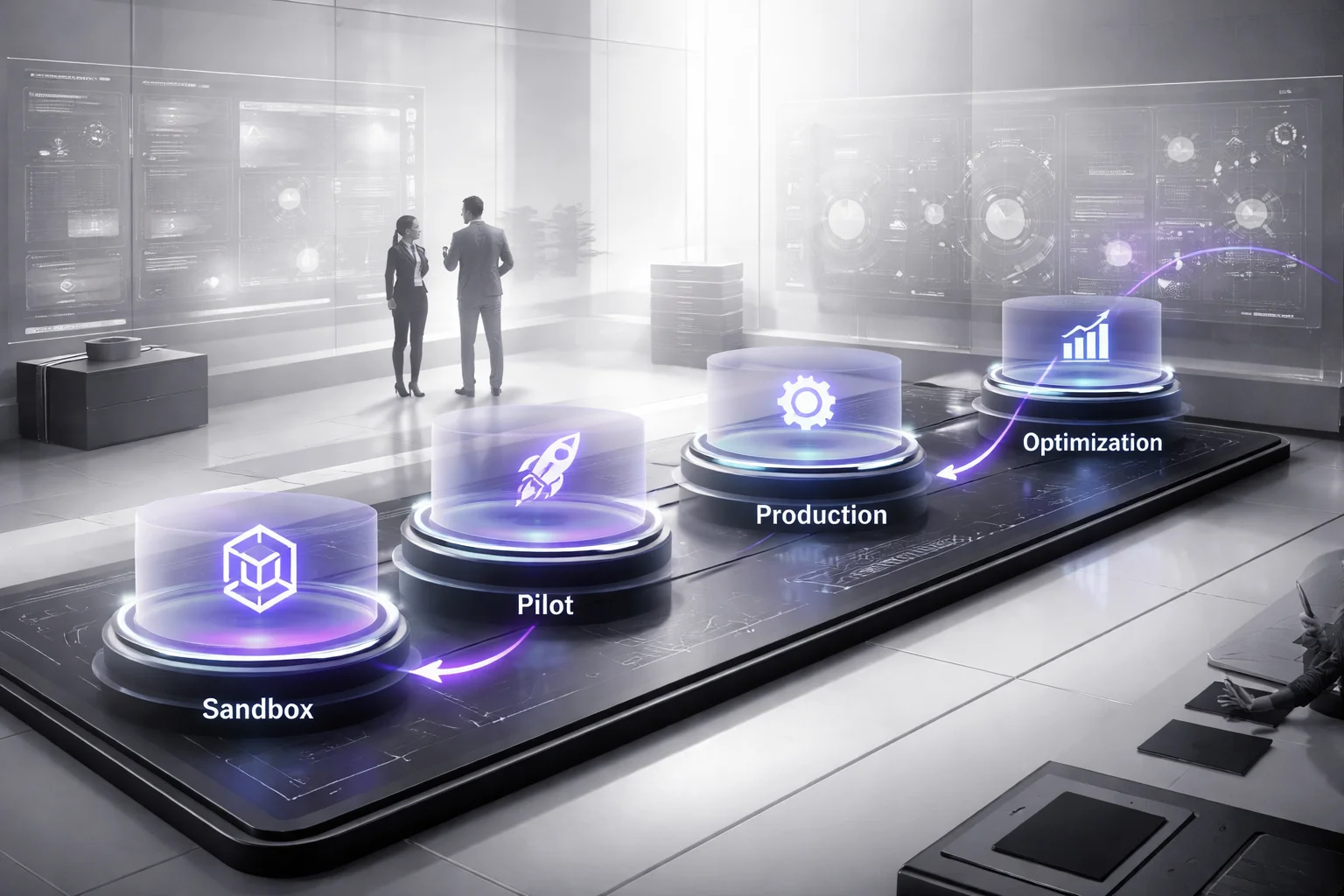
You need four modes: sandbox, pilot, production, optimization. Different roles. Different artifacts. Different controls. Different stage-gate calls. Call it bureaucracy if you want. I'd argue it's cheaper than turning curiosity into technical debt that hangs around for 18 months.
Sandbox mode
This is where an idea has to earn another week of life. Not prove world-changing impact. Earn oxygen.
Success here means learning fast and killing weak ideas early. Keep the team tight: a product owner or business sponsor, a data scientist, a domain expert, light PMO support. Keep the paperwork light too: hypothesis statement, baseline definition, data readiness check, experiment log, simple risk note.
Light governance still means governance. Portfolio governance should approve a time box, a budget cap, and exit criteria. Give it 2 to 6 weeks. No signal improvement? Data turns out unusable? Stop funding it. I've seen teams drag a bad concept for three months because nobody wanted to admit the source data was junk.
Pilot mode
This is where optimism gets punched in the mouth by real operations.
Pilot mode answers a harder question: does promising evidence survive contact with actual work? Success means controlled value in a limited environment, not applause from a demo.
The cast changes fast here. Engineering leads show up. Security review shows up. Legal or compliance joins when needed. You also need an accountable business owner now, not vague “executive support.” The artifacts tighten with it: pilot charter, requirements traceability for key workflows, evaluation metrics, human override rules, rollout plan for one team or one region.
“We're still exploring” stops working as cover in pilot mode. You're still learning, yes. You'd better be learning something measurable. Risk management gets tighter here. Adoption signals need numbers attached to them.
Production mode
Production is boring on purpose.
No heroics. No mystery ownership. No midnight message asking who remembers why the model behaves strangely on edge cases from last quarter.
Success means repeatable operation inside the business. That takes platform engineering, MLOps ownership, service operations, business operations leaders, and PMO oversight tied to enterprise controls.
The artifacts aren't decorative either: deployment architecture, SLA targets where relevant, monitoring dashboards, incident playbooks, model lifecycle management plan, retraining triggers, approval records.
If those pieces don't exist, don't call it production. You've got a live pilot wearing nicer clothes.
Optimization mode
Launch isn't the finish line. That's one of the most expensive lies in AI work.
This is where organizations either compound value or slowly collect stale models nobody trusts enough to champion and nobody wants to retire because retiring things feels political.
Optimization mode exists to improve cost, performance, adoption, and governance after launch. Success means sustained value instead of post-launch drift.
The team shifts again: product management, analytics, ops leads, finance partners watching ROI. The artifacts shift too: KPI reviews, drift reports, backlog prioritization,, model comparison results,, retirement criteria for stale models.. Yes,, retirement criteria.. Most teams forget that until they're paying for systems nobody really wants anymore..
This is also where mode switching keeps going after release: scale winners,, fix what's slipping,, pull the plug when needed.. That's basic AI program portfolio management..
Breeze.pm says the project management software market will grow from $10..56 billion in 2026 to $39..16 billion by 2035.. Fine.. More software is coming.. Software won't answer the real question for you: which rules apply right now,, what evidence matters at this gate,, and who actually signs off when it's time to move..?
When and How to Switch Modes
Everybody says the same thing about AI delivery: start small, prove value, then scale. Sounds sensible. It also leaves out the part that wrecks teams—knowing the exact moment you're no longer experimenting and are now on the hook to run the thing.
I've seen people hide behind both mistakes.
One team got dazzled by a polished demo and treated that as proof they were ready. They weren't. Once the feature hit real workflows, humans had to clean up outputs constantly, source data showed up late twice a week, and the room went quiet every time someone asked the ugly question: who owns this after launch?
The opposite failure looks more responsible, so it gets a free pass. A use case keeps showing value month after month, but no business lead wants delivery ownership, so it just sits there in pilot limbo while the PMO writes “continued progress” into status decks. I've read that line in a Friday report at 6:12 p.m., and no, it doesn't mean progress. I'd argue it's indecision wearing a lanyard.
People try to settle this with market numbers. They shouldn't. Grand View Research sized the global AI in project management market at USD 2,226.5 million in 2022 and projected 17.3% CAGR through 2030. Fine. That tells you vendors will keep multiplying, dashboards will keep getting prettier, and sales reps will keep showing immaculate screenshots. It doesn't tell you whether your team should still be learning or should be executing.
Here's the missing piece: the switch isn't about excitement, budget, or how many demos went well. It happens when two things change at once—uncertainty drops below a threshold you've already defined, and operational ownership starts getting real.
That's where most teams get sloppy. They act like evidence alone is enough. It isn't.
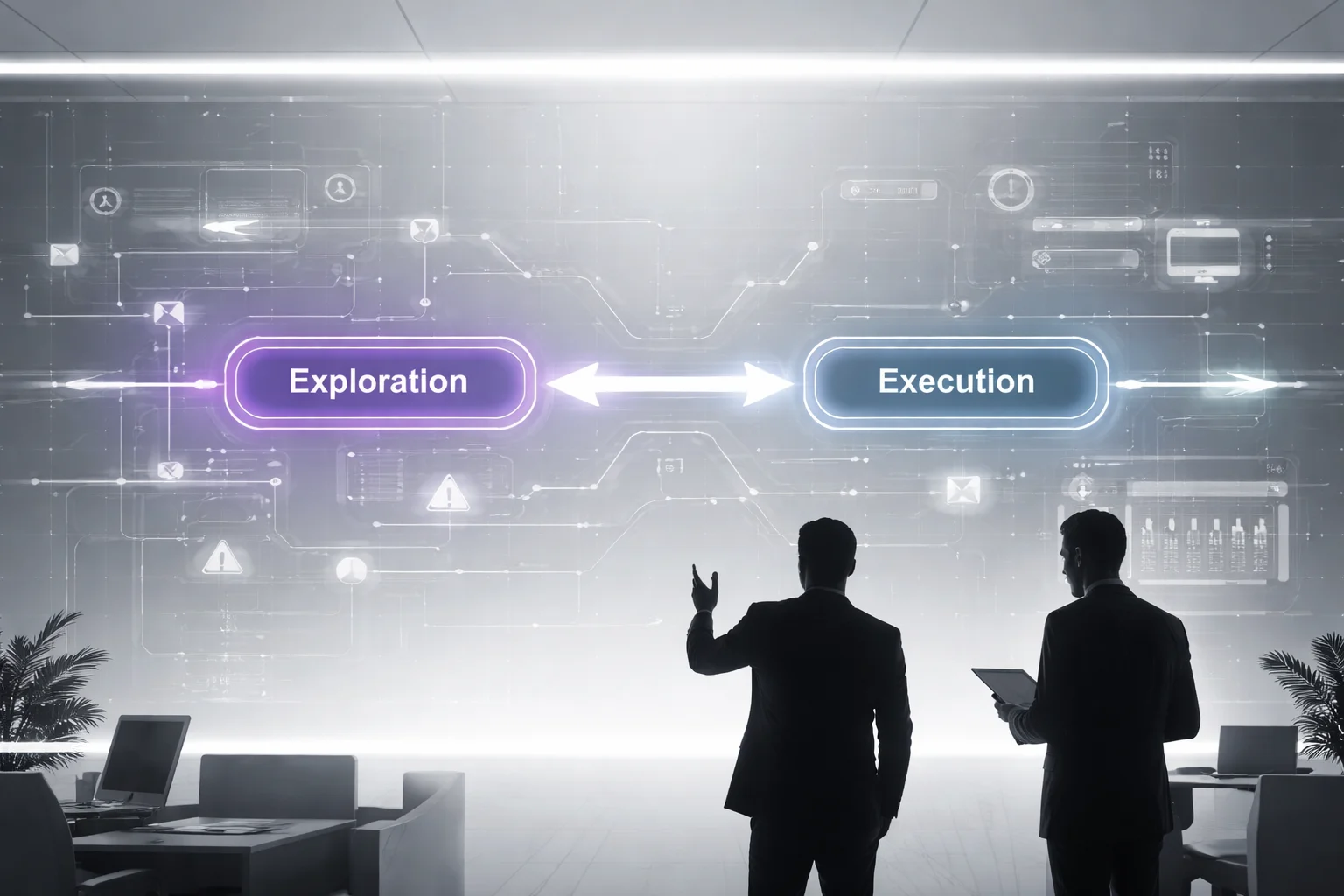
Exploration and execution answer different questions, and mixing them is how you end up with fake confidence. Exploration is for testing signal quality, data readiness, repeatability of experiments, and whether your hypothesis beats the current baseline at all. Execution is a different animal: integration risk, service ownership, controls, model lifecycle management, and whether the failure modes are understood well enough that nobody panics at 4:45 p.m. on a Friday.
That's the real split. One mode cuts uncertainty. The other cuts exposure.
A blunt way to decide
I don't use fancy language for this because fancy language lets people wiggle out of decisions.
Ask one question: are we still learning something that changes the decision, or are we just seeing the same answer again? If learning keeps changing what you'd do next, stay in exploration. If results repeat and actual owners are stepping forward to run it, move into execution.
Move into execution when learning starts repeating itself instead of changing your decision.
- Three or more experiments show stable uplift against baseline
- Data inputs are available at production frequency and quality
- A business owner accepts KPI targets and adoption accountability
- Risk management review says known risks are controllable
- Stage-gate decisioning confirms architecture, security, and operating support
If one of those is missing, don't kid yourself. You're still in discovery whether anyone likes that label or not.
The part stubborn teams hate
Sometimes you have to go backward.
Teams treat that like embarrassment. I think that's backwards. Reverse movement is governance doing its job.
Go back to discovery when new uncertainty shows up faster than delivery can absorb it.
- Model performance drops sharply across user segments
- Requirements keep changing because users don't trust outputs
- Compliance or ethical concerns emerge late
- The cost to productionize exceeds likely value
- No team will own monitoring or retraining after launch
A 2025 MDPI review said this pretty clearly: AI's effect on project work isn't only about automation. It's also about human-AI collaboration, knowledge-sharing, ethical concerns, predictive analytics, and risk management. That's why forced forward motion is dangerous. New facts show up late. Sometimes very late.
The control model I'd actually trust
Name the triggers before people get attached to their preferred story.
Use three comparisons: sandbox to pilot for feasibility proof; pilot to production for operating proof; production back to discovery for material drift or newly exposed risk. Every jump needs explicit trigger criteria owned by portfolio governance—not executive instinct after one enthusiastic meeting.
Your PMO should escalate by severity, not by who sounds most alarmed in steering committee meetings. Team leads handle metric misses inside tolerance bands. A portfolio governance forum handles unresolved ownership gaps or cross-program conflicts. Executive review steps in for budget shifts, regulatory exposure, or strategic reprioritization.
If you want a practical model for those control points, read these AI risk management frameworks. Teams usually don't get stuck in the wrong mode because process failed first. Governance usually failed quietly long before that and somebody called it strategy.
So what changed on your last AI initiative—uncertainty actually dropped, or people just got tired of asking who owns the risk?
Balanced AI Program Governance in Practice
Here's the mistake I see over and over: people blame slow governance, even though the real problem is bad sorting.

Leaders toss exploration work, pilot work, and production systems into the same bucket, demand one timeline, one scorecard, one story for the board, then act shocked when a flashy pilot falls apart the minute it touches a real workflow. I've watched that happen with a model that looked great in demo week and then failed because the upstream pipeline broke every third run. The slides were polished. The system wasn't.
A portfolio review usually tells on itself fast. The CTO wants two pilots live before quarter close. Finance wants proof the spend hits this year's targets. The model owner knows the data foundation is still shaky and doesn't want to say it out loud in front of twelve people. That's not a reporting problem. That's where speed, quality, and business value stop matching unless somebody forces the issue.
So force the issue with one monthly portfolio review that changes funding and staffing.
Not another status meeting. An allocation meeting.
I'd argue most PMOs make this harder than it needs to be because they group AI initiatives by executive sponsor instead of by operating mode. Bad move. A sandbox project doesn't become mature just because a loud SVP likes it. Exploration work should be judged on learning rate and evidence quality. Pilot work should be judged on adoption signals and whether it's ready for a stage-gate call. Production work should be judged on delivered value, operating cost, and model lifecycle health.
The money piece matters more than people admit. Grand View Research said project scheduling and budgeting accounted for 21.8% of revenue share in 2022. That number makes sense to me. I've seen teams lose an entire quarter because funding showed up in March for work that needed January data access approvals. Thirty days late on budget can mean ninety days late on outcomes.
Run risk checks every two weeks
The dull routine beats the heroic rescue session.
Every two weeks, check data quality drift, human override rates, security findings, dependency blockers, and ownership gaps. Keep it mechanical. No speeches. No "almost there" debates that drag on for six weeks. If one use case keeps missing the same threshold, change its mode. It probably isn't ready.
If you want a tighter structure for that cadence, see AI risk management frameworks.
Pick KPIs that match the mode
Early AI work shouldn't have to cosplay as mature ROI.
- Exploration: hypothesis pass rate, experiment cycle time, data readiness score
- Pilot: user acceptance, exception rate, baseline uplift
- Production: ROI, SLA adherence, drift rate, retraining frequency
This is where teams quietly wreck good programs. They ask production questions too early and kill ideas before they've had a fair test. Then they keep using pilot metrics after launch and miss obvious operating trouble sitting right there in drift rates for two straight months.
Standardize stakeholder communication
Executives need one page.
Status by mode. Key risks. Funding asks. Next gate decision.
That's enough.
Everything after that usually turns into noise wearing a tie and calling itself transparency. Tools can help if they pull signals together instead of spraying updates across five dashboards and seventeen Slack threads. A 2025 Fortune Business Insights summary highlighted Zoho's Projects Plus for combining real-time insights, risk prediction, and task automation in one platform. Fine idea. Still not the cure.
The cure is simpler and less glamorous: governance that tells the truth while there's still time to do something about it. Funny thing is, the healthiest AI programs often sound less ambitious in meetings because they're willing to say the sentence weak programs avoid: this shouldn't go live yet.
The question worth sitting with
AI program management works only when you stop treating exploration and delivery like the same kind of work, and start governing each mode by what it actually needs.
Your next move isn't buying another tool or adding another status layer. It's defining mode-specific rules for funding, stage-gate decisioning, risk management, requirements traceability, and model lifecycle management, then making AI mode switching explicit instead of political. And watch your portfolio governance closely, because the real failure pattern isn't slow experimentation or cautious delivery by itself, it's forcing one operating model across both until you get pilot graveyards on one side and fragile production systems on the other.
If your AI program governance still rewards tidy reporting over honest uncertainty, are you managing an AI portfolio or just protecting a story about control?
FAQ: AI Program Management That Balances Delivery
What is AI program management?
AI program management is the discipline of running multiple AI initiatives with clear goals, governance, delivery rules, and business accountability. It goes beyond model building. You’re coordinating data readiness, experiment design, risk management, MLOps, and stakeholder decisions across a portfolio, not just shipping one proof of concept.
How do you balance exploration and execution in AI programs?
You balance them by treating them as different operating modes, not as one blended workflow. Exploration should test hypotheses, reduce uncertainty, and produce evidence. Execution should work from defined requirements, delivery plans, and stage-gate decisioning so promising ideas can turn into production systems without chaos.
Why do AI programs fail without governance and delivery discipline?
Because AI work creates ambiguity fast, and ambiguity without accountability turns into drift. According to a 2026 Breeze.pm summary, the gap is not tooling, it is governance, workflow redesign, and clear accountability for AI outputs. If nobody owns approval rights, requirements traceability, or model lifecycle management, teams keep experimenting while the business thinks delivery is happening.
When should a team switch from exploration to execution mode?
A team should switch when the core use case is validated, the data is good enough, risks are known, and success criteria are measurable. In practice, that means you’ve moved past “can this work?” and into “can we deliver this reliably?” If the answer still depends on open research questions, you’re not ready to switch.
Can AI program governance slow down delivery?
Bad governance slows everything down. Good AI program governance speeds delivery because it sets decision rights, approval thresholds, and risk checks before teams hit production blockers. According to a 2026 Breeze.pm summary, organizations need clear accountability for what AI can draft versus what humans must approve, and that clarity removes a lot of rework.
Does MLOps play a role in AI program management?
Yes, and not as a side topic. MLOps is how you move from a promising model to repeatable deployment, monitoring, rollback, and model lifecycle management. Without it, AI delivery depends on heroics, and heroics don’t scale across an AI program portfolio.
What decision criteria should be used at stage gates for AI initiatives?
Stage gates should test business value, data readiness, technical feasibility, compliance risk, integration effort, and ownership after launch. You also need evidence, not optimism: experiment results, baseline comparisons, cost estimates, and resource allocation plans. If a team can’t show that, the initiative should stay in exploration or get cut.
How do you set KPIs and leading indicators for both exploration and delivery work?
Exploration KPIs should measure learning speed and uncertainty reduction, things like hypothesis cycle time, experiment quality, and data coverage. Delivery KPIs should measure execution, like deployment frequency, defect rates, adoption, SLA performance, and business impact. If you use delivery metrics to judge exploration work, you’ll kill useful discovery before it has a chance to prove anything.