AI POC Development Without Scope Creep
Most AI proof of concepts don't fail because the model was weak. They fail because the team let the project bloat into a half-built product and called it...

Most AI proof of concepts don't fail because the model was weak. They fail because the team let the project bloat into a half-built product and called it strategy. I've watched smart CTOs lose months this way, adding “just one more workflow” until nobody could even say what success looked like anymore.
That's why AI POC development scope is the whole fight, not some planning detail you clean up later. And the numbers are ugly. We'll get into why so many AI POCs stall, what tight POC scope definition actually looks like, and how to set completion criteria that stop scope creep before it starts (because yes, “we'll know it when we see it” is how teams burn budgets).
What AI POC Development Really Means
Hot take: most AI proof-of-concepts fail because people can't resist building a product before they've proved the model works.
I've seen this movie. Six weeks into a document-classification project for insurance claims, a clean little test had turned into a fake app with an admin dashboard, user roles, audit logs, and API hooks into the core system. Looked busy. Demo looked sharp. We still hadn't answered the only question that mattered: could the model sort incoming claims into five categories with acceptable accuracy?
That's the whole point of a POC. One question. One hypothesis. One proof.
Not something impressive. Not a sneaky first draft of production. I'd argue teams talk themselves into that because feature creep feels productive right up until the moment nobody can tell what success even is.
Kursol gets this exactly right: AI proof-of-concept work should stay tightly focused on one question or use case. They're not being precious about process. They're protecting the experiment. Add enough extras and your test starts lying to you.
The numbers should make people more nervous than they are. Linksft says 30% of GenAI PoCs will be abandoned by the end of 2025. I don't think all those projects are doomed by bad models. A lot of them get buried under vague goals, moving targets, and somebody saying, "while we're here, let's add..."
People mash these stages together all the time, and that's where the trouble starts.
- POC: a feasibility test with one use case, one hypothesis, and clear completion criteria.
- Prototype: something that shows flow or behavior. Useful for feedback. Doesn't prove the tech works.
- MVP: a minimum product that gives real users actual value.
- Implementation: production work with security, reliability, monitoring, and integrations handled properly.
I sometimes call the first stage a minimum viable proof, though honestly even that sounds dressed up. The better mindset is smaller than that. Think 500 labeled documents, an agreed target like 85% accuracy, and a yes-or-no decision at the end. Not three integrations and a dashboard pretending to be progress.
Do it differently.
- Name the business question: what exact problem are you trying to prove AI can solve?
- Set success metrics: accuracy, latency, cost per task, reduction in manual review time. Use numbers.
- Write explicit completion criteria: what counts as pass, and what counts as fail?
- Create requirements rules: decide what's in scope now and what gets rejected automatically in this phase.
- Use a change request process: if someone wants "just one more feature," make them log it and explain why it belongs now instead of later.
That's scope control. That's how you protect learning from ambition.
If your team keeps confusing POCs, prototypes, and MVPs, read AI prototype development vs POC vs MVP. It might save you from spending eight weeks polishing something that never proved anything in the first place.
The weird part? A boring POC is usually the healthy one.
Why Scope Creep Destroys POC Value
Everybody says the same thing about a proof of concept: make it feel real. Add enough polish that stakeholders can see it, click it, believe in it. Sounds sensible. Usually isn't.

I watched a team spend six weeks arguing over CSV exports in Jira and Slack while the only question that mattered sat untouched: could the model classify incoming support tickets well enough to reduce triage time?
That was the whole job. One question. By week two, the room had moved on. Suddenly it was user permissions, staging versus production, malformed upload handling, and whether a manager at a company like Zendesk would expect downloadable reports on day one. People kept calling it a POC, but come on — once you're debating export formats and role-based access, you're not running an experiment anymore. You're dragging a half-built product uphill.
I think this is where teams kid themselves. They tell themselves extra features create confidence. That realism is responsible. That a dashboard calms people down. It does calm them down, for about five minutes, right before the feedback loop gets slower, the success criteria get muddy, and the bill gets fatter for an answer that's somehow less clear.
The missing piece isn't technical at all. It's business discipline.
A POC has one real job: give you a narrow, clean yes-or-no learning outcome. That's it. Not "promising." Not "we built a lot." Not "maybe if we get another quarter." Clean signal. If the timeline stretches, decisions start bending with it. The timeboxed test becomes an open-ended initiative. Money meant to validate one hypothesis gets burned on side quests somebody called "small."
You can see the damage in the numbers. According to Linksft, 42% of companies abandoned most AI initiatives in 2025, up from 17% in 2024. I don't buy the story that all those efforts died because the models were weak. A lot of them probably never got a clean read on feasibility because the original question got buried under extra work.
I've seen that middle state too many times. Nobody wants to kill the project because too much has already been built. Nobody wants to approve rollout because the evidence is thin. So it just sits there in limbo, soaking up money and attention — like a pilot project still running nine months later because no one wants to admit they stopped measuring the thing it was supposed to prove.
Kursol gets one part exactly right: you need a written scope document with an explicit out-of-scope section. Not good intentions. Not Monday morning speeches about staying focused. A document somebody can point at when request number four shows up and calls itself tiny.
- Start with one fixed business question.
- Set specific AI POC completion criteria before build work starts.
- Create scope control rules for anything new requested midstream.
- Keep basic requirements management in place so assumptions don't mutate every week.
- Force every change through a request process that makes tradeoffs visible instead of letting scope quietly expand.
Simple rule: if your POC workflow can't reject work, it can't protect learning.
If nobody defines that boundary before code gets written, what exactly are you measuring?
How to Define a POC Scope That Stays Small
Why do so many AI PoCs die before they get anywhere useful?
I’m not asking in a philosophical way. I mean the ugly, ordinary version of failure — the project that gets a kickoff deck, a few excited meetings, maybe even a demo, then quietly disappears because nobody can agree on what it was supposed to prove in the first place.
46% of AI PoCs get scrapped before they ever reach production. That number bugs me. Not because AI is magic and should always work. It shouldn’t. A lot of ideas deserve to fail fast. But I’d argue a huge share of those projects didn’t really fail on the model or the data. They failed because the scope got bloated before anyone answered one real business question.
I’ve seen it happen with support-ticket triage more than once. Day one: classify incoming tickets into queues. Clean. Useful. Boring in the best way. By week two, someone wants sentiment scoring too. Then reply generation sneaks in. Then multilingual support shows up because one exec says “Europe” in a meeting and suddenly everybody acts like shipping in three languages was always part of the plan.
That’s not one experiment anymore. That’s three flimsy experiments wearing a trench coat.
Small makes people nervous. It feels unimpressive. So they keep adding “just one more thing,” which is how a test turns into a wishlist with a deadline. I think that instinct wrecks more PoCs than bad models do.
SmartDev defines an AI proof of concept as a small-scale, focused experiment that proves feasibility for one specific business problem before full deployment. That’s right. A POC isn’t a mini product. It isn’t phase one of your grand platform plan. It’s a test.
If your team can’t say the business question in one sentence, you’ve already got drift.
Pick one bottleneck that hurts enough to matter
Not “we want to use AI.” That’s not a business problem. That’s caffeine talking.
- Bad: improve customer operations with AI
- Good: reduce manual routing time for inbound support tickets by classifying them into 8 queues
The second one gives you something solid. You can measure it. You can test it. You can reject it if it flops. If you’ve named two bottlenecks, you haven’t made a choice yet. Pick the painful one and leave the others alone for now.
Write one hypothesis, not five half-formed ambitions
This is where teams either get disciplined or start lying to themselves.
Your minimum viable proof should test one claim:
- Format: We believe [model/system] can achieve [result] for [use case] under [constraints].
- Example: We believe GPT-4o mini can classify inbound tickets into 8 queues at 90% precision using the last 6 months of labeled data.
That single sentence carries more weight than most kickoff decks I’ve sat through. It tells you what you’re testing, what success means, and what data you’re betting on.
I once watched a team burn two weeks on this exact mistake. Twelve people on calls, probably $18,000 in loaded time gone, all because nobody agreed whether “good enough” meant 80% accuracy or simply less agent effort per ticket. Same project name. Totally different goals. Brutal.
The answer is boring: success criteria decided early
That’s the thing nobody wants to hear.
The middle of an AI POC is where scope usually gets killed, and vague success criteria are usually holding the knife. People call this flexibility. I don’t buy that. It’s moving the finish line after the race starts.
Set completion criteria before anybody builds anything:
- target precision or accuracy
- latency limit
- manual review rate
- timeboxed delivery window
- go/no-go threshold
Make it concrete: 90% precision, under 2 seconds per ticket, less than 15% manual review, delivered in 4 weeks, no extension unless the original hypothesis changes. Now “done” actually means something.
Use-case boundaries need teeth
This is where teams get squishy and regret it later.
Your POC workflow should include an out-of-scope list that people can’t charm their way around: no dashboard, no full integration, no role management, no second use case unless something else gets cut first.
I know some folks hate lists like that because they sound restrictive. Good. They’re supposed to be restrictive.
This isn’t bureaucracy. It’s requirements management with a backbone.
A lot of abandoned PoCs weren’t actually disproven. They just sprawled until nobody could tell what was being validated anymore.
Treat every extra request like it has a price tag attached
Because it does.
If somebody asks to add something, don’t smile and say yes by default. Ask one question: does this help answer the original feasibility question?
If no, it waits.
If yes, something else comes out.
That’s how CTOs and business owners keep scope honest instead of letting planning calls turn into feature shopping trips. Teams mix up product planning with feasibility testing all the time; if yours does too, AI prototype development vs POC vs MVP will save you some grief before the next meeting goes sideways.
The right AI POC scope isn’t bigger or flashier or smarter-looking. It’s the smallest test that can clearly prove or reject one important business question. That’s it. So what are you actually trying to learn?
POC Scope Protection Mechanisms That Work
I watched a perfectly sensible AI PoC get bent out of shape because somebody asked for “just a simple dashboard” in a Thursday review. Nobody pushed back. Nobody wanted to be the difficult one. By Monday, two engineers had stopped testing ticket-classification accuracy and were wiring up UI screens that had nothing to do with the original question. The model wasn't the problem. The tech stack wasn't the problem. Permission was.

That's the part teams miss. They act like scope creep starts in Jira or in some sloppy project plan. I don't buy that. It starts the moment extra work gets waved through because saying no feels awkward, political, or dangerous.
I've heard “stay focused” a thousand times, and honestly, it's useless advice on its own. Focus isn't a mood. It isn't a personality trait. It's a set of guardrails that catches nonsense before it lands on the sprint board.
Omdia makes the standard pretty clear: a strong AI PoC should stay lean and purposeful, built to test technical feasibility and early business value without overbuilding it into something bigger than it needs to be. That's the job. Not making it feel polished. Not dressing it up so leadership gets excited. That's how teams wander into fake-product territory and call it progress.
The ugly stat behind all this is from Linksft: only 26% of organizations make it from PoC to production. And here's where I think people make it worse. They see that number and panic, then respond by stuffing in more features, more demo flourishes, more reassurance theater. None of that answers the core question. It just hides it.
Start with a line in the sand
If you don't write down what's in bounds and what's out, somebody will assume everything's fair game. Your scope definition needs to say exactly what you're testing, which data you're using, what output you'll judge, and what you are absolutely not building.
- In scope: classify support tickets into 8 queues using historical labeled data
- Out of scope: dashboard, SSO, CRM integration, multilingual support, human review workflow redesign
That “no dashboard” example sounds small until it burns 16 engineering hours in two days and suddenly your clean little routing PoC has turned into six parallel workstreams. That's how bad requirements management usually begins: not with sabotage, just vagueness.
Put every new request through three questions
A stakeholder drops a Slack message at 9:14 p.m. asking for one more feature. Happens all the time. Fine. Don't build anything yet.
Run the request through three checks first: does this help answer the feasibility question, what gets cut to make room, and who signs off on that tradeoff?
That's the framework I'd use every single time. Simple enough to remember, annoying enough to stop impulse decisions.
Give one person the right to hold the boundary
Not a committee. Committees are where deadlines go to die.
You need one owner for AI POC development scope from end to end, usually a product lead or a CTO delegate with enough authority to say no without opening a week-long debate. Once everybody knows whose call it is, your POC workflow for teams gets cleaner fast. Funny how much confusion disappears when ownership stops being shared performance.
Timebox it hard and leave some parts rough
A good AI proof of concept should feel a little unfinished on purpose. Two weeks for discovery and framing, then another two to four weeks for build and evaluation is often plenty to learn what you actually came to learn.
If week six turns into week ten because somebody wants prettier outputs or another prompt cleanup pass before demo day, you're not testing feasibility anymore. You're decorating uncertainty.
If your team keeps mixing up these stages, read AI prototype development vs POC vs MVP. People blur those lines constantly, then act surprised when the work gets weird.
The strange part is that a well-run PoC often feels unsatisfying while you're in it. Someone's favorite idea gets cut. Something still looks rough in the demo. Good. That's usually evidence the boundary held. If everyone got everything they wanted, was it ever really a proof of concept?
Completion Criteria for AI POC Development
Tuesday, 4:40 p.m., somebody says the sentence that wrecks timelines: “Can we just plug it into Salesforce so it feels real?” I've seen that movie. In one insurance claims triage test using GPT-4o, the team had already answered the actual question with a single classifier on historical claims data. Then they burned 17 more days on formatting rules and UI polish because the demo looked a little rough and nobody wanted to be the person who said, “We're done.”
That's how a proof of concept quietly stops being a proof of concept.
Not with some huge strategic mistake. With tiny add-ons. Better prompts. Cleaner outputs. A light Zendesk integration. A dashboard nobody asked for at kickoff. The Jira board gets less scary, leadership gets less twitchy, the meeting demo looks smoother, and suddenly “almost done” really means “we're tired and don't want to make the call yet.”
I think teams lie to themselves here because a real ending feels weirdly plain. No big launch. No polished handoff. Just enough evidence to decide whether the thing is feasible.
That's the line. A POC ends when it answers the feasibility question. If it keeps going because people want safer feelings or prettier screens, you're not finishing a POC anymore. You're drifting into an unfinished implementation.
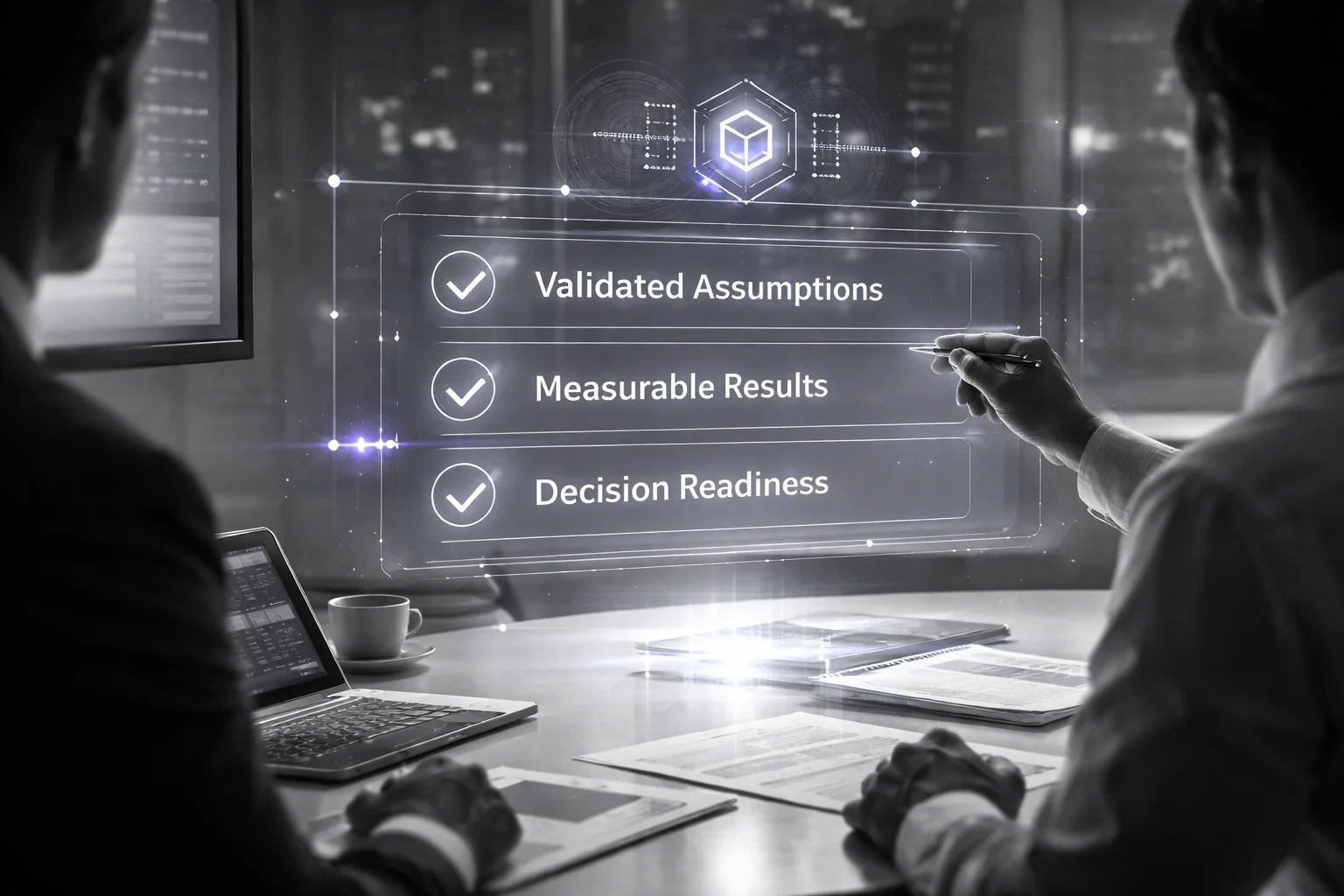
So your AI POC completion criteria shouldn't revolve around feature readiness. They should revolve around decision readiness.
Write that down before anyone builds anything. Seriously. Once work starts, every half-finished piece gains emotional value. The prompt tuning pass becomes “essential.” The extra workflow becomes “small.” The test environment suddenly needs production-grade behavior because nobody wants their work cut from scope.
A tight POC scope definition really comes down to three exit checks:
- Validated assumptions: Did you prove or disprove the main hypothesis? Example: can Claude or GPT-4o classify incoming claims with acceptable precision using your real historical data, not a cleaned-up demo set someone massaged in Excel?
- Measurable results: Did you hit agreed thresholds for quality, latency, cost, or manual review rate? Actual numbers. Not “promising.” Not “leadership liked it.” Numbers.
- Decision readiness: Do stakeholders have enough evidence to say go, no-go, or revise without asking for one more prompt pass, one more workflow, or one more dashboard?
That last one gets ignored all the time, and I'd argue it's the one that matters most. Codebridge has the right instinct here: keep a PoC locked on core functionality that answers the key feasibility question instead of letting it swell into a half-built product stuffed with extras. That's just scope control. Also plain old requirements management.
The timeline usually gives people away. Linksft says AI-assisted PoC delivery often lands in 4 to 6 weeks versus a 10 to 12 week industry average. I don't buy the idea that those teams are magically faster coders. Usually they just had sharper exit criteria and a cleaner change request process. They didn't spend week nine debating whether a staging setup needed production-level behavior for a test that was only supposed to answer one question.
If you need a shortcut in your head, use this: minimum viable proof. Not polished system. Not soft launch. Proof.
If your team still insists the POC can't be judged until it behaves like production, go read AI prototype development vs POC vs MVP. It separates learning goals from build goals, which is exactly where scope creep prevention either holds firm or falls apart fast.
So what are you actually trying to finish here: a proof, or a product-shaped excuse to avoid making the decision?
A Scope-Controlled AI POC Workflow for Teams
Here's the mistake I see over and over: teams blame the model, but the real damage usually happens the first time everyone says "sure, add that too." Week one, it starts small. A dashboard request. Permissions. A quick extra use case because somebody got excited after a demo. By Friday, one proof of concept has turned into three unfinished products and nobody can explain what success was supposed to look like.
I think SoftBlues gets the most important part right: decide the business problem, the success metrics, and the go/no-go line before anybody starts building. Miss that step and your AI POC development scope isn't scope. It's improv with invoices attached.
Buzzi.ai pushes a workflow built to learn fast and cut fast. Good. Slow guessing feels responsible right up until month three, when you've spent $60,000 proving nothing.
Start with one expensive problem
Not "improve operations." That's not a problem. That's office wallpaper.
Pick something tied to money or time. Reducing insurance claim-routing time by 40% with model-based classification. Cutting manual invoice triage from 12 minutes to 3. Something a CFO can understand in one sentence.
That's where POC scope definition stops being fake ceremony: one business problem, one hypothesis, one owner. If ownership is blurry here, it'll be chaos later. I've never seen fuzzy ownership magically become clear in sprint two.
Write down what you're refusing to build
The best scope doc usually isn't the shiny part. It's the blacklist.
No dashboard. No deep integration with Salesforce or SAP. No role permissions. No second workflow sneaking in because somebody says, "while we're here." I've watched that exact phrase turn a clean test into a seven-week mess.
That's scope control. People dodge it because saying no feels awkward for 20 minutes. Paying for it feels worse for six weeks.
Decide what counts as proof before demo politics kick in
If you wait until results are on a screen to define "good," you're already in trouble.
Set the evidence first: accuracy threshold, latency ceiling, review rate, cost per task. Get specific. 92% classification accuracy. Under 1.5 seconds per response. Human review under 15%. Cost below $0.08 per document. Numbers stop meetings from turning into opinion contests.
Then lock the AI POC completion criteria. What means go? What means no-go? What means revise and rerun?
This is basic requirements management. It also saves you from that miserable meeting where product says "promising," ops says "not usable," and leadership hears both and funds another month anyway.
Build less than feels satisfying
Kursol talks about a two-week AI proof-of-concept cycle to test feasibility before bigger investment. I'd argue that's aggressive in a healthy way.
The point of a timeboxed build isn't to impress people. It's to prove or kill the hypothesis before the team starts decorating it. Two weeks is often enough to find out whether an idea has legs. I once saw a team spend 11 weeks polishing an internal support workflow they could've invalidated in 9 days if they'd stayed honest about scope.
If you need help shaping that first pass, our AI POC development services start with framing and constraints, not random prototyping.
Treat every new request like it costs real money
Because it does.
A stakeholder asks for something new. Fine. Don't smile and toss it on the pile like it's free.
Run a simple change request process: does this help validate the hypothesis, what gets removed to make room, and who approves the swap? If nobody can answer those three things, the request waits.
That's actual scope creep prevention. Most teams don't have scope control problems because they're careless people. They have them because nobody wants to be the person who says no in front of a VP.
The best ending might be "stop"
Check the outcome against your original success metrics and AI POC completion criteria. Then pick a path: move to pilot deployment or implementation, revise and rerun with a smaller question, or stop.
A lot of teams expect every POC to end in launch plans. Bad expectation.
A good POC sometimes ends with "don't build this." That's not failure. That's six months of waste you didn't approve, staff you didn't distract, budget you didn't light on fire.
Funny thing about disciplined AI work: sometimes the smartest product decision is proving there shouldn't be a product at all.
FAQ: AI POC Development Without Scope Creep
What is AI POC development?
AI POC development is a small, focused test that checks whether an AI idea can solve one specific business problem. It isn't a product build. The whole point is to validate feasibility, data readiness, and early business value before you spend real money on scaling.
How do you define the right AI POC development scope?
The right AI POC development scope starts with one use case, one hypothesis, and a short list of measurable outcomes. You should document what the team will build, what data will be used, how model evaluation will work, and, just as important, what is explicitly out of scope. If that last part is missing, you're basically inviting scope creep in.
Why does scope creep ruin an AI proof of concept?
Because an AI proof of concept is supposed to answer a narrow question, not become a half-built product. Once teams pile on dashboards, integrations, extra models, and edge-case requests, they blur the result and make success impossible to judge. That's how a fast feasibility test turns into an expensive mess.
Can teams actually prevent scope creep during an AI POC?
Yes, but not with good intentions alone. You need a written POC scope definition, named owners, fixed success metrics, and a simple change request process that forces every new ask to be approved or deferred. Kursol puts it plainly: the out-of-scope section is the discipline that stops the project from drifting.
What should be included in an AI POC scope statement?
A solid scope statement should include the business problem, target users, data sources, technical approach, timeline, success metrics, acceptance criteria, and AI POC completion criteria. It should also list assumptions, constraints, and a blunt out-of-scope section. Keep it small enough that the team can finish it in weeks, not months.
What success metrics and acceptance criteria make sense for an AI POC?
Use metrics tied to the actual hypothesis, like classification accuracy, response quality, time saved, analyst review rate, or reduction in manual effort. Acceptance criteria should say what result counts as a pass, what counts as a fail, and what evidence the team must show at review. If success is vague, the POC workflow for teams will drift fast.
Does an AI POC need production-grade infrastructure?
No, and this is where a lot of teams waste time. A proof of concept (POC) needs enough engineering to test feasibility safely and credibly, not full production architecture, perfect observability, or enterprise-scale deployment. Build only what's needed to validate the hypothesis, then decide if it's worth hardening later.
Is a timeboxed approach the best way to control AI POC development scope?
Usually, yes. Timeboxed development forces tradeoffs, which is exactly what a healthy AI POC needs. According to Linksft, AI-assisted PoC delivery can take 4 to 6 weeks versus a 10 to 12 week industry average, and Kursol describes even a two-week AI proof of concept process for fast feasibility checks.
What data and evaluation requirements should be locked before starting?
You should lock the dataset source, sample size, labeling rules, privacy constraints, baseline method, and model evaluation plan before work starts. If the team is still arguing about test data halfway through, the POC scope definition wasn't real in the first place. Data readiness is usually the hidden reason these projects stall.
How should teams handle change requests without derailing the POC?
Treat every change request as a tradeoff, not a free add-on. If a new request doesn't directly support the original hypothesis or completion criteria, move it to a later pilot deployment or MVP backlog. That's how you keep scope control without pretending stakeholders will stop asking for more.
What are the completion criteria for an AI POC?
AI POC completion criteria should be set before development begins and should include technical results, business evidence, and a go, no-go, or iterate decision. That might mean hitting a model evaluation threshold, proving the workflow works with real users, and documenting risks that block scaling. If you can't say exactly what "done" means, the project isn't scoped yet.
What is the difference between an AI POC and an MVP?
An AI POC tests whether something can work. An MVP tests whether people will use a working version of it in a real setting. Put differently, MVP vs POC is feasibility first, product value second, and mixing those stages is one of the fastest ways to blow up your AI POC development scope.
How do you decide whether to stop, iterate, or scale after the POC?
Go back to the original hypothesis, success metrics, and acceptance criteria and judge the result against those, not against team enthusiasm. If the POC proved feasibility and showed business value, move toward pilot deployment. If it partially worked, tighten the scope and run one more iteration, and if it failed the core test, stop and save yourself the bigger loss.