AI Model Training Company Buyer Guide
How do you tell whether an AI model training company can actually get your model into production, or just hand you a demo that falls apart the minute your data...

How do you tell whether an AI model training company can actually get your model into production, or just hand you a demo that falls apart the minute your data gets weird?
That question usually shows up after the first polished pitch deck. Maybe after the vendor says “end-to-end” three times and somehow never explains model training, data preparation, handover documentation, or who owns what when the contract ends. It sounds small. It isn't.
This buyer guide is built for that moment. We'll look at the six things that separate credible AI model training services from expensive ambiguity, from data governance and evaluation metrics to production-ready model handover and AI contract clauses for IP portability.
What an AI Model Training Company Actually Delivers
What are you really buying when an AI vendor shows you a smooth demo and a benchmark slide with all the ugly bits sanded off?

Don't answer too fast. I've watched teams get this wrong because the room felt convincing. Clean deck. No awkward pauses. Procurement pushing to get signatures done before quarter-close. I've made that call myself, and yeah, it looked smart for about two weeks.
Then production happened. Live traffic has a way of humiliating polished assumptions. Edge cases stacked up, the model missed examples it absolutely should've handled, and the postmortem wasn't about some exotic training failure. It was dumber than that. Messy data. Labeling rules half-documented. Governance decisions buried in Slack threads and living in one person's head instead of actual handover docs.
That's why I don't get too excited when vendors obsess over fine-tuning stories. The miss usually isn't the model. It's the gap wrapped around the model, and that's the part buyers keep underestimating.
A lot of companies think they're buying AI model training services. Sometimes they're buying a performance. One sandbox result. One benchmark chart. One reassuring meeting with three solution architects and a sales engineer who knows exactly when to stop talking and let confidence do the work.
The answer to that opening question? You should be buying a chain of deliverables from an AI model training company, not isolated fragments that look good in a proposal and collapse under real use.
But here's the problem: the pieces people stare at most aren't usually the ones that decide whether the project survives.
- Data preparation: source review, cleaning, schema checks, sampling strategy, and exception handling.
- Data labeling: labeling guides, quality checks, inter-annotator agreement rules, and version control.
- Model training: baseline selection, fine-tuning approach, hyperparameter logs, and reproducible runs.
- Evaluation: agreed AI training deliverables and metrics tied to business outcomes, not vanity scores.
- Production-ready model handover: deployment notes, rollback steps, monitoring thresholds, and ownership transfer.
- Post-launch support: drift checks, retraining triggers, incident response paths, and change management.
Most buyers fixate on labeling and training because those feel like the "real AI" parts. I'd argue that's backwards. Data prep and governance decide whether you're building something usable or just funding expensive theater. Oracle has said it plainly: poor-quality data teaches models the wrong lessons. That's not a side note. That's the whole job showing up early.
I remember one team that had a perfectly decent classifier in staging and still couldn't launch because nobody could answer a basic question: what confidence threshold triggers human review? Not a hard research question. Just missing ownership. They lost nearly six weeks arguing over policies that should've been written before training run number one.
The money makes this worse, not better. TrendX Insights said in its 2026 report that cloud-based AI model training is projected to grow at a 24.5% CAGR through 2034. Genesys reported in 2025 that 33% of CX budgets are expected to go toward AI-powered technology. That's not lab-money anymore. That's board-visible budget, which means sloppy buying has a longer blast radius.
If you're building an AI vendor RFP checklist, don't ask for claims you can't verify after the contract is signed. Ask for artifacts you can inspect line by line: labeling guides, version histories, threshold definitions, rollback instructions, ownership transfer notes. This AI model training consulting engagement framework is a good place to stress-test what should be handed over before anything gets signed, especially around AI contract clauses IP portability.
ISG Research looked at 28 providers in its 2026 AI Platforms Buyers Guide across preparation, training, deployment, and governance. That's the full chain right there. So if a vendor keeps dragging you back to accuracy scores like that's the whole story, what exactly don't they want sitting in writing?
Why Vendor Transparency Matters in AI Model Training
Handoff day. Friday afternoon. Somebody shared a folder called final_model_assets, and inside it was the usual mess: three checkpoints, a half-finished README, two CSVs with no dates, and a config file named latest-final-v2. I’ve watched teams lose two full weeks over that kind of nonsense, trying to figure out which model actually shipped to production and whether anyone could reproduce the numbers from fine-tuning. Nobody could. The vendor had “handled it.” Sure they had.

That’s the part people skip when they talk about AI model training. They act like the job is picking a smart AI model training company, moving fast, and letting specialists do their thing. Sounds efficient. It also falls apart the second you ask for proof.
Business Research Insights put the AI Training Dataset Market at USD 7.47 billion by 2026. I don’t hear that and assume quality magically improves. I think more vendors rush in, more slick demos get polished, more ugly details get buried where nobody asks hard questions. Slide 19. Appendix C. Nowhere.
Transparency isn’t paperwork. It’s how you separate an operating partner from a black box with a decent sales team.
Model performance gets all the attention. I think that’s backwards. Traceability is what keeps you out of trouble.
If an experiment can’t be reproduced, you can’t show what actually improved the model. If data lineage is vague, you can’t tell whether gains came from legitimate data preparation, bad source material, or leakage nobody wants to admit. If dependencies stay hidden, your team inherits something it can’t rerun, debug, or migrate six months later after a cloud policy changes or the original vendor stops replying in Slack.
I’ve seen strong metrics survive exactly until handoff. Then everything gets weird.
No runbooks. No versioned datasets. No labeling guide anybody can use without guessing intent. No environment specs. No record of which checkpoint went live. That’s not a transfer of work. That’s abandonment wearing a blazer.
ISG Research said in its 2026 Buyers Guides that its AI and Data Platforms coverage spans seven platform industry areas, including AI Platforms, AI Agents, Sovereign AI and Data, and Data Platforms. That matters because training doesn’t sit in isolation anymore. Hosting posture affects it. Governance affects it. Agent behavior affects it. Data controls affect it. Deployment assumptions affect it. A vendor saying “we handled it” tells you almost nothing unless they can show what “it” covered, who owned each piece, and where the evidence lives.
No, I wouldn’t accept “trust us” here.
RWS says its TrainAI community includes more than 100,000 active AI data specialists and supports 400-plus language variants across 175-plus countries. That’s serious scale. It still doesn’t answer the question that matters: can they show your annotation rules, reviewer structure, exception handling process, quality thresholds, and rework logs on demand? Big workforce, great. Big workforce without process discipline? That can make opacity worse, not better.
More people in the system means more chances for inconsistency unless somebody locked the process down hard.
Your AI vendor RFP checklist should force evidence into the room early. Ask for experiment logs. Ask how dataset versioning works in practice, not what their sales deck says about it in theory. Ask for dependency manifests. Ask who approved key data governance decisions and where that approval history is stored. Ask for named ownership of every artifact needed for a production-ready model handover.
Get painfully specific about ownership too.
Ask which assets belong to you on day one and which stay licensed by the vendor. Put AI contract clauses IP portability in plain English so nobody plays dumb later about the difference between access rights and transfer rights.
Ask for samples before procurement signs anything. Not promises. Samples. A real runbook excerpt. A dataset version record with dates attached. An annotation guideline with revision history showing who changed what and when. This AI model training consulting engagement template is useful because gaps show up fast once you compare a vendor’s claims against actual handover materials.
The rule is simple enough to remember during a tense meeting: if an AI model training company can’t explain how your model was built, rerun it cleanly, and transfer every critical artifact without drama, then its AI model training services carry more risk than the pitch deck admits.
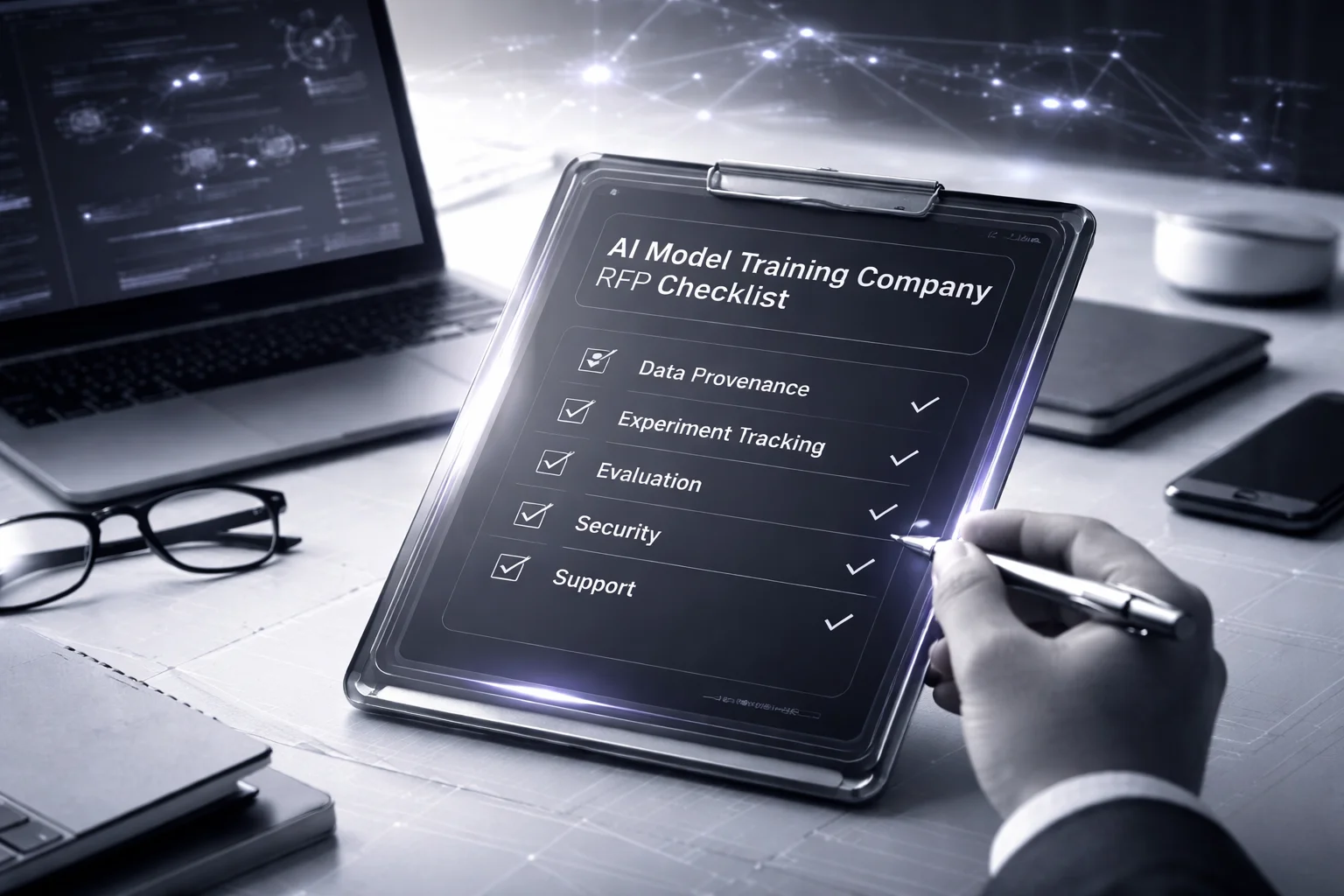
AI Model Training Company RFP Checklist
Everybody says the same thing in these vendor reviews: pick the team with the strongest process, the sharpest demo, the most mature-looking deck. I've heard it from procurement, founders, even technical leads who should know better. It sounds sensible right up until you're six weeks in and someone finally admits nobody can tell you which dataset version produced the model you're testing.
I signed off on one of those vendors once. Beautiful slides. Tight pilot story. Lots of confidence. Then delivery started, and all the vague parts stayed vague: data origin, experiment history, ownership after launch. Procurement bought polish. Engineering inherited guesswork.
People still treat transparency like a nice extra. That's outdated. The Open Data Institute has already pointed at the real problem: many major AI firms still reveal too little about the data used to train and test models, and their training-data transparency scores have been weak. I'd argue that's not a footnote in vendor selection. That's the whole thing.
The market's only making this mess harder to spot. Business Research Insights projected in 2026 that the AI Training Dataset Market would grow at a 24.16% CAGR through 2035. More vendors. More lookalike sales motions. More teams saying "our methods are proprietary" when what they really mean is "we'd rather not show our homework."
That's the missing piece: your AI vendor RFP checklist shouldn't reward fluency. It should force evidence. Any serious AI model training company ought to answer operational questions in plain English and attach artifacts that prove the answers weren't invented for the call.
I learned this the hard way on a Thursday night around 11:40 p.m., trying to reconstruct a training run from Slack threads, an exported CSV, and a checkpoint file named final_v2_reallyfinal. Never again.
So I'd make every vendor prove four things in writing before I score anything.
1. Data provenance and rights come first
This is where bad contracts hide in plain sight. Ask where every training and fine-tuning dataset came from, who labeled it, what rights apply, and what gets recorded for audit.
- What are the exact data sources used for model training and fine-tuning?
- For each source, what usage rights, licenses, consent terms, or restrictions apply?
- How do you document data preparation steps, filtering rules, and exclusion criteria?
- How do you handle personal information, copyrighted material, and disputed source content?
- If third-party data labeling is involved, what quality controls and reviewer structure do you use?
2. Reproducibility isn't optional
If a vendor can't rerun its own winning result from dataset version through final checkpoint, you don't have a repeatable method. You have a lucky screenshot.
- Which tools do you use for experiment tracking: MLflow, Weights & Biases, SageMaker Experiments, or something else?
- Can you reproduce the winning run from dataset version to final checkpoint?
- Do you provide hyperparameters, prompts, seeds, environment specs, dependency manifests, and model cards?
- What artifacts are included in a production-ready model handover?
3. Pretty benchmarks can still tell you nothing useful
This is where teams get hypnotized by numbers that don't map to the actual product. A model can post strong BLEU or F1 scores and still fail on your workflow because nobody tested hallucination risk in customer support flows or latency spikes under production load.
- What evaluation set did you use, and how was it separated from training data?
- Which failure modes do you test for: hallucination, bias drift, false positives, latency spikes?
- Which AI training deliverables and metrics are contractually committed: precision, recall, F1, BLEU, human review pass rate, cost per inference?
- How do you benchmark against a baseline model or prior release?
4. Security, governance, and support are where sales answers usually get thin
This part of the meeting always gets quieter. Suddenly nobody wants to be precise about exception approvals, retraining triggers, or what happens after launch if something breaks.
- What security and compliance controls apply to training environments and stored datasets?
- Who approves exceptions in data governance decisions?
- What post-launch support is included: monitoring setup, retraining triggers, incident response times?
- Which AI contract clauses IP portability terms guarantee that weights, code artifacts, prompts, labeling guides, and documentation transfer to us if we switch vendors?
The practical move is boring but effective: require written responses plus sample handover documents before any scoring starts. If you're comparing AI model training services, don't accept verbal reassurance where documentation should exist. This Ai Language Model Training Strategy Framework can help organize that review.
You’ll also hear vendors sell scale as if scale settles everything. RWS says it supports data work across more than 400 language variants in over 175 countries. Fine. That matters if your product spans regions or regulated markets. But scale alone doesn't rescue sloppy execution. Ask how locale-specific rules actually change annotation policy, evaluation design, and escalation paths inside the delivery team handling your account.
If two vendors both look mature on paper, which one can show you exactly what happens when a disputed data source shows up three weeks before launch?
Sample Deliverables and Metrics to Require
Twenty-eight. That's how many software providers show up in ISG Research's 2026 AI Platforms Buyers Guide. Twenty-eight vendors, and if you've sat through enough sales calls, you already know what happens next: same polished deck, same benchmark brag, same confident voice telling you their stack is different. I think most buyers still get hypnotized by the demo and ignore the thing that'll bite them 90 days later.
Not the model. The handoff.
I've watched teams accept a gorgeous endpoint on a Friday, celebrate over Slack, then spend Tuesday morning trying to rerun one experiment and realizing they never got the config files, random seeds, or labeling rules. One client had three engineers lose nearly 11 hours chasing a result they couldn't reproduce because the vendor shipped outputs without the trail that created them. That's not a working delivery. That's a souvenir with an invoice attached.
The market's making this easier to see if you pay attention. The ODI says most tech providers and companies using AI in the UK are more likely to be doing fine-tuning on pre-trained models than full model training from scratch. That matters more than people admit. If the job is fine-tuning, then weights and accuracy alone don't tell you much. You need the base model identified clearly, records showing how data preparation changed the inputs, details on any adapters or checkpoints created during tuning, and enough documentation so your team can reproduce that tuning path later without begging for help.
That's the split I'd care about. Not Vendor A versus Vendor B on a single accuracy chart. It's whether your staff can rerun the work, audit it, improve it, or move it onto another stack without opening a support ticket every time something breaks.
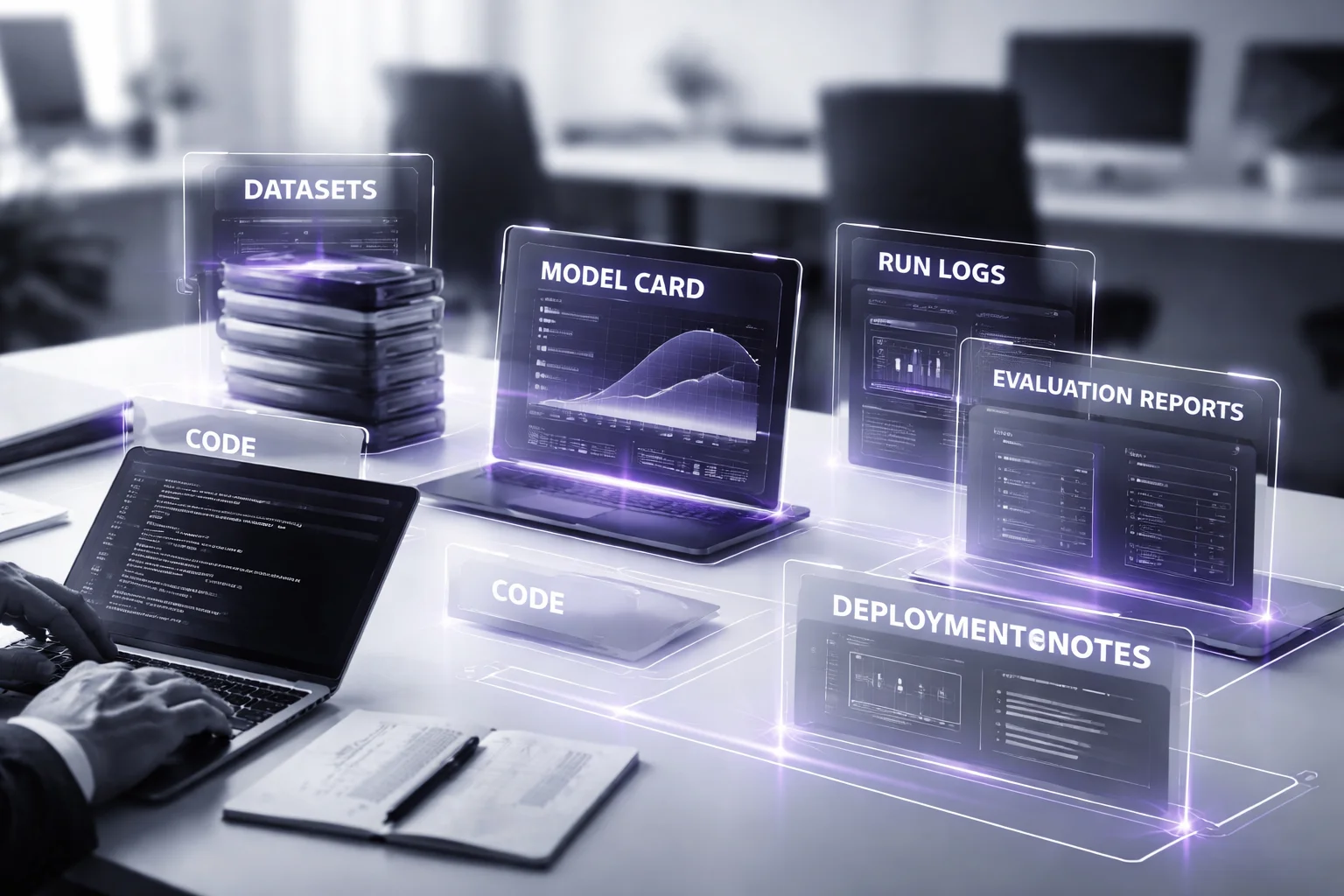
What weak vendors hand over vs what serious vendors hand over
- Weak: a final model endpoint. Serious: versioned datasets, sampling logic, exclusion rules, and full data labeling guidelines.
- Weak: a summary slide with performance claims. Serious: evaluation reports with baseline comparison, error buckets, failure analysis, and confidence thresholds.
- Weak: talk about a "proprietary pipeline." Serious: training code, configs, dependency manifests, run logs, seeds, hyperparameters, and environment specs.
- Weak: a generic compliance statement. Serious: documented approvals for key data governance decisions and known risk exceptions.
- Weak: a deployment call recording and little else. Serious: rollback steps, monitoring thresholds, infrastructure assumptions, API schemas, and support contacts for a real production-ready model handover.
A polished sample output is easy to overstate. A real handoff is harder to fake because it shows whether the work can survive contact with your internal team. That's why I'd argue the vendor worth paying doesn't sound different in the pitch. They look different in the artifacts they leave behind.
The metrics procurement and technical teams should require
You need two scoreboards. Everybody obsesses over quality metrics because they're easy to put on one slide for the CFO. Portability is where bad deals finally get exposed.
- Quality metrics: precision, recall, F1, task accuracy, human review pass rate, latency p95, cost per inference, and hallucination or false-positive rate where relevant.
- Portability metrics: time to reproduce the best run, percentage of artifacts transferred successfully, environment rebuild success rate, documentation completeness against checklist, and time required for internal team takeover.
Those belong in acceptance criteria for A I training deliverables and metrics, not dumped into an appendix nobody opens after procurement signs off. If a vendor hits quality targets but misses portability targets, they haven't finished the job. They've just locked your team out of it.
A lot of buyers confuse market size with operating discipline. Business Research Insights says North America holds 47% of the AI Training Dataset Market in 2026. Big share. So what? Big doesn't guarantee clean documentation, mature handoffs, or sane process at the level you'd expect from an AI model training consulting engagement template. IBM can ship immaculate docs on one engagement and another provider can bury key assumptions in a call recording; scale doesn't save you from messy delivery habits.
The boring binder might be worth more than the model itself. So ask for it up front: every artifact listed above, both metric sets tied to acceptance criteria, and proof your team can actually take over the system without vendor babysitting. If they flinch at that request, what exactly are you buying?
Contract Clauses for IP, Portability, and Handover
Here’s the mistake I see over and over: buyers obsess over model quality, then barely read the exit language. Bad trade. If your contract doesn't spell out what you own and what gets handed over before the final invoice is paid, the cheapest proposal on day one can turn into the most expensive breakup six months later.

I think people call this a drafting problem because that sounds cleaner. It usually isn't. It's a buying problem. I learned that the hard way on a project where the statement of work promised a “deliver trained solution,” which sounded fine right up until the engagement ended and we spent weeks fighting over model weights, adapters, training configs, synthetic data outputs, and labeling guidelines. One phrase. Fourteen days of calls. Nobody felt clever by the end.
An AI model training company will say all the warm partnership words in the sales cycle. Sure. The contract is where you find out whether “partnership” means “we'll help you leave cleanly” or “we're keeping half the value unless you pay us again.”
This got sharper once training runs stopped being cute experiments. Epoch AI has reported that frontier-scale runs can consume tens to hundreds of megawatts. Read that again. Tens to hundreds. So if a vendor tells you rerunning your best experiment later is “out of scope,” they're not making a technical point. They're telling you your future will be billable, and possibly rebuilt from scratch.
What I'd force into every deal
- IP ownership: say plainly that customer-specific outputs from training and fine-tuning belong to you — weights, adapters, prompts, evaluation sets, and handover documentation included.
- Reuse rights: draw a hard line between their generic tooling and your business-specific artifacts. Their internal utilities can stay theirs. Your data prep logic, labeling policy, acceptance thresholds, and domain-tuned assets shouldn't quietly become reusable property across other clients.
- Artifact transfer: require export of everything needed for a production-ready model handover: code repositories, configs, checkpoints, dataset versions, feature schemas, model cards, dependency manifests, and recorded data governance decisions.
- Reproducibility obligations: make acceptance depend on one clean rerun in your environment or your nominated cloud account for AI training deliverables and metrics. No rerun, no real proof.
- Exit support: lock in 30 to 90 days of transition help with named contacts, knowledge-transfer sessions, and defect fixes tied to whatever gets transferred.
The synthetic data point isn't some lawyerly corner case anymore. Ask who owns generated datasets and derivative rights. Ask it early. Business Research Insights reported 36% adoption growth in synthetic data generation in 2026, which means this issue is showing up in normal deals now, not weird ones.
Sovereignty belongs in writing too. Don't leave hosting posture implied because everybody nodded on Zoom. ISG Research's 2026 Sovereign AI and Data Buyers Guide evaluated 16 providers for a reason: buyers are pressing harder on where systems run, who controls access, and what happens at exit. Ambiguity is great if you're selling lock-in.
If you need a starting point for these terms inside your AI vendor RFP checklist, use this AI model training consulting engagement framework. Good AI model training services don't panic when you ask for portability. They price it clearly. Weird question to end on: if your vendor vanished next quarter, what exactly would you still have?
How a Production-Ready Vendor Engagement Works
46%. Nearly half of organizations are already using workforce engagement management, Genesys said in its 2025 report. Another 26% expect to have it live by mid-2026. I see that and think: okay, we're past the phase where teams get to call this a pilot and hide behind curiosity.

That's a buying pattern now. A budget line. A contract review. Somebody in operations wants queue times down, somebody in support leadership wants cleaner triage, and somebody in procurement is about to pretend this is just another software purchase.
One case sticks with me because it sounded so plain. Faster case routing. Better agent assist. Support workflow only. No dramatic AI vision statement taped to a conference room wall, just a business owner staring at rising handle times and agents wasting 90 seconds here, two minutes there, trying to figure out what to do next.
People still talk like these engagements move in a clean little arc from discovery to delivery. I don't think that's how the real ones feel at all. The first week usually has almost nothing to do with glamorous model work. It's workshops, source-system review, success criteria, and awkward conversations about whether the data says what people claim it says.
That's where rooms get quiet. Team A uses one label one way, Team B uses the same label another way, and suddenly your future automation plan is sitting on top of a naming mess nobody wanted to admit existed. Then you hit the governance wall: what data can leave a controlled environment, what can't, who signs off, what's masked, what's locked down. I've seen that single question burn two full weeks because nobody asked it before kickoff.
The middle is where good vendors earn their money and bad vendors start tap-dancing. Data preparation. Data labeling. Historical ticket sampling. Junk records stripped out. Annotation rules written for edge cases instead of hand-waved away. Reviewer thresholds agreed before serious model training begins. In one support program like this, cleaning 18,000 ugly records mattered more than any slick demo deck ever could.
That order isn't busywork. Epoch AI has reported that compute used to train notable AI models has grown 4.5x per year since 2010, even while algorithms got more efficient. Buyers hear that and jump straight to scale: more GPUs, more spend, more horsepower. I disagree. Most companies hiring an AI model training company don't win because they spent the most. They win because they scoped tightly and fine-tuned against the right business problem.
So yes, there is model work in the middle: baseline selection, fine-tuning runs, error analysis, evaluation against agreed business metrics, deployment-readiness checks, security review, rollback planning. It can look boring from a milestone tracker. Good. Boring is exactly what you want if your production stack matters and it's 4:40 p.m. on a Friday.
This is also where an AI vendor RFP checklist stops being procurement cosplay and starts acting like a control mechanism. The real question isn't whether a vendor can make something impressive in staging. It's whether they leave behind systems your team can actually use — named owners, handover docs, runbooks, acceptance evidence tied directly to AI training deliverables and metrics.
The part most buyers miss comes later than they expect: delivery isn't the finish line. Operational transfer is. A serious AI model training company isn't done because a model scored well in staging on Tuesday afternoon. It's done when your team can run it without supervision, monitor it without guessing, retrain it without panic, and explain its decisions without calling the vendor like tech support.
The last two weeks tell you almost everything about who you hired. In this case, the vendor walked engineering through pipelines step by step, handed operations monitoring thresholds and alert logic they could actually use at 2 a.m., transferred artifacts for a real production-ready model handover, and tied contract language back to ownership boundaries under AI contract clauses IP portability. Buyers rush past that stuff all the time. Then six months later they're stuck arguing over access rights and retraining responsibility.
The pressure behind all this isn't subtle either. TrendX Insights projected in 2025 that the cloud-based AI model training market would rise from USD 12 billion in 2025 to USD 86.24 billion by 2034. That's a lot of vendors learning how to sell speed because speed closes deals fast.
Don't let speed be the thing that tricks you. Write down the workflow before signatures start flying around. Make ownership explicit before anyone says "we'll sort that out later." This AI model training consulting engagement framework shows what a serious engagement should cover from discovery through handoff — but really, what are you planning to buy here: a model demo or an operation your team can own?
The question worth sitting with
An AI model training company is only worth hiring if it can hand you a model your team can understand, operate, audit, and move, not just admire in a demo.
So push past the benchmark slides. Ask for the training deliverables and metrics, the handover documentation, the MLOps onboarding plan, and the contract language on IP ownership and licensing before you sign anything.
And watch for vagueness around data preparation, model evaluation metrics, production-ready model handover, and AI contract clauses IP portability. Actually, that's not quite right. The real issue is whether your team can take over without paying a ransom in time, rework, or dependency.
If the vendor disappeared the day after launch, would you own an asset or inherit a hostage situation?
FAQ: AI Model Training Company Buyer Guide
What does an AI model training company actually deliver?
A good AI model training company should deliver more than a trained model. You should expect training datasets or dataset manifests, data labeling guidelines, training code or reproducible pipelines, model evaluation metrics, performance benchmarking results, and handover documentation for deployment readiness. If the vendor only promises “a working model,” that's too vague to manage in production.
How do I evaluate an AI model training vendor before signing a contract?
Start with proof, not promises. Ask for relevant case studies, sample AI model training services deliverables, details on their data preparation workflow, MLOps onboarding process, security and compliance controls, and how they handle model monitoring after launch. According to ISG Research’s 2026 AI Platforms Buyers Guide, buyers are comparing 28 providers across preparation, training, deployment, and governance, which tells you the bar is much higher than “can they fine-tune a model.”
Why does vendor transparency matter in AI model training?
Transparency tells you what risks you're actually buying. The ODI says many leading AI firms still disclose very little about the data used to train and test models, and that weak training data transparency creates problems around consent, copyrighted material, and internal accountability. You need clear documentation on data sources, labeling methods, model limitations, and evaluation methods so your team can trust the output and defend it later.
What should be included in an AI vendor RFP checklist for model training?
Your AI vendor RFP checklist should cover scope, target use cases, data access rules, data labeling approach, data governance requirements, model evaluation metrics, deployment environment, security controls, and production support expectations. Ask vendors to spell out what they will train from scratch versus fine-tune, because the ODI notes that many companies are fine-tuning pre-trained models rather than building new ones from zero. That one distinction changes cost, timeline, IP terms, and handover requirements.
Which evaluation metrics should I request in an AI model training RFP?
Request business-facing and technical metrics together. That usually means accuracy, precision, recall, F1, false positive rate, latency, throughput, inference cost, failure cases, and performance benchmarking by segment or class. Actually, that's not quite enough, you should also ask for baseline comparisons, acceptance thresholds, and the exact test dataset definition so the numbers mean something.
Does the contract need clauses for IP ownership, portability, and handover?
Yes, and this is where many buyers get sloppy. Your contract should define ownership and licensing for model weights, training code, prompts, labeled data, synthetic data, derived artifacts, and documentation, along with AI contract clauses IP portability that let you move the system to another vendor or platform. If those terms aren't explicit, “handover” can turn into a rental agreement you didn't mean to sign.
What should be included in a production-ready model handover package?
A production-ready model handover should include model artifacts, API specs, infrastructure configuration, runbooks, monitoring setup, rollback steps, retraining triggers, access controls, and named owners on both sides. You also want production-ready model handover materials like test results, dependency lists, known limitations, and escalation paths for incidents. If your internal team can't operate the system without the vendor on day one, the handover isn't finished.
What security and compliance terms should I require for AI model training engagements?
Require clear terms for data retention, encryption, access logging, subprocessors, geographic data handling, incident response, and deletion timelines. The vendor should document how training data, labeled data, and model artifacts are protected during model training and after deployment. If regulated data is involved, make them map controls to your compliance needs before work starts, not after the first audit question lands.