WhatsApp Voice AI Integration: Scale Safely
Most companies building voice bots for WhatsApp are solving the wrong problem. They obsess over accents, avatars, and demo polish. But the real winner in...
Most companies building voice bots for WhatsApp are solving the wrong problem. They obsess over accents, avatars, and demo polish. But the real winner in WhatsApp voice AI integration is the team that gets latency, consent, routing, and fallback logic right before they touch any of the shiny stuff.
That sounds harsh. It's also what the evidence keeps showing. WhatsApp has more than 3 billion active users, customers abandon slow service fast, and voice only works at scale when it carries context across channels instead of acting like a silo. In this guide, I'll break down the 7 parts that actually matter if you want to scale safely, without creating a support mess you'll regret later.
What WhatsApp Voice AI Integration Really Means
What actually breaks first in a WhatsApp voice AI system?
Most teams will tell you it's the model. Bigger model, better prompts, maybe a different provider, maybe some last-minute fine-tuning, and surely the thing will stop acting confused. I've heard that pitch in too many planning calls, usually right before somebody shows a six-minute demo that sounds polished enough to fool the room.
Then the room meets users.
A real customer sends a muffled 23-second voice note from a bus, follows it with another one eight seconds later, has a TV blaring somewhere in the background, and expects the system to understand both messages as one thought. It doesn't. The transcript mangles key words. Session context slips. The reply comes back confident and wrong.
That's where this gets interesting. Or ugly.
The weak point usually isn't the LLM at all. I'd argue that's the part people obsess over because it's visible and easy to swap. The mess starts earlier and ends later: getting WhatsApp audio in reliably, cleaning up rough recordings enough for ASR to work, figuring out intent instead of worshipping raw transcripts, generating a response that still fits context, turning it back into speech, and keeping the whole thing from collapsing under retries, logging gaps, bad state management, or missing policy controls.
So here's the answer. The hard part isn't the model. It's the product system around it. But that's also too neat, because "product system" sounds abstract until something very specific fails at exactly 9 a.m., support opens, and 2,000 inbound voice notes hit in an hour while your audio webhook starts dropping requests. Nobody on the customer side thinks, wow, fascinating architecture issue. They think your company can't be trusted.
That's why voice AI architecture matters more than model choice. Not by a little. By a lot.
Zendesk put one piece of this into numbers: nearly 80% of CX leaders say voice AI is making problem-solving feel more seamless. Fine. The better takeaway from their piece sits under the headline — scale comes from handling common high-volume requests well, routing people intelligently, and tying voice to other channels so conversations don't fracture into separate silos. That's systems design. Not API shopping.
WhatsApp pushes you toward that reality whether you like it or not. People use it for actual back-and-forth they care about, not just throwaway chat. A 2026 PMC study found that 51.5% of participants preferred a WhatsApp questionnaire over other research methods. Different use case, same signal: people are comfortable doing meaningful exchanges inside WhatsApp. Which means if your speech-to-text flow loses context between two consecutive voice notes, they'll notice fast.
I think this is where teams make the category error. They treat WhatsApp voice as a feature instead of a chain of custody. Media ingestion. STT. Intent mapping. NLU for voice assistants. Response orchestration. Text-to-speech integration. Playback delivery. Compliance checks. Every link needs an owner. If one link snaps, the rest should fail gracefully instead of face-planting in front of the user.
A practical reference helps more than another abstract strategy deck. This WhatsApp voice AI integration architecture lays out the stack clearly enough to be useful.
And yes, reliability and compliance sound boring until they become the entire experience. Sloppy consent handling isn't back-office paperwork. Dropped audio events aren't just ops noise. They're what customers remember.
Funny part is the thing that makes a WhatsApp voice system feel smart usually isn't the voice at all — so why do so many teams keep buying brains before they build memory?
Why Voice on WhatsApp Fails at Scale
Tuesday afternoon, nice little demo, everyone smiling. The team sent a clean WhatsApp voice note from an iPhone 15 in a silent conference room, the bot answered almost instantly, and for about ten minutes people acted like they'd solved customer support.
By Thursday, they were listening to real clips from actual users. A guy recording from a bus stop in Jakarta. Someone whispering because a baby was asleep. A caller who said one thing, stopped, restarted, and changed the request halfway through. The bot that sounded sharp in the demo started stumbling all over itself.
That's the part people keep forgetting. Demo audio isn't production audio. I'd argue most teams don't fail on model quality first. They fail on reality.
People love quoting upbeat numbers here, especially 65% of customers saying voice AI improves phone interactions. Fine. That tells you voice can feel better than an awful IVR maze where you press 4, then 7, then somehow end up back at the start. It does not prove your WhatsApp voice bot can survive messy audio, delivery lag, session timing issues, and traffic spikes without making customers give up and type instead.
The preference data was already waving a red flag. A 2026 PMC study found that 56.5% preferred text messages for expressing themselves, while only 28.2% chose voice messages. That's not some tiny footnote you bury under a product screenshot. That's the whole mood of the channel. Most people are already leaning toward text. So if voice is even a little slow or weird, they're gone.
Usually the first crack is latency. Not glamorous. Just deadly. WhatsApp media takes time to arrive, your speech-to-text process starts late, your ASR misses turn boundaries, and the reply lands six or seven seconds after the user has already opened the keyboard and started typing "hello??"
No customer says, "your latency budget was poorly managed." They say the bot's broken.
Then session expiry hits you twice. Once in operations, because delayed replies can miss the valid messaging window or break continuity mid-conversation. Once in cost, because now you've triggered awkward re-engagement flows or shoved the mess to human agents who weren't supposed to be involved. I've seen teams measure model inference down to 200 milliseconds and somehow ignore what happens when five agents spend half a day cleaning up expired conversations.
The ugliest failure is transcription drift. This is where polished demos lie straight to your face. Studio-quality samples make speech recognition look easy. Real WhatsApp audio is dogs barking, fans humming, clipped syllables, regional accents, weak mobile data, and people who don't speak in neat complete sentences. One bad transcript pushes intent detection off course. Then NLU gets the wrong idea. Then text-to-speech answers with total confidence and says the wrong thing back to the user.
Honestly? That's worse than a fallback.
A plain "sorry, I didn't catch that" is annoying but recoverable. A confident wrong answer can send someone into the wrong flow entirely — refund instead of reschedule, card freeze instead of balance check — and now trust is gone.
Pilots hide rate-limit pain too well. Your first hundred conversations can look smooth because almost anything looks stable at low volume. Then traffic bunches up after a campaign launch or service outage. Media downloads queue up. Webhook events arrive in bursts. STT requests stack behind TTS calls and whatever orchestration layer you've bolted on top — maybe Twilio for routing, Deepgram or Whisper for transcription, ElevenLabs or Amazon Polly for voice output — and suddenly one weak link starts choking everything behind it.
This isn't theoretical. I've watched systems look fine at 100 conversations a day and wobble hard at 3,000 because nobody built proper queues, retries, idempotency keys, or backpressure controls from day one.
Privacy gets brushed aside until legal asks obvious questions nobody answered early enough. Voice data isn't just another log entry sitting next to a JSON payload. It brings consent rules, retention rules, access control questions, and one blunt practical issue: should that audio file still exist after STT finishes? Teams act relaxed about this right up until someone asks who can listen to stored clips from last month and whether those clips include account details spoken out loud.
I'd start somewhere less sexy than model comparisons. Trace failure paths before you touch another accuracy slide. Put hard delay budgets on media retrieval and response timing. Test with ugly audio on purpose — cheap Android microphones, street noise at rush hour, interrupted speech, code-switching between languages in one message. Assume session expiry will happen and design for it early. Lock retention and access policies before launch, not after legal panics. Build queues and retry logic like traffic spikes are guaranteed, because they are.
If you want something practical to compare against, this AI voice bot for WhatsApp CX blueprint is a good place to stress-test your assumptions.
And really — if more people prefer text than voice in the first place, why are so many teams building voice bots as if users will wait forever just because talking feels natural?
WhatsApp Voice AI Integration Architecture
Nearly 30%. That's the number Zendesk has cited from Gartner for people who abandon service journeys when the wait starts dragging. I believe it. I've watched a system look perfectly healthy at 9:07 a.m. and feel broken by 9:11, just because a few dozen voice notes landed at once and every slow step was sitting right in front of the customer.
That's the trap. Not model quality. Not the prettiness of your diagram in Miro. The thing that decides whether a WhatsApp voice AI integration holds up is simpler and uglier: are users forced to sit through your slowest systems, yes or no?
People assume WhatsApp users will be patient because it's a familiar app. I don't buy that for a second. WhatsApp trains people to expect fast back-and-forth, almost like texting a friend, so if your bot makes them wait while speech recognition churns, intent gets scored, backend logic runs, and text-to-speech finishes, they'll disappear faster than callers stuck in an IVR queue.
The architecture that fails usually looks tidy on paper. Webhook comes in. Signature gets checked. Audio is downloaded. File is stored. ASR runs. Intent detection runs. NLU for voice assistants kicks in. Reply gets generated. TTS renders audio. Response goes back to WhatsApp. One long synchronous chain, one vendor slowdown away from timeout trouble.
I've seen teams brag about that flow because it feels complete. It's not complete. It's fragile.
The version that survives load is less exciting to present and much better to operate. Your webhook should do three things and leave: verify the signature, write an idempotency key, publish the job to a queue. Return fast. No media download there. No speech-to-text there. No cleverness there.
Everything expensive belongs off that request path. An async worker can fetch media from the WhatsApp CDN, clean up the audio, run optional voice activity detection, push the file into encrypted object storage, and handle speech to text for WhatsApp. After that, another orchestration layer can manage session state, intent thresholds, fallback rules, and the decision most teams weirdly avoid talking about: do you answer with text immediately, or make the user wait for polished audio?
If it's simple, send text first and generate TTS in parallel. If it isn't—say account verification needs two internal systems plus a policy engine—acknowledge receipt right away and keep processing outside the user-facing path. I think too many teams get this backward because they're chasing elegance. Fast and clear wins. Late and perfect loses.
- Synchronous: secure webhook handling, auth check, dedupe, queue publish, fast acknowledgment.
- Asynchronous: media fetch, storage scan rules, STT/TTS jobs, NLU scoring, policy checks, retry handling.
- Observability: trace IDs per message, latency by stage, transcript confidence scores, vendor error rates.
A WhatsApp voice AI integration architecture should make failure obvious and recovery cheap. That's what keeps a bot alive when real customers send three-minute voice notes over shaky 4G during peak traffic instead of neat little test clips from your office Wi-Fi. So what should you do? Pull heavy work out of ingress, measure every stage like it can betray you, and stop making users wait on STT and backend logic before they hear anything back—because if you're still doing that, what exactly are you optimizing for?
Choosing STT, TTS, and NLU Components
Two weeks. That's how long one WhatsApp voice pilot looked great before it fell apart.
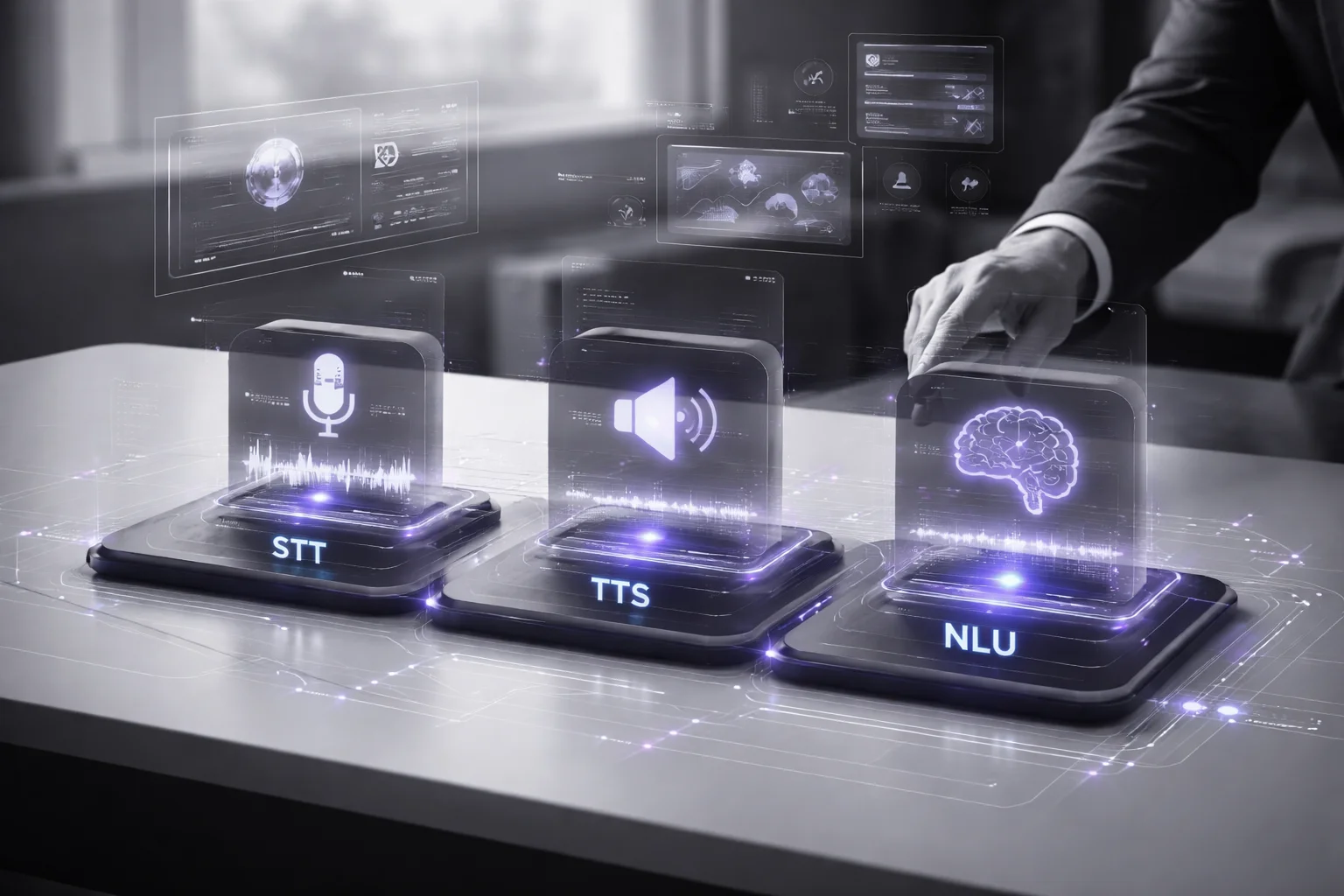
The setup was almost too tidy: clean English audio, short requests, barely any traffic, everyone speaking like they were testing a headset in a carpeted meeting room. Then production happened. A customer in Miami sent a 42-second voice note that bounced between Spanish and English. Another tried to read a policy ID from a bus stop with traffic behind him. Another sent a text ten minutes later assuming the bot remembered the voice exchange. It didn't. By Friday, the team had gone from "this is working" to "why are escalations spiking?" I've seen that movie before.
That's the real mistake. Teams shop for STT, TTS, and NLU like they're buying separate software boxes. Customers don't care about your architecture diagram. They care about one thing: did the bot understand them, answer fast, and keep track of what just happened?
3 billion. That's WhatsApp's active-user count in 2025, according to Inconcert. Numbers that big should kill the fantasy that users will sound neat and consistent. At that scale, mixed accents, cheap Android microphones, packet loss, street noise, long rambling voice notes, and code-switched speech aren't weird cases. They're Tuesday.
STT is usually where things go bad first. If speech-to-text lags, the whole interaction feels slow. If it gets one order number wrong or mangles a claims reference, the NLU downstream starts guessing and those guesses get expensive fast. I'd argue this is where too many teams get seduced by per-minute pricing. Saving a fraction of a cent on ASR doesn't look clever if bad transcripts push enough conversations to human agents by the end of the week.
I'd compare ASR vendors on four things and nothing fuzzy: median latency, word error rate on noisy mobile audio, language coverage, and production-volume pricing. Not demo pricing. Real pricing at actual traffic levels. If you're supporting identity verification, claims intake, or policy lookups, failure cost matters more than getting the cheapest rate card.
TTS gets judged for the wrong reason all the time. Teams chase realism like they're casting a movie trailer voice. I think that's backward. Clarity wins first. Always. You need fast first-byte response, consistent pronunciation for names and numbers, and tone control that fits the situation. A WhatsApp voice bot can't sound cheerful while denying a refund or explaining a rejected claim. You'll annoy people in under five seconds.
NLU is where memory stops being optional. Genesys has this part right: WhatsApp messaging and voice should feel like one continuous interaction instead of two disconnected systems pretending to work together. Your NLU needs to read the transcript alongside prior text messages, session state, and next-best-action logic. Otherwise it misses obvious intent shifts — like someone sending a voice note asking about delivery status and then texting "actually change the address" right after.
That's the principle I'd use: don't choose components by headline quality alone; choose them by how much failure your business can absorb in production.
- Pick STT based on failure cost: for identity verification, claims intake, and policy lookups, accuracy beats the lowest per-minute price.
- Pick TTS based on job fit: simple confirmations can use plainer voices; refund denials, payment reminders, and sensitive support flows need better pacing and prosody.
- Pick NLU based on memory: if it can't use conversation history well across voice and text, it won't hold up once real traffic hits.
Here's how I'd test it before signing anything: feed vendors ugly audio on purpose — long messages, mixed accents, code-switched speech, IDs read too fast, background traffic noise, low-end phone recordings, follow-up texts that rely on memory from ten minutes earlier. Score mistake tolerance before price. Run side-by-side trials with actual WhatsApp-style inputs, not polished lab clips. If one vendor saves pennies per minute but causes even a modest bump in escalations at volume — say 7% more handoffs over a week — you've already burned the savings.
If you want a practical decision frame instead of vendor sales copy, this Ai Voice Bot Development For Natural Conversation piece is worth reading.
I might be wrong about this, but WhatsApp voice AI integration usually isn't a model problem first. It's a tolerance-for-failure problem wearing procurement clothes.
Session Management and Error Handling Patterns
Friday, 6:40 p.m., somebody ships a voice bot. By 7:12, a customer has sent two WhatsApp voice notes about a missed flight, the worker has replayed one of them after a crash, and the bot answers twice with two different replies. I've watched versions of that mess happen, and it's always the same story: nobody thought the ugly parts would show up this fast.
Meta has said WhatsApp handles 100 billion messages a day. Your bot won't see anything close to that. Still, users don't care about your scale. They've been trained by products that remember what they said, don't lose their place, and don't make them repeat the obvious.
That's the real bar. Not “did STT run.” Not “did intent detection finish.” Continuity.
Genesys made a point I think too many teams treat like marketing copy: voice carries urgency, hesitation, tone, empathy. If someone says they need help with a missed flight and your system forgets that context on the next turn, you didn't just drop state between services. You dropped emotional signal.
So no, I wouldn't model this as isolated audio files moving through STT, intent detection, and TTS like cans on a conveyor belt. Easy architecture diagram. Bad product behavior. A WhatsApp voice AI integration has to act like a session with memory.
What actually needs to stick
Most teams build this like API teams. I'd argue that's the mistake. Product teams know the conversation has to survive handoffs, pauses, retries, and half-finished thoughts.
Keep a session record keyed by user ID plus conversation window. Save the last transcript, detected intent, confidence score, slot values, preferred language, and the last prompt you sent.
Boring? Sure. Until it saves you at 9:03 on a Monday morning.
A user says, “I need to change tomorrow's booking.” Eighteen seconds later they send another note: “make it after 5.” Your NLU for voice assistants should inherit the booking context automatically. Starting from zero there is how bots turn into homework.
The duplicate problem is not hypothetical
Webhook duplicates happen. Media fetch retries happen. Workers crash and replay jobs. That's normal distributed-system behavior, not some edge case you can wave away in planning.
I've seen the same 14-second audio note processed twice and two different responses sent back to one customer. Trust disappears fast after that.
Give every request an idempotency key at ingress and keep it attached through every downstream step in your voice AI architecture.
- If audio was already processed: return the stored transcript and response metadata instead of processing it again.
- If STT failed transiently: retry with backoff and stop after a hard cap.
- If NLU confidence is low: ask a short clarifying question instead of bluffing.
- If TTS fails: fall back to text so the conversation doesn't stall.
A pause isn't the end of the conversation
People get distracted. They board trains. Their kid starts yelling. They switch apps. A two-minute silence shouldn't wipe session state and force them to start over through speech to text for WhatsApp yet again.
Recover based on the task that's already in progress. Say something like: “I still have your refund request open. Want to continue by voice or text?” That's practical, human enough, and way better than pretending nothing happened.
If I had to keep one rule and throw out the rest, it'd be this: preserve context aggressively, but process side effects conservatively. That's what keeps WhatsApp voice AI integration reliable when load gets weird and systems start acting like systems always do. If you're building this for real, not just drawing boxes on a whiteboard, read AI voice bot for WhatsApp CX blueprint. Are you actually storing enough state to survive one messy conversation?
GDPR, PDPA, and Voice Data Privacy Requirements
What kills a WhatsApp voice AI deal faster than a broken demo?
Not the model missing an intent. Not a clunky handoff. Not even a pricing surprise buried in month-two usage.
It's a much uglier question, and I've seen it land in a vendor review like a brick through glass: where, exactly, does the raw audio go after transcription?
A lot of teams still think this is paperwork. Clean up the policy page. Add a checkbox. Drop “GDPR” and “PDPA” into the footer somewhere. Done. That's the fantasy. In real enterprise buying, that's how you get stalled by procurement and then quietly removed from the shortlist.
I watched this happen on a call where the product looked fine and the integration worked. Then legal asked that raw-audio question. The engineering lead said, “We keep it for model improvement.” Bad answer. Or rather, accurate answer delivered in the worst possible way. Legal heard: you're retaining customer voiceprints longer than necessary. Meeting over, momentum gone, trust gone with it.
That's why I think people frame this wrong. Privacy isn't copy. It isn't branding. It isn't some last-minute legal patch job on Friday at 6:40 p.m. while someone hunts for a consent sentence in Figma. It's system design. If your team can't explain the data flow in plain English, your polished terms page won't save you.
Here's the answer to the opening question: privacy design kills deals faster than product flaws do.
But only if it's vague.
Enterprise buyers don't come in gently, and they shouldn't. They usually ask five things right away: did the user consent, what exactly gets stored, who can access it, what gets redacted, and whether any data leaves the country during STT, TTS, or NLU processing. If your team starts answering with “it depends on the vendor configuration,” you've already made their job harder.
The pressure's getting worse, not better. NextLevel.AI projects that U.S. voice assistant users will hit 157.1 million by 2026. More adoption doesn't buy anyone slack. It buys more audits, more DPIAs, more security questionnaires, more lawyers asking where an audio file was sitting at 2:14 p.m. last Thursday and which processor touched it at 2:15.
The part nobody wants to romanticize is also the part that matters most: collect less, keep it briefly, lock it down hard. Boring? Yes. Optional? Not even close.
- Consent: say what happens before capture starts. If a WhatsApp voice flow stores audio, creates transcripts, or uses samples for QA, spell that out plainly. Don't hide speech-to-text consent inside generic messaging terms and act surprised when legal pushes back.
- Retention: raw audio and transcripts shouldn't automatically share the same clock. In plenty of setups, ASR finishes in seconds, the source file can be deleted right after processing, and only a redacted transcript stays for intent classification or case history. I've seen teams move raw-audio retention from 30 days to under 24 hours and get through review a whole lot faster.
- Access control: role-based access should be the default, not the cleanup step after somebody exported recordings they never needed. Most employees don't need recordings. Most managers don't either. A support analyst may need transcript access; almost nobody should be exporting raw files without approval plus logging.
- Redaction: strip payment card data, health details, national ID numbers, and street addresses before anything touches analytics dashboards or training datasets. If your logs only become clean after export, you're late already.
- Cross-border handling: map every region used by every vendor in the voice stack. If STT runs in one geography, TTS in another, and NLU somewhere else entirely, document all of it. If any processor moves data outside an approved jurisdiction, you need contract coverage and technical controls before launch—not after somebody spots it during a DPIA.
This is also why giant security claims don't impress me much on their own. Business Wire ran a release about Synthflow's WhatsApp Business Calls push highlighting security features and escalation paths. Fine. Useful even. But if there's no default deletion schedule, no clear secure-webhook handling story, and no clean audit trail across processor boundaries, a real GDPR or PDPA review can still stop the rollout cold.
If you want less chaos later, build privacy controls into the architecture from day one instead of treating them like legal cleanup week leftovers. This WhatsApp voice AI integration architecture is a strong place to start mapping that out.
The weird part is privacy work usually doesn't slow teams down nearly as much as guessing does.
Testing, Monitoring, and Scale Benchmarks
I once watched a team celebrate too early. Friday, 4:17 p.m., staging looked clean, the bot handled 50 concurrent WhatsApp sessions without breaking a sweat, and everyone started talking like launch was basically a formality. Then traffic climbed toward 500. Nobody saw a dramatic outage. No red sirens. Just one vendor backlog, then another delay behind it, and suddenly every step in the chain turned into a line at the DMV. Users waited. The bot answered late. People dropped.

That's the trap. Teams check speech-to-text accuracy, glance at latency, and decide they're covered. I don't buy that. A WhatsApp voice AI integration usually fails in the handoff points: audio to text, text to intent, intent to action, action back to a reply that lands before the user gives up.
The fix starts smaller than most people expect: stop measuring the whole experience first. Split it apart.
Start with the seams, not the summary dashboard
Webhook intake. Media download. ASR. Intent detection. NLU. Outbound delivery. Test each piece alone before you trust them together.
If your WhatsApp voice AI integration architecture can't show p50 and p95 latency for every stage, you're not monitoring — you're guessing with nicer charts. Track at least four timestamps: audio fetch, transcription completion, first response sent, and full reply delivered.
I saw one team spend two weeks staring at average response time because the dashboard looked reassuring. The real problem was media download burning 1.8 seconds before transcription even began. Average numbers hid it completely.
Here's the framework I'd use:
- Stage metrics first: measure each hop before you judge end-to-end performance.
- Mixed-mode journeys second: test how people actually switch between voice notes, buttons, text, and TTS in one session.
- Failure behavior last: break components on purpose and see whether the system stays useful.
Test the way people actually message
The PMC study on WhatsApp-based interactions makes this painfully clear: users don't stay in one mode. They'll send a voice note, tap a button, switch to text, then expect continuity like nothing happened.
So don't run only neat little voice-only scripts. Run voice note to text reply. Voice note to button selection. Text input to TTS response. Same user. Same session. Mixed mode is the real workload.
This is where lots of bots look smart in demos and dumb in production.
Use bad audio on purpose
Not studio clips. Real phones. Street noise. Accents. Long pauses. Clipped endings because somebody let go of record too fast while crossing Avenida Paulista or standing in a packed clinic waiting room in Manila.
Add messy entities too: order IDs, addresses, appointment times, confirmation numbers. That's where systems crack.
Score transcript accuracy if you want. I'd argue downstream intent detection matters more. A transcript can be ugly and still trigger the right action. A beautiful transcript that sends someone into the wrong workflow is worse than useless.
If you're serving multiple languages, ignore the swagger from vendor decks for a minute. NextLevel.AI says top platforms now support 20+ languages natively. Fine. Native support isn't the same as production-grade performance under noise, bad microphones, regional accents, or rushed speech.
Break it before customers do
Kill TTS jobs halfway through playback. Delay STT by 10 seconds. Force low-confidence NLU results from voice assistant responses. Expire session state in staging while an active conversation is still going.
Then watch what happens next, because that's your product more than the happy path is.
The fallback behavior tells you whether you've built something usable or just something impressive in a meeting: send text instead of audio, ask a clarification question instead of bluffing understanding, escalate to a human instead of replaying the same broken prompt three times.
- Latency: keep p95 first response under 3 seconds for short flows.
- Transcription: benchmark word error rate and intent detection accuracy by language.
- Fallbacks: test 100% coverage across STT, TTS, and webhook failure paths.
- Conversion: track completion rate, escalation rate, abandonment after first reply, and recovery after fallback.
- Rollout: don't launch until you've passed load tests at 2x expected peak volume for 60 minutes with no critical failures.
I think that's the standard that matters. Not whether the demo worked at 2 p.m., not whether one clean test call sounded slick — whether the system stayed useful while parts of it were slow, confused, or flat-out failing. If it didn't, what exactly are you putting in front of users?
FAQ: WhatsApp Voice AI Integration
What is WhatsApp voice AI integration?
WhatsApp voice AI integration connects WhatsApp voice notes or business calls to AI services that can transcribe speech, detect intent, manage dialog, and reply with text or synthesized audio. In practice, it ties together STT, NLU, dialog management, and TTS so your business can handle voice interactions inside the same WhatsApp experience customers already use.
How does voice AI work on WhatsApp?
A WhatsApp voice bot usually receives an audio message through the WhatsApp Business Platform, sends it through audio preprocessing and ASR, then passes the transcript into an NLU layer for intent detection. The system decides what to do next, pulls data from your backend if needed, and returns a text reply, a voice reply through text to speech integration, or a handoff to a human agent.
Why does WhatsApp voice AI fail at scale?
Most systems don't fail because the speech model is bad. They fail because the architecture ignores queueing, session management, retries, webhook security, and latency spikes under load. If you don't design for noisy audio, burst traffic, and fallback paths, a demo-quality bot turns into a production incident fast.
What are the core components of a WhatsApp voice AI architecture?
You need secure webhook handling, media retrieval, audio preprocessing, speech to text for WhatsApp, NLU for voice assistants, dialog management, business logic, and response delivery. Add session storage, observability, consent and retention controls, and human escalation, because those pieces are what keep the system safe once real users start sending messy audio at odd hours.
Can I use STT, TTS, and NLU with WhatsApp voice messages?
Yes, and you probably should if you want a usable experience instead of a transcription toy. STT converts the audio, NLU interprets meaning, and TTS lets you answer with natural audio, which matters when users are driving, multitasking, or dealing with urgent issues.
How should session management be designed to avoid context leakage?
Use a session key tied to the WhatsApp user, conversation, and a short-lived interaction window, not a shared global thread. Store state with strict expiration, idempotency checks, and channel-specific metadata so one user's transcript or intent history can't bleed into another user's flow.
What's the right error handling pattern for timeouts, low confidence, and ASR failures?
Don't pretend the model understood when it didn't. Set confidence thresholds, ask for clarification on weak ASR output, retry only when the failure is transient, and route to text input or a human when the system hits repeated errors. Good error handling patterns protect trust more than fancy voice features ever will.
Should you use streaming or batch transcription for WhatsApp voice notes?
For standard voice notes, batch transcription is often simpler and cheaper because the full audio arrives before processing starts. Use streaming transcription when you're handling live WhatsApp calling or you need partial results to cut response time, but be ready for more complexity in buffering, VAD, and session timing.
What privacy controls are required for WhatsApp voice data under GDPR and PDPA?
You need clear consent language, data minimization, defined retention windows, secure storage, access controls, and deletion workflows for audio and transcripts. GDPR compliance and PDPA readiness also mean documenting why you collect voice data, where it flows, who can access it, and how users can revoke consent or request erasure.
How do you test and monitor a WhatsApp voice AI system at scale?
Track end-to-end latency, ASR accuracy, intent detection accuracy, fallback rate, handoff rate, timeout rate, and throughput during peak traffic. Test with noisy clips, accents, code-switching, long pauses, and malformed audio, because production traffic won't look anything like the clean samples vendors use in demos.
How can you reduce latency without wrecking transcription accuracy?
Start with audio preprocessing, voice activity detection, and the right model size for your traffic, then cache repeated prompts and keep backend calls out of the critical path when possible. The trick isn't chasing the fastest ASR in isolation. It's cutting wasted milliseconds across media fetch, inference, dialog logic, and response generation so the whole WhatsApp voice AI integration feels instant enough to trust.