Voice Assistant Development That Works in Noise: Mic-to-Model
Voice assistant development succeeds or fails on audio capture. Learn an audio-first stack—mics, acoustics, DSP, and testing—to ship reliable voice in noise.
Why do voice assistants sound “magical” in demos—then suddenly go deaf in kitchens, cars, and call centers? If you’ve worked on voice assistant development for more than a sprint, you’ve probably seen the pattern: near-field, quiet-room demos look flawless, then far-field usage turns into wake word misses, chopped utterances, and transcripts that read like word salad.
Here’s the uncomfortable thesis: most real-world voice failures are not model failures. They’re audio capture and acoustics failures that cascade downstream until your ASR accuracy craters and your voice user interface feels “unreliable” in a way no prompt tweak can fix.
Organizations misdiagnose the problem because the model is visible. You can swap an ASR provider, tweak decoding parameters, or upgrade to the newest LLM. The constraints that actually set your ceiling—mic placement, enclosure ports, echo paths, DSP ordering, latency budgets—are hidden, cross-team, and usually “someone else’s problem”.
In this guide we’ll take an audio-first approach: how to define acoustic requirements, design an audio front-end architecture (mics → DSP → ASR), make pragmatic hardware choices, and validate with repeatable test scenes that match reality. At Buzzi.ai, we build voice assistants end-to-end—including microphone-to-model reliability for noisy environments and emerging-market deployments where voice notes and WhatsApp audio are the default. The goal is simple: if your product must listen in noise, you need to engineer the capture stack like it’s the product.
Voice assistant development is an audio problem first
It’s tempting to treat speech as a “model input”, the way you’d treat text. In practice, speech is a physical signal dragged through a messy world: fans, reverberant rooms, cheap enclosures, packet loss, clipping, and your own device’s loudspeaker. That’s why voice assistant development often feels like it’s haunted—until you map the system as a signal chain.
The hidden stack: mic → acoustics → DSP → ASR → NLU
A working voice assistant is a stack, and each layer has a job it can do well—and jobs it cannot do at all. The rough order looks like this:
- Microphones: convert air pressure into an electrical signal; set the noise floor and clipping ceiling.
- Acoustics: the room and enclosure shape what the mics capture (reverberation, echoes, resonances).
- DSP (digital signal processing): attempt to undo the world (beamforming, AEC, noise suppression, AGC).
- ASR (automatic speech recognition): convert audio to text; highly sensitive to SNR and distortion.
- NLU/LLM: interpret intent and produce actions; depends on stable transcripts.
When the upstream audio is unstable, the ASR front-end becomes probabilistic in a bad way: it produces different transcripts for the same intent depending on angle, distance, background noise, or whether the device is speaking. Then NLU is forced to “reason” over corrupted text, and errors look like logic bugs even though the root cause is signal quality.
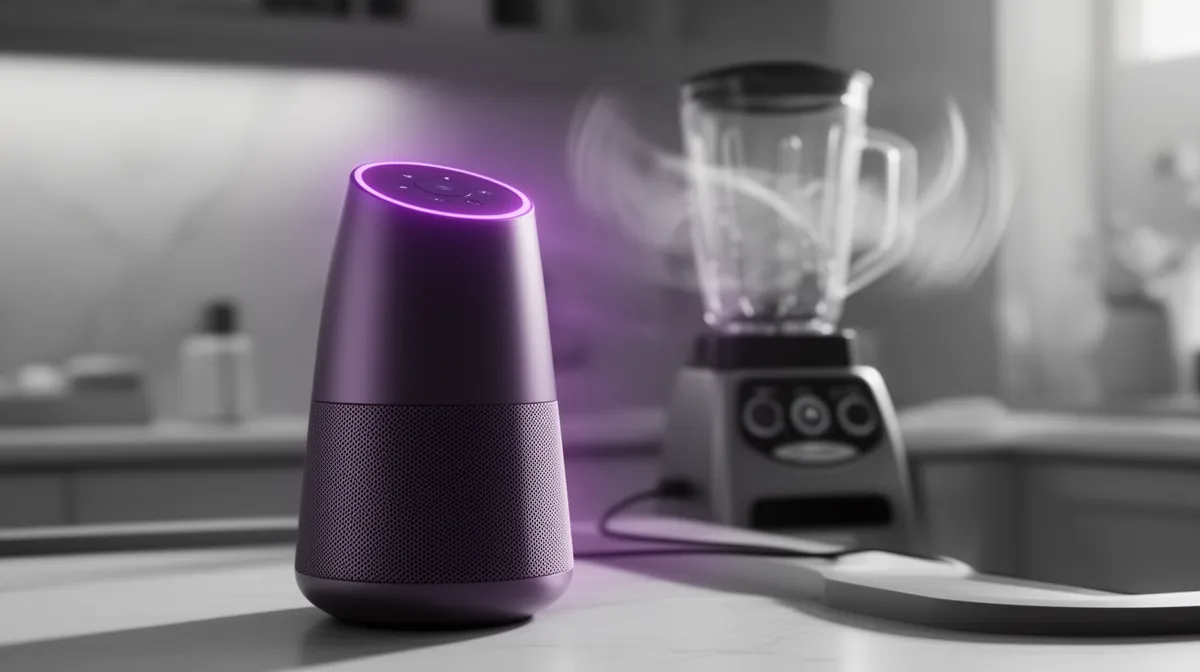
Consider the classic smart-speaker demo: you speak clearly from 30 cm away in a quiet room. Then you move the same device into a real kitchen: the exhaust fan adds broadband noise, the fridge compressor cycles on, and the TV injects competing speech. The wake word detection fails intermittently, and when it does wake, the assistant “hallucinates” an intent because the transcript is wrong. No LLM upgrade can fix a wake word that never fired.
Why teams misdiagnose: the org chart doesn’t match the signal chain
Voice systems fail at the seams, and most companies are built out of seams. Hardware comes from a vendor, firmware owns drivers, a DSP team (if you have one) tunes audio preprocessing, the app team owns UX flows, and an ML team owns ASR/NLU selection. The signal chain crosses all of them.
Procurement can lock in performance ceilings early. A single bad decision—like choosing a mic with high self-noise, or forcing a mic port behind an IP-rated membrane—sets an SNR ceiling you can’t buy your way out of later. Meanwhile the teams closest to customers (and bug trackers) usually have access to model knobs, not mechanical redesigns.
This is how you end up optimizing prompts while the real issue is a mic port partially occluded by a decorative mesh. The assistant “works” on the bench, but fails in the product because the enclosure is now part of the acoustic system.
A simple mental model: ASR accuracy is a function of SNR + distortion + latency
If you want one mental model to carry through this article, use this: ASR accuracy is mostly a function of signal-to-noise ratio + distortion + latency. Models matter, but they’re downstream of physics.
Signal-to-noise ratio (SNR) is your budget. Speech is the money; noise is the tax. The higher the SNR, the more “evidence” your ASR has to resolve phonemes and words. Far-field voice capture is hard because distance reduces speech level fast, while noise often stays constant.
Distortion is everything that warps the signal: clipping from loud machinery, reverberation that smears consonants, codec artifacts from Bluetooth or compression, and AGC “pumping” that makes background noise breathe. Latency is both UX and accuracy: it affects barge-in, endpointing, and the system’s ability to stream stable partial results.
A back-of-the-envelope SNR example helps. Near-field at 20–30 cm might give you clean speech that’s 20–30 dB above the noise. Far-field at 2–3 meters can drop that advantage dramatically, and in a loud environment you may end up with single-digit dB SNR. At that point, “improving the model” is like upgrading your calculator while your measurement tool is broken.
If you want a gentle refresher on sampling and filtering basics, MIT OpenCourseWare has solid DSP fundamentals materials (start here: https://ocw.mit.edu/courses/6-003-signals-and-systems-fall-2011/).
Define acoustic requirements before you choose models or vendors
Most teams start with vendors: “Which ASR should we use?” or “Should we do on-device processing?” That’s backward. Far-field voice is a physics problem, so you start by specifying the physics. If you don’t define acoustic requirements early, you’ll discover them late—when industrial design is frozen and the only remaining lever is apologizing to customers.
Near-field vs far-field voice capture: pick your physics
Near-field and far-field sound like product categories. They’re really physics categories.
Near-field (phone, headset, push-to-talk handheld) assumes the microphone is close to the mouth. You can get away with a single good mic, minimal DSP, and cloud ASR. Far-field voice capture (smart speakers, kiosks, car cabins, conference rooms) assumes meters of distance, competing talkers, and reflection-heavy spaces. That jump usually forces multi-mic processing, beamforming algorithms, tighter enclosure constraints, and a more deliberate noise suppression pipeline.
This is the step-function teams underestimate: the move from “it recognizes my voice note” to “it recognizes me across a room” is not linear. It’s a different class of engineering.
Concrete comparison:
- Mobile app voice input: near-field, user already holding the device, predictable geometry.
- Conference room assistant: far-field, multiple talkers, long RT60, strong echoes.
- Factory-floor kiosk: far-field, high SPL noise, intermittent alarms, users wearing PPE.
Before you decide how to build a voice assistant with far field microphones, decide what “far-field” means in meters, noise level, and geometry for your product.
Write measurable targets: SNR, RT60, SPL, and wake distance
“Works in noise” is not a requirement. It’s a wish. Requirements need numbers and test conditions.
At minimum, define targets for:
- Wake word performance: false reject rate (misses), false accept rate (false wakes), and target wake distance.
- Background SPL: maximum noise level in dBA where the system must still function.
- SNR at distance: target SNR at 1 m / 2 m / 3 m for a standard speech level.
- Reverberation (RT60): acceptable reverberation range; long RT60 environments demand better echo handling and endpointing.
- Latency budget: end-to-end and per-stage budgets; especially wake-to-beep and barge-in.
Here’s a simple prose template you can copy into a PRD:
Environment: Retail kiosk, 1–2 m talk distance, background noise up to 75 dBA, intermittent music and speech.
Wake: ≥ 95% wake success at 1.5 m, false accepts ≤ X per hour, consistent across ±45° angle.
ASR accuracy: WER ≤ Y% under recorded noise scenes; no more than Z% endpointing truncations.
Latency: wake-to-ready ≤ A ms; barge-in success ≥ B% during TTS playback.
For RT60 measurement basics, ISO 3382-1 is the canonical standard reference (overview here: https://www.iso.org/standard/40979.html).
Don’t forget echo: AEC requirements depend on speaker loudness and geometry
If your assistant ever speaks while listening, acoustic echo cancellation is not “nice to have”. It’s mandatory. Acoustic echo cancellation (AEC) removes your device’s own playback from the microphone signal so the system can support barge-in and avoid self-triggering.
AEC is geometry-sensitive. Mic-to-speaker distance, enclosure reflections, and multi-path echoes all affect how hard the filter has to work. Double-talk—when a user speaks while playback continues—is where most systems die. If your AEC fails double-talk, your wake word detection will miss or your ASR will transcribe the assistant’s own voice as the user.
Picture a meeting room assistant reading out a calendar: “Your next meeting is…” A user interrupts: “Cancel it.” Without stable AEC, the system hears mostly itself, and the user concludes it’s broken. In reality, it’s just missing an echo budget and the right DSP ordering.
Microphone and enclosure choices: where accuracy is won or lost
Teams like to debate models because models are legible. Microphones feel like commodity parts until you’ve shipped a device that’s “deaf” in the field. In voice assistant development, mic and enclosure choices are where you quietly decide whether the product has a chance.
Mic basics that matter: sensitivity, self-noise, dynamic range
Microphone datasheets are long because they’re hiding the few numbers that matter. Start with three:
- Sensitivity: how strong the output is for a given sound pressure; impacts gain staging.
- Self-noise: the mic’s own noise floor; sets the minimum audible detail.
- Dynamic range: how loud it can get before distortion/clipping.
In loud environments (machinery, music, PA systems), clipping is the silent killer. Once you clip, you create harmonics that look like speech features, and ASR accuracy collapses. This is where “voice assistant development with noise cancellation” fails as a concept: you can’t cancel distortion after it happens.
MEMS mics dominate because they’re small and cheap. For arrays, channel matching matters: if one mic has a different response, your beamforming algorithms inherit that mismatch and produce artifacts. Also: the enclosure port and mesh are part of the acoustic system. A waterproof membrane or dense mesh can attenuate high frequencies that carry intelligibility, especially consonants.
A real “what went wrong” story looks like this: a kiosk placed near machinery works in quiet off-hours, then fails during shift changes. The machinery spikes SPL; the mic clips; ASR produces a string of plausible-but-wrong tokens. The team blames the ASR vendor. The fix is gain staging, dynamic range, and sometimes simply moving the mic port away from the noise source.
Array geometry and placement: beamforming starts with mechanics
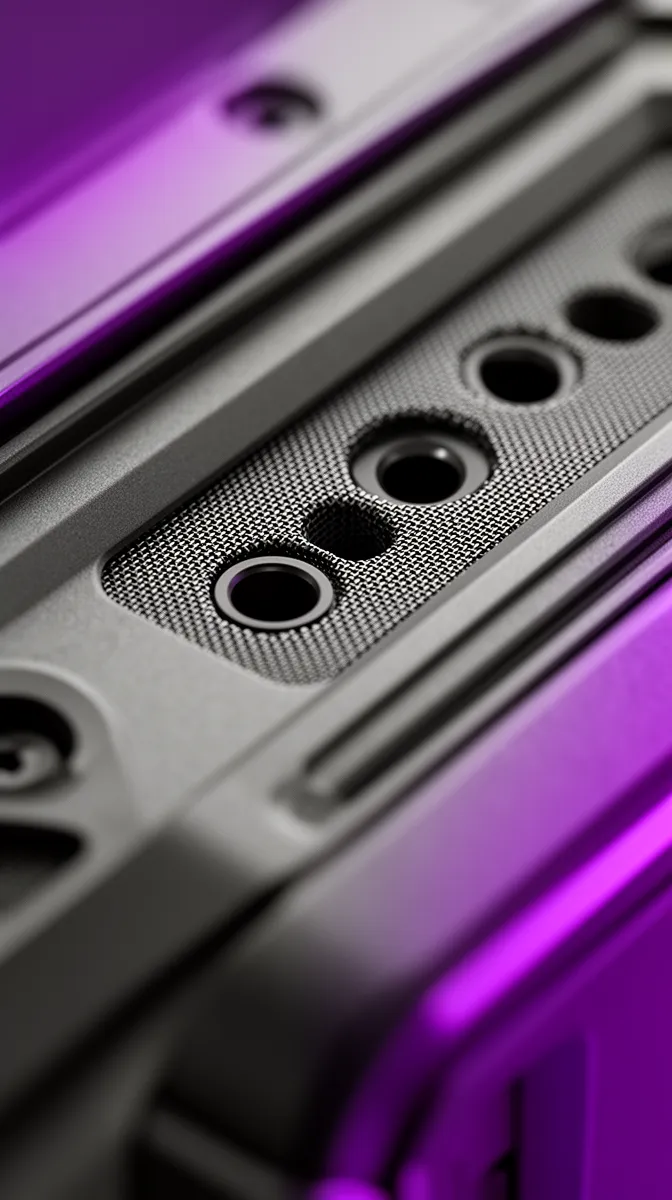
Array performance is not something you bolt on later in software. Microphone array design is mechanical: spacing, orientation, and placement relative to the talker and the device.
Beamforming works by aligning signals across mics based on expected time delays. If your spacing is wrong for your target frequencies, or your mics don’t “see” the same world because one is shadowed by the enclosure, beamforming becomes fragile.
Placement pitfalls show up everywhere:
- Mics mounted on an edge where hands or cases occlude the port.
- Mics behind glass or thick bezels that reflect and smear speech.
- Vibration coupling from motors or fans into the mic PCB.
- Enclosure resonances that amplify a narrow band of noise.
Example: a kiosk with mics behind a protective glass panel may look premium, but far-field voice capture degrades because reflections create short echoes and high-frequency loss. Move the mics to the bezel with a properly designed port, and the same ASR model suddenly “gets smarter”. That’s hardware-software co-design in practice.
Codecs, ADCs, and clocks: the boring parts that break everything
Audio front-end architecture has a few “boring” details that can ruin multi-mic systems.
Sampling rate and bit depth matter. Many speech systems operate at 16 kHz because it’s efficient and aligned with traditional ASR. But wake word engines and some noise suppression systems benefit from 48 kHz capture upstream, even if you downsample later, because it preserves phase and high-frequency cues for preprocessing. The right answer depends on your DSP and power budget, not ideology.
For arrays, synchronization is critical. Clock drift between channels creates phase errors that look like “moving talker” noise to the beamformer. You also need to care about electrical interference: poor grounding or EMC issues can couple digital noise into the analog front-end, producing whines or hiss that only appear in production builds.
Microsoft Research has a long line of work on microphone arrays and far-field speech recognition; it’s useful context when you’re setting expectations for what physics allows (start here: https://www.microsoft.com/en-us/research/ and search for far-field speech / microphone arrays).
Design the audio front-end: beamforming, VAD, AEC, noise suppression
The audio pipeline is where you turn raw capture into something an ASR system can reliably consume. This is the part of voice assistant audio pipeline design that feels like plumbing—until it becomes your product’s differentiator.
Reference pipeline: what runs when (and why ordering matters)
A practical reference pipeline for far-field systems looks like this:
- Multi-channel capture
- Channel synchronization / drift handling
- Beamforming (optional for near-field; common for far-field)
- AEC (if there is playback)
- Noise suppression
- AGC (careful, and often last)
- Voice activity detection (VAD) + endpointing
- Streaming ASR
Ordering matters because these blocks interact. AGC before AEC can destabilize echo cancellation because the echo reference no longer matches the mic path. Noise suppression can change the spectral characteristics the AEC filter is trying to model. VAD thresholds that work in quiet can fail under aggressive suppression because the background becomes artificially smooth, and endpointing cuts the user off.
Walk through one utterance: the TV is playing speech in the background. The assistant asks, “What can I help with?” (playback). The user responds immediately, from 2 meters away. Without stable AEC, the mic signal is dominated by playback; wake word detection may never fire, or it may fire on its own prompt. With AEC first, you reduce self-playback, then noise suppression reduces the TV as a competing source, then VAD can decide when the user actually started speaking, and streaming ASR has a chance.
All of this runs under real-time DSP constraints. Frame size decisions (e.g., 10–20 ms frames) and buffering affect latency. And latency isn’t cosmetic: it changes turn-taking behavior, barge-in success, and how “alive” your voice user interface feels.
Beamforming: focus on improving SNR, not “magic directionality”
Beamforming sounds like a superpower. In reality, it’s a method of improving SNR by combining multiple mics with time alignment—often described as “align-and-sum.” It can reduce diffuse noise and emphasize the direction you care about.
The mistake is expecting “magic directionality.” Real environments have moving users, reflective surfaces, and sometimes multiple talkers. A narrow beam can suppress the user when they move off-axis, which feels like random deafness. In enterprise voice assistant development for noisy environments—warehouses, shop floors, logistics—users move. They don’t stand in the beam.
Practically, choose between:
- Fixed beamforming: stable, predictable, good when geometry is consistent (kiosk with known user position).
- Adaptive beamforming: can track changes, but harder to tune and more failure-prone under multi-talker conditions.
Ask “What improves SNR without harming coverage?” before you ask “How directional can we get?”
AEC + noise suppression: the barge-in and ‘TV problem’ combo
AEC solves your self-playback problem. Noise suppression reduces external noise. Together, they determine whether barge-in works and whether the assistant can handle the “TV problem”: competing speech.
But they also fight each other. If noise suppression aggressively changes the signal, AEC can lose its echo path model. If AEC leaves residual echo, the noise suppressor may interpret it as noise and smear it, which confuses VAD and ASR. The practical make-or-break is double-talk handling: the pipeline must remain stable when user speech and playback overlap.
A test scene you should treat as mandatory: assistant speaks a long TTS confirmation (“Your order is confirmed…”) while a user interrupts with “Stop” or “No, change it.” Measure barge-in success rate with and without your tuned AEC. If you don’t pass this, your assistant will feel rude, not smart.
If you’re implementing or benchmarking AEC, WebRTC’s Audio Processing Module is a widely referenced baseline; their docs provide helpful context on components and trade-offs (start here: https://webrtc.googlesource.com/src/+/refs/heads/main/modules/audio_processing/).
On-device vs cloud voice processing: reliability is a product decision
“Edge AI voice” isn’t a slogan; it’s a reliability posture. Cloud ASR can be excellent, but it introduces dependencies you don’t control: network jitter, outages, and cost-per-utterance. On-device processing can reduce latency and give you predictable behavior, but it costs compute, power, and engineering time.
Most robust systems use a hybrid split:
- On-device wake word + VAD + basic audio preprocessing (sometimes light noise suppression)
- Cloud ASR for richer language and vocabulary
- Offline fallback for critical commands (“stop”, “cancel”, “repeat”) when connectivity is poor
This is especially important in industrial sites with patchy Wi‑Fi. Teams often blame “bad ASR” when the root cause is intermittent cloud access and timeouts that feel like deafness.
For a practical view into streaming ASR/TTS latency considerations, NVIDIA’s Riva documentation is a useful reference point even if you don’t use their stack (see: https://docs.nvidia.com/deeplearning/riva/user-guide/docs/).

Hardware–software integration: DSP budgets, power, and thermal reality
The best voice assistant development teams treat DSP budgets the way mobile teams treat battery budgets: as a hard constraint that drives architecture. The pipeline you want is rarely the pipeline you can afford on your chosen hardware.
Latency and compute budgets: set them like you’d set a battery budget
End-to-end latency is the sum of many “small” delays:
- Audio capture buffering and frame size
- Beamformer/AEC/noise suppression compute time
- VAD/endpointing decisions (waiting to be sure speech ended)
- Network round trips (if cloud ASR)
- ASR decoding time, plus NLU and response generation
Each stage can be “only 50 ms.” Stack ten of those, and your assistant feels sluggish, interrupts poorly, and cuts users off. Latency optimization is not just polish; it influences accuracy because users change how they speak when systems lag (they pause, repeat, or talk over prompts).
A concrete budget contrast: a mobile app can tolerate more latency because the user expects a screen and a spinner. A kiosk or smart speaker cannot; it has to feel like a conversational appliance. For barge-in, you want the system continuously listening and quickly suppressing playback, which is a compute and memory commitment, not a UI choice.
Chipset patterns: MCU + DSP vs application processor vs smart audio IC
At a high level, you have three patterns:
- MCU + DSP: lower power, good for wake word and lightweight preprocessing; harder for heavy models.
- Application processor: flexible and powerful; higher power/thermal concerns; easier to update.
- Smart audio IC / codec with DSP: offloads parts of the pipeline; can reduce complexity but increases vendor lock-in.
The “best hardware for voice assistant development” depends on your acoustic targets and product constraints. If you need robust far-field performance with AEC, beamforming, and strong noise suppression, make sure the silicon can sustain it under thermal throttling and long runtimes.
A procurement-style checklist to ask vendors:
- What AEC quality and tail length are supported under our speaker loudness?
- How does performance change under thermal constraints?
- Do you provide multi-mic synchronization primitives?
- What is the update path for DSP tuning in production?
- Can we instrument KPIs (wake/ASR/VAD) without storing raw audio?
Retrofitting: improving existing products without a full redesign
Sometimes you’re rescuing a shipped product. Retrofitting is possible, but only within the ceiling your hardware created.
Software levers include: retuning AEC, beamforming parameters, VAD thresholds, better endpointing, and environment-specific profiles (e.g., one profile for “vehicle cabin”, another for “retail floor”). Hardware levers include: an external mic accessory, a revised port/mesh, or a small PCB revision to improve placement and synchronization.
But there are cases where retrofit isn’t viable. If you have a single mic, a bad enclosure path, and high reverb, your ceiling may be too low. Recognizing that early saves months of chasing ghosts in the model layer.
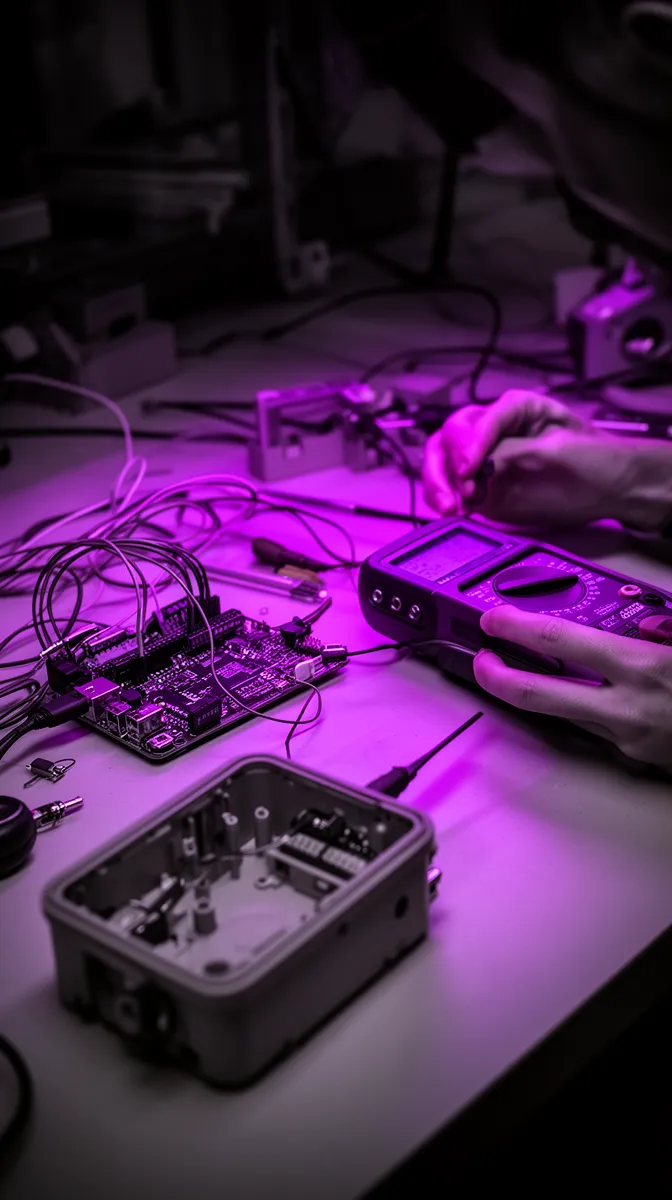
Testing methodology: prove it works outside the lab
Voice systems fail in the places your lab didn’t model. The fastest way to ship reliability is to treat audio testing like you treat software testing: a repeatable harness, regression runs, and a launch gate tied to metrics.
Build an audio test harness: repeatable scenes, not ad-hoc demos
A demo is a performance. A test harness is a measurement system.
Build a golden dataset of recorded field audio and simulated environments. Use noise scenes and impulse responses (room recordings that capture reverberation) so you can replay the same conditions across firmware builds. Then vary distance, angle, and speech styles, including barge-in and playback interference.
Canonical test scenes (start with these 8):
- Kitchen fan + intermittent clatter
- Living room TV with competing speech
- Car cabin at highway speed (steady broadband noise)
- Warehouse beeps + forklifts (non-stationary, impulsive noise)
- Office HVAC (low-frequency hum)
- Retail music + chatter (multi-talker babble)
- Assistant playback + user barge-in (double-talk)
- Overlapping talkers (two humans, different angles)
The key is automation: every DSP tweak and firmware change reruns core scenes. This is how you avoid “it got worse but we didn’t notice” regressions.

KPIs that correlate with customer complaints
Most customer complaints are not technical. They’re emotional: “It doesn’t respond.” You need KPIs that map to that feeling.
- Wake word detection: false reject rate, false accept rate, wake distance consistency.
- ASR accuracy: WER in noise, stability of partial results, rate of “nonsense” transcripts.
- VAD/endpointing: truncation rate (cutting users off), trailing silence delays.
- System: turn latency, barge-in success rate, audio dropout rate, cloud-to-offline fallback rate.
Example: a high false reject rate maps directly to “it doesn’t wake up.” When you instrument wake rejects by environment SPL and distance, you often discover a simple pattern: performance collapses past a certain distance because the SNR budget was never met, or because the device orientation shadows the mic port.
Field testing: instrumented pilots beat ‘beta feedback’
Pilots are not about vibes. They’re about clusters of failures.
Run instrumented pilots in representative sites. Capture metrics and environment metadata (SPL estimate, device state, whether playback was active) without storing raw audio unless users explicitly consent. Then analyze failures by category: distance, angle, noise type, time of day, or specific device batches.
Create a go/no-go launch gate tied to the measurable requirements you defined earlier. A simple checklist is often enough:
- Wake success and false accepts within target in all canonical scenes
- WER and endpointing within target at specified distances
- Barge-in success rate during playback meets target
- Latency within budget under worst-case connectivity (if cloud)
- No regression versus last release on golden dataset
What a “microphone-to-model” engagement with Buzzi.ai looks like
When voice fails in noise, the fix is usually not a single tweak. It’s accountability across the mic-to-model stack. That’s why we approach voice assistant development services as an integrated engagement: requirements → capture architecture → DSP pipeline → ASR integration → testing and monitoring.
Discovery: requirements, environments, and failure diagnosis
We start with an audio-first discovery. That means an environment audit (where will this run, what are the SPLs, what are the distances?), user flows (push-to-talk vs hands-free), latency targets, and privacy constraints.
Then we diagnose failure modes: is the system failing at capture, DSP, ASR front-end, NLU, or workflow integration? This is often where teams finally get an answer to the question: why does my voice assistant fail in noisy environments—because we can attach symptoms to layers.
The output is a written acoustic requirements document plus a test plan. In one recent noisy-site rescue (anonymized), wake rate improved materially after changes that had nothing to do with the model: mic port redesign guidance, updated AEC tuning for the loudspeaker geometry, and a tighter endpointing strategy for reverberant spaces.
Build: hardware guidance + pipeline implementation + ASR integration
Next we build. Depending on your stage, that can mean recommending a mic/array/enclosure approach, or integrating into your existing firmware and edge runtime. This is where voice assistant hardware software integration becomes real: clocking, buffering, DSP frame sizes, and getting stable performance under real-time DSP constraints.
Typical deliverables include:
- Reference audio front-end architecture and pipeline implementation
- Beamforming, acoustic echo cancellation, noise suppression, and VAD/endpointing tuning profiles
- ASR integration (streaming) and quality validation under your scenes
- Automated regression tests and a repeatable test harness for audio
- Production KPI plan (wake, ASR, latency, fallback, barge-in)
If you’re evaluating a custom voice assistant development company, this is the key question: will they own the capture stack, or only the model integration? The former is how you get reliability.
You can see our AI voice assistant development services here, including end-to-end build and tuning for noisy environments and hands-free interaction.
Scale: production hardening, monitoring, and iteration loops
Shipping is not the end; it’s where the world starts generating data. We set up monitoring for wake/ASR KPIs and alerting for regressions, then iterate via controlled experiments: parameter changes, firmware updates, and environment-specific profiles.
Scaling to new languages and accents often works better when you first improve audio capture and preprocessing. Better SNR and lower distortion makes every model you use behave more consistently. That’s the leverage of an audio-first strategy.
Conclusion
If your assistant fails in noise, start with microphones, acoustics, and the capture pipeline—not the model. Far-field voice is a physics-and-integration problem: microphone array design, beamforming algorithms, acoustic echo cancellation, and latency budgets decide whether the ASR ever sees usable speech.
Define measurable acoustic requirements early (SNR, background SPL, wake distance, RT60) so you don’t discover reality after industrial design freezes. Then build a repeatable audio test harness and instrument field pilots; it’s the fastest path to a voice user interface that feels dependable.
If you’re building (or rescuing) a system where microphone-to-model reliability matters, book a voice stack review. We’ll map your failure modes, define acoustic targets, and propose a mic-to-model path to shipping-grade voice assistant development.
FAQ
Why do voice assistants work perfectly in demos but fail in real environments?
Demos usually optimize the easiest variable: clean audio. The speaker is close, the room is quiet, and there’s no competing speech, reverberation, or device playback to create echo.
In the real world, far-field voice capture reduces SNR while noise and reverb stay high. That “upstream” degradation makes ASR unstable, and the downstream NLU/LLM layer can’t recover from missing or incorrect words.
What are the most common audio engineering mistakes in voice assistant development?
The biggest mistake is treating microphones and enclosure design as commodity decisions. A single mic port behind the wrong mesh, or a placement choice that creates reflections, can erase your model gains.
Second is mis-ordering the DSP pipeline—like applying AGC before AEC—causing instability under playback and double-talk. Third is shipping without a repeatable audio test harness, so regressions slip in unnoticed.
How do microphones and hardware choices impact voice assistant accuracy?
Microphones set the noise floor (self-noise) and the clipping ceiling (dynamic range). If you clip under loud noise, distortion creates “speech-like” artifacts that destroy ASR accuracy.
For multi-mic arrays, channel matching and clock synchronization affect beamforming quality. Enclosure ports and membranes can attenuate critical high frequencies, reducing intelligibility before DSP even starts.
What acoustic requirements should I define before building a voice assistant?
Start with measurable targets: wake word performance (false rejects/accepts), target wake distance, max background SPL, and an SNR-at-distance goal tied to your environments.
Then define reverb tolerance (RT60 range), plus a latency budget (wake-to-ready and barge-in). These requirements prevent “late surprises” when the device is already designed and you can’t change the physics.
What’s the difference between near-field and far-field voice capture?
Near-field assumes the mic is close to the mouth (phones, headsets), which naturally yields a high SNR and consistent geometry. You can often succeed with simpler audio preprocessing and cloud ASR.
Far-field assumes meters of distance and noisy, reflective spaces (kiosks, rooms, vehicles). It typically requires multi-mic processing, beamforming, stronger AEC, and careful latency optimization to feel reliable.
How do beamforming, AEC, and noise suppression work together in one pipeline?
Beamforming aims to improve SNR by combining multiple microphones to emphasize the user’s direction. AEC removes the device’s own playback so the system can listen while speaking (barge-in).
Noise suppression reduces external noise, but it must be tuned to stay stable with AEC during double-talk. If you’re building this end-to-end, our AI voice assistant development services focus on the full mic-to-model pipeline, not just the model layer.
When should voice processing run on-device vs in the cloud?
On-device processing is the reliability play when you need low latency, privacy, or offline behavior—especially for wake word detection, VAD, and basic DSP. Cloud processing can offer higher accuracy and easier updates, but it depends on network quality.
Many teams choose a hybrid: on-device wake/VAD plus cloud ASR, with offline fallback commands. The right split is a product decision tied to latency budgets and deployment environments, not just compute cost.
What are the best hardware components for voice assistant development in noisy spaces?
There isn’t a universal “best”, but there are consistent priorities: low self-noise mics, adequate dynamic range, predictable multi-mic synchronization, and enough DSP/compute headroom to run AEC and noise suppression in real time.
In noisy spaces, you also want mechanical design that supports the array (ports, placement, vibration isolation). Hardware decisions should be driven by your measurable acoustic requirements, not vendor marketing.