Enterprise AI Services That Are Actually Enterprise (Not SMB+)
Enterprise AI services are often SMB tools with add-ons. Learn 5 enterprise pillars, vendor checks, SLA demands, and due diligence questions to buy safely.
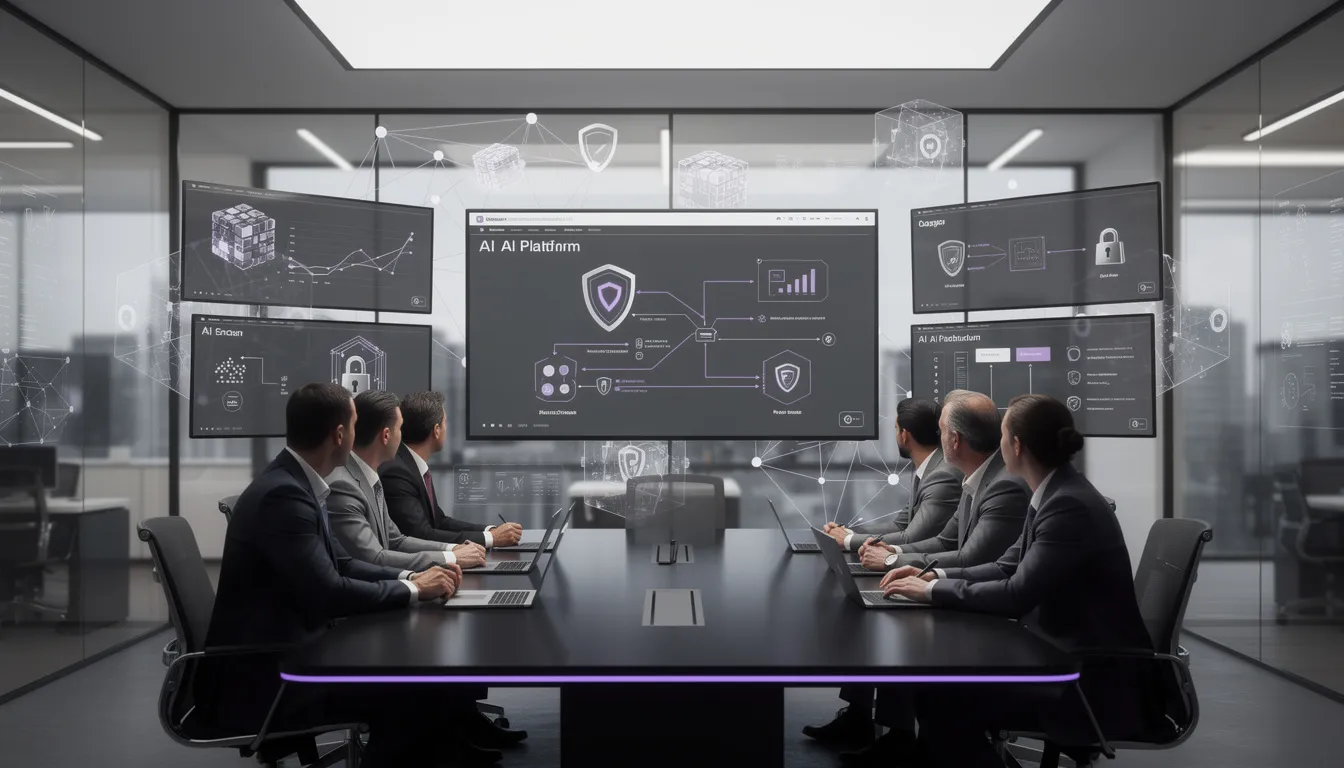
Most “enterprise AI services” aren’t enterprise systems—they’re SMB products wearing a compliance jacket. At scale, the jacket tears.
If you’ve ever watched a promising pilot turn into a procurement fire drill, you’ve seen the pattern. The demo looks polished, the features check out, and the vendor says all the right words about security. Then the hard questions arrive: How do tenants stay isolated? Who can do what, exactly? Where are the audit logs, and can we prove they weren’t edited? What happens when a region fails at 2 a.m.?
The problem is that enterprise labels get applied to SMB architectures, and that creates hidden failure modes: tenancy leaks, weak RBAC, missing audit trails, and shaky disaster recovery. Meanwhile your organization is being pushed to move fast, and security and architecture teams are asked to bless a black box.
In this guide, we’ll treat enterprise AI services as what they really are: a set of architectural invariants and operational guarantees, not a feature list. You’ll get five pillars to verify, practical validation checks, demo red flags, and a due diligence evidence checklist you can copy into your next vendor thread.
At Buzzi.ai, we build tailor-made AI agents and automation with enterprise-first patterns—governance, access control, and resilience—because regulated and large organizations don’t get to “iterate into” safety later. They have to prove it.
Why “SMB+” AI breaks at enterprise scale
The mismatch: feature checklists vs architecture guarantees
Enterprise-ness isn’t a set of toggles in a settings page. It’s a set of guarantees that must hold even when the organization is messy: multiple business units, multiple admins, multiple compliance regimes, and multiple integration surfaces.
SMB products are optimized for a different game. Their job is to help a small team move quickly with minimal setup. Enterprise systems are optimized to behave predictably under stress—organizational stress (permissions and approvals) and technical stress (load, incidents, audits).
That difference shows up in the risks enterprises actually pay for:
- Data leakage across tenants, business units, or environments (dev/prod).
- Failed audits because logs are incomplete, mutable, or not tenant-scoped.
- Outages because “we’re on AWS” gets confused with resilience engineering.
- Vendor lock-in because operations are opaque and integrations are proprietary.
Here’s the scenario that repeats: a chatbot platform wins a pilot in one department. Then three more departments onboard, each with different data sources and policies. A regulator (or internal audit) asks for immutable logs showing who changed prompts, tools, and access rules. The vendor has “logs,” but they’re basically a debug stream. Suddenly the tool that “worked in production” can’t survive an architecture review.
Common retrofits that look enterprise in demos
Retrofitting can be fine—if it’s a rebuild. The problem is when it’s just a coat of paint. You’ll see enterprise-grade security claims that don’t cash out into enforceable controls.
These are the retrofits that often look good on a slide but fail in a deep dive:
- SSO added, but authorization is still “admin vs user” with no real scoping.
- “Workspaces” that are UI partitions, not true isolation in storage and compute.
- Audit logs that exist, but can’t answer who did what to which resource.
- Key management that is global (one key per environment) instead of per tenant.
- Operations hidden behind a CSM: key rotation, retention changes, incident handling.
- Backups exist, but restore is untested or not tenant-specific.
- “Enterprise plan” means a bigger invoice, not a different architecture.
If you want a quick “demo red flag” sweep, watch for these:
- Only one global admin role exists.
- Support needs production access to debug customer issues.
- No mention of per-tenant encryption keys (KMS strategy is vague).
- Vector store and caches are shared with no tenant-level controls.
- Audit logs can’t be exported to your SIEM.
- They can’t show an incident postmortem template or status page.
- They can’t explain failure domains (what breaks when X breaks?).
- “We’re compliant” but can’t define the certification scope.
Who should own which questions (procurement vs security vs architecture)
One reason vendor due diligence drags is that everyone asks the same questions at different times. The fix isn’t to “go faster.” It’s to assign the right questions to the right owners and converge on an evidence checklist early.
Here’s a practical RACI-style narrative you can use:
- Procurement owns contract and commercial enforceability: SLA/SLOs, DR commitments, right to audit, subcontractors, data processing addendum, and termination/portability terms.
- Security owns enterprise-grade security verification: IAM integration, audit logging integrity, penetration testing reports, certification scope (SOC 2/ISO), data residency, and incident response process.
- Architecture/Platform owns the architecture review: tenancy model, isolation boundaries, scaling strategy, observability and monitoring, failure domains, and integration patterns.
The goal is simple: procurement should never be negotiating “best effort” because security and architecture didn’t get proof in time. And security shouldn’t be the last-minute blocker because the vendor can’t produce artifacts.
The 5 pillars of true enterprise AI services (and how to verify each)
Think of an enterprise AI platform like a building. The UI is the paint and furniture. The five pillars are the load-bearing beams. If the beams aren’t there, you can decorate endlessly—and still fail an audit or an outage.
Pillar #1: Real multi-tenant architecture with provable data isolation
Multi-tenant architecture isn’t binary. It’s a spectrum, and the right point depends on your risk tolerance and compliance requirements.
- Single-tenant: dedicated infrastructure per customer. Higher cost, simpler isolation story.
- Pooled multi-tenant: shared infrastructure with logical isolation. Efficient, but requires rigorous controls.
- Hybrid: pooled control plane with isolated data plane components for sensitive workloads.
What matters is not what they call it, but what “data isolation” covers end-to-end: primary storage, object stores, caches, vector databases, logs, backups, and even model/tool execution contexts. Most “best enterprise AI platforms with true multi tenant architecture” succeed because they treat these layers as part of the same boundary, not separate teams’ problems.
How to verify (ask for a proof pack, not promises):
- Tenancy design doc: what is a tenant, and what is tenant-scoped?
- Data flow diagrams (docs, not screenshots): where data enters, transforms, and persists.
- Threat model for cross-tenant leakage.
- Evidence of tenant-scoped encryption (e.g., per-tenant KMS keys or envelope keys).
- Isolation tests: how they test that tenant A cannot enumerate tenant B artifacts.
- Shared responsibility matrix (what you must configure vs what they guarantee).
- Data residency options: where data and backups live, and how that’s enforced.
The key question: can the vendor show how tenant boundaries are enforced in storage, compute, and operations—without hand-waving?
Pillar #2: Identity, RBAC, and segregation of duties (SoD) that match real org charts
SSO is table stakes. Enterprise AI services need identity and access management that matches how real organizations operate: least privilege, separation of duties, and lifecycle automation.
Start with standards. If a vendor claims “enterprise,” they should be comfortable referencing OpenID Connect and explaining their support for SAML/OIDC flows, MFA enforcement, and conditional access compatibility. For provisioning and deprovisioning, SCIM is the practical baseline; the spec is RFC 7644.
Then get specific about RBAC. A true role-based access control system usually includes:
- Custom roles (not just 2–3 fixed ones).
- Scopes (tenant, business unit, project, environment).
- Resource hierarchies (org → workspace → agent → tool → dataset).
- Just-in-time and break-glass access for emergencies.
- Segregation of duties: admin ≠ auditor ≠ developer ≠ operator.
Here’s a simple permission matrix narrative to sanity-check “enterprise AI services with advanced role based access control”:
- Platform admin: manages SSO/SCIM, tenant-wide policies, and integration keys; cannot edit business content or view sensitive outputs by default.
- Business owner: can create agents and connect approved data sources within their scope; cannot modify global security policies.
- Compliance auditor: read-only access to configurations and audit logs; can export logs; cannot change agents or permissions.
If the vendor can’t model these personas cleanly, they’re telling you something: their authorization layer is still SMB-grade.
Pillar #3: Audit logging that survives regulators and incident response
Enterprise AI is ultimately an accountability problem. When something goes wrong—data exposure, a bad automation decision, or a policy change—your organization needs to reconstruct the chain of events quickly. That is what audit logging is for, and it’s a major part of ai governance.
Good audit logs answer: who did what, to which model/agent/tool/data resource, when, from where, and with what outcome. They also need integrity: immutability (WORM), tamper-evidence, and time synchronization. Ideally they support chain-of-custody for exports into a SIEM.
If you’re asking “how to evaluate enterprise AI vendors for security and compliance,” start by requiring a mandatory fields checklist. At minimum:
- Actor identity (user/service principal), auth method, and role/permission set at time of action
- Tenant and scope identifiers
- Resource IDs (agent, prompt/policy version, tool, dataset, connector)
- Action + decision (allowed/denied) + reason (policy)
- Timestamp with synchronized source
- Correlation IDs / request IDs across services
- Input/output hashes or references (to prove what was processed without storing raw sensitive payloads everywhere)
- Policy version and configuration version used
Then ask where logs live, how long they’re retained, who can search them, and how you export them. If logs are not tenant-scoped, you’ll end up blocking your own auditors—or worse, exposing other tenants’ metadata.
For governance alignment, it’s also reasonable to ask how their approach maps to frameworks like the NIST AI Risk Management Framework (AI RMF 1.0)—not as a checkbox, but as a way to describe controls and evidence.
Pillar #4: Resilience, disaster recovery, and business continuity that are testable
Resilience is where marketing language goes to die. “We’re highly available” can mean anything from multi-AZ engineering to “we have two servers.” Enterprises need commitments that are measurable and tested.
Translate buzzwords into concrete requirements:
- High availability: active-active or active-passive across availability zones, with clear failure domains.
- Disaster recovery: cross-region capability with documented RPO/RTO and tested procedures.
- Backups: frequency, encryption, retention, and restore testing evidence.
- Operational readiness: on-call, incident response, postmortems, and a status page.
A good external reference point for how serious vendors think about reliability is the AWS Well-Architected Framework Reliability Pillar. You don’t need to be on AWS to learn from it; you need to adopt the mindset: reliability is engineered, not assumed.
Mini case: it’s quarter close, a region has an outage, and finance is running an AI-assisted invoice workflow. What should continue to work? At minimum: authentication, access controls, and queueing should fail safely; critical automations should degrade gracefully; and you should have a tested failover path for core workflows—or an explicit contractual statement that you don’t.
Pillar #5: Scalability and performance engineering for production workloads
Enterprise workloads don’t fail because the model is “bad.” They fail because the platform can’t handle spiky demand, noisy neighbors, and integration backpressure.
Separate two concepts that vendors often blur:
- Model latency: how long a model takes to respond.
- Platform throughput: how many requests/jobs you can process reliably with predictable tail latencies.
Production workloads need queues, rate limits, and noisy-neighbor controls so one department’s batch job doesn’t tank another department’s customer support experience. They also need capacity planning, not “we’ll add servers.”
Evidence you should request:
- Scalability testing methodology (load profiles, peak factors, soak tests)
- p95/p99 latency targets and historical performance data
- Per-tenant quotas, burst controls, and autoscaling policies
- Cost observability by tenant/project (so success doesn’t become a surprise bill)
- SLO dashboards or equivalent operational reporting
When a vendor can’t produce this, it’s not a moral failing. It simply means they’re not built for enterprise production workloads yet.

Due diligence: the evidence checklist to request from AI vendors
Due diligence works best when it’s not adversarial. You’re not trying to “catch” the vendor; you’re trying to reduce uncertainty. The fastest way to do that is to request a standardized evidence pack early, then review it cross-functionally.
Architecture proof: documents that reveal the load-bearing design
Ask for documents that force specificity. If a vendor can’t document their boundaries, they likely can’t enforce them.

Here’s a practical request list you can paste into an email (edit for your context):
- System architecture overview (control plane vs data plane)
- Tenancy model description (single-tenant / pooled / hybrid) and isolation controls
- Data flow diagrams covering ingestion, storage, vector stores, caches, logs, and backups
- Threat model focused on cross-tenant leakage and insider risk
- Encryption design: in transit, at rest, key management approach, key rotation process
- Shared responsibility model (what we configure vs what you guarantee)
- Data residency options and enforcement mechanisms
- Integration patterns (SSO/SCIM, SIEM export, DLP hooks if available)
Then ask the “how” questions: how are secrets stored? How are tenant boundaries enforced in the vector database? How is access checked at runtime? An architecture review is less about diagrams and more about whether the vendor can explain these mechanisms coherently.
Security proof: tests, certifications, and what they actually mean
Security documentation is full of traps, mostly around scope and timing. The goal is to understand what has been validated, when, and for which components.
Certifications that commonly matter in enterprise contexts include SOC 2 Type II and ISO 27001. Don’t treat them as magic shields; treat them as structured evidence. Start with the authoritative sources: the AICPA’s overview of SOC reporting and Trust Services Criteria is here, and ISO’s ISO/IEC 27001 overview is here.
Then add penetration testing and secure SDLC proof:
- Penetration testing: frequency, scope, independent vs internal, and remediation SLA for critical findings.
- Change management: how changes are reviewed, approved, rolled back; how config changes are logged.
- Vulnerability management: dependency scanning, patch SLAs, and how they handle critical CVEs.
Certification gotchas to watch for:
- SOC 2 scope excludes a critical subsystem (e.g., the data plane or managed vector store).
- ISO certificate covers a corporate entity but not the product environment you’ll use.
- Pen test is older than 12 months, or excludes core API endpoints.
- They say “HIPAA ready” or “GDPR compliant” without a concrete controls mapping.
Operations proof: logs, on-call, incident response, and audit rights
Enterprise risk usually shows up in operations, not in the marketing deck. Ask for operational artifacts early.
- Sample audit log exports + log schema (redacted is fine, structure must be real)
- Retention policies for logs and backups, including immutable storage details
- On-call coverage model and escalation path
- Incident response plan + post-incident report examples (redacted)
- MTTR history or at least internal targets and how they measure them
- Contractual right to audit, subcontractor list, and DPA
What good looks like in an incident report outline:
- Timeline with timestamps and correlation IDs
- Customer impact assessment (who/what/when)
- Root cause analysis (technical + process)
- Containment actions and recovery steps
- Preventive remediations with owners and deadlines
- Evidence links (logs, dashboards, change tickets)
SLA/SLO demands: what large enterprises should put in the contract
Architecture tells you what is possible. The contract tells you what is enforceable. Enterprises don’t buy enterprise AI services just to “hope” they’re reliable; they buy guarantees and remedies.
Availability and performance: metrics that prevent “best effort” AI
An SLO is an internal objective; an SLA is a contractual commitment with consequences. When vendors blur them, you get “best effort” performance dressed up as reliability.
When you negotiate a service level agreement, require explicit measurement methods and exclusions. Otherwise, the SLA becomes an argument instead of a guarantee.
Sample clause list (not legal text, but a practical baseline):
- Monthly availability percentage, defined by specific endpoints
- Clear maintenance windows and notice periods
- Latency SLO targets (p95/p99) for core APIs where feasible
- Throughput guarantees for critical workflows (requests/min or jobs/hour)
- Error budget policy and escalation when breached
- Service credits and termination rights for repeated misses
- Defined support response times by severity level
- Status page requirement and incident communication cadence
Data and security clauses: residency, retention, and incident timelines
Security clauses are where enterprise-grade security becomes real. They should be specific about where data lives, how it’s protected, and what happens when something goes wrong.
Include:
- Data residency commitments by region, including backups and disaster recovery replicas.
- Retention and deletion SLAs for customer data and logs (including customer-controlled retention where needed).
- Breach notification timeline and required vendor support obligations.
Example: a regulated industry may require one-year audit log retention and a 72-hour incident notice. If the vendor can’t meet it, you need to know now, not after deployment.
DR commitments: RPO/RTO backed by testing evidence
Disaster recovery is easy to promise and hard to operate. Require RPO/RTO numbers, testing frequency, and disclosure of the last test outcome.
Typical RPO/RTO ranges by criticality tier (use as a negotiating and classification aid):
- Tier 0 (mission-critical): RPO minutes–1 hour, RTO 1–4 hours
- Tier 1 (critical): RPO 1–4 hours, RTO 4–12 hours
- Tier 2 (important): RPO 4–24 hours, RTO 12–48 hours
Also specify whether customers can participate in DR drills (tabletop + technical). The real point of DR testing isn’t passing; it’s learning where the system breaks.

Demo red flags: how to spot retrofitted “enterprise” in 30 minutes
Demos are designed to be flattering. Your job is to turn a demo into an interrogation of boundaries: tenant boundaries, permission boundaries, and failure boundaries.
Tenancy and isolation red flags
If they can’t explain tenancy simply, it probably isn’t cleanly implemented. Push for concrete answers about boundaries in storage, vector stores, logs, and backups.
Eight live questions to ask during the demo:
- What is your tenant identifier, and where is it enforced?
- Do you use per-tenant encryption keys? How are they rotated?
- How do you prevent cross-tenant access in your vector database?
- Are caches tenant-scoped? What about embeddings and retrieval indexes?
- Do support engineers ever access production data? Under what controls?
- Can we restrict data residency for this tenant to a specific region?
- How are backups stored and restored per tenant?
- Do you have isolation test results you can share?
RBAC and audit red flags
Coarse roles and vague logs are a tell. Enterprises need access control policies that are scoped and reviewable, and audit trails that can reconstruct intent and impact.
Ask them to show, live:
- Creating a least-privilege custom role with resource scoping
- Assigning it via your identity provider group mapping
- Attempting an action that should be denied (and showing the denial reason)
- Viewing the corresponding audit log entry, including actor, tenant, correlation IDs, and policy version
If they can’t do this without “we’ll follow up,” you’ve learned something valuable.
Resilience and ops red flags
Watch for hand-waving: “We’re on AWS so it’s redundant,” “We can scale horizontally,” “We’ve never had an outage.” None of those are resilience answers.
Operational red flags include:
- No public status page or unclear incident communication.
- Vague DR story with no RPO/RTO or last test date.
- No evidence of scalability testing or SLO dashboards.
- Scaling described as “we’ll add servers” instead of capacity planning.
Follow-up after the demo (what to request next):
- Last DR test report and remediation plan
- Load test report with p95/p99 latency under defined load profiles
- Sample incident postmortem (redacted)
- Audit log schema and SIEM export method

How Buzzi.ai approaches enterprise AI services (without the retrofit tax)
The retrofit tax is what you pay when you start with an SMB architecture and then try to bolt on enterprise guarantees later. The cost isn’t just engineering time. It’s approval delays, rework, and risk that shows up when you can least afford it.
Enterprise-first building blocks: governance, access control, observability
At Buzzi.ai, we build AI agents with enterprise guardrails from the start: policy-driven access, tenant-aware design, and an audit-first mindset. That’s not because governance is trendy; it’s because production AI touches sensitive systems and people want accountability.
We also design for observability and monitoring as a core capability, not an add-on. In practice, that means you can answer: what’s running, who changed it, what it touched, and how it performed—without “asking engineering.”
A typical enterprise rollout path looks like this:
- Discovery: requirements gathering, controls mapping, data classification, and architecture options.
- Pilot: bounded scope with clear tenant boundaries, IAM integration, and audit logging enabled.
- Governed production: DR planning, SLO dashboards, runbooks, and evidence generation for audits.
If you want a structured starting point, our enterprise AI discovery and readiness assessment is designed to map your needs to the five pillars and produce an evidence-first plan you can actually take to InfoSec and procurement.
Designed for regulated rollouts: evidence-ready from day one
“Evidence-ready” means you don’t scramble later to prove controls. You plan logs, control mapping, DR, and operational runbooks early, then you generate artifacts as part of delivery.
Practically, that can include deliverables like:
- Security architecture document and data flow diagrams
- Logging schema and audit event taxonomy
- DR plan outline with RPO/RTO targets and test schedule
- SLA/SLO target recommendations aligned to workflow criticality
- Operational runbooks (on-call, incident response, escalation)
This approach reduces approval cycles because security and procurement aren’t guessing. They’re reviewing evidence.

Where to start: pick one high-value workflow and make it auditable
If you’re trying to introduce enterprise AI services into a large organization, don’t start with a sprawling “AI platform rollout.” Start with one workflow where ROI is visible and auditability matters.
Good starting points often include:
- Support ticket routing and triage (high volume, clear outcomes)
- Intelligent document processing and data extraction (compliance-heavy)
- Sales assistant workflows (bounded data sources, measurable lift)
That’s where governed automation pays off twice: faster cycle times and fewer compliance surprises. If you’re building agents to automate these workflows, our AI agent development for governed automation approach focuses on production patterns: access control policies, audit logging, and resilience built in from the start.
Conclusion
Enterprise AI isn’t defined by a vendor’s logo wall. It’s defined by architectural guarantees: isolation, identity and access management, auditability, resilience, and scalability. When those guarantees are real, you move faster—because fewer surprises appear in security review, audits, and incidents.
Multi-tenancy, RBAC, and audit logging must be provable with artifacts, not promised verbally in a demo. Disaster recovery and performance claims should be backed by repeatable tests, clear RPO/RTO, and transparent SLO reporting. And procurement, security, and architecture teams work best when they share a single evidence checklist and contract baseline.
If you’re evaluating enterprise AI services for a regulated or large organization, ask Buzzi.ai for an enterprise readiness review. We’ll map your requirements to the five pillars and provide an evidence-first rollout plan—starting with enterprise AI discovery and readiness assessment.
FAQ
What makes enterprise AI services truly enterprise-grade vs SMB tools?
Enterprise AI services are defined by guarantees, not features: provable data isolation, strong IAM and RBAC, immutable audit logging, tested disaster recovery, and predictable performance at scale.
SMB tools often add surface-level enterprise features (like SSO) without the underlying enforcement layers (like scoped authorization and tenant-aware key management).
If the vendor can’t provide evidence artifacts—design docs, test results, log schemas, DR reports—it’s usually “SMB+,” even if the pricing says otherwise.
How do enterprise AI platforms implement multi-tenant data isolation safely?
Safe multi-tenancy requires isolation across every layer: storage, compute, vector stores, caches, logs, and backups—not just UI workspaces.
The strongest implementations use tenant-scoped namespaces plus encryption strategies like per-tenant keys (or tenant-scoped envelope keys) and consistent policy enforcement at runtime.
You should also ask for isolation testing results that prove tenant A cannot access tenant B resources under misconfiguration or attacker behavior.
What RBAC features should enterprise AI services include for segregation of duties?
At minimum, you want custom roles, resource scoping (org/workspace/project), and clear separation between admin, developer, operator, and auditor personas.
Look for lifecycle automation via SCIM, compatibility with conditional access, and “break-glass” access that is time-bound and fully logged.
If the product has only 2–3 coarse roles, it’s unlikely to support real segregation of duties in an enterprise org chart.
Which audit logging fields are mandatory for regulated enterprise AI deployments?
Mandatory fields include actor identity, tenant/scope, resource IDs (agent/tool/dataset), action and decision, timestamp, correlation IDs, and the policy/config version used.
For AI-specific governance, it’s also helpful to log references or hashes of inputs/outputs so you can prove what happened without duplicating sensitive payloads everywhere.
Regulators and incident response teams both need the same thing: a trustworthy reconstruction of events, quickly.
How can buyers verify audit logs are immutable and complete?
Ask where logs are stored, how immutability is enforced (for example WORM storage), how time sync is handled, and what prevents privileged users from editing or deleting entries.
Request a sample export, the log schema, and a demonstration of searching/filtering by tenant, actor, and correlation ID.
Completeness is proven by coverage: ensure configuration changes, permission changes, data connector activity, and agent execution events all generate audit records.
What does disaster recovery look like for enterprise AI services (RPO/RTO, failover tests)?
Real DR includes documented RPO/RTO targets, a defined failover architecture across regions, and proof of regular testing with recorded outcomes and remediation plans.
A vendor should be able to tell you the last DR test date, what failed, and what they changed afterward—without treating it as confidential trivia.
If you’re unsure how to structure your requirements, Buzzi.ai can help via an enterprise readiness review that maps DR needs to workflow criticality.
Which SLA and SLO guarantees should enterprises demand from AI vendors?
Demand explicit availability SLAs (with measurement definitions), support response times by severity, and incident communication requirements (including a status page).
Where feasible, require latency targets (p95/p99) and throughput commitments for critical production workloads, plus clear maintenance windows and exclusions.
Finally, tie repeated misses to remedies: service credits, escalation, and termination rights—otherwise the SLA is just decoration.
What are the biggest red flags in an enterprise AI vendor demo?
Red flags include vague answers about tenant boundaries, lack of per-tenant key management, and support requiring production access to troubleshoot.
On the governance side, watch for coarse RBAC, inability to show least-privilege role creation, and audit logs that don’t include actor/tenant/correlation IDs.
Operationally, “we’re on AWS so it’s redundant,” no DR test evidence, and no SLO dashboards are strong signals of an SMB architecture.