Travel Chatbot Development That Survives Real Trip Complexity
Learn how travel chatbot development can handle multi-leg trips, changes, cancellations, and IROPS with safe, integrated automation for airlines and OTAs.
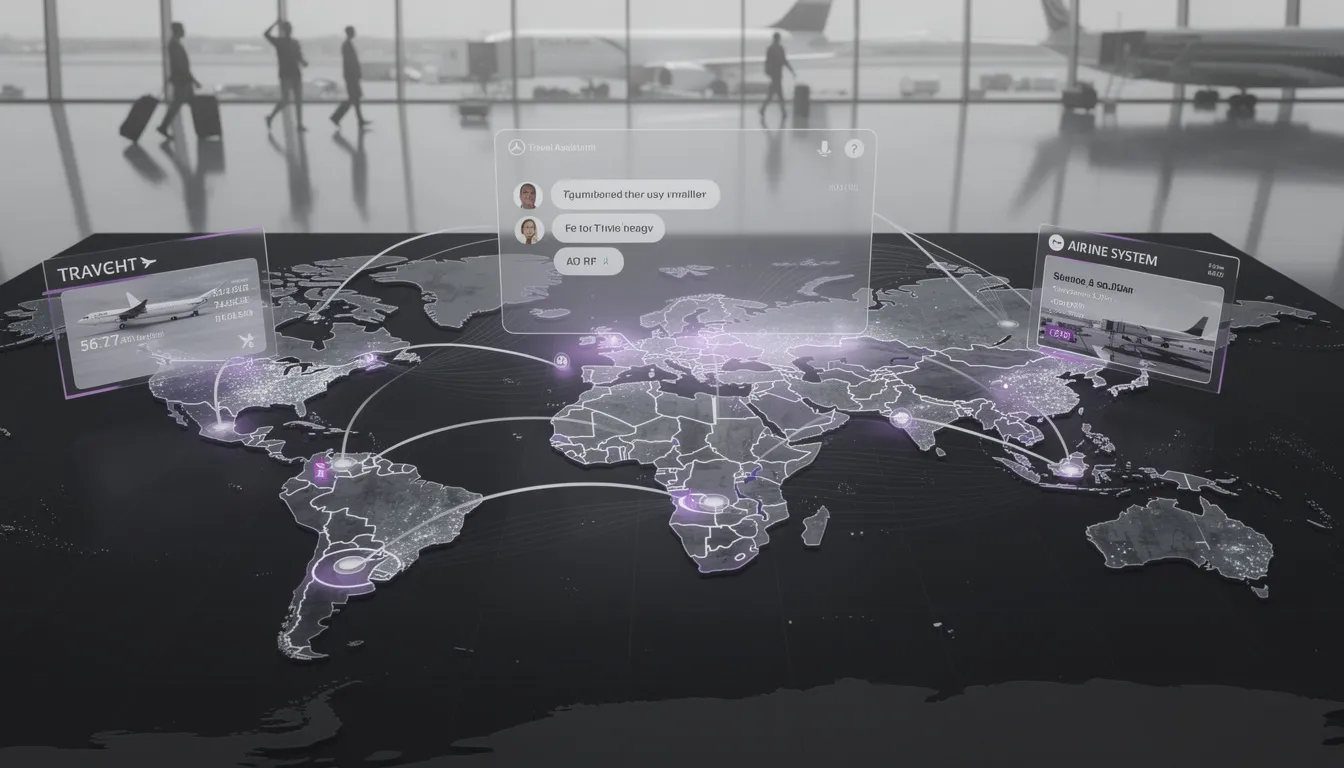
Most travel chatbots can book a simple round trip—but fall apart the moment real life happens: missed connections, schedule changes, partial cancellations, mixed carriers. That’s the gap between a cute booking widget and serious travel chatbot development that can survive real trip complexity.
If you run an airline, OTA, or TMC, you know this pain. Your bot handles basic FAQs and maybe a simple booking, but the moment a multi-leg itinerary is disrupted, customers flood your call center for changes, cancellations, and IROPS support. Self-service travel support breaks exactly where it matters most.
In this article, we’ll treat “travel chatbot” as more than a search-and-book UI. We’ll look at what it takes to design an AI travel chatbot for complex bookings that understands full itineraries, applies policies, and safely executes real changes. We’ll map the kinds of messy scenarios your bot must handle to the architectural and design patterns that make it possible.
At Buzzi.ai, we specialize in production-grade AI agents, including travel chatbots that operate in the real world, not just demo environments. We’ll walk through how to architect, integrate, and govern chatbots that deliver true self-service travel support without putting your P&L or compliance at risk.
What Travel Chatbot Development Really Means Today
Beyond FAQ and One-Click Bookings
For years, “travel chatbot development” usually meant building a glorified FAQ or a thin booking layer on top of a search API. These bots recognized a handful of intents—"book a flight," "check my booking," "what is your baggage policy?"—and then either answered from a knowledge base or handed off to a web form. They were closer to interactive IVRs than true digital assistants.
Most legacy travel chatbot projects stopped there. A basic airline chatbot or OTA chatbot could look up a PNR, display a confirmation, maybe let you cancel an entire trip if the fare was refundable. But if a traveler wanted to change just one segment of a multi-leg journey, or rebook after a missed connection, the bot’s answer was usually: “Please contact our call center.”
A modern, scenario-complete travel chatbot is different. It is built to support the entire lifecycle of a trip: inspiration, search, booking, post-booking support, changes, disruptions, and follow-up. That means understanding itinerary structure, managing risks, and working with back-end systems—not just recognizing simple questions.
Imagine two bots facing the same situation. A traveler on a three-leg itinerary (NYC–LHR–DXB–BOM) misses the London connection due to a delay. The FAQ bot can only show flight status and a link to "manage booking." The scenario-complete bot pulls the PNR, understands which segment is disrupted, evaluates options across carriers, checks fare rules, and proposes safe rebooking options directly in chat. Only the second deserves to be called real travel chatbot development.
The Four Layers of a Modern Travel Chatbot
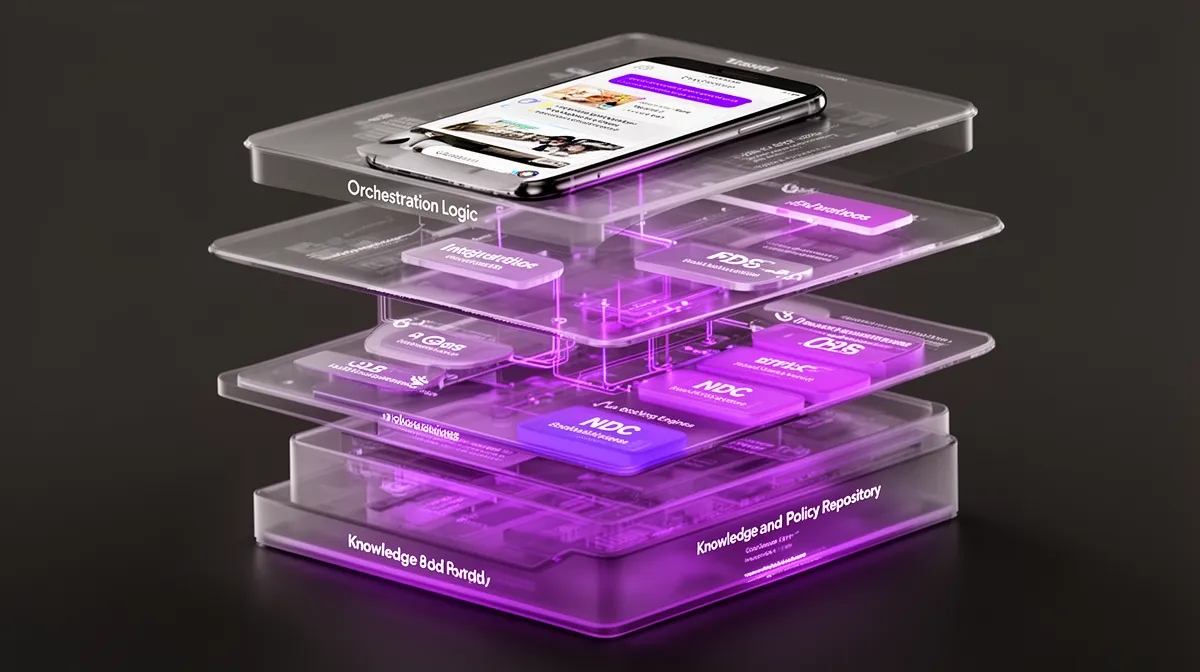
To reach that level of capability, you need to think in layers, not just intents. Modern travel chatbot development has four key layers: the conversational layer, the orchestration layer, the integration layer, and the knowledge & policy layer. Each solves a different part of the problem of making context-aware AI work in a tightly regulated, high-stakes domain.
The conversational layer is what travelers see: LLMs and NLP handling intent recognition, entity extraction, dialog management, and conversation state management. It’s responsible for turning “can you move my return flight to Sunday night?” into structured data: who, which segments, dates, and constraints. It also keeps the conversation coherent when users change their minds mid-flow.
The orchestration layer sits behind that, acting like an air traffic controller for the bot. It decides which workflows to run, which APIs to call, and how to apply business logic. If the user wants to move one leg, orchestration determines whether this is a simple segment change or a full reprice-and-reissue, considering travel policy rules and risk.
Below orchestration sits the integration layer. This connects the bot to GDSs, NDC APIs, booking engines, CRM, and payment systems. It’s where travel CRM integration, PNR reads/updates, and payment and ticketing actually happen. If conversation and orchestration are the brain, integrations are the nerves and muscles.
Finally, there’s the knowledge & policy layer. This is where you store fare rules, cancellation policies, disruption playbooks, and other domain knowledge. Using retrieval-augmented generation and rules engines, this layer lets the bot reason about what’s allowed, what’s recommended, and what must go to a human. Together, these four layers turn dialog management into a safe, governed system—ready for real-world travel.
Why Most Travel Chatbots Fail When Trips Get Messy
Failure Modes in Real-World Itineraries
Most travel chatbots look fine in a demo because demos use simple itineraries and happy paths. In production, they hit a wall as soon as they face real behavior: customers changing just one leg, adding a passenger, combining miles and cash, or dealing with a misconnection. The bot loses context, misreads what the traveler wants, or simply punts to the call center.
Common failure modes include: forgetting earlier details when the user changes their mind, not understanding partial changes, applying whole-trip rules to segment-level changes, or misinterpreting natural language like "cancel my last leg" on a three-segment trip. Rule-based flows with shallow integrations make this worse: they can’t see the entire PNR or apply nuanced itinerary management logic.
Consider a traveler on a multi-leg itinerary facing a delay. The bot first offers basic status info. When the traveler asks, "Can I move the second leg to tomorrow?", the bot either says that changes aren’t possible online or sends a generic manage-booking link. After two or three loops of confusion, the traveler calls support anyway. Containment is low, and the customer experience in travel takes a hit.
Underestimating IROPS and Edge Cases
Irregular operations (irregular operations (irops)) is industry shorthand for the events that blow up your operation: delays, cancellations, missed connections, schedule changes, crew issues, system outages. These events may be statistically rare per passenger, but they dominate call center volume and social media sentiment when they hit. That’s exactly when a weak bot fails catastrophically.
On major storm days or during large-scale IT failures, call volumes can spike by 5–10x. IATA and industry studies highlight how disruptions stress both operations and digital servicing. If your travel chatbot is only built for normal operations, you’ll be reduced to splash screens telling people to “expect long wait times” while agents firefight.
Real trip disruption handling means designing for mass IROPS: auto-detecting affected PNRs, proactively engaging travelers, and offering safe self-service rebooking. Without that, your chatbot becomes an additional frustration layer—a pretty button that leads nowhere—during the very moments when travelers need self-service travel support most.
Fear of Giving Bots Real Control
Executives aren’t irrational when they’re cautious about automation here. Fare structures, interline agreements, cancellation policies, EU261 and DoT rules, and loyalty impacts all make ticket changes high stakes. A misapplied refund or incorrect reissue can trigger revenue loss, regulatory risk, or social media storms.
As one hypothetical head of operations might put it:
“I’m not letting a bot loose on our PNRs when a single miscalculated reissue could lose thousands in revenue and trigger compensation obligations.”The instinctive response is to neuter the bot: keep it to FAQs, booking, and maybe simple status checks. The result is a chatbot that never moves the needle on core cost and experience drivers.
The real solution is not to avoid power but to pair it with strong guardrails and domain-aware orchestration. With clear travel policy rules, controlled workflows, and safe rebooking workflows, an AI travel chatbot for complex bookings can automate the majority of cases safely—and escalate the true edge cases where humans add real value.
Map the Real Complexity: Travel Scenarios Your Chatbot Must Handle
Multi-Leg and Multi-Carrier Itineraries
If you want to know how to build a travel chatbot for multi leg trips, start by modeling the structures that actually show up in PNRs. You’ll see A–B–C itineraries, open jaws (A–B, C–A), mixed cabins, codeshares, and complex interline journeys with multiple carriers. Each pattern implies different constraints on what can be changed and how repricing works.
On a single-carrier round trip, a date change might be a straightforward segment swap with a change fee. On a multi-carrier, mixed-cabin itinerary, changing one segment can require a full journey reprice and reissue. Your chatbot must have pnr management logic that understands segments, fare components, and carriers—not just a “change flight” button.
Picture a traveler on an A–B–C itinerary, with A–B on a partner airline and B–C on your metal. They ask the bot to "move the second leg to tomorrow morning." A scenario-complete enterprise travel chatbot solution for end to end itineraries identifies the specific segment, checks interline rules, evaluates whether a segment-only change is allowed, and then offers constrained options. A naive bot just says "online changes not supported" and forces a call.
Date Changes, Partial Cancellations, and No-Shows
Next, enumerate the change and cancellation patterns your bot must handle. These include: change outbound only, cancel return only, shift entire trip by one or more days, convert an unused ticket to credit, and deal with no-shows. Each of these triggers different fare rules, fees, residual values, and sometimes different treatment for adults, children, and infants.
For example, in custom travel chatbot development for booking changes and cancellations, you might define patterns like:
- Outbound-only change: reprice outbound, keep return; show fee + fare difference, explain impact on minimum stay rules.
- Return-only cancellation: refund or credit for the unused return, preserve flown segments, clarify whether ancillaries (bags, seats) are refundable.
- No-show handling: explain that no-show forfeits value on some fare types, or show what residual credit remains under specific cancellation policies.
An effective travel chatbot for flight changes and rebooking doesn’t just say “this fare is non-refundable.” It explains, in human language, what parts are flexible, what penalties apply, and what options exist, grounded in the actual fare and policy data for that PNR.
Disruptions and Involuntary Changes (IROPS)
Voluntary changes (traveler wants to leave a day earlier) and involuntary changes (flight cancelled by airline) are entirely different beasts. In involuntary cases, passengers often have more rights, and airlines have defined playbooks: automatic reprotection, alternative flights, vouchers or hotels, or full refunds in some markets. Your bot must know which playbook to follow.
Common irregular operations (irops) include long delays, cancellations, misconnections, equipment swaps with fewer seats, and schedule changes days or weeks ahead. Real trip disruption handling means proactively identifying affected PNRs and offering clear paths: accept auto-rebooking, choose another flight, request a refund if eligible.
Imagine a cancellation scenario. The system auto-rebooks the passenger onto a later flight the same day. The traveler receives a message from the travel chatbot for flight changes and rebooking summarizing the new itinerary and asking for confirmation. If they’re unhappy with the option, the bot guides them through alternatives within policy, and escalates only when exceptions are required. That’s how you turn IROPS from a pure cost center into a controlled, semi-automated process.
Multi-Passenger and Policy-Constrained Travel
Trips rarely involve just one generic traveler. You have families with children and infants, small groups, corporate bookings with strict travel policy rules, and high-status frequent flyers with special treatment rules. A robust enterprise travel chatbot solution for end to end itineraries must respect these differences.
For TMCs and corporate travel, the bot must understand cabin class limits, maximum fares, preferred carriers, and approval workflows. If a traveler asks for a change that violates policy—say, upgrading to business class on a non-preferred carrier—the chatbot should explain why and either offer compliant alternatives or route the request for approval.
Picture a corporate traveler asking to move from a fully booked economy flight to a higher-priced alternative that exceeds policy. The chatbot checks the traveler’s profile, company rules, and loyalty status. It might say: “I can offer you Flight 456 in economy, which is within policy, or request approval for Business on Flight 789 due to your status and the disruption. Which should I do?” That’s travel personalization with guardrails, not guesswork.
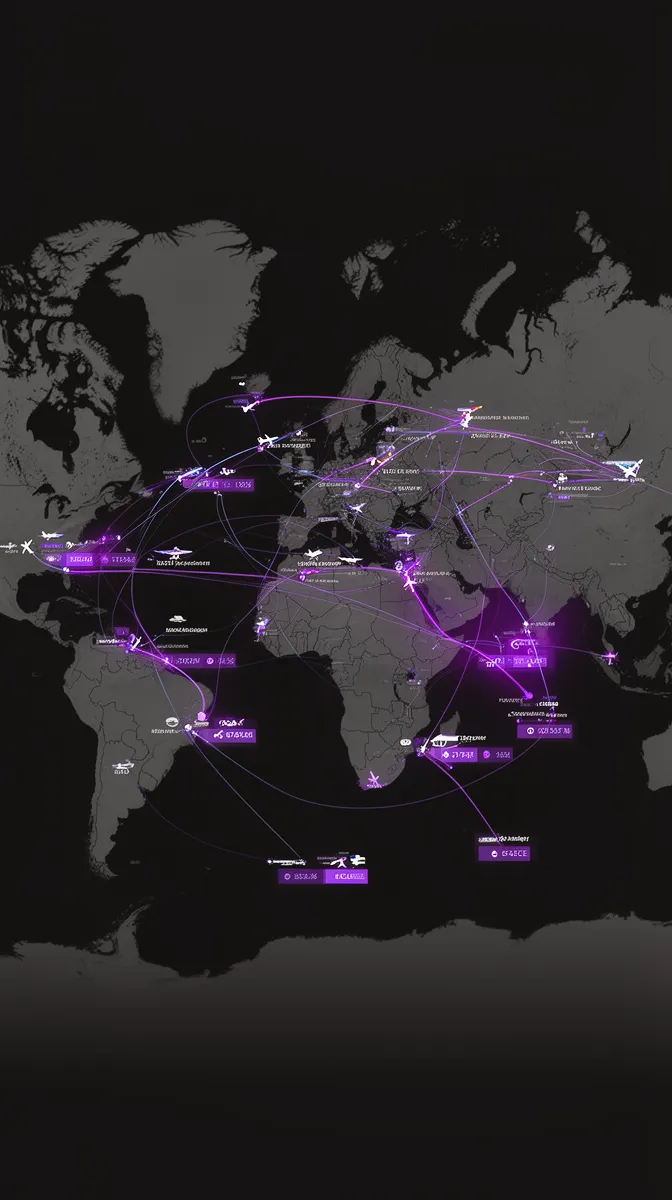
Architecture for Complexity-Handling Travel Chatbots
Conversation Layer: LLMs Plus Deterministic Flows
At the top of the stack is the conversation layer. Modern NLP and LLMs give you far better nlp intent recognition and entity extraction than the old pattern-based engines—but you still can’t just “let the model decide” everything in travel. You need a balance between freeform natural language and deterministic flows for high-risk actions.
In practice, the LLM handles the front-end dialog: understanding what the traveler wants, asking clarifying questions, and keeping conversation state management coherent. Once the user expresses an intent like "change my return to Sunday," the bot passes a structured representation of that request into a protected workflow. That workflow might then take over the interaction, guiding the traveler through confirmation screens in a more constrained way.
Think of it as a two-tier dialog management system. Tier one is open, flexible, and user-friendly; tier two is controlled and auditable. This is how you combine delightful UX with the necessary safety for payment and ticketing operations.
Orchestration Layer: Travel Brain of the Chatbot
Beneath conversation sits orchestration, which is where most of the travel-specific intelligence lives. Orchestration maps intents to workflows, calls back-end APIs, applies travel policy rules, evaluates fare rules, and decides when to escalate. It is the decision engine that turns “I want to change my flight” into "run the simple date-change workflow for segment 2" or "run full reprice-and-reissue for the entire journey."
Because workflows live here rather than in the LLM, you can change and govern them independently. Adding a new rebooking workflow or tweaking refund logic doesn’t require retraining models, just updating orchestration logic. That’s essential for long-term travel chatbot development, especially when you’re refining rebooking workflows in response to new fare brands or policies.
Consider a case where a passenger wants to move a leg forward by one day. Orchestration inspects the fare basis, determines whether same-brand availability exists, and decides if a simple revalidation is enough or a full reissue is needed. It then either executes automatically or flags the case as too complex, routing it to a human with full context.
Integration Layer: GDS, NDC, and Booking Engine Integration
The integration layer is where your travel chatbot connects to the real world. It must speak to GDS systems (Amadeus, Sabre, Travelport), NDC APIs, and internal booking engine integration services to read and write PNRs, check availability, reprice, and issue tickets or EMDs. This is where your pnr management and payment and ticketing actually occur.
For example, a change request might flow like this: the chatbot retrieves the PNR from the GDS, passes it to an NDC or pricing engine to get alternative offers, then confirms the selected option via your booking engine. Official docs like Amadeus APIs or Sabre APIs give a sense of the practical integration requirements.
Robust integrations also need error handling, rate limiting, and graceful fallbacks. If a GDS call times out during a reprice, the bot should explain the issue and either retry or move to an assisted channel, not leave the traveler hanging in an infinite spinner.
Knowledge and Policy Layer: RAG and Rule Engines
The knowledge and policy layer ensures your chatbot gives accurate, explainable answers about rules and rights. Here, retrieval-augmented generation (RAG) works with structured rules. RAG pulls current policies, detailed cancellation policies, disruption playbooks, and fare brand descriptions into context for the LLM. Rule engines handle hard constraints like eligibility for refunds or compensation.
For instance, the bot might retrieve the specific policy document for a fare brand on a given route and summarize it in plain language. At the same time, a rule engine verifies whether a refund is allowed based on flown segments, elapsed time, and region. You get the best of both worlds: flexible explanation plus deterministic enforcement.
This layer also underpins governance. Versioning, audit trails, and controlled rollouts allow you to update travel policy rules or disruption strategies quickly while maintaining compliance. It’s also where you can connect to external knowledge sources like EU261 guidance or internal legal interpretations.
For these deeper orchestration and governance needs, many teams look to specialist partners. Buzzi.ai’s AI agent development for complex, multi-step workflows is designed precisely for these kinds of layered, policy-aware systems.
Design Patterns for Changes, Cancellations, and Rebooking
Clarify Intent and Scope Before Touching the PNR
One of the simplest but most powerful patterns in travel chatbot development is: clarify intent before acting. In practice, that means confirming who, what, and when before any pricing or PNR modification. This reduces expensive API calls and prevents costly mistakes.
The LLM-driven layer uses nlp intent recognition and summarization to restate the request. For example: “You’d like to change the second leg of your trip, from London to Dubai, to Sunday night for just yourself, keeping other flights the same. Is that right?” This is good conversation state management in action—resolving ambiguity up front.
In an AI travel chatbot for complex bookings, that confirmation acts as a gate. Only once the traveler confirms does the orchestration layer proceed to pricing and availability checks. It’s a small UX detail with big implications for system cost and safety.
Explain Options with Transparent Rules and Penalties
Next, present options that are both optimized and understandable. The bot should typically offer 2–3 clear choices, each with times, prices, and tradeoffs. Behind the scenes, it’s translating dense fare rules and cancellation policies into human language.
An example response might read: “I found three options: (1) Move to Flight 456 today at 18:30 with a $75 change fee plus $40 fare difference; (2) Move to tomorrow’s Flight 789 at 09:00 with no change fee, but you’ll pay a $60 fare difference; or (3) Cancel this segment for a $120 credit toward future travel.” The detailed legalese sits in the knowledge base; the bot surfaces just enough to support good decisions.
Layering this with smart travel personalization makes it even better. If you know the traveler prefers morning flights and aisle seats, you can rank options accordingly while still being transparent about why you’re recommending them. That’s how you improve customer experience in travel without creating black-box behavior.
Safe Execution: Guardrails, Checks, and Escalation
Execution is where things can go expensively wrong, so it deserves explicit design patterns. Before charging cards or issuing refunds, the chatbot should present a final summary: flights, passengers, totals, and applicable rules. It should ask for explicit confirmation, similar to a checkout page.
Behind the scenes, orchestrated rebooking workflows perform automated checks: seat availability, minimum connection times, payment authorization, and any special constraints during trip disruption handling. If anything fails or looks ambiguous—mixed-cabin, multi-carrier reissues, or policy overrides—the bot should gracefully escalate with full context to a human via omnichannel customer support tools.
A good pattern is: “I can’t safely complete this change automatically due to mixed carriers and cabin classes. I’m transferring you to an agent with all the details so you don’t have to repeat yourself.” That preserves containment where it’s safe, while preserving trust where it isn’t.
Post-Action Follow-Through and Notifications
Once a change is executed, the bot’s job isn’t done. It should send confirmations with updated itineraries, receipts, and policy reminders via email, SMS, or WhatsApp, depending on customer preferences. This is core to modern itinerary management and post-booking support.
Integration with CRM ensures loyalty profiles, preferences, and notes are updated—supporting better travel CRM integration and future personalization. If the traveler later wants to tweak their plans again, they should be able to jump back into the conversation, with the bot recognizing the context and resuming smoothly across channels as part of omnichannel customer support.
An ideal follow-up message might say: “You’re now confirmed on Flight 456 on Sunday at 18:30. Your seat 12A is retained, and a $115 charge has been applied to your card ending in 1234. Reply ‘More options’ if you’d like to adjust seats or add bags.” That’s clarity plus a clear next step.
Context, Memory, and Omnichannel Journeys in Travel
Maintaining Context Across Long Travel Timelines
Travel plans unfold over weeks or months, and travelers rarely complete everything in one session. They might start a date change on the website, come back three days later on mobile, and then follow up via WhatsApp from the airport. Without durable conversation state management, each of these feels like starting from scratch.
A context-aware AI assistant ties state to customer identity and PNRs, not just to a single browser session. It tracks where a complex change flow left off, what options were presented, and which constraints apply. That enables the bot to say, “Last time we spoke, you were considering moving Flight 123 from Saturday to Sunday—would you like to continue?” even after a channel or device switch.
This is particularly important for itinerary management and post-booking support, where decisions may require time, approvals, or waiting for new availability. Long-lived context turns the bot from a series of disconnected queries into a persistent travel companion.
Multi-Channel, One Brain
Travelers don’t think in channels; they just want help. Web chat, in-app messaging, WhatsApp, SMS, and even voice should feel like different doors into the same assistant, powered by one orchestration and context layer. That’s what real omnichannel customer support looks like.
With this design, a storm-triggered disruption might send proactive notifications via app push and SMS, inviting travelers into chat to review options. Whether they tap into the app bot or reply on WhatsApp, the same stateful workflows and policies apply. At Buzzi.ai, we’ve extended this to AI voice bots for WhatsApp and other channels, where a whatsapp ai agent can offer the same flows as web or app.
The traveler doesn’t care that one flow is text and another is voice; they care that the assistant remembers who they are, what they booked, and what’s already been agreed. That’s the essence of self-service travel support done right.
Personalization Without Creeping Travelers Out
Done well, travel personalization feels like competence, not surveillance. Your chatbot can use existing data—frequent routes, seat and meal preferences, loyalty tier—to pre-filter options and defaults. If someone consistently chooses early morning flights, show those first.
But it should also be transparent. Instead of just saying “Here are your options,” a better answer is: “Based on your usual preference for morning flights on Airline X, I’ve prioritized similar options, but you can see all flights below.” That improves customer experience in travel while explaining the logic.
Respect for privacy and clear opt-outs matter here. Providing simple controls over what data shapes recommendations, and documenting this in your travel CRM integration, builds trust over time.
Security, Compliance, and Governance for Enterprise Travel Chatbots
Protecting PII, Payments, and Sensitive Travel Data
Enterprise travel chatbots operate on sensitive ground. They see PII (names, contact details), journey patterns (which can reveal VIPs and executives), and payment details. Any credible enterprise travel chatbot solution for end to end itineraries must treat this like any other critical production system.
That means encryption in transit and at rest, tokenization of payment data, and strict role-based access control. For LLM-based components, you often want to redact or tokenize sensitive details before passing context into the model, especially around payment and ticketing. A safe design might let the LLM reference a token like “CARD_REF_1234” without ever seeing the underlying PAN.
Best-practice guides like the PCI-DSS standard and GDPR resources provide useful baselines for secure handling of payments and personal data in conversational interfaces.
Regulatory and Policy Compliance (EU261, DoT, GDPR, etc.)
In travel, compliance isn’t optional. Regulations like EU261 in Europe, DoT rules in the US, and local equivalents dictate refund, rerouting, and compensation rights during disruptions. Cancellation policies and travel policy rules must be aligned with these obligations.
Your knowledge and policy layer should encode jurisdiction-aware rules and responses. For a flight cancellation departing the EU, the chatbot might say: “Under EU261, you may be entitled to rerouting and compensation depending on the circumstances. Here are your options…” and then walk through available paths. Academic and industry research on EU261 and passenger rights can guide these flows.
On the data side, GDPR and similar frameworks require explicit consent, purpose limitation, and data minimization. Logs of decisions, policy versions, and customer consents are key to demonstrating compliance—especially when automation drives outcomes.
Governance: Change Management for Bots That Change Trips
Once your chatbot can actually modify trips, governance becomes as critical as code. You need clear ownership for policies, workflows, and knowledge updates, and a release process that includes testing in sandboxes and phased rollouts. This is where ai governance meets practical operations.
A typical governance checklist for an automated refund workflow might include: business approval, legal review, unit and integration tests, A/B testing on a small cohort, monitoring plans, and rollback triggers. This is part of a broader enterprise travel chatbot solution for end to end itineraries and should connect with your broader ai readiness assessment efforts.
External best-practice guides on PCI-DSS and GDPR, combined with internal legal and risk teams, make up the full picture. The key is to treat your bot like any other mission-critical system—not a side project.
Measuring ROI: From Containment to IROPS Impact
Core Metrics That Actually Matter
To justify investment in travel chatbot development services, you need to measure the right things. Start with containment rate, but segment it: containments for changes/cancellations are far more valuable than containments for FAQs. You also want handle time and resolution time comparisons between bot and human for equivalent scenarios.
Track leakage: where in the flow users escalate to humans or abandon. If you see frequent drop-offs right after options are shown, you may have pricing clarity issues. If they drop off at payment, you may have trust or UX problems. This is how you tune self-service travel support over time.
Finally, look at customer experience in travel metrics like CSAT and NPS specifically for post-booking support journeys. An improvement here is often much more correlated with loyalty than a small bump in booking conversion.
Disruption-Specific ROI
Mass IROPS days are where the ROI of a good bot is most visible. During a storm or major outage, you can measure peak concurrent sessions handled, reduction in average call wait time, and the percentage of reprotections completed entirely by the chatbot. These are the moments when irregular operations (irops) capacity translates directly into customer goodwill.
Imagine a storm causing 5x normal volume. With a capable travel chatbot for flight changes and rebooking, perhaps 60–70% of simple reprotections (accepting new flights, minor time changes) can be self-served. Human agents then focus on complex edge cases: multi-carrier reissues, special assistance, stranded families.
To support this, you’ll want analytics streams that classify interactions by disruption type and flow completion, and to connect them to your broader trip disruption handling strategy. Buzzi.ai can also help connect bots with systems like smart support ticket routing and triage to optimize the full service stack.
Beyond Cost Savings: Revenue and Loyalty Effects
Cost avoidance is only half the story. A mature travel chatbot can also drive incremental revenue through smart offers at the right moment: paid seat upgrades, priority boarding, bags, or same-day confirmed changes that genuinely help. The key is to integrate travel personalization so these offers feel like service, not spam.
For example, during a rebooking, the bot might say: “I can move you to Flight 456 at 18:30. There’s also an option to move to Premium Economy with extra legroom for $60—this might be more comfortable given your new late arrival.” That kind of contextual upsell, backed by knowledge of the traveler’s history, often feels like helpful curation.
Over time, better customer experience in travel, higher app engagement, and smoother post-booking support can have outsized impacts on retention and share of wallet—especially in competitive markets.
Why Partner With a Specialist for Advanced Travel Chatbot Development
The Hidden Complexity of Travel AI Projects
On paper, travel chatbot projects look simple: plug an LLM into your website, add some intents, and you’re done. In reality, the combination of legacy systems, domain complexity, and regulation makes this one of the hardest sectors for automation. Many airlines and OTAs discover that their generic chatbot stalls after the MVP stage.
Integrating with clunky PSS, brittle GDS connections, custom gds integration adaptors, and bespoke booking engine integration is tough enough. Layer on fare rules, IROPS playbooks, corporate policies, and loyalty specifics, and you’re far beyond what a generic bot platform is built to handle. That’s why serious players look for travel chatbot development services with deep travel DNA.
We’ve seen teams launch a basic airline chatbot or OTA chatbot that works fine for FAQs and simple bookings, only to realize months later that extending it to real rebooking is essentially a new project. The lesson: designing for complexity up front is cheaper than patching it in later.
What to Look for in a Travel Chatbot Partner
When you evaluate partners, think beyond demos. Look for proven domain knowledge (airlines, OTAs, TMCs), real-world IROPS experience, and referenceable enterprise travel chatbot solution for end to end itineraries. Check for integrations with your core systems: GDS, NDC, PSS/CRS, CRM, and payments.
From a technology standpoint, the best travel chatbot platform for airlines and OTAs will have robust orchestration, solid RAG capabilities, versioned knowledge bases, and strong security posture. It should support multi-channel deployments out of the box and provide detailed analytics and governance tooling.
Good RFP questions include: “Show us how your bot handles a three-leg, multi-carrier rebooking after a misconnection,” or “How do you ensure ai travel chatbot for complex bookings apply fare rules and policies correctly in edge cases?” Ask for sandbox access and real metrics, not just slideware.
How Buzzi.ai Approaches Scenario-Complete Travel Chatbots
At Buzzi.ai, we approach travel chatbot development from the perspective of scenarios, not features. We start by mapping your highest-friction journeys—date changes, IROPS flows, partial cancellations—and then design workflows, integrations, and guardrails specifically for those. Only then do we layer on conversational UX.
Our core strength is in custom ai agent development and ai chatbot development for domains with real-world complexity, including travel. We build channel-agnostic assistants (web, app, WhatsApp, voice) backed by robust orchestration, travel chatbot development services, and tight integration with your systems. That includes handling true ai travel chatbot for complex bookings scenarios—not just single-leg leisure trips.
A typical engagement starts with discovery: cataloging your scenarios, policies, and systems. Then we co-design flows with your operations, contact center, and digital teams, pilot on a narrow but high-impact set of cases (like date changes and IROPS reprotection), and iterate based on hard metrics. From there, we expand coverage in controlled phases.
If you’re ready to move beyond cute booking widgets to scenario-complete assistants, that’s exactly the kind of work we’re built for. Our AI chatbot and virtual assistant development services are designed to plug into your existing stack while raising the ceiling on what automation can safely do.
Conclusion: Turning Real-World Travel Chaos Into Structured Automation
The hard part of travel isn’t booking a simple round trip—it’s everything that happens after. Multi-leg itineraries, disruptions, policies, and edge cases are where most chatbots fail, and where the real opportunity lies. Treating travel chatbot development as a serious, layered engineering and product problem is the first step.
Robust assistants combine a conversational layer with a strong orchestration brain, deep integrations, and a governed policy and knowledge layer. They embed explicit design patterns for changes, cancellations, and IROPS, and they measure success based on high-friction journeys rather than easy FAQs.
If you can map and automate your top disruption and change scenarios, the payoff is substantial: lower call volumes, faster recovery during IROPS, and better traveler experiences when it matters most. The question isn’t whether you need a travel chatbot; it’s whether it can survive real trip complexity.
If you’re ready to identify your top three high-friction scenarios and design a scenario-complete roadmap, we’d love to help. You can talk to Buzzi.ai about your travel chatbot roadmap and explore how a production-grade assistant could reshape your operations.
FAQ: Advanced Travel Chatbot Development
What is travel chatbot development and how is it different from a basic booking bot?
Travel chatbot development is the end-to-end process of designing, architecting, and integrating a chatbot that can handle the full lifecycle of a trip, not just search-and-book. A basic booking bot usually supports simple itineraries and FAQs, then hands off complex cases to humans. A serious travel chatbot can understand itineraries, apply policies, and safely execute changes, cancellations, and disruption workflows.
How can a travel chatbot handle multi-leg and multi-carrier itineraries reliably?
To handle multi-leg and multi-carrier journeys, the chatbot needs deep PNR awareness, segment-level logic, and orchestration that understands fare components and carrier rules. It must read and write PNRs through GDS/NDC, interpret how changes to one leg impact the entire journey, and surface options accordingly. This requires more than intent recognition—it requires a travel-specific decision engine.
What integrations are required for a travel chatbot to modify or cancel bookings safely?
At minimum, your bot should integrate with your GDS or NDC APIs, booking or PSS/CRS engine, payment provider, and CRM/loyalty systems. These enable PNR retrieval and updates, repricing, payment and ticketing, and context-aware personalization. A well-architected solution isolates these integrations in a dedicated layer with strong error handling and logging.
How should a travel chatbot handle flight changes, cancellations, and IROPS events?
A robust travel chatbot uses explicit rebooking workflows and disruption playbooks rather than ad-hoc logic. For voluntary changes, it clarifies scope, prices options, and executes changes with clear confirmations. For IROPS, it proactively contacts affected travelers, applies jurisdiction-specific rights (like EU261), offers rerouting or refunds when appropriate, and escalates edge cases to human agents with full context.
What role do LLMs, RAG, and orchestration layers play in advanced travel chatbots?
LLMs handle natural language understanding, conversation flow, and summarization, making the experience feel human. RAG connects the bot to up-to-date policy, fare, and disruption knowledge, allowing accurate explanations and guidance. The orchestration layer is the decision brain that maps intents to workflows, enforces rules, and decides when to call external systems or escalate.
How can we ensure fare rules, penalties, and travel policies are applied correctly by the bot?
You need a combination of structured rules and retrieval-augmented knowledge. Hard constraints like refund eligibility should live in a rules engine, while detailed descriptions of brands and penalties can live in documents consumed via RAG. A rigorous testing and governance process ensures that policy changes are versioned, validated, and rolled out safely before they impact live customers.
How do airlines, OTAs, and TMCs measure ROI from complexity-handling travel chatbots?
They focus on containment and resolution for high-friction journeys like changes, cancellations, and IROPS, not just FAQs. Metrics include containment rate for these flows, handle time, CSAT/NPS comparisons, and observed reductions in call volume and wait times during disruptions. Over time, they also measure ancillary revenue uplift and loyalty improvements tied to smoother post-booking experiences.
What security and compliance requirements apply to enterprise travel chatbots?
Enterprise travel chatbots must comply with PCI-DSS for payments and GDPR or similar laws for personal data, alongside aviation regulations like EU261 and local equivalents. This requires encryption, tokenization, access control, and careful scoping of what data is exposed to LLM components. Many organizations engage partners like Buzzi.ai, whose AI chatbot and virtual assistant development services are built with these constraints in mind.
Can a travel chatbot maintain context across channels like web, app, and WhatsApp?
Yes—if designed properly. The key is to use a central context and orchestration layer that ties state to user identity and PNRs rather than to individual sessions. With this in place, a traveler can start a change on the web, continue in the app, and confirm on WhatsApp or voice, all within a single coherent conversation.
Why should we partner with a specialist like Buzzi.ai instead of building a simple in-house travel bot?
Building a simple FAQ or booking bot is straightforward; building a scenario-complete assistant that handles real disruptions, multi-leg trips, and complex policies is not. Specialists bring reusable architectures, integrations, and governance practices that shorten time-to-value and reduce risk. Buzzi.ai, for example, focuses on tailor-made AI agents that operate safely in complex domains like travel, backed by proven patterns and tooling.