Design AI Digital Transformation Services That Actually Last
Design AI digital transformation services for sustainability, not just launch. Learn how to embed MLOps, governance, and capability transfer for lasting impact.

Most AI “transformations” quietly fail in year two—not because the models stop working, but because the organization slowly slides back to how it worked before. The real test of AI digital transformation services isn’t launch day; it’s what your operations look like 18–24 months later.
If your dashboards are dark, your teams have gone back to spreadsheets, and every AI change request needs to “go back to the vendor”, you don’t have transformation—you have an expensive pilot. Sustainable AI digital transformation consulting is about designing for what happens after the first go-live, when the hype fades and the real work starts.
In this article, we’ll unpack how to make AI-driven digital transformation services with change management actually stick. We’ll look at why so many AI programs regress, what “sustainability” really means here, and a practical sustainability framework that covers governance, MLOps and maintenance, capability transfer, and long-term business value realization. Along the way, we’ll show how to build an AI operating model that compounds value over years, not quarters.
At Buzzi.ai, we focus on AI digital transformation services that are durable, adaptable, and truly owned by your teams—not just impressive in the boardroom demo. This is the blueprint we use and the lens you can use to evaluate any partner, including us.
What Are AI Digital Transformation Services—And Why They Fail to Stick
From Generic Digital Transformation to AI-Native Change
Most enterprises have been through at least one wave of “digital transformation.” New CRM, new ERP, cloud migration, maybe some process automation. Useful, but fundamentally about digitizing existing workflows, not reshaping them around intelligence.
AI digital transformation services for enterprises are different. Here, machine learning models and AI agents sit in the critical path of decisions, workflows, and customer experiences: what lead gets a callback, which ticket gets escalated, what price is offered, which claim gets flagged. The system doesn’t just store or route information—it decides.
That creates AI-specific dimensions generic digital transformation doesn’t face. You’re now dependent on data quality, model assumptions, feedback loops, and continuous learning. A credible digital transformation roadmap for AI has to show how models will be trained, monitored, retrained, and governed over time, not just where they plug into existing process automation.
Consider a traditional CRM rollout versus a CRM augmented with AI. The first digitizes contacts and activities. The second uses machine learning models for lead scoring and automated outreach, changing how sales prioritizes its day. That’s why modern AI implementation services must blend technology with organizational change management. You’re not just installing tools; you’re altering how decisions are made.
Why So Many AI Programs Revert to the Old Normal
Given the stakes, why do so many AI initiatives regress to the old way of working? One reason is the “hero project” pattern. A small expert team builds an impressive model under a senior sponsor’s protection—but no one embeds it into normal operations, so it quietly dies once the spotlight moves on.
Another failure mode: no ownership and no budget for post implementation support. Models drift silently as the business changes. The team that built them has moved on. Monitoring is minimal. Eventually, business users stop trusting the predictions and fall back to manual workarounds and shadow IT.
Organizational dynamics make this worse. There’s change fatigue from previous digital initiatives that promised a revolution and delivered a new login screen. Executives become skeptical of bold AI adoption claims. Without a credible operating and governance model, every issue becomes a political battle: who is accountable if the model is wrong?
Underneath all this is technical debt and what we might call operationalization debt. It’s relatively easy to get a predictive model working in a pilot. It’s much harder to wire that model into production systems, define support processes, write runbooks, and ensure data pipelines don’t break. When this work is under-scoped, AI programs stall after year one.
Industry surveys illustrate the gap. McKinsey has repeatedly found that only a minority of companies capture meaningful, sustained value from AI at scale, despite high levels of experimentation. Their 2023 State of AI report shows many firms stuck in pilot purgatory or struggling with scaling and governance.
What Sustainability Really Means in AI-Led Transformation
So what does sustainability mean in this context? It’s not about energy usage or carbon (important, but a different conversation). Here, sustainability means your AI systems stay useful, compliant, and improvable for years, with clear owners, operating rhythms, and guardrails.
A sustainable AI program is one where an AI operating model is in place: decisions have owners, models have SLAs, data has stewards, governance has forums, and teams have rituals for continuous improvement. The system can adapt as business conditions change, instead of becoming a brittle relic from last year’s strategy deck.
This is where a sustainability framework helps. Instead of chasing one-off ROI spikes, you intentionally design compounding value realization: small but repeated improvements in how AI augments decisions. The difference is like running a one-off marketing campaign for a Q4 bump versus building an always-on personalization engine that steadily improves over multiple quarters.
In other words, sustainable AI digital transformation services prioritize long-term business value realization over launch theatrics. The transformation looks less like a single big bang, and more like a series of well-governed, learn-and-iterate cycles.
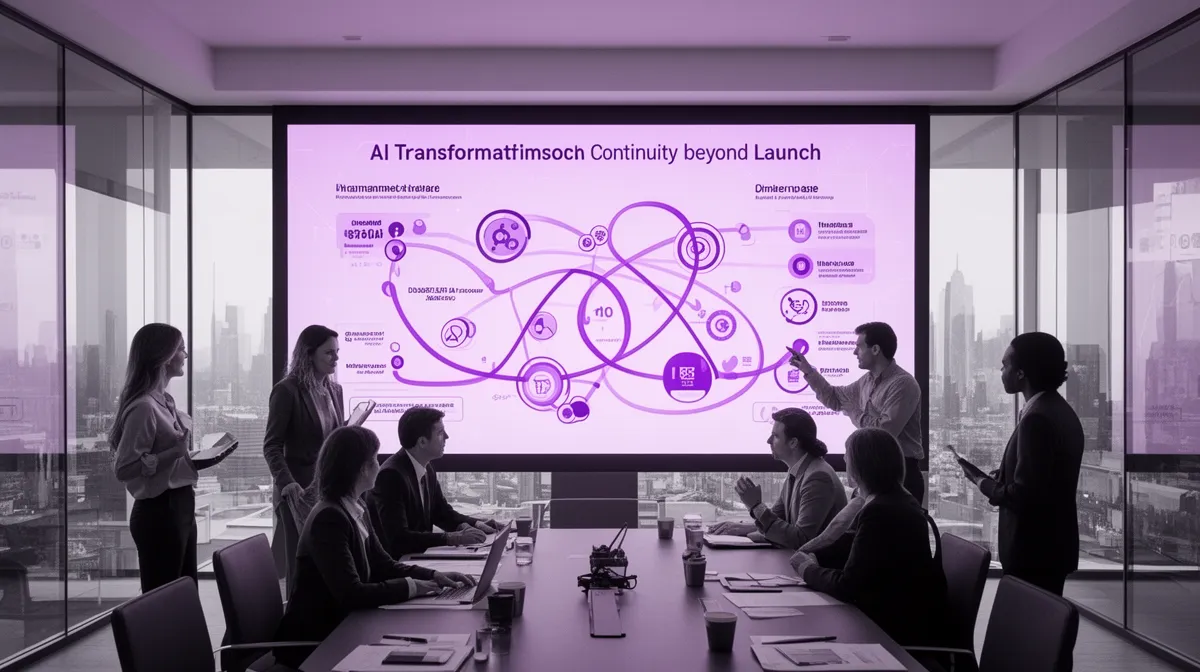
A Sustainability Blueprint for AI Digital Transformation Services
Principles of Sustainability-Designed AI Transformation
If you want to know how to make AI digital transformation sustainable, you start with a few non-negotiable principles. These should shape your AI transformation strategy before any code is written.
Here’s a practical checklist:
- Design for day 2, not just launch day. Every initiative should include a maintenance plan, monitoring, and handover from the first sprint.
- Default to internal ownership. For each model and workflow, define a clear business owner and technical owner inside your organization.
- Minimize vendor lock-in. Favor open standards, accessible code, and documented data schemas over tightly proprietary platforms.
- Tie every model to a decision owner. If no one “owns” the decision the model informs, its outputs will be ignored when things get busy.
- Favor simple, maintainable patterns. Sustainable AI operating models prefer fewer, well-understood tools over sprawling, complex stacks.
These principles should be explicit in your AI transformation strategy and any statement of work with sustainable AI digital transformation consulting partners. If they don’t show up in early workshops and your digital transformation roadmap, they won’t magically appear later.

The Four Lanes of a Sustainable AI Transformation
One way to think about sustainability is as four parallel lanes that move in sync. If any lane lags, your AI-driven digital transformation services with change management become brittle.
The lanes are:
- Technology & data platform. The cloud, data platform, and integration layer that feed and host your models.
- MLOps & maintenance. The pipelines, monitoring, and processes that keep models in production healthy.
- Governance & risk. The policies, forums, and controls that define what’s acceptable and how issues are handled.
- People & capability transfer. The skills, roles, and ways of working that let your teams own and extend the solution.
Imagine a project where the technology lane races ahead—sleek data platform, impressive models—while governance and people lag. No one is sure who can approve changes, legal is nervous, and front-line staff feel the model is a black box. Adoption stalls, and what looked like cutting-edge AI digital transformation service packages for mid sized businesses ends up underused.
By contrast, when all four lanes move together, you get a robust sustainability framework. Technology choices are guided by an AI operating model. MLOps matches your risk appetite and sector. Governance forums match the scale of decisions being automated. Capability transfer ensures your teams don’t need a vendor for every small tweak.
Right-Sizing the Blueprint for Mid-Sized Enterprises
Many mid-sized businesses worry that all of this sounds like over-engineering—like they need a fully staffed AI center of excellence before they can do anything. That’s the wrong lesson. The blueprint is scalable; your implementation should be proportionate to your size and complexity.
For a mid-sized manufacturer, for example, “governance” might be a lightweight monthly forum with operations, IT, and finance reviewing key AI systems. MLOps might be a managed service with simple dashboards rather than a full in-house platform team. The AI operating model can be codified in a few clear RACI charts instead of a 100-page manual.
The key is that sustainable AI digital transformation consulting matches organizational maturity and budget. You don’t need a formal center of excellence on day one, but you do need named owners, simple rituals, and clear escalation paths. That’s what separates mid-sized clients who quietly scale AI adoption from those who stall after the first showcase project.
Whether you’re designing AI digital transformation services for enterprises or leaner programs for mid sized businesses, the sustainability lens is the same: align ambition with capacity, and evolve as capability grows.
Designing MLOps and Maintenance Into the Transformation—Not After
Why MLOps Is the Heartbeat of Sustainable AI
If AI is to be more than a slide in the strategy deck, you need MLOps. In business terms, MLOps is the operating system for your production AI systems: how models are deployed, monitored, retrained, and rolled back safely.
Done well, MLOps underpins reliability, speed of change, and regulatory compliance. It’s how you ensure your production AI systems behave predictably when data shifts, markets change, or new regulations arrive. Any credible AI implementation services proposal that ignores MLOps is essentially selling prototypes, not products.
A useful analogy: think of MLOps as the factory that consistently produces updated models, similar to a release pipeline for software. Without a factory, you’re hand-crafting a model each time—slow, error-prone, and impossible to scale. With MLOps, updates become routine, governed by defined service level agreements and a clear maintenance plan.
For a deeper dive, Google’s work on production ML systems and hidden technical debt in machine learning offers a helpful framing of why MLOps matters beyond the model itself. Their research on ML technical debt is essential reading for leaders treating AI as infrastructure, not a toy.

Planning Maintenance from the First Sprint
MLOps is not something you bolt on after go-live. It should be designed during the very first sprint of your AI digital transformation services engagement, and reflected in your digital transformation roadmap.
A robust maintenance plan includes at least:
- Monitoring and alerting for model performance, data drift, and system health.
- Defined retraining schedules and triggers—time-based and performance-based.
- Data quality checks on upstream sources with clear owners.
- Rollback procedures if a new model version degrades performance.
- Named owners and RACI for responding to alerts and incidents.
These elements should flow into concrete service level agreements and post implementation support commitments—whether handled internally, by your partner, or jointly. Designing them upfront reduces technical debt and firefighting later. It’s also where our own workflow and process automation services often intersect with AI: by automating parts of these support flows so your teams can focus on higher-value work.
Patterns and Rituals That Keep Models Healthy
Technology alone doesn’t keep models healthy; people and rituals do. Sustainable AI transformations embed recurring patterns into the calendar, not just the architecture diagram.
Common patterns include:
- Monthly Model Health Reviews. Business owners, data scientists, and ops review key metrics, incidents, and proposed improvements.
- Quarterly governance forums. Cross-functional group reviews AI portfolio risk, policy updates, and regulatory changes.
- Incident post-mortems. For significant AI-related issues, run blameless reviews to capture lessons and update playbooks.
- Change advisory boards for AI. Structured review of high-impact changes to models affecting sensitive decisions.
These rituals form the living tissue of your sustainability framework and governance model. They support continuous improvement and align with how you manage other critical production AI systems and IT infrastructure. When they’re in place, AI feels less like a fragile experiment and more like a stable part of how the business runs.
Capability Transfer: Building Internal Owners, Not Permanent Dependence
Why Capability Transfer Is Non-Negotiable for Sustainability
Even the best-designed AI systems will stagnate without internal capability. If every change requires calling the vendor, your teams will eventually stop asking, and your investment will atrophy.
That’s why capability transfer is non-negotiable in any serious AI transformation strategy and capability transfer services engagement. Critical roles—product owner, data/ML engineer, analyst, business champion—need to be developed within your organization, not rented indefinitely.
Imagine two similar companies launching AI-driven customer support triage. One bakes explicit knowledge transfer and organizational change into the plan: internal owners are trained, documentation is created, and responsibilities gradually shift in-house. Two years later, they’re iterating confidently.

The other keeps everything behind the vendor curtain. They get impressive demos but no access to code, limited documentation, and minimal training. When budgets tighten, the contract is trimmed—and the AI capability quietly collapses. That’s not transformation; that’s dependency.
Practical Models for Capability Transfer
There isn’t one “right” way to do capability transfer; there are models that fit different contexts. What matters is that you consciously pick one.
Common patterns include:
- Embedded hybrid teams. Vendor experts and client staff form a single squad, sharing backlogs and pairing on tasks.
- Side-by-side delivery. Initial sprints led by the vendor, later sprints co-led, final sprints led by the client with light support.
- Train-the-trainer programs. Power users and internal champions are trained deeply, then teach others.
- Playbooks and runbooks. Documented processes for model deployment, issue handling, and change requests.
In larger enterprises, these often culminate in a formal or informal center of excellence. For mid-sized firms, the same ideas work on a smaller scale—maybe one data engineer and a product owner who become the nucleus of your internal AI capability. The point is that AI transformation strategy and capability transfer services must be explicit about how vendor involvement reduces as your skills grow.
Designing Artefacts That Survive People Turnover
Capability transfer isn’t just about people; it’s about artefacts that endure when people move on. In fast-growing or high-churn environments, relying on tacit knowledge is a recipe for fragility.
Sustainable AI digital transformation consulting treats documentation as a first-class deliverable. That includes runbooks, architecture decision records, onboarding guides, and operational checklists that describe your AI operating model in plain language. These artefacts are crucial for post implementation support, whether provided internally or via a partner.
Typical deliverables might include:
- System diagrams showing data flows and model touchpoints.
- Step-by-step guides for retraining and deploying models.
- Incident response procedures and escalation paths.
- Onboarding guides for new analysts, engineers, and product owners.
When knowledge transfer is treated this way, AI adoption becomes resilient to turnover. New hires can get up to speed without reverse-engineering opaque systems or calling the vendor for basic context.
Governance and Operating Models That Keep AI Safe and Useful
From One-Off Steering Committees to Working Governance
Many organizations believe they have AI governance because they created a steering committee. It meets quarterly, reviews slides, and rarely says “no” to anything. That’s symbolic governance, not operational governance.
Operational AI governance has clear mandates and forums embedded in how the business runs. Typical elements of a practical governance model include:
- An AI steering group that aligns AI initiatives with strategy and budget.
- A model risk committee that reviews high-impact models for fairness, bias, and robustness.
- A data council that oversees data quality, access, and stewardship.
These forums tie into existing corporate governance structures instead of sitting in a separate “AI bubble.” They support organizational change by making AI a normal part of decision-making, not an exception that needs special treatment.
Aligning Governance with Regulation and Risk Appetite
Regulation is catching up with AI, and governance is where you reconcile innovation with risk. Depending on your region and sector, you may need to respond to GDPR, sector-specific rules, and emerging AI regulations like the EU AI Act.
Good AI governance frameworks focus on principles: accountability, transparency, auditability, and proportionality. They define what can be automated end-to-end, what must have a human-in-the-loop, and when escalation is required. This is where responsible AI, compliance, and risk management become concrete, not aspirational.
For example, the World Economic Forum’s guidance on responsible AI and similar work from OECD and NIST give practical guardrails. Translating these into your policies is a classic enterprise AI consulting challenge: how do we codify our risk appetite in ways engineers and product teams can actually use?
Operating Models That Outlive the Project Plan
Governance defines what is acceptable; an AI operating model defines how work actually happens. It answers questions like: How do AI ideas become backlog items? Who prioritizes them? How are updates shipped? How are issues raised and resolved?
A robust operating model embeds AI into existing rhythms: product planning, release cycles, ITSM processes, and process automation roadmaps. Instead of “the AI team” off to the side, you have cross-functional teams where AI is part of how features are conceived and delivered.
Picture a customer support AI system. New features are captured in a shared backlog, prioritized by a product owner, and delivered in sprints. Incidents are logged through your existing ITSM tooling, with runbooks routing cases to the right people. KPIs for continuous improvement are reviewed alongside other operational metrics. That’s what sustainable AI digital transformation consulting should design—not just a system, but the machinery around it.
Measuring Long-Term Value: Metrics for Sustainable AI Transformation
Move Beyond Launch KPIs to Compounding Value Metrics
Launch KPIs are necessary but not sufficient. UAT pass rates, first-week uplift, and initial adoption are like taking a photo of a marathon runner at the starting line. What matters more is whether the value continues to grow over time.
Sustainable AI digital transformation services focus on compounding metrics: cumulative cost savings, revenue uplift over multiple quarters, error-rate trends, cycle-time reductions that persist. This is the essence of business value realization in AI: does the curve keep rising, or does it spike at launch and flatten?
For leaders, that means asking for value realization plans that look out 18–36 months, not just 90 days. You want to see how continuous improvement is built into the plan: what’s the cadence for optimization? How do we respond when performance drifts? Where do we expect diminishing returns?
Designing Metrics That Match Decision Journeys
The best metrics are anchored to the decisions AI is influencing. If an AI system prioritizes support tickets, success is not “number of predictions made.” It’s first-response time, resolution time, CSAT, and cost-per-ticket.
This is where your data platform and monitoring tools matter. They need to connect model outputs to business outcomes so you’re not stuck with vanity metrics. When you treat AI as part of the decision journey, metrics become a natural extension of your digital transformation roadmap and process automation strategy.
A simple mapping for an AI-powered triage system might include: percentage of high-priority cases correctly escalated, average resolution time by category, re-open rates, and customer satisfaction. These are tangible business value realization signals, not abstract precision scores.
Value Realization Reviews as a Governance Ritual
To keep focus on long-term value, make value realization reviews a governance ritual. Quarterly or biannual sessions where product owners, finance, and operations review whether AI systems are still delivering against expectations.
These reviews can trigger decisions to retrain, redesign, or retire models. They should be tied to explicit service level agreements and post implementation support from your providers. When done well, they keep AI investments aligned with strategy and hint at where the next wave of improvements might come from.
Case studies from leading adopters consistently show that those who institutionalize value reviews capture more of AI’s upside over time. BCG and others have documented how structured value tracking separates companies who scale AI from those who stall.
How to Choose AI Digital Transformation Partners for Long-Term Results
Questions to Ask About Sustainability, Not Just Strategy
When you’re evaluating the best AI digital transformation partners for long term results, the RFP usually focuses on vision and use cases. Those matter, but the harder questions are about sustainability.
Here are questions you should be asking:
- How do you design AI digital transformation services for sustainability, not just launch?
- What is your approach to MLOps and ongoing maintenance—tools, processes, and ownership?
- What does your standard maintenance plan and post implementation support package include?
- How do you structure capability transfer and knowledge transfer so we’re not dependent on you forever?
- What governance forums and artefacts do you help us set up?
- How do you measure multi-year business value realization for your clients?
- Can you describe your AI digital transformation service packages for mid sized businesses versus large enterprises?
- What access will we have to code, models, and data structures during and after the engagement?
- How do you handle handover if we decide to insource or switch vendors?
Vague answers here are a red flag. Strong partners can point to concrete examples of AI digital transformation services that are still running—and evolving—years later.
Spotting Vendor Lock-In vs Designed Maintainability
Vendor lock-in is sometimes treated as an unavoidable side effect of sophistication. It doesn’t have to be. The patterns are predictable.
Lock-in tactics include proprietary platforms with opaque internals, restricted access to code and data, and licensing models that penalize you for experimenting or switching. By contrast, designed maintainability favors open standards, documented interfaces, shared repositories, and joint runbooks.
Sustainable AI digital transformation consulting lives on the second side of that line. It assumes your needs will evolve, that you may build an internal center of excellence, and that one day you might choose different AI implementation services or vendors. The goal is to leave you stronger, not trapped.
How Buzzi.ai Designs AI Transformation for Durability
This sustainability-first philosophy shapes how we at Buzzi.ai work. Our AI digital transformation services for enterprises and mid-sized clients start with a sustainability blueprint—covering MLOps, governance, capability transfer, and operating model design—from the very first AI transformation strategy workshop.
We build MLOps and maintenance into the program plan, not as optional extras. Our AI discovery and transformation planning engagements map out governance forums, ownership models, and value realization metrics before we scale use cases. And our teams design explicit AI transformation strategy and capability transfer services, so your staff can own and extend what we build together.
Across offerings—from AI agent and voice assistant development, to predictive analytics and forecasting solutions, to workflow automation—we right-size frameworks for both mid-sized and enterprise clients. A typical storyline: 18–24 months after we begin, the client is running their AI systems day-to-day with their own teams, calling us not to keep the lights on, but to explore the next wave of transformation.
Conclusion: Design AI Transformation That Survives Year Two
Most AI programs are judged on the wrong horizon. Launch success is easy to celebrate and easy to fake. The real measure of AI digital transformation services is what your operations look like a year or two later.
Sustainability requires deliberate design: MLOps and maintenance planning from sprint one, governance frameworks that actually work, and capability transfer that turns vendors into accelerators, not crutches. With right-sized frameworks, both enterprises and mid-sized organizations can avoid over-engineering while still embedding durable AI capabilities.
If you’re planning—or already running—an AI initiative, now is the time to audit it against this sustainability blueprint. Are ownership, governance, MLOps, and value realization clearly defined? If not, that’s your risk register. We’d be glad to help you run that audit and shape a sustainability-first roadmap through an AI discovery or transformation planning engagement focused on long-term resilience and value.
FAQ
What are AI digital transformation services and how do they differ from traditional digital transformation?
AI digital transformation services embed intelligence into the critical path of decisions and workflows, not just digitize existing processes. Traditional digital transformation focuses on systems of record—CRMs, ERPs, portals—while AI-led change augments or automates decisions like routing, pricing, or prioritization. That introduces new needs around data, models, feedback loops, and ongoing MLOps that generic digital projects don’t face.
Why do many AI and digital transformation projects fail to deliver lasting impact?
Many AI initiatives are treated as hero projects: a small expert team builds something impressive, but ownership and support are never embedded in the organization. Without clear governance, maintenance plans, and capability transfer, models drift, trust erodes, and teams quietly revert to old ways of working. Sustainability has to be designed from the start; it can’t be patched in after launch.
What does sustainability mean in the context of AI digital transformation services?
Here, sustainability means your AI systems remain useful, compliant, and improvable for years, not just months. It implies an AI operating model with clear owners, governance forums, MLOps pipelines, and recurring rituals for improvement and value review. When sustainable, AI becomes a stable part of how you run the business, not a fragile experiment you’re afraid to touch.
How can we make our AI digital transformation sustainable beyond the first year?
Start by designing for “day 2” from the first sprint: define ownership, monitoring, retraining, and escalation paths before go-live. Build a lightweight but real governance model, with regular forums and value realization reviews. Finally, insist on explicit capability transfer so your internal teams can maintain and extend solutions without depending on vendors for every small change.
Which sustainability frameworks work best for AI-driven digital transformation?
Effective frameworks usually align four lanes: technology & data platform, MLOps & maintenance, governance & risk, and people & capability transfer. Within that, you can adapt known models such as data governance councils, DevOps-style release pipelines, and centers of excellence to the AI context. The key is right-sizing them to your organization’s maturity instead of copying heavyweight enterprise blueprints wholesale.
How should MLOps and maintenance be planned during an AI transformation program?
MLOps and maintenance should be first-class workstreams in your digital transformation roadmap, not afterthoughts. Define what will be monitored, what thresholds trigger retraining or rollback, who owns alerts, and what service level agreements will apply. This planning reduces technical debt, supports compliance, and avoids firefighting once models are in production.
What are effective models for capability transfer in AI and data teams?
Effective capability transfer often uses embedded hybrid teams, side-by-side delivery, and train-the-trainer programs. Vendors work directly with your staff, gradually shifting responsibility as skills grow, supported by playbooks and runbooks. Over time, you can formalize this into a center of excellence or a small internal AI squad that owns core systems.
How can AI governance and operating models keep solutions compliant and useful over time?
AI governance frameworks define the policies and forums for approving, monitoring, and reviewing AI systems in line with regulation and risk appetite. An AI operating model then describes how ideas become features, who owns backlogs, and how issues are resolved in day-to-day operations. Together, they ensure AI evolves with your business and regulatory environment instead of drifting out of alignment.
What metrics should we track to measure long-term value from AI transformation?
Focus on compounding metrics tied to decisions: cumulative cost savings, revenue uplift over time, cycle-time reductions, error-rate trends, and satisfaction scores. Avoid vanity indicators like “number of models” or “predictions made” that don’t prove impact. Regular value realization reviews help you adjust models or retire those no longer pulling their weight.
What questions should we ask when choosing AI digital transformation partners?
Ask about their approach to MLOps, maintenance plans, governance design, and capability transfer—not just strategy and use cases. Probe how they avoid vendor lock-in, what access you’ll have to code and data, and how they measure multi-year success for clients. Strong partners will have clear answers and reference engagements where their solutions are still thriving years later.
How does Buzzi.ai’s approach to AI digital transformation focus on long-term sustainability?
Buzzi.ai designs AI transformation with sustainability baked in: MLOps, governance, and capability transfer are part of the core blueprint, not optional add-ons. Our AI discovery and transformation planning work centers on ownership models, operating rhythms, and value realization metrics that clients can sustain. We aim for clients to run independently after 18–24 months, calling us back for the next wave of innovation, not basic support.
How can mid-sized enterprises right-size AI sustainability without over-complicating their operations?
Mid-sized firms can apply the same sustainability principles using lighter-weight structures: small cross-functional forums instead of large committees, managed MLOps services instead of in-house platforms, and a few named owners instead of a big center of excellence. The goal is clarity, not bureaucracy. Start with minimal-viable governance and operating models, then evolve them as your AI adoption and internal capability grow.