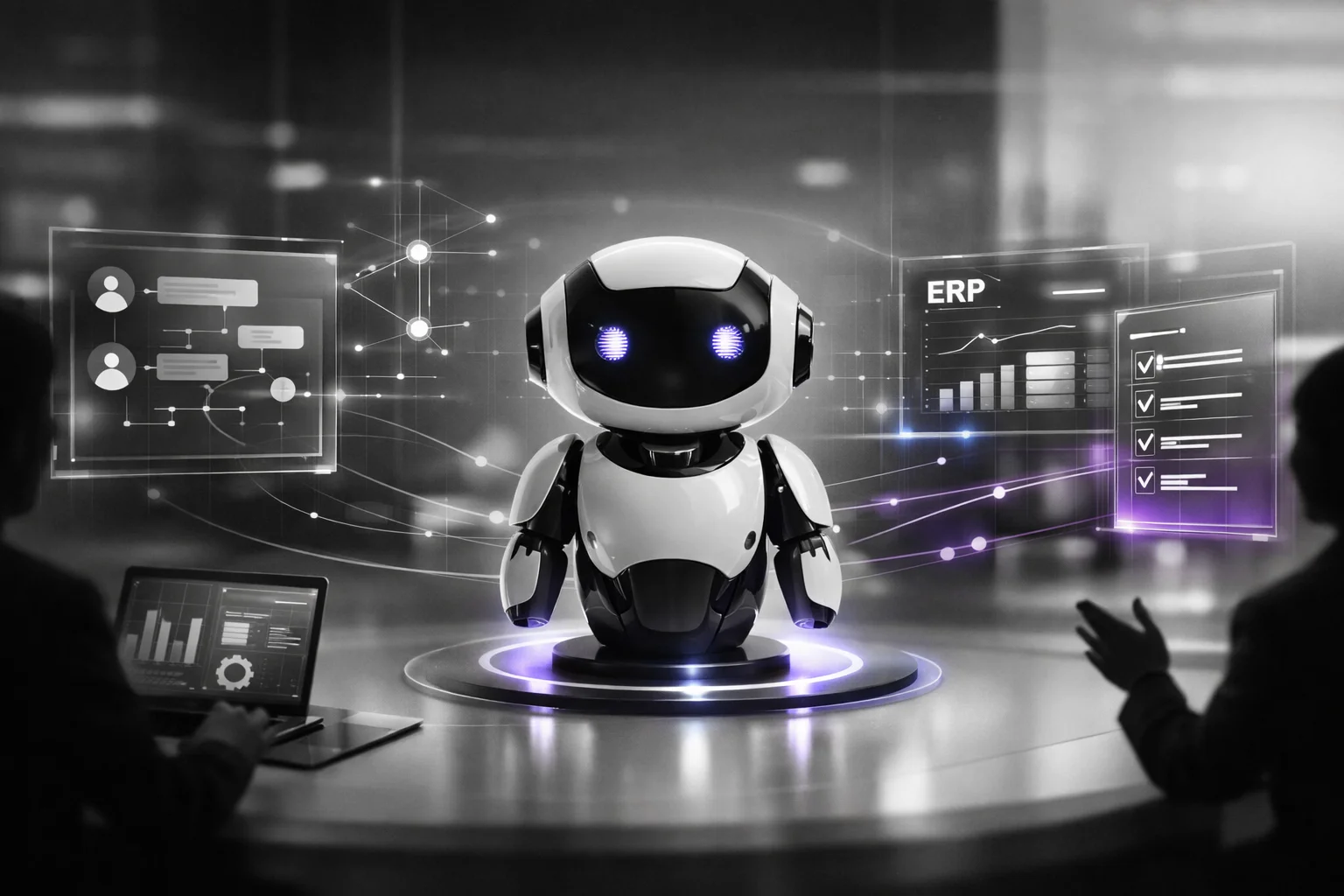
Design Supply Chain AI Development Around Uncertainty, Not Illusions
Most supply chain AI breaks at the first disruption. Learn how uncertainty-first supply chain AI development builds plans that survive reality.

Most “AI-optimized” supply chain plans are wrong the moment they’re generated—because they quietly assume a world that never changes. The uncomfortable truth is that a lot of supply chain AI development today is just a smarter calculator wrapped around a fragile forecast. It looks optimal on a slide; it collapses at the first disruption.
If you run a modern supply chain, you don’t live in that slideware world. You live in the one with delayed containers, demand spikes, factory outages, regulatory surprises, and competitors who discount at the worst possible moment. You feel the gap between “AI promises” and the reality of stockouts, excess inventory, and late-night firefighting when the plan breaks.
The core problem isn’t AI itself. It’s that most tools force AI to operate in a deterministic frame—one forecast, one plan, one illusion of control. To build truly resilient supply chains, supply chain AI development has to start from explicit uncertainty modeling, not bolt-on risk dashboards after the fact.
In this article, we’ll unpack what that shift really means: stochastic modeling instead of single-point estimates, scenario planning baked into tools instead of PowerPoint, and simulation-based planning as a wind tunnel for decisions. We’ll walk through a practical blueprint to evolve your stack from fragile optimizers to uncertainty-ready supply chain AI solutions. And we’ll share how we at Buzzi.ai partner with teams to build systems that don’t just look optimal—they survive reality.
Why Deterministic Supply Chain AI Fails in the Real World
The Hidden Assumption: One Forecast, One Optimal Plan
Most enterprise planning tools, including a lot of impressive-looking pilots, are built on a quiet but deadly assumption: there is one best-guess view of demand and supply. Feed that into an optimizer, get a neat “optimal” plan, and you’re done. This is deterministic planning in a nutshell.
The optimizer itself might be brilliant. The problem is the frame. When you optimize against a single demand number, a single lead time, and a single view of available capacity, you’re telling the system that the future will match those values closely enough that it doesn’t matter. In a world of high demand variability and unstable logistics, that’s rarely true.
Imagine a consumer goods company that upgrades its demand forecasting models with ML and improves MAPE by 20%. The forecast looks tighter; dashboards are greener. But then a promotion overperforms—demand doubles in a few regions because a rival runs out of stock. The AI-generated plan, optimized for that single “best” forecast, has no slack. Shelves go empty, while other regions sit on surplus inventory.
What happens next is familiar: planners override the “smart” supply chain optimization outputs, build shadow spreadsheets, and lose trust in the system. The AI didn’t fail because it was stupid. It failed because the deterministic planning frame assumed away the uncertainty you actually live with.
Four Types of Uncertainty Most AI Models Ignore
To understand why deterministic systems break, we need to name the different kinds of uncertainty they ignore. Not all risk is the same, and each requires different uncertainty modeling choices.
First, there’s demand variability: seasonality, promotions, competitive actions, macro shifts. Demand doesn’t just go “up 5%”—it moves in ranges, with skew and fat tails. Then there’s lead time variability: port congestion, customs delays, carrier reliability. A lane with a nominal 10-day transit might swing from 7 to 25 days depending on external factors.
Third is capacity and logistics variability: unplanned downtime, labor shortages, truck availability, warehouse constraints. Finally, there’s disruption risk modeling: supplier failures, geopolitical events, weather extremes. These don’t show up every week, but when they hit, they redefine the baseline.
Most planning dashboards compress all this into single numbers: “10-day lead time,” “2-week production cycle,” “95% supplier reliability.” It’s easier to show, but it hides the range and the correlations that matter. When a major port clogs, transit times spike exactly when demand surges for certain SKUs. When a supplier shuts down unexpectedly, lead time isn’t just “a bit longer”—it becomes “unknown.” Ignoring this structure is why many “AI-enabled” tools fall apart in volatile markets.
The Cost of Overconfidence: When ‘Average’ Kills You
Deterministic AI is essentially an engine for optimizing around averages. If average demand is 1,000 units and average lead time is 10 days, it finds the cheapest way to support that. But your risk doesn’t live at the average. It lives in the tails.
In a stable world, optimizing for expected values might be fine. In a world of fat tails and regime shifts—COVID, canal blockages, energy shocks—it’s a recipe for systemic failure. As McKinsey’s research on supply chain resilience shows, disruptions that used to be “once in a decade” are now regular features of the landscape.
Consider a distributor whose average inbound lead time from Asia is rock steady at 30 days. Dashboards show no trend. But the variance starts creeping up: some shipments are still 30 days, some 45, some 60. A deterministic system anchored on the average doesn’t react. Inventory is set as if 30 days is reality. When a cluster of delayed containers hits, stockouts cascade through the network. On paper, the averages still look fine; in practice, service-level misses and expedited freight costs explode.
This is where optimization under uncertainty comes in. If you want resilient supply chains, you can’t ask, “What’s the cheapest plan for the average case?” You need to ask, “What plan keeps service levels and downside risk within our tolerance across a range of futures?” That shift requires stochastic, scenario-based, and robust optimization—not just better solvers on bad assumptions.

Stochastic Supply Chain AI Development: What It Really Means
From Single Numbers to Probability Distributions
So what does it mean to design stochastic supply chain AI solutions rather than deterministic ones? At its core, it means modeling key inputs—demand, lead times, capacity—as probability distributions instead of single numbers. That’s the essence of stochastic modeling.
In plain language: instead of saying, “Next month’s demand is 10,000 units,” we say, “There’s a 50% chance demand will be between 9,000 and 11,000, a 20% chance it’s higher, and a 10% chance it’s much higher.” Instead of “lead time is 10 days,” we say, “Most of the time it’s 8–12 days, but 10% of the time it’s 20+.”
We can learn these distributions from historical data, but also from external signals (macro data, search trends, weather, competitor behavior) and expert judgment. The result is probabilistic forecasting—a cone of possible futures, each with a probability, rather than a single fragile line. Once your AI for supply chain uncertainty modeling runs on distributions, it can optimize against a landscape of possibilities instead of pretending there’s one future.
This isn’t academic nuance. It’s what lets you design policies that are slightly less “perfect” in the best case but dramatically more robust in the real world.

Monte Carlo Simulation and What-If Analysis in Plain English
Once you have distributions, you can do something powerful: simulate thousands of possible futures and see how your plan holds up. That’s what Monte Carlo simulation really is—an industrial-strength version of the “what if?” questions your planners already ask.
In practice, you let the computer draw random samples from your demand, lead time, and capacity distributions. Each draw is one possible future. You run your replenishment policy or allocation logic through that future and record what happens: stockouts, service levels, inventory peaks, backlog time. Then you repeat this process thousands of times.
This is the backbone of simulation-based planning. Instead of asking, “What happens if demand is +20%?” you ask, “Across thousands of plausible futures, how often do we miss our service-level target? How much inventory do we typically carry? How bad are the worst 5% of cases?” Your digital twin for supply chain becomes a sandbox for risk-informed decisions.
For example, you might compare two replenishment policies: one that minimizes average inventory and one that holds a bit more safety stock for high-variance SKUs. Monte Carlo results could show that the “lean” policy saves 3% on average inventory but doubles stockout frequency and triples expedite costs. Now the trade-off is explicit and quantified.
Robust Optimization vs Traditional Optimization
Traditional optimization answers, “What’s the best plan given these inputs?” It’s fantastic if the inputs are right and the world behaves. But for optimization under uncertainty, we need a different question: “What plan performs acceptably across a range of uncertain conditions?” That’s where robust optimization comes in.
Robust optimization builds constraints and objectives around performance distributions, not single outcomes. A classic example is a service level constraint: “Maintain 95% fill rate across all plausible demand scenarios.” The optimizer is allowed to trade cost against robustness, but only within that service-level envelope.
Imagine designing a transportation plan. A least-cost solution might route everything through the cheapest port, with no redundancy. It looks great—until that port faces a labor strike or closure. A robust plan might diversify flows across multiple ports and carriers, costing 2–3% more in steady state but maintaining 90%+ service under disruptions that would cripple the “optimal” plan.
Done right, supply chain optimization becomes a design problem under uncertainty, not a math trick on top of wishful thinking. Your supply chain AI development efforts should explicitly target this robustness, not just prettier dashboards.
Designing Uncertainty-Ready Supply Chain AI: A Practical Blueprint
Step 1: Map Your Uncertainty Landscape
Before you change models, you need to change how you see your system. The first step toward uncertainty-ready AI is a structured map of where uncertainty actually lives in your network. Think of it as turning “stuff happens” into a concrete risk register.
Start with four buckets: demand, supply, logistics, and external risk. For each, list your main drivers of volatility. On the demand side, note products with high demand variability, promotional sensitivity, or exposure to macro swings. On the supply side, list long-lead items, fragile suppliers, and components sourced from concentrated regions.
Then quantify what you can. For demand: coefficients of variation by SKU, seasonality patterns, promotion uplift factors. For supply: lead time variability by lane, supplier on-time performance, minimum order quantities. For logistics: lane reliability, capacity fluctuations, historical bottlenecks. This exercise immediately shows where ai for supply chain uncertainty modeling will pay off fastest.
A mid-market manufacturer, for instance, might discover that 20% of its raw materials—with long, volatile lead times—drive 80% of its stockout risk. That insight turns a vague “we need better forecasting” complaint into a targeted roadmap: start by modeling these materials stochastically instead of treating them like deterministic inputs.
Step 2: Upgrade Demand and Inventory Models to Probabilistic
Once you know where uncertainty matters most, the next move is upgrading your demand and inventory models from points to ranges. This is where supply chain demand forecasting AI with stochastic models earns its keep.
Technically, that might mean moving from a single ML regression model to quantile regression, Bayesian approaches, or ensemble methods that produce full predictive distributions. Practically, it means your planners stop seeing “Forecast = 1,000” and start seeing “P10 = 800, P50 = 1,000, P90 = 1,300” for a given horizon. Those ranges then feed directly into inventory optimization and safety stock calculation.
With probabilistic inputs, you can apply multi-echelon logic across your multi-echelon supply chain: which tier should hold safety stock for a high-variance SKU, and how much, given service-level targets and cost-to-serve? For long-lead or promotion-sensitive items, these models can quickly highlight where you’re structurally under-covered or over-inventoried.
One effective way to start is a focused pilot on a subset of SKUs: for example, the top 100 volatile items that drive lost sales. Implement probabilistic forecasting and updated safety stock calculation for those, then measure the impact. It’s not uncommon to see stockouts drop meaningfully while overall inventory stays flat or even falls—because you’re finally sizing buffers where the uncertainty actually is.
Step 3: Embed Scenario Planning Frameworks into AI Tools
Probabilistic models answer, “What’s likely?” Scenario planning answers, “What if the world changes in more structural ways?” Both are necessary for top strategies for uncertainty-ready supply chain AI.
At a minimum, your planning environment should support three scenario types: base, stress, and opportunity. The base scenario reflects your best current view. Stress scenarios capture downside risks (e.g., a major supplier outage, a 30% demand drop in one channel, a fuel price spike). Opportunity scenarios explore upside cases (e.g., competitor failure, successful product launch) so you don’t get caught flat-footed by good news.
The key is to bake these scenarios into your AI tools, not into offline decks. A good ai driven supply chain risk management platform lets planners define, store, and compare scenarios in one place: what happens to capacity utilization, inventory, service, and margin under each? How do different policies perform?
These scenario views should also connect to S&OP / IBP. When executives debate investments or capacity shifts, they should be looking at live, scenario-based outputs, not static spreadsheets. Transparency is critical: the system should make clear which assumptions drive which recommendations, so leaders can argue about the right thing—the assumptions, not the math.
Step 4: Test Policies via Simulation Before You Go Live
The final step before trusting AI recommendations at scale is to test them in a safe environment. This is where simulation-based planning and digital twin for supply chain concepts converge into something pragmatically useful.
Think of it as a wind tunnel for your policies. You encode your replenishment rules, allocation priorities, and capacity plans in a simulation model. Then you feed it stochastic inputs—demand and lead-time distributions, supplier reliability profiles—and run many simulated futures via Monte Carlo simulation. The output is a distribution of outcomes: service-level performance, stockouts, inventory turns, backlog, and expedites.
In one case-style example, a retailer considering a new “lean” allocation rule discovered through simulation that, under certain demand spikes, the rule amplified a bullwhip effect across DCs. The policy looked fine in an average-case scenario but created dangerous oscillations in stress cases. Because they caught it pre-deployment, they adjusted the rule and avoided real-world pain.
This kind of data-driven supply chain decision making doesn’t just prevent failures; it builds trust. Planners and executives can see, quantitatively, how a policy behaves across many futures before turning it on. That confidence is often what separates AI experiments from AI embedded in daily operations.
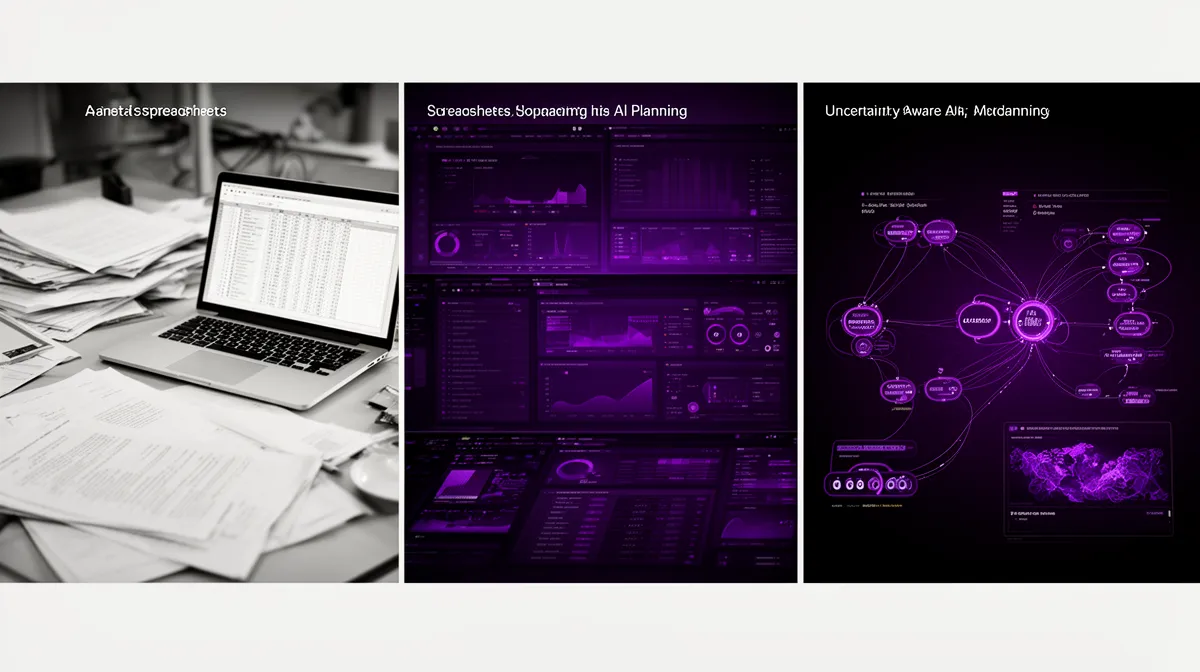
As you progress through these steps, specialized partners can accelerate the journey. For instance, Buzzi.ai’s predictive analytics and forecasting services are designed to help teams move from deterministic spreadsheets to uncertainty-aware models and workflows without ripping out existing systems.
Data, Metrics, and Governance for Uncertainty-Aware Supply Chain AI
The Data You Actually Need for Stochastic Models
Uncertainty-first AI sounds sophisticated, but the data requirements are more attainable than many teams assume. You don’t need a perfect data lake to start building ai for supply chain uncertainty modeling. You need the right granular history and a plan to improve it over time.
At minimum, that means: detailed historical demand (ideally at daily or weekly level, by SKU-location), order lines, promotion flags, and price changes. On the supply side, you want planned versus actual lead times by lane and supplier, supplier performance metrics, capacity data, and downtime logs. For logistics, collect transit times, delays, and capacity constraints by route and mode.
From there, you can engineer features for uncertainty modeling: empirical lead time distributions per lane or supplier, volatility measures for demand, promotion uplift factors by category, and indicators for special events. You’ll also clean outliers, adjust one-off events, and standardize time buckets. This is classic predictive analytics in supply chain, but with explicit focus on distributions instead of means.
For example, instead of storing “lead time = 15 days” for a route, you compute the actual distribution of historical lead times. That distribution then feeds directly into your stochastic models and Monte Carlo runs. Imperfect data is fine as long as you iterate: start with what you have, learn where it misleads you, and refine.
Metrics That Reflect Robustness, Not Just Average Cost
Once your models reflect uncertainty, your metrics have to follow. Otherwise, you’ll accidentally punish robustness and reward fragility. Traditional KPIs like average cost or MAPE don’t see tail risk; they reward the cheapest plan for the expected case.
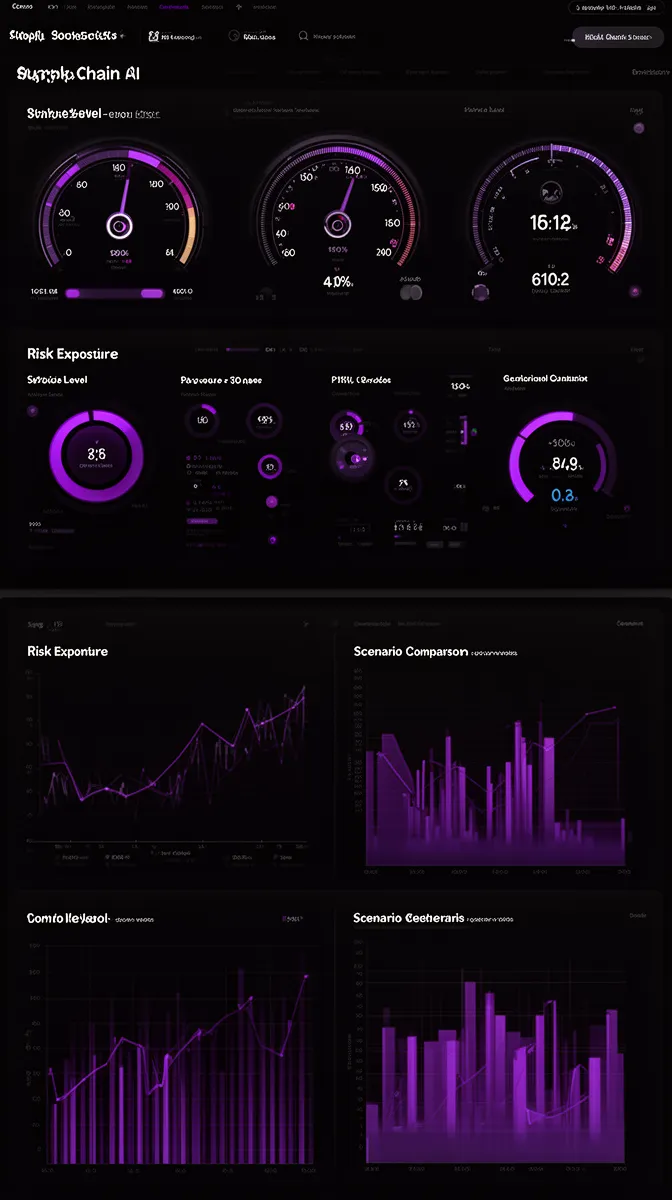
For uncertainty-ready AI, you need metrics that surface performance under stress. Examples include: service level under disruption scenarios, downside risk to margin (e.g., 5th percentile outcome), frequency and severity of stockouts versus plan, and a resilience index (like time to recovery after a disruption). These metrics complement, not replace, cost and forecast accuracy.
Explicit service level constraints are critical too. Leadership should articulate risk appetite: which products or customers must be protected at 99% service, and which can tolerate 90%? That clarity lets your models optimize trade-offs instead of guessing. It also supports better supply chain risk management conversations in the C-suite: you can show how different service-level promises drive inventory, capacity, and cost under uncertainty.
Picture a KPI dashboard where conventional metrics sit alongside robustness indicators. Executives can see that while average inventory is flat, the probability of catastrophic stockouts has fallen and time to recovery from simulated disruptions has improved. That’s what resilient supply chains look like in numbers.
Governance: How to Trust AI When the Future Is Uncertain
The more your decisions depend on AI, the more governance matters. Under high uncertainty, you’re not just asking, “Is the model accurate?” You’re asking, “When should we trust it, when should we override it, and how will we know when the world has changed enough to retrain?”
A good governance framework starts with decision rights. For low-risk, high-volume decisions—say, replenishing stable SKUs—you might allow automatic execution of AI recommendations. For volatile categories or major allocation choices, you keep a human-in-the-loop. This blend of ai-driven decision making and human judgment should be intentional, not accidental.
You also need monitoring: drift detection on demand patterns, volatility indices, and model performance under new regimes. When volatility spikes, your ai transformation services should include alerts that tell planners, “The environment we trained on no longer matches reality; review policies and thresholds.” Documentation of assumptions, data sources, and scenario definitions creates auditability, which matters for regulators and for internal trust.
Finally, don’t underestimate change management. Planners need training to interpret ranges, probabilities, and scenario comparisons. They need to see that uncertainty-aware tools are not black boxes but structured ways to make their implicit judgment explicit and scalable. Here, practical aids like clear UI, explainable probabilistic outputs, and even workflow and process automation for AI-driven planning can make the difference between adoption and abandonment.
Choosing the Right Partner for Supply Chain AI Development
Questions to Ask Any Supply Chain AI Vendor
Not all supply chain AI development services are created equal—especially when it comes to uncertainty. Many vendors still sell deterministic engines with “AI” sprinkled on top. To avoid that trap, your RFP and demos should probe specifically for uncertainty-first capabilities.
Ask: How do you model demand and lead time variability? Can your system output full predictive distributions, not just point forecasts? Do you support Monte Carlo simulation and simulation-based planning natively, or is that an add-on? How does your platform handle scenario planning, and can planners easily define and compare stress and opportunity scenarios?
On integration, dig into how they connect with your ERP, WMS, TMS, and existing planning tools. A credible enterprise supply chain AI implementation partner should be comfortable augmenting your current stack rather than insisting on a full rip-and-replace. Finally, ask for war stories: When have their models failed due to regime shifts, and what did they change? Vendors who can’t answer that are either new or not paying attention.
How Buzzi.ai Builds Uncertainty-First Supply Chain AI
At Buzzi.ai, we approach supply chain AI development from the uncertainty side first. We start with an uncertainty mapping workshop to surface where volatility actually drives value and risk in your network. From there, we design stochastic models, scenario frameworks, and simulation tests around your real constraints—not around an idealized textbook network.
Our stochastic supply chain AI solutions are built to integrate with your existing systems and workflows. We don’t assume you’re going to throw away your ERP or planning tools. Instead, we aim to make those systems smarter and more resilient by plugging in probabilistic forecasting engines, robust optimization modules, and simulation capabilities that reflect how your business really operates.
Equally important, we focus on planner adoption. That means explainable probabilistic outputs, transparent assumptions, governance-by-design, and training that respects the expertise of your team. Whether you’re a fast-growing startup or a complex enterprise, our ai implementation services are built to meet you where you are and help you move, step by step, toward an uncertainty-ready future.
For example, with a regional retailer struggling with stockouts on long-lead imported SKUs, we might start with a pilot that introduces probabilistic demand forecasts on those items, revises safety stock policies, and tests everything in simulation before rollout. Once the value is proven, we expand the approach across categories and nodes. It’s a pragmatic way to bring AI for startups and AI for enterprises to life in supply chains that don’t have the luxury of hitting pause.
Conclusion: Build for the World You Actually Live In
Deterministic supply chain AI fails not because the algorithms are weak, but because the framing assumes away the volatility you face every day. If your tools still optimize against single forecasts and fixed lead times, they’re building plans for a world that doesn’t exist. In that world, “average” performance looks good right up until it doesn’t.
When you embrace stochastic modeling, probabilistic forecasting, and robust optimization, AI becomes an asset in turbulence, not just in calm seas. Scenario planning and simulation-based planning let you test strategies before they hit operations. Robust metrics and governance frameworks then help leaders trust AI decisions, explain them, and prove ROI with fewer expedites, fewer write-offs, and more stable service levels.
The next step doesn’t have to be a wholesale transformation. Pick one critical planning process—say, inventory planning for volatile SKUs—and re-examine it through an uncertainty-first lens. If you’d like a partner for that journey, explore Buzzi.ai’s predictive analytics and forecasting services or reach out to discuss a pilot that combines stochastic modeling, scenario planning, and simulation-tested policies tailored to your supply chain.
FAQ: Supply Chain AI and Uncertainty
Why do deterministic supply chain AI models fail in real-world operations?
Deterministic models assume a single “best guess” for demand, lead times, and capacity, then optimize around that static view. In reality, these inputs fluctuate, often with fat tails and regime shifts that averages can’t capture. When the world deviates from the assumed point, the plan quickly breaks, leading to stockouts, excess inventory, and constant manual overrides.
What is stochastic modeling in supply chain AI and how does it work?
Stochastic modeling represents key variables—like demand and lead times—as probability distributions instead of fixed numbers. AI systems then use these distributions to simulate many possible futures and design policies that perform well across that range, not just in one forecast. This approach makes supply chain decisions more robust to volatility and unexpected shocks.
How can AI help model uncertainty in demand, lead times, and capacity?
AI can learn patterns of variability from historical data, external signals, and expert input to build probabilistic demand and lead time models. It can then run Monte Carlo simulations to see how different replenishment, allocation, and capacity strategies behave across thousands of futures. The result is a set of policies tuned to your specific risk profile, instead of generic safety factors.
What are the main types of uncertainty in modern supply chains that AI must handle?
Modern supply chains face uncertainty in demand (seasonality, promotions, competitive moves), supply (supplier reliability, quality issues), logistics (port congestion, carrier performance), and external risks (geopolitics, pandemics, weather). Each type has different statistical behavior and correlation structures. Effective AI solutions model these explicitly rather than compressing them into single averages.
How does Monte Carlo simulation apply to supply chain planning and optimization?
Monte Carlo simulation generates many random but plausible futures based on your probabilistic models of demand, lead times, and capacity. For each future, it runs your planning policies and records outcomes like service levels, stockouts, and inventory peaks. By aggregating results, you can compare strategies based on their full risk profiles, not just average performance, and choose plans that align with your resilience goals.
What is the difference between robust optimization and traditional optimization in supply chain AI?
Traditional optimization finds the best solution given assumed inputs, implicitly trusting forecasts and lead times to be accurate. Robust optimization, by contrast, looks for solutions that maintain acceptable performance across many uncertain scenarios, often with explicit service level or risk constraints. It may trade a bit of average efficiency for dramatically lower chances of catastrophic failure when disruptions occur.
How can scenario planning frameworks be integrated into AI-powered supply chain planning tools?
Scenario planning frameworks let planners define base, stress, and opportunity scenarios directly inside their AI tools, rather than in offline spreadsheets. The system can then optimize and simulate policies under each scenario, making trade-offs transparent. This integration aligns tactical planning with strategic risk discussions in S&OP and IBP processes.
Which AI techniques are best suited for probabilistic demand forecasting and inventory planning?
Techniques such as quantile regression, Bayesian time-series models, Gaussian processes, and ensemble machine learning methods are well-suited to probabilistic forecasting. They output full predictive distributions rather than single values. These outputs then feed into inventory and multi-echelon optimization models that explicitly target service-level and risk objectives.
How can digital twin and simulation help test supply chain AI against uncertainty?
A supply chain digital twin is a virtual replica of your network, enriched with stochastic models of demand, lead times, and capacity. By running simulation and Monte Carlo experiments on this twin, you can evaluate new policies, AI recommendations, and network designs before deploying them. This “wind tunnel” approach reveals hidden failure modes and builds confidence in AI-driven changes.
What metrics should be used to evaluate uncertainty-ready supply chain AI models?
Beyond standard KPIs like cost and forecast accuracy, you should track service levels under stress scenarios, probability and severity of stockouts, downside risk to margin, and time-to-recovery from simulated disruptions. These robustness metrics show how well your AI supports resilient operations. They also help demonstrate ROI in terms of fewer expedites, write-offs, and service failures.
How can enterprises transition from spreadsheet-based planning to uncertainty-aware AI planning?
A practical path starts with mapping key uncertainties, then piloting probabilistic forecasting and simulation on a focused SKU or category set. From there, enterprises can integrate scenario planning into existing tools, roll out robust optimization policies, and gradually automate low-risk decisions. Working with partners like Buzzi.ai that specialize in uncertainty-first design can shorten this journey and reduce execution risk.
What data is required to build effective stochastic supply chain AI models?
You need detailed historical demand, order lines, promotions, prices, lead times (planned and actual), supplier performance, capacity utilization, and logistics transit times. Clean, granular data allows AI to learn realistic distributions and correlations. Over time, you can enhance models with external data such as macro indicators, weather, and market signals.
How should organizations govern and monitor AI-driven supply chain decisions under uncertainty?
Organizations should define clear decision rights, specifying which recommendations can be auto-executed and which require human review. They also need monitoring for model drift, volatility shifts, and performance degradation, with alerts that trigger retraining or policy review. Governance frameworks should document assumptions and scenarios, ensuring transparency for leaders and regulators.
What are common pitfalls when implementing AI for supply chain risk management?
Common pitfalls include treating AI as a bolt-on to deterministic planning, underestimating data quality issues, and over-automating high-stakes decisions without proper governance. Many teams also neglect scenario planning and simulation, relying too heavily on historical averages. Avoiding these traps requires a deliberate, uncertainty-first design philosophy and the right implementation partner.
How does Buzzi.ai’s approach to supply chain AI differ in its treatment of uncertainty?
Buzzi.ai starts every engagement by explicitly mapping uncertainty and designing models around it, instead of forcing AI into deterministic workflows. We combine stochastic modeling, scenario planning, and simulation-based testing to ensure recommendations hold up across many futures. To see how this works in practice, explore our predictive analytics and forecasting services or contact us to discuss a tailored pilot for your network.