Sales Forecasting Services That Match Your Sales Process
Most sales forecasts are fiction with a spreadsheet attached. That's blunt, but the numbers back it up: Gartner research cited by Apollo says only 7% of sales...

Most sales forecasts are fiction with a spreadsheet attached. That's blunt, but the numbers back it up: Gartner research cited by Apollo says only 7% of sales organizations hit 90%+ forecast accuracy, and most teams sit in the 50-70% range.
That's why sales process forecasting services matter more than another dashboard, another roll-up call, or another heroic end-of-quarter cleanup. Everyone says forecasting is a data problem. Actually, that's not quite right. The real issue is process fit. If your pipeline stages, deal definitions, and CRM habits don't match how your buyers actually buy, your forecast won't deserve anyone's trust.
In this article, you'll see what the best sales forecasting services get right, where generic tools fall short, and how to build forecast trust and adoption across your sales team.
What Sales Forecasting Services Actually Do
Everybody says sales forecasting is a data problem. Better model. Better AI. Better dashboard. That's the standard pitch, and sure, it sounds good in a boardroom. I think it's also how teams end up with forecasts that look sharp in a slide deck and collapse by Tuesday's pipeline review.

The missing part isn't glamorous. It's process.
I've seen teams obsess over historical sales data, lead scoring, and win-rate models while reps were still advancing deals on gut feel. One manager treated a strong demo like late-stage confidence. Another wouldn't move the same deal until procurement got involved. Same CRM. Same quarter. Completely different meanings. That's not forecasting. That's private mythology with reporting attached.
That's what sales forecasting services are really there to fix.
The useful ones don't just produce a number and call it science. They take messy pipeline behavior and force clarity into it: what counts as a real stage change, what pipeline coverage actually means for this team, how conversion rates behave by stage, how old deals are, when they tend to close, and whether any of that matches how buyers move in real life. They pull from CRM activity and historical sales data, yes. But if that's all they do, you've bought a calculator with better branding.
ThoughtSpot has said this plainly: custom forecast categories work best when they're tied to stages that reflect how the team actually sells. The Sales Collective found the same thing from another angle. In its 2025 audience profiling analysis of 123,197 professionals, 51% said implementing a structured sales process massively improved forecasting accuracy. Fifty-one percent. Not "a few people preferred it." More than half pointed to structure as the reason the forecast got better.
People usually get the trust part wrong too. They think trust comes from visibility. More dashboards, more widgets, more color-coded confidence scores. No. Trust comes from consistency. If one rep marks a deal as commit after a promising second call and another waits until legal review starts, the forecast isn't more precise because it has decimals on it. It's just dressed up.
A decent service starts with observable stage definitions. Not vibes. Not "qualified-ish." Actual buyer actions: security review started, budget confirmed, mutual close plan agreed, legal sent redlines back. I've watched teams cut argument time in forecast calls by 30 minutes a week just by defining stages that way. Then you connect those stages and their conversion rates to forecast categories so sales, finance, and leadership stop speaking three dialects of the same language.
Only after that should win-rate modeling and lead scoring come in. Not first. That's where a lot of companies go sideways. They try to model chaos before they've named it.
Then there's the boring part nobody brags about: cutting admin drag so reps keep records current without doing their Friday 4:47 p.m. cleanup because leadership wants numbers before Monday's meeting. That detail matters more than most teams admit. According to a 2026 Rox report, Clari users reported a 90% reduction in time spent on forecasting-related activities. Less friction usually means fresher data. Fresher data beats elegant nonsense every single time.
If you want the technical side of reducing manual work, see predictive analytics forecasting. But here's the blunt version: if your forecast doesn't match your actual sales motion, nobody's going to trust it. And if they don't trust it, what exactly did you build?
Why Generic Forecast Models Fail Sales Teams
Hot take: most forecast misses aren't a model problem. They're a sales hygiene problem wearing a math costume. I think too many teams hide behind formulas because it sounds smarter than admitting the pipeline is messy. The model gets blamed. The process should.

Here's what that looks like in real life. Salesforce says a deal is commit. The manager says, "maybe." The rep says, "well, if legal turns it today." I've sat in calls like that with eight people staring at the same dashboard and nobody meaning the same thing by the same stage. That's not forecasting. That's improv with commission checks on the line.
The usual routine is painfully familiar: pull a few quarters of historical data, average performance, apply broad win rates, split by region or segment, ship the report. Clean spreadsheet. Dirty inputs. An average can smooth over the exact thing that matters most — whether revenue closes this month or slides by 47 days because procurement went dark and nobody logged it.
The biggest offender? Stage labels. Two opportunities can both sit in stage three and have almost nothing in common. One has been sitting there for 45 days with no next meeting booked. The other already has procurement involved, security review underway, and two executive calls completed. Generic forecasting services often treat those deals as near twins because the CRM tag matches. That's the flaw. Not some tiny defect buried in a formula.
Zendesk has been pretty direct about this: if you want consistent data and better forecasting, you need standardized stages and repeatable steps. They're right. If one rep moves an opportunity to stage four after a decent demo and another waits until security signs off in Salesforce, your forecast is already corrupted before anyone opens a dashboard.
It gets worse when companies shove totally different motions into one model and act surprised when nobody trusts it. Self-serve expansion deals don't behave like mid-market demo cycles. Mid-market doesn't behave like enterprise deals where legal, procurement, security, and three executives show up in week nine and slow everything down by 21 days. Jam all of that into one pipeline view and confidence falls apart fast.
ZoomInfo makes a point more teams should take seriously: forecasting tools can be configured around your actual sales process using stages, probability percentages, and custom fields. Sounds obvious. It isn't. I've seen teams skip that work because it feels tedious, then spend two quarters arguing about why the call was missed by 18%.
The numbers back this up. Forecastio cites 2026 Gartner research showing companies that forecast within 10% of actuals are more than twice as likely to post consistent year-over-year growth. A 2026 Rox report says Clari helped teams reach 95%+ forecast accuracy. Not magic. Better setup. Better inputs. Better reflection of how deals really move in the field.
So do it differently. Define stages around buyer actions, not rep optimism. Split your models by motion, segment, or sales-cycle length instead of pretending every deal follows the same path. Fix that first. Then layer in activity signals from tools like Salesforce or HubSpot, opportunity aging rules, lead scoring, and conversion thresholds once the base stops wobbling.
If you're rebuilding now, predictive analytics forecasting is where this gets practical fast.
The part people never expect? A harsher forecast often earns more trust than a cheerful one. Pretty numbers don't help much. Honest ones do — especially the kind that make everyone uncomfortable while there's still time to fix something.
The Sales Process Factors Forecasting Must Understand
What does “proposal” actually mean?

I’m not asking for the CRM definition. I mean in real life, on a Monday at 8:07 a.m., on the forecast call, with a quarter hanging there and everyone pretending the stage names are doing more work than they are. I’ve watched one rep say “proposal” because procurement had already rejected pricing twice. Same meeting, another rep said “proposal” because he sent a deck on Friday and liked the energy on the call. Same label. Not even close to the same deal.
People still act like clean stage mapping equals understanding. It doesn’t. It just means the dropdown fields look tidy. I think that’s where a lot of sales process forecasting services fall apart: the labels stay neat while the behavior underneath goes feral, and then everyone acts shocked when the number misses.
Forecastio made this point pretty directly: forecasting software improves when sales stages and opportunity definitions are standardized and tied to the actual sales methodology. Obvious? Sure. Common? Not really. I’ve seen teams with immaculate Salesforce dashboards where three reps gave me three different answers for what “evaluation” meant, and all three said it confidently.
Here’s the answer: stage names prove almost nothing by themselves.
But that doesn’t mean process doesn’t matter. It means process has to match how the team actually sells, and that starts with sales cycle length because cycle length changes nearly everything about how a forecast should work.
A team closing in 21 days shouldn’t forecast like a team living inside 210-day enterprise deals. That sounds basic until you see companies ignore it. Short-cycle SMB motions need weekly pipeline trend checks, conversion tracking, and plain old volume discipline. Long-cycle enterprise motions need aging rules, milestone checks, and somebody willing to kill fantasy close dates before they contaminate the quarter.
You can see it fast in the field. An SMB team can lean harder on recent weekly movement because smaller deals tend to bunch up and convert quickly. An enterprise team can’t get away with that. They have to watch slippage, legal review timing, security approvals, procurement delays, and whether an executive sponsor ever showed up at all. One six-figure deal slipping 19 days can ruin the quarter by itself.
Then I’d stop staring at stage counts for a second and look at movement between stages instead. A fat pipeline can still be junk. If 40 deals enter discovery and only 8 reach solution fit, top-of-funnel volume probably isn’t your issue. Qualification is weak, or reps are dragging deals forward early because nobody wants to explain why they’re stuck.
The 2025 Sales Collective number fits that reality: 51% said a structured sales process massively improved forecasting accuracy. That sounds right to me, not because structure makes dashboards prettier, but because it gives you cleaner movement data. That’s the useful part.
Velocity gets abused too. People talk about speed like fast automatically means healthy and slow automatically means dead. That’s lazy thinking. Fast can mean rushed garbage. Slow can mean a real enterprise buying process doing what enterprise buying processes do. Stalled deals are different though. Those wreck timing, and timing is where forecasts usually go off a cliff.
Historical sales data helps if you don’t mash everything into one generic probability model. Build win-rate views by segment, deal size, and motion type. Compare current deals against those patterns instead of pretending a renewal behaves like net-new enterprise business or that channel looks like direct sales just because both end up in one report tab.
Rep behavior sneaks into all of this whether leadership likes it or not. If one manager requires budget confirmation before moving an opportunity into evaluation and another moves it on pure enthusiasm, your forecast categories stop being predictive. They become political. Worse than that, they stop being trusted.
Forecastio cited Gartner research in 2026 showing fewer than 50% of sales leaders were confident in their team’s forecasting accuracy. Of course they weren’t. If stage progression depends on who inspected the deal instead of what actually happened in the account, why would anybody trust the roll-up?
And I really don’t buy the idea that you can average unlike motions together and call it rigor. Enterprise needs one logic set. Mid-market needs another. Renewals behave differently from channel deals too. Blend them together and you get a nice-looking number that feels scientific right until reality shows up.
Clari Labs data cited by ORM in 2026 said 87% of enterprises missed revenue targets in 2025. Markets were rough, sure. But I’d argue a lot of teams helped create that outcome themselves by forcing every motion through one forecasting method when they should’ve been using several.
The fix is boring, which is usually how you know it works: use predictive analytics forecasting with inputs tied to how selling actually happens — lead scoring, stage entry criteria, segment-level conversion rates, rep compliance patterns, close-date reliability. That’s how forecasting becomes useful instead of something built to survive a QBR slide review.
So if your next forecast still treats two “proposal” deals as basically equal, what exactly are your stages measuring besides optimism?
How Process-Informed Sales Forecasting Services Work
Here's the part people hate hearing: your forecast probably isn't broken because the math is weak. It's broken because your stage names are lying to you.

I think too many teams buy the shiny part first. AI scoring. Probability curves. Dashboard screenshots for the board deck. Meanwhile, “proposal sent” is still doing absurd amounts of work inside the CRM.
I've watched this go sideways in real life. One rep says “proposal sent” because a PDF left their inbox at 4:47 p.m. on a Tuesday. Another uses the same stage only after procurement joined, legal got looped in, and pricing was argued over on a live call. Same label. Completely different deal reality. If those two records feed the same forecast logic, you're not forecasting revenue. You're averaging confusion.
IBM's standard is much stricter than most vendors sell, and honestly, that's a good thing. Pipeline stages should map to measurable buyer actions that show movement toward a close. Not internal hope. Not prettier reporting. Buyer actions.
Miss that and you get polished nonsense.
The weird middle step is the one that actually matters most: the service has to adapt to your selling motion. Not force your team into somebody else's template. That's where generic sales forecasting services lose people quietly. They install a canned process, your reps start bending around it, and now the tool is teaching the process instead of reflecting it.
The Sales Collective reported in 2025 that 42% said a structured sales process had the biggest impact on team performance. I don't read that as “be more disciplined.” I'd argue it means something more basic: if ten sellers use ten definitions for the same stage, your inputs aren't believable enough to forecast from.
Start with discovery, not modeling
Before anyone builds anything, they need to figure out how revenue actually happens in your business.
That means interviews. Sales leaders, frontline managers, ops, sometimes finance too. And the questions sound simple until they aren't: What really creates an opportunity? What has to happen before a deal can move? Which motions run at the same time but shouldn't be measured the same way?
A self-serve expansion motion closing in 14 days shouldn't sit in the same forecasting bucket as an enterprise procurement cycle stuck in security review for 90 days. I've seen companies do exactly that and then act surprised when nobody trusts the quarter call.
Rewrite stage definitions in plain English
The goal isn't prettier labels. It's shared meaning.
“Proposal” sounds clean right up until you test it across ten reps and discover five separate definitions hiding inside it. A serious sales process forecasting service replaces vague labels with observable buying signals: pricing review completed, technical validation passed, legal review opened.
Even that can go wrong if you're lazy about it. The real job is making sure stage movement means the same thing across reps, teams, and segments so historical data doesn't turn into fiction six months later.
Fix the CRM so it matches reality
Your CRM can't run on rep folklore.
This is where historical sales data gets lined up against actual stage rules, along with close-date behavior, loss reasons, and activity patterns. And this is usually where the mess shows up fast: skipped fields, inflated probabilities, dead deals left open for 120 days, close dates pushed three times because nobody wanted to mark something as stalled.
No mystery there. Bad inputs make bad forecasts.
Only then build the model
Model design comes after process clarity, not before it.
Once the process map is real, forecasting for sales teams can finally be built around how you actually sell: pipeline forecasting by segment, win-rate modeling by motion, even lead scoring if top-of-funnel quality clearly changes downstream conversion.
If you want the technical side behind that layer, see predictive analytics forecasting.
Test it against history before anyone trusts it
A forecast earns credibility by surviving contact with past quarters.
You check predicted versus actual outcomes by segment and by stage path before rollout. That's not theater. That's the first honest proof that the system can handle how your business really sells.
The benchmark is rough for a reason. Gartner research cited by Apollo in 2023 found only 7% of sales organizations hit forecast accuracy of 90% or higher. So yes, better models matter. But validation is what gets adoption because it's when people stop asking whether the number looks smart and start asking whether it's earned belief.
The funny part? A lot of companies think they're buying forecasting software when they're really paying to find out what their sales process actually is. Not sexy. Usually useful. And if that's what's waiting underneath your pipeline data, wouldn't you rather learn it now than after next quarter misses?
Building Forecast Trust Across Sales and Leadership
Monday, 8:07 a.m. The CRO has the board slide up. It says Q3 forecast: $4.8M. One rep is staring at Salesforce because two "late-stage" deals haven't had buyer replies in 11 days, a manager is defending a commit number nobody in the room really believes, and someone says, "Can we get a cleaner dashboard for next week?" I've watched that exact scene play out with Gong open on one screen and Excel on the other. Same ritual. Same bad outcome.

The problem usually isn't that people can't see the forecast. It's that they can't see what made it think that number was reasonable in the first place.
Everybody asks for more dashboards and more forecast calls. More charts. More inspection. More repeats of the same number in the Monday meeting. Sure, that can help a bit. I think it's also where teams waste months, because hearing a number ten times doesn't make it trustworthy. People trust a forecast when they can inspect the build: which assumptions are doing too much work, what evidence supports them, and how wrong the result could still be without anybody pretending it's a scandal.
That's where sales and leadership split fast. Reps look at the model and think, "This thing has no idea what's happening inside my deals." Executives look at that same forecast and think the field is sandbagging, guessing, or polishing hope until it looks like pipeline hygiene. Same spreadsheet. Totally different suspicion.
Then comes pressure. Tighter calls. Cleaner commit language. More deal inspection. I've seen this movie enough times to know the ending: a VP asks for "accountability," managers start grilling close dates, reps get better at sounding confident, and nobody gets better at reporting risk. If your sales process forecasting services can't show the logic under the number, pressure doesn't create honesty. It creates performance.
The accuracy numbers aren't subtle about this either. Apollo cited Gartner research in 2023 showing most teams land around 50% to 70% sales forecasting accuracy. That's not some tiny miss you smooth over in a quarterly review. That's what it looks like when the forecast is stuck between rep intuition and executive expectation, without a shared method either side can defend out loud.
People love to say visibility is the answer. It isn't. The missing piece is explainability tied to calibration.
Opaque forecasting gets compliance. Reps update fields because they have to. Explainable forecasting gets adoption, which is what you actually need if forecast trust and adoption matters more than everyone checking boxes before the pipeline call.
For reps, show the drivers at the deal level. If pipeline forecasting says next quarter looks soft, don't dump a top-line warning on them like it came down from a mountain tablet. Show stage conversion rates by actual stage. Show close-date slippage over the last 30 days. Show weak lead-scoring bands. Show that win-rate modeling fell in one segment while enterprise healthcare held steady and mid-market SaaS slipped. That's useful because a seller can push back on it or accept it based on something real.
Executives need something different. Show the roll-up assumptions plainly: expected conversion by stage, the historical sales data used to set baselines, where manager judgment overrode the model, where finance added caution, where reality is coming from data versus opinion. If a CRO sees Stage 3 modeled at 42% because that's what the last four quarters support, now you're having an adult conversation. If all they get is "Q3 forecast: $4.8M," they'll tear it apart on instinct.
And I'd argue one number is usually fake confidence dressed up nicely for leadership slides.
A credible forecast should show ranges. Say $4.4M to $5.1M instead of acting like $4.8M is holy truth because somebody put one decimal place on it in Google Slides. That range should come from stage progression, current opportunity quality, and how similar deals have actually moved before. Forecastio has pointed out that mature B2B teams do this better because they match forecasting methods to their sales model and data maturity, often mixing quantitative models with machine learning instead of betting everything on one method.
The wording matters too, more than people admit in public. "Commit," "best case," and "pipeline" sound obvious right up until leadership means one thing and reps mean another. I've sat in meetings where "best case" quietly meant legal would need to turn documents in 48 hours during Thanksgiving week so procurement could squeeze approval in by Friday afternoon. That's not best case. That's fantasy with decent CRM hygiene. Define those categories with measurable rules so forecasting for sales teams stops getting mangled by translation errors.
You also need feedback loops or this dies after one quarter of good intentions. Review misses every month and ask what failed: stage definition, conversion expectation, deal quality signal, manager judgment? Get specific about it. Maybe Stage 2 opportunities created after May 15 converted 18 points lower than baseline because inbound quality dropped after a campaign change. Good. That's something you can use.
The AI angle doesn't magically fix any of this either. The Sales Collective reported in 2025 that 60% are improving their sales processes with AI for customer segmentation. Fine. Helpful even. But better scoring alone won't make forecasts believable if nobody can explain why an account scored high, why conversion assumptions changed, or why judgment calls beat the model in three strategic accounts last month.
If you're building that explainability layer into model design instead of slapping on another dashboard tab later, predictive analytics forecasting is where this starts getting practical.
So before you add another call to the calendar or another chart to Salesforce, ask yourself something uglier and more useful: can both reps and leadership trace the number back to logic they'd actually defend?
What to Look for in Sales Forecasting Services
Hot take: the prettiest forecasting demo in the room is usually the one you should distrust first.
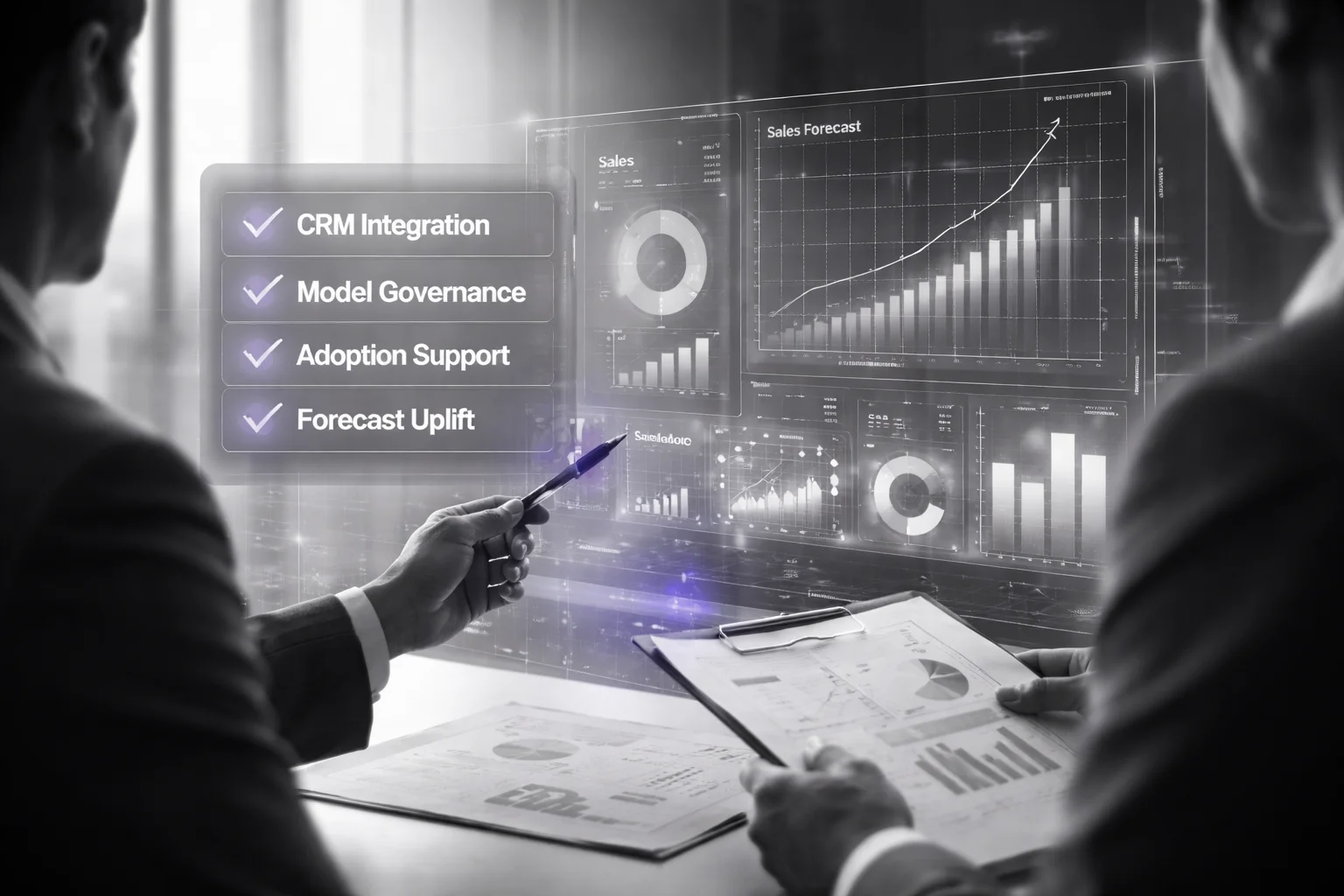
I’ve watched teams get sold on glossy dashboards, “revenue intelligence,” and enough AI language to fill a keynote, then spend 90 days discovering the tool still can’t explain why a deal sat in “proposal sent” for 17 days after legal disappeared. That’s the stuff that wrecks forecasts. Not the chart colors. Not the homepage copy.
Fullcast put a number on it in its 2026 report: 81% of sales leaders said bad forecasts came from disconnected data and gut-feel calls. I buy that. You can see it happen in real life — a rep updates Salesforce 48 hours late, a manager bumps commit numbers at 4:47 p.m. on Friday, and someone in ops is still exporting CSVs at 10:30 p.m. because HubSpot, Salesforce, and whatever reporting layer they bolted on don’t agree.
Salesforce’s buying advice is reasonable enough: match the tool to your team size, your sales process, and your tech stack; look for CRM integration, real-time sync, customizable dashboards, and collaboration features. Sure. That covers the brochure version of the problem. I think it skips the part that actually decides whether this thing lives or dies after launch: who owns the forecast logic once the consultants leave, and what happens if your stage definitions are sloppy to begin with?
That’s where most buyers get fooled. They shop from a feature sheet when they should be shopping for proof that a vendor can survive their actual operating mess.
- Process discovery depth: Don’t start with model setup. Start with how revenue really moves through your business. Ask whether they can map multiple motions, buyer-side actions, and ugly handoffs between SDRs, AEs, and customer success. If they can’t walk through why a deal sits frozen in one stage while everyone argues about next steps, they don’t understand your process.
- CRM integration: If you’re on Salesforce or HubSpot, make them show the field mapping live. Not “yes, we integrate easily.” Show how historical sales data flows in, how lead scoring updates, how activity signals land, and what breaks if one field is renamed by ops next month.
- Model governance: Ask who owns forecast logic after go-live. Who reviews win-rate models? How are manager overrides tracked? Who approves changes to assumptions? If nobody can answer that in plain English, you’re not buying software. You’re buying future arguments between sales leadership and rev ops.
- Adoption support: The Sales Collective reported in 2025 that 31% of teams were already using AI for automated follow-ups. Fine. Useful sometimes. But automation doesn’t fix distrust. If reps think the inputs are junk, all you’ve done is speed up bad assumptions.
- Measurable lift: Ask for before-and-after forecasting accuracy numbers. Actual numbers. Not “better visibility.” Not “improved alignment.” Give me a baseline and a result.
Buzzi.ai makes sense if you want this tied to the way your team already sells instead of dumped into the stack like one more dashboard nobody opens after quarter two. That’s the point of predictive analytics forecasting, at least as I see it: forecasting for sales teams has to feel believable every single week or people stop using it fast.
A vendor who can explain your workflow back to you better than your own ops manager? That’s interesting. A vendor who can only spin up polished charts? That’s decoration. So what are you actually paying for — insight, or nicer confusion?
The question worth sitting with
Sales process forecasting services work when they reflect how your deals actually move, not when they slap prettier math on messy pipeline data.
So if you're evaluating providers, start with your own process first: tighten CRM data hygiene, define measurable buyer signals for each stage, and ask exactly how the model handles deal stages and stage conversion, sales cycle length, seasonality adjustments, and confidence intervals. According to The Sales Collective (2025), 51% said implementing a structured sales process massively improved forecast accuracy, which tells you where the real lift usually comes from. And watch for any tool that promises sales forecasting accuracy without clear forecast governance, review cadence, and sales leadership alignment. Actually, that's not quite right. The real issue is whether your team will trust the number enough to change behavior because of it.
If your forecast still ignores how your buyers buy, is it really a forecast or just a more expensive guess?
FAQ: Sales Forecasting Services That Match Your Sales Process
What are sales process forecasting services?
Sales process forecasting services are forecasting systems and advisory methods built around how your team actually sells, not a generic probability template. They use your CRM pipeline stages, deal stages and stage conversion, sales cycle length, win rate modeling, and historical sales data to predict revenue in a way that matches your motion.
Why do generic forecast models fail so many sales teams?
Generic models usually fail because they treat every pipeline as if stages mean the same thing across every company. Actually, that's not quite right. The real issue is that many teams label stages consistently but don't tie them to measurable buyer actions, so pipeline forecasting turns into opinion instead of evidence.
How do sales forecasting services improve sales forecasting accuracy?
They improve sales forecasting accuracy by combining process data with performance data, things like stage conversion rates, lead scoring, historical close patterns, and quota attainment forecasting. According to The Sales Collective (2025), 51% said implementing a structured sales process massively improved forecast accuracy, which tells you the process itself is part of the forecast model, not just background context.
What sales process factors should be included in a forecast model?
The useful inputs usually include pipeline stages, exit criteria for each stage, sales cycle length, win rates by segment, average deal size, rep performance, and seasonality adjustments. If you sell across territories or pricing tiers, you also need scenario planning for those differences, or your forecast will look clean on paper and fall apart in the quarter.
Does CRM data quality really affect forecast outcomes?
Yes, directly. Poor CRM data hygiene, missing close dates, stale opportunity records, and inconsistent stage definitions weaken forecasting for sales teams because the model can't separate real pipeline movement from bad data entry. According to Fullcast (2026), 81% of sales leaders cite disconnected data and reliance on intuition as major obstacles to accurate forecasting.
How do process-informed sales forecasting services map CRM stages to forecast outcomes?
They connect each CRM stage to a forecast assumption based on actual conversion behavior, not gut feel. That means a stage like “proposal sent” might carry a very different probability for SMB than for enterprise, and better services keep recalibrating those assumptions as stage conversion, deal velocity, and loss patterns change over time.
How is forecast trust built with leadership and frontline teams?
Forecast trust and adoption improve when everyone can see the forecast methodology, review cadence, and assumptions behind the number. According to Gartner research cited by Forecastio (2026), fewer than 50% of sales leaders are confident in their team's forecasting accuracy, so trust usually comes from clear forecast governance, consistent inspection, and fewer last-minute surprises.
What should you look for in sales process forecasting services?
Look for services that match your sales motion, support bottom-up and top-down forecast methodology, handle confidence intervals, and fit your CRM and reporting stack. You also want customization around sales leadership alignment, scenario ranges, and forecast review cadence, because a forecast that no one uses isn't a forecast, it's just a dashboard.