RAG System Development That Maintains Quality
You can ship a flashy chatbot in two weeks. Keeping it accurate three months later is the part that bites you. RAG system development looks easy in demos, then...
You can ship a flashy chatbot in two weeks. Keeping it accurate three months later is the part that bites you. RAG system development looks easy in demos, then production shows up with stale documents, weird retrieval misses, rising latency, and answers that sound confident while being flat-out wrong.
That’s the real problem. Most teams obsess over the first launch and barely think about retrieval augmented generation quality once real users start hammering the system. I’ve seen smart teams tune prompts for days when the actual issue was retrieval drift monitoring, bad chunking, or a knowledge base that quietly went stale.
This article shows you how to build for quality that lasts, not quality that disappears after week one. I’ll walk through the systems, checks, and production habits that actually keep grounded responses grounded, because I’ve tested enough RAG setups to know where they break first.
What RAG system development Really Means in Production
RAG system development is the ongoing work of keeping retrieval, context, and answers aligned as your data changes. A live retrieval-augmented generation system isn’t “done” when you ship v1. It keeps moving, because your documents, users, and failure modes keep moving too.
I’ve seen teams celebrate launch week, then get blindsided 30 days later when answer quality quietly slips. Not because the model got worse. Because the index aged, the chunking strategy was sloppy, a new policy folder got dumped into the vector database, and nobody was watching retrieval relevance closely enough.
That’s production.
Here’s what people miss: a real system is a chain, not a chatbot. You’re dealing with ingestion pipelines, document parsing, metadata cleanup, chunking, embedding generation, ranking and reranking, prompt assembly, citation formatting, and feedback loops that tell you whether the thing is actually producing grounded responses. Miss one link and the whole setup starts lying with confidence, which is always a fun surprise for legal, support, or whoever gets yelled at first.
A few years ago, I worked on an internal assistant for a mid-sized insurance company with roughly 42,000 policy and claims documents, plus weekly compliance updates from three separate teams. Launch looked great. Then users started seeing citations to the right PDF but the wrong clause, because the chunks were too large, the ranking layer favored older high-frequency documents, and fresh files took 18 hours to hit the index. That wasn’t a model problem. It was a production RAG architecture problem.
So no, I don’t buy the “just connect a vector database and you’re good” advice. That line drives me nuts. Retrieval augmented generation quality depends on continuous evaluation, citation accuracy, and actual feedback from users who can flag bad answers before they spread.
And yes, you need a RAG evaluation framework early, not as cleanup work later. If you want a practical breakdown of citation design, read this guide on AI document retrieval and RAG citation architecture.
Next up, the messy part gets messier: once your system is live, drift starts showing up where most teams never bother to look.
Why RAG Quality Degrades Without Continuous Evaluation
A retrieval-augmented generation system can look sharp in April and quietly turn unreliable by May. That’s not edge-case behavior. It’s normal production behavior, and if your RAG system development plan doesn’t assume drift, you’re budgeting for disappointment.

Last quarter, I watched a perfectly decent internal assistant go sideways after a policy team “cleaned up” its SharePoint structure. Same documents, mostly. New folder logic, renamed files, revised acronyms, and a couple of merged PDFs. The model didn’t suddenly get dumb. The retriever started pulling stale sections, the ranking layer overfavored legacy language, and answer confidence still looked fine on the surface, which is exactly why this stuff is dangerous.
Here’s the part people underestimate.
Most teams treat drift like a content freshness problem. I don’t. In my experience, the nastier failure mode is semantic mismatch: your business changes the words before it changes the facts, so retrieval relevance drops weeks before anyone notices obvious answer errors. Support says “benefit activation.” Legal now says “coverage commencement.” Sales keeps using the old phrase anyway. Your system starts missing the best evidence, then stuffing the context window with near-matches, and grounded responses slowly turn into polished guesswork.
That’s where continuous evaluation stops being a nice-to-have and becomes operational hygiene.
You need a RAG evaluation framework that checks more than whether the final answer sounds good. I’d measure retrieval relevance, citation hit rate, answer faithfulness, and failure patterns by source type, because a broken PDF parser and a drifting embedding model create very different messes. Actually, scratch that, I’d start even earlier: monitor ingestion lag and document schema changes too, since those are often the first cracks in a production RAG architecture.
Business owners feel this fast.
Declining retrieval augmented generation quality kills trust long before anyone files a formal complaint. Then come the expensive parts: compliance exposure from outdated policy answers, support teams rechecking AI output by hand, and AI spend that looks impressive in a board deck but weak in the real workflow. If you’re serious about knowledge drift detection and retrieval drift monitoring, this is a useful companion read: RAG consulting foundation assessment framework.
And once you accept that quality decay is inevitable, the next question gets a lot more practical: what exactly should you measure, and how often?
Common RAG system development Mistakes That Cause Drift
Most drift starts quietly in retrieval, not in the model output. Bad RAG system development habits let quality rot in the background for weeks, sometimes months, before users stop trusting the system out loud.
I saw this firsthand in February with a B2B support assistant for a SaaS team in Austin. They had 18,000 help center articles, release notes, and internal escalation docs indexed in Pinecone, and the launch looked great for about three weeks. Then a product rename rolled out, two old feature names stuck around in Zendesk macros, and their one-time relevance test never caught the shift. Answer acceptance dropped from 82% to 61% in 19 days, but nobody noticed because the chatbot still sounded confident. Classic mess.
That’s the trap.
Everyone talks about hallucination reduction. Fair. But I’d argue the bigger issue is slow decay in retrieval relevance, because once retrieval starts pulling second-best evidence, grounded responses turn into polished nonsense with citations attached (which is somehow worse).
Static benchmarks are usually the first mistake. Teams build a tidy test set once, pat themselves on the back, and never refresh it after product changes, policy rewrites, or taxonomy updates. Your RAG evaluation framework can’t be a museum piece. It needs continuous evaluation, fresh gold sets, and checks that reflect what users ask now, not what they asked at launch.
And stale embeddings will bite you.
I know the common advice is to re-embed only when documents change. I don’t buy that. Query language changes too. If your embedding model, chunking strategy, or metadata filters stay frozen while your business vocabulary shifts, retrieval-augmented generation quality slides fast. The same goes for lazy chunking assumptions, like splitting every 800 tokens because some tutorial said so. I’ve tested that. It fails badly on policy docs, API references, and anything with tables.
Then there’s the boring stuff people skip.
No metadata strategy. No knowledge drift detection. No retrieval drift monitoring on top-k source movement, empty-hit rates, or reranker score changes. Honestly, this is where a lot of “AI quality problems” are just weak production RAG architecture. If you want grounded citations and cleaner retrieval behavior, read this guide on AI document retrieval and RAG citation architecture.
Next up, I’ll get practical and show you what to measure before drift turns into a boardroom problem.
Continuous Evaluation Framework for RAG system development
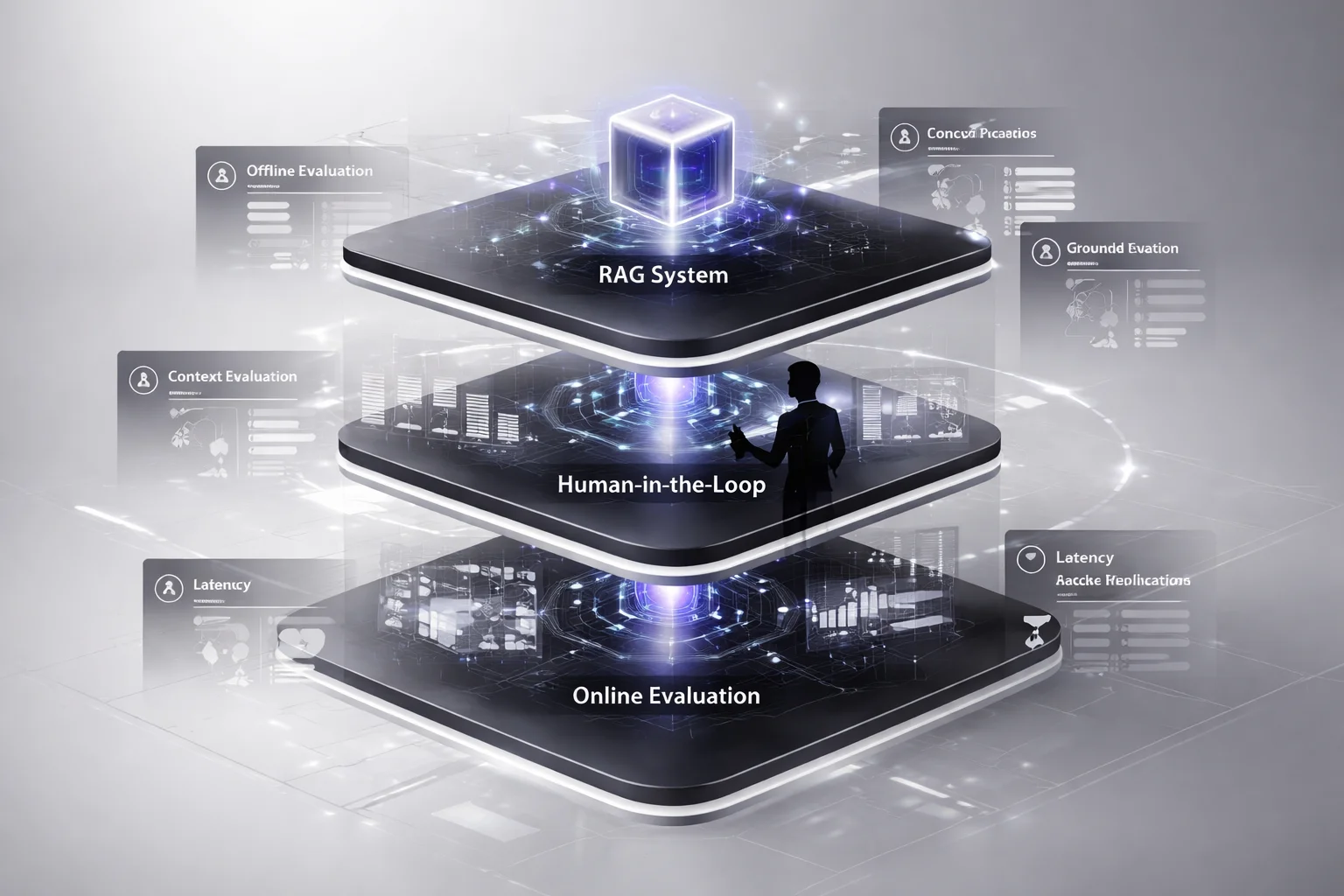
A practical RAG evaluation framework has three layers: offline tests, online monitoring, and human review. If you skip one, your RAG system development process will miss failures that only show up under real traffic, real documents, and real business pressure.
I learned this the annoying way. One client had great offline scores, decent latency, and a polished dashboard. Users still hated the assistant. Why? The system retrieved plausible chunks, answered fluently, and cited the wrong paragraph often enough to wreck trust. On paper, fine. In production, not fine at all.
So I’d build the framework like this.
Offline evals check the mechanics before release. Measure retrieval precision at top-k, context recall, groundedness, citation accuracy, answer completeness, and latency by query type. For example, if your retriever pulls 8 chunks and only 2 actually support the answer, your retrieval relevance is weak even if the final response sounds smart. That’s the kind of issue that kills retrieval augmented generation quality quietly.
Then watch live behavior.
Online monitoring tells you whether the system is drifting after launch, which it will. Track empty retrievals, reranker score shifts, source distribution changes, citation click behavior, business-task success rates, and answer acceptance trends. I also like monitoring top-k document movement over time because it catches retrieval drift monitoring problems earlier than most teams expect. Sometimes the answer is still “correct” while the evidence quality is already sliding.
Humans still need a seat at the table, and no, I don’t think auto-evals replace that.
Sample real conversations every week. Have subject matter experts label grounded responses, missing evidence, citation mismatch, and task success for high-risk workflows like policy, finance, or support escalations. That review layer is where knowledge drift detection gets sharper, because people notice language shifts long before dashboards do (especially when the business invents new terminology for old problems, which happens constantly).
Here’s what that looks like in a mature production RAG architecture:
- Offline: retrieval precision, context recall, groundedness, citation accuracy, completeness, latency
- Online: acceptance rate, source drift, empty-hit rate, reranker movement, business outcome success
- Human review: faithfulness checks, edge-case labeling, escalation audits, gold set refreshes
If you want the citation side done right, read AI document retrieval and RAG citation architecture. Because once you can measure quality continuously, the next problem gets very specific: figuring out which signals actually predict drift early enough to act.
How to Detect Knowledge Drift Detection and Retrieval Drift Monitoring Early
Early drift detection means catching retrieval decay before users start saying, “this thing used to be better.” In RAG system development, the best warning signs usually show up in retrieval behavior first, not in the final answer.
A few years ago, I watched a healthcare assistant stay “accurate” right up until it wasn’t. The ugly part? Answer scores looked steady for almost two weeks while the source corpus had already shifted, fresh guidance documents were arriving late, and the retriever kept favoring old policy chunks with familiar wording. By the time people noticed bad answers, the system had been drifting for days.
That’s why I don’t track everything equally.
I care most about three signals: retrieval miss rate, source freshness score, and citation mismatch. Not dashboard candy. Actual early warnings. If your top-k results stop containing answer-supporting evidence, if retrieved documents skew older than the current knowledge base, or if answers cite chunks that don’t really back the claim, your retrieval augmented generation quality is already slipping.
And yes, some metrics are overrated.
Latency matters, sure. Generic answer-confidence scores? I trust them a lot less. I’ve seen systems sound extremely sure while quietly losing retrieval relevance, which is kind of like a GPS giving calm directions straight into a lake.
Here’s what I’d monitor in a live production RAG architecture:
- Corpus change monitoring: track document adds, deletes, schema changes, and ingestion lag by source.
- Embedding drift checks: compare retrieval performance before and after vocabulary shifts, model swaps, or metadata changes.
- Source freshness scoring: measure whether retrieved evidence reflects the newest approved content.
- Query distribution shifts: flag new intents, renamed products, and sudden spikes in unseen phrasing.
- Retrieval miss rates: watch empty hits, low-similarity hits, and top-k sets with weak support.
- Citation mismatch: catch answers that quote or cite text that doesn’t fully support the claim.
- Answer-confidence anomalies: review cases where confidence rises while grounded responses fall.
I’d also split drift into two buckets. Knowledge drift is when the facts changed. Retrieval drift is when the facts are there, but your system stops finding them. Different disease, different fix. One needs reindexing or freshness rules. The other often needs retuning chunking, embeddings, filters, or reranking.
Look, this is where a good RAG evaluation framework earns its keep. Set thresholds that trigger reindexing, retesting, or human review before quality visibly collapses. If you want a useful companion on source traceability, read AI document retrieval and RAG citation architecture. Next up, I’ll show you how to turn these signals into operating rules your team can actually run.
Build a Quality-Maintaining RAG Architecture
A quality-maintaining production RAG architecture is a system that expects drift, tests for it, and contains the blast radius when things go wrong. In plain English, RAG system development stops being a demo project the moment you add versioned corpora, scheduled re-embedding, CI/CD eval gates, canaries, rollback, and human review for risky flows.

I learned this the hard way. Back in 2023, a healthcare knowledge assistant looked fantastic in staging, then started citing retired care guidance in production because one “small” ingestion update skipped a metadata field and nobody had a rollback-ready corpus snapshot. The model wasn’t the villain. Our architecture was.
Here’s my unpopular take.
Most teams over-automate the last mile. I wouldn’t let sensitive answers, like policy, legal, pricing, or clinical guidance, go fully autonomous just because the eval scores look pretty. I know the common advice is to automate everything you can. I think that’s lazy architecture. For high-risk flows, escalation to human review is cheaper than cleaning up confident nonsense later.
What does the pattern look like?
Keep your corpus versioned by source, timestamp, and schema. Re-embed on a schedule, not only on document edits, because query language shifts faster than people admit. Gate every release in CI/CD with a RAG evaluation framework that checks retrieval relevance, answer faithfulness, latency, and retrieval augmented generation quality on a fresh eval set. Then ship canaries to 5% of traffic, watch source overlap and citation accuracy, and keep one-click rollback ready.
And watch the boring metrics.
I care about dashboard panels for ingestion lag, parser failures, empty-hit rate, reranker score movement, source freshness, and retrieval drift monitoring. That’s where knowledge drift detection actually shows up. Not in a feel-good weekly summary. In ugly little charts that tell you your grounded responses are about to get weird.
According to Gartner, retrieval-augmented generation helps ground outputs in enterprise data, but only if the retrieval layer stays current. And Microsoft’s Azure architecture guidance also stresses evaluation and monitoring across the pipeline, which matches what I’ve seen in the field.
If you need the retrieval side nailed down before you wire all this together, read AI document retrieval and RAG citation architecture.
The bottom line? Continuous evaluation, rollback discipline, and selective human checkpoints beat one-off launch success every single time. That’s how you protect hallucination reduction, preserve grounded responses, and keep retrieval-augmented generation useful after the honeymoon period ends.
A Practical Rollout Plan for Evaluation-Continuous RAG
A practical rollout for evaluation-first RAG system development starts with baselines, gets real with messy eval data, and only then adds alerts and operating rhythms. If you try to do all of it at once, your team will drown in dashboards and still miss the actual quality failures.
I’ve seen that movie already.
One team I worked with wanted the neat 30, 60, 90-day plan on a slide by Friday. Fine. We built it. Then week three hit, their “baseline” was garbage because they hadn’t separated retrieval relevance from answer style, and their product lead kept grading polished wrong answers as wins. So yes, phases help. No, they never stay clean.
Start with the first 30 days.
Measure what matters now, not what looks impressive in a board update. I’d lock in baseline metrics for retrieval relevance, citation accuracy, grounded responses, latency, fallback rate, and a small but representative sample of user-rated outcomes. Keep it ugly and honest. If your retrieval-augmented generation stack can’t tell you whether the right chunk showed up before the model spoke, you’re still guessing.
Then build your eval set.
Days 31 to 60 should focus on a living RAG evaluation framework, not a pretty spreadsheet. Pull 100 to 300 real queries across support, compliance, sales, and edge-case junk that annoys everyone but tells the truth. I like mixing easy wins with nasty ambiguous prompts, because that’s where retrieval augmented generation quality actually breaks. And yes, you’ll probably backtrack here once you realize your first gold set ignored fresh terminology.
Days 61 to 90 are where operations kick in. Wire up knowledge drift detection and retrieval drift monitoring for source freshness, top-k overlap shifts, empty-hit spikes, and citation mismatch. Define one owner for retrieval, one for source ingestion, and one for final answer policy review. Shared ownership sounds nice. In practice, it’s how nobody fixes anything.
Real talk: review cadences slip first.
I’d run weekly quality reviews for high-risk flows, monthly eval-set refreshes, and immediate triage when drift alerts cross thresholds. If you need help figuring out whether your team is ready for that level of discipline, Buzzi AI’s RAG consulting foundation assessment framework is a good place to start.
And if you want a partner who builds this into the system from day one, that’s Buzzi AI’s whole angle: production RAG architecture with continuous evaluation baked in, not taped on later after the chatbot starts making confident mistakes.
FAQ: RAG System Development That Maintains Quality
What is RAG system development in production?
RAG system development in production means building a retrieval-augmented generation system that keeps working after launch, not just in a demo. You’re dealing with real documents, changing knowledge bases, latency limits, ranking and reranking, and ongoing quality checks. I’d put it this way: if your system can’t handle drift, bad retrieval, and stale answers, it’s not production-ready.
How do you maintain quality in a RAG system over time?
You maintain quality by treating evaluation as part of the product, not a side project. That means running offline evals, watching online monitoring signals, reviewing grounded responses, and checking knowledge base freshness on a schedule. I’ve seen teams skip this because launch felt like the finish line, and that’s exactly when answer quality starts sliding.
Why does RAG quality degrade without continuous evaluation?
Because the moving parts don’t stay still. Documents change, embeddings shift, chunking strategy gets tweaked, user queries evolve, and your vector database starts returning different neighbors than it did last month. Without continuous evaluation, you won’t catch retrieval relevance problems or answer faithfulness drops until users complain, which is a lousy monitoring plan.
What’s the difference between knowledge drift and retrieval drift in RAG?
Knowledge drift happens when the source content changes and your system serves outdated or incomplete information. Retrieval drift happens when the retrieval layer starts pulling worse context, even if the knowledge base itself is fine. I’ve watched teams confuse the two, and it sends debugging in the wrong direction fast.
How can you detect retrieval drift early in a RAG pipeline?
Track retrieval relevance, hit rate on known-good queries, reranker score shifts, and changes in top-k document overlap over time. You should also compare current retrieval outputs against a fixed benchmark set before and after any embedding model or chunking update. Honestly, small ranking changes can wreck answer quality long before anyone notices in a dashboard.
Does a RAG system need continuous evaluation after launch?
Yes. No debate. A production RAG architecture needs continuous evaluation after launch because launch is when real query variety, edge cases, and content churn start hammering the system.
Can RAG reduce hallucinations in production AI systems?
Yes, but only if the retrieval step brings back relevant, fresh context and the model stays grounded in it. RAG helps with hallucination reduction by anchoring answers to source material, but bad retrieval just gives the model new ways to be confidently wrong. I mean, garbage in still wins.
Is RAG system development different from building a basic chatbot?
Completely different. A basic chatbot can survive on prompt design and decent UX, while RAG system development depends on indexing, chunking strategy, retrieval quality, context window management, and ongoing evaluation. If you treat RAG like “just a chatbot with documents,” you’ll ship something that looks smart for a week and then falls apart.
What metrics should teams track in a RAG evaluation framework?
Track retrieval relevance, answer faithfulness, grounded responses, latency, recall at top-k, citation accuracy, abstention rate, and user-reported failure patterns. I also like monitoring the latency and recall tradeoff because teams love shaving milliseconds right up until they kneecap answer quality. Keep both offline evals and online monitoring in the mix, or you’ll miss half the story.
Can embedding changes or chunking updates degrade RAG quality unexpectedly?
Absolutely, and this bites teams all the time. Swap the embedding model, change chunk size, or alter overlap rules, and you can trigger embedding model drift, weaker retrieval relevance, and lower-quality context without any obvious system error. That’s why I always want before-and-after evals on a locked test set before rollout, not after the damage is done.