NLP Chatbot Development Is Becoming Legacy
Most NLP chatbot development is already maintenance work dressed up as innovation. A few years back, we helped assess a bot that looked fine in demos and fell...

Most NLP chatbot development is already maintenance work dressed up as innovation.
A few years back, we helped assess a bot that looked fine in demos and fell apart the minute customers asked anything slightly off script. That wasn’t bad implementation. It was the architecture showing its age. According to Primotech, the conversational AI market has moved past early experimentation, and the real shift now is from rules-based systems to LLM-powered systems. In this article, I’ll show you where legacy NLP chatbots still make sense, where they quietly fail, and how to judge whether modernization is actually worth it.
What NLP Chatbot Development Means Now
At 4:17 p.m. on a Thursday, somebody types: “Hey, I need to move my appointment to next Thursday afternoon, and also can you check if my insurance info is still on file?” That’s the moment old bot thinking usually cracks. Not because the request is weird. Because it’s normal.

A lot of teams still say “NLP chatbot” like it means what it meant a few years back: detect intent, grab a few entities like a date or order number, then march the user through a scripted flow without falling over if they don’t use the approved wording. That used to be enough. In plenty of cases, it still was.
Look at banking. Azumo reported that by 2025, roughly 88% to 92% of North American Tier 1 banks had AI chatbots in production. Nobody rolled those out because they were charming. They got approved because they handled the repetitive stuff support teams hate and customers expect instantly: password resets, card activation, balance checks, appointment changes. If the bot could do those jobs cleanly and not trigger compliance panic, leadership called it a success.
The problem is scale changed the standard. Primotech said more than 987 million people worldwide were using AI chatbots regularly in 2025. Once nearly a billion people get used to chatting with machines, they stop typing like they’re filling out a form. They ask follow-ups. They switch topics halfway through. They pile three requests into one message. Your neat little intent tree starts looking like cardboard in the rain.
The old stack was pretty straightforward. Intent classification guessed what the person wanted. Entity extraction pulled out the variables: city, date, account type, order ID. Dialog management decided the next step using rules someone had to write by hand. I’ve seen teams build 40- to 50-node flows just to reschedule one appointment without making a mess of edge cases. That’s not elegance. That’s maintenance debt wearing a tie.
I’d argue people get this wrong in both directions. Some act like classic NLP is obsolete. It isn’t. Some act like adding a large model on top fixes everything. It doesn’t.
Primotech said the conversational AI market had moved past early experimentation by 2025. You can feel that shift in how systems are built now. Foundation model chatbots can do work that used to be split apart across intent models, entity parsers, and rigid flow logic. They can infer intent from context, remember what happened across multiple turns, and produce usable replies without somebody hardcoding every branch ahead of time.
Still, “newer” isn’t the same as “better for every task.” That’s where teams burn money. If you’re doing NLP chatbot modernization, start with an actual chatbot capability assessment. Not a sales demo with polished prompts. Not a strategy deck written by people who never touched your production logs. Pull transcripts from the last 90 days. Find where users succeed, where they rephrase, where they abandon the chat, where agents have to step in.
Legacy NLP chatbots can still beat newer systems on tightly controlled workflows, especially during a conversational AI transition where reliability matters more than style points. Card activation at a bank is a good example. Appointment changes for a healthcare group too. In those cases, a boring rules-based path with known failure states may be safer than a flashy model that improvises once every few hundred conversations. Once every few hundred is fine for movie recommendations. It’s not fine for regulated operations.
Keep what already holds up under pressure. Replace what users keep breaking by accident just by talking normally. If your current bot handles balance checks flawlessly but collapses when someone asks a plain-English follow-up question, don’t tear out the whole system because foundation models are fashionable this quarter.
That’s why AI chatbot virtual assistant development services look different now than they did before. The assignment isn’t just “build us a bot.” It’s deciding which parts of the old NLP stack should stay exactly where they are and which parts foundation models should absorb.
That’s the real shift. Modern NLP chatbot development often has less to do with replacing the past than admitting the oldest logic in your system might still be the part doing the most useful work.
Why Traditional NLP Chatbots Are Becoming Legacy
What actually kills a chatbot?

Not the big outage everybody remembers. Not the screenshot in Slack with ten angry reactions under it. I’ve watched bots stay “successful” on paper while quietly getting more expensive, more fragile, and more annoying every month.
A Tuesday support queue is usually where you see it first. One customer writes, “Can you check where my shipment ended up?” A few minutes later another says, “My order’s not here yet, what’s going on?” Same problem. Same resolution. The bot misses it because nobody manually mapped those phrasings together.
I’ve seen teams swear the model is fine because intent accuracy still looks decent in a dashboard. Then you open the actual design and it’s a mess: core intents, sub-intents, fallback rules for overlapping intents, entity patches because one team says “shipment” and another says “order,” dialog exceptions stacked on dialog exceptions. Six months later nobody wants to touch it. I once saw a support bot with 14 intents turn into 41 labeled variants after three quarters of patching. It still failed on simple paraphrases.
That’s the answer: they usually die one paraphrase at a time.
Traditional NLP chatbots are becoming legacy for a boring reason, not a glamorous one. The maintenance curve keeps going up while the capability ceiling doesn’t move much. They did work. They still do work for password resets, order tracking, and FAQ flows. I’d argue people get this wrong by turning it into a false choice between “old bots bad” and “LLMs good.” Narrow bots can absolutely earn their keep.
Primotech is right about that part. Rules-based chatbots still make sense for constrained tasks like password resets, order tracking, and FAQs, especially in places where compliance and auditability matter. A bank shouldn’t let a generative model freestyle disclosures. Azumo reports banks can save $0.50 to $0.70 per interaction using chatbots, with global annual savings reaching $7.30 billion based on the 2026 figures it cites. That’s real money.
Narrow is the catch.
Foundation model chatbots changed user expectations fast. People now type half a question, switch direction mid-sentence, tack on two more requests, and expect the system to keep up. Older natural language processing stacks can handle some of that, sure, but only if your team keeps hand-authoring edge cases forever. Foundation models are simply better at ambiguity, indirect phrasing, and messy multi-part asks.
Not magic, though. I think people oversell them constantly. They’re not wise sages in a browser tab. They just absorb language variation more naturally than traditional intent recognition systems usually can.
The cost trap isn’t usually inference first. It’s upkeep. That’s the bill teams miss until they’re buried in taxonomy changes, retraining cycles, routing logic updates, and failure review meetings for a bot that was supposed to be “simple.”
The breakage pattern is sneaky because nothing fully collapses at once. One paraphrase fails here. One channel shift hurts performance there. Volume changes. New phrasing shows up from SMS users instead of web users. Accuracy drops again. If you keep using old patterns for broad customer conversations, you’re buying more maintenance for less upside every quarter.
That’s what sits underneath a lot of legacy NLP chatbots: they perform fine as long as users stay inside the box somebody drew for them. Users don’t.
NLP chatbot modernization starts with a blunt question: is this workflow actually constrained, or have you just been pretending it is because rebuilding sounds painful?
I’d use a simple chatbot capability assessment.
- Keep legacy architecture if requests are repetitive, regulated, and easy to audit.
- Add foundation model layers if users paraphrase heavily or ask multi-part questions.
- Rebuild for hybrid conversational AI transition if intent recognition accuracy drops every time volume or channel mix changes.
The market data points the same way. Azumo says ChatGPT market share went from roughly 86.7%–87.2% in January 2025 down to about 64%–68% by January 2026. That doesn’t mean foundation models are fading out. It means buyers are spreading bets across providers because this category is starting to look like infrastructure instead of novelty.
If you’re planning Ai Chatbots, don’t ask whether your old bot still technically works. Ask whether it works cheaply enough, broadly enough, and well enough to justify another year of patching.
NLP Capabilities That Still Matter in Chatbots
I watched a travel bot faceplant over “next Fri” once. Looked great in the demo. Friendly tone, smooth reply, even asked a nice follow-up. Then it tried to push the request into the booking flow and choked because “next Fri from JFK” isn’t a usable record. A reservation system wants an actual date. It wants the airport code mapped correctly. It wants bad input rejected before anything downstream gets touched. One fuzzy field can wreck the whole handoff in under 200 milliseconds.

That’s the mistake.
Teams keep acting like modern chatbot stacks replaced classic NLP outright. They didn’t. They mostly made giant intent trees less attractive while making a handful of narrow NLP jobs more valuable than ever.
I think the comparison itself is broken. People love to stage this fake fight: legacy NLP chatbots over here, foundation-model bots over there, as if one side is “real AI” and the other belongs in a forgotten 2018 support center. That’s sloppy thinking. Some older natural language processing pieces still beat large models anywhere control, predictability, and cost have to survive contact with production.
GigaSpaces AI said plainly that traditional chatbots struggle with context, memory, real-time data, and personalization. True enough. If you need broad conversational coverage, foundation models are better with messy phrasing, odd wording, and multi-turn requests that wander all over before they finally ask for something useful. Azumo pointed to 2026 numbers showing ChatGPT at 800 million weekly active users. Massive adoption like that tells you people are comfortable talking to these systems.
Comfort doesn’t clean dirty data.
- Foundation models win on open-ended questions, summarization, and flexible response generation.
- Specialized NLP wins on entity normalization, language detection, moderation filters, deterministic extraction, and tightly scoped intent recognition.
You feel this fastest in boring industries. Travel. Banking. Insurance. Healthcare. The flashy demo crowd usually skips that part because “almost right” sounds fine on stage and gets you fired in production. Those systems expect exact formats, known entities, valid identifiers. A model can understand what a customer meant by “next Fri from JFK.” Great. A deterministic extractor turns that into a valid date field, normalizes “JFK” to the right airport code, and rejects malformed input every single time instead of gambling with your booking system.
That’s the framework I’d use.
1. Let the model interpret. Use it where language is loose: open questions, wandering requests, summaries, human-sounding replies.
2. Make classic NLP verify. Dates, IDs, airport codes, account numbers, language detection — anything that has to land in a fixed format belongs in deterministic extraction and normalization.
3. Put policy in fixed rails. Moderation and risk classification need thresholds, repeatability, and audit logs; they don’t need a model inventing its own standard on Tuesday afternoon.
Sentiment analysis and moderation are where people get weirdly overconfident with LLMs. You probably don’t want an LLM deciding abuse risk or self-harm language on vibes alone if your policy team expects consistent labels and a clean evidence trail for review. Consistent classification wins there. Every time. During a conversational AI transition, those older extraction and classification layers often leave cleaner logs than the polished generative interface sitting on top.
The support use case makes this painfully obvious. WotNot reported that customer support accounted for 41.82% of chatbot market share in 2025. That number tells you where this stops being theory fast. Support bots can’t just sound helpful; they need dialog management that escalates reliably, catches language early, extracts IDs correctly, and blocks unsafe content before any generated response gets near an agent queue or customer record.
No dramatic rebuild required. NLP chatbot modernization shouldn’t mean ripping out every classic component because somebody got excited about foundation models after one good pilot. Use your chatbot capability assessment like an adult: keep the boring parts that prevent expensive mistakes. Let the model handle conversation. Let deterministic NLP check facts, normalize inputs, enforce policy, and keep logs clean.
I’d argue that split is usually the smartest architecture choice precisely because nobody claps for it.
If your bot sounds brilliant but can’t reliably parse a date, catch unsafe content, or extract an ID without drifting off-script, what exactly did you modernize?
Foundation Model vs NLP Chatbot Comparison
One Monday morning, around 7:12 a.m., a support lead was staring at three nearly identical tickets about remote access. One user wrote, “VPN won’t connect after hotel Wi-Fi login.” Another said, “can’t get on corp network from Marriott.” The third went with, “remote access broken while traveling.” Same problem. Three different phrasings. The old bot treated them like strangers. The newer foundation-model assistant saw the family resemblance.
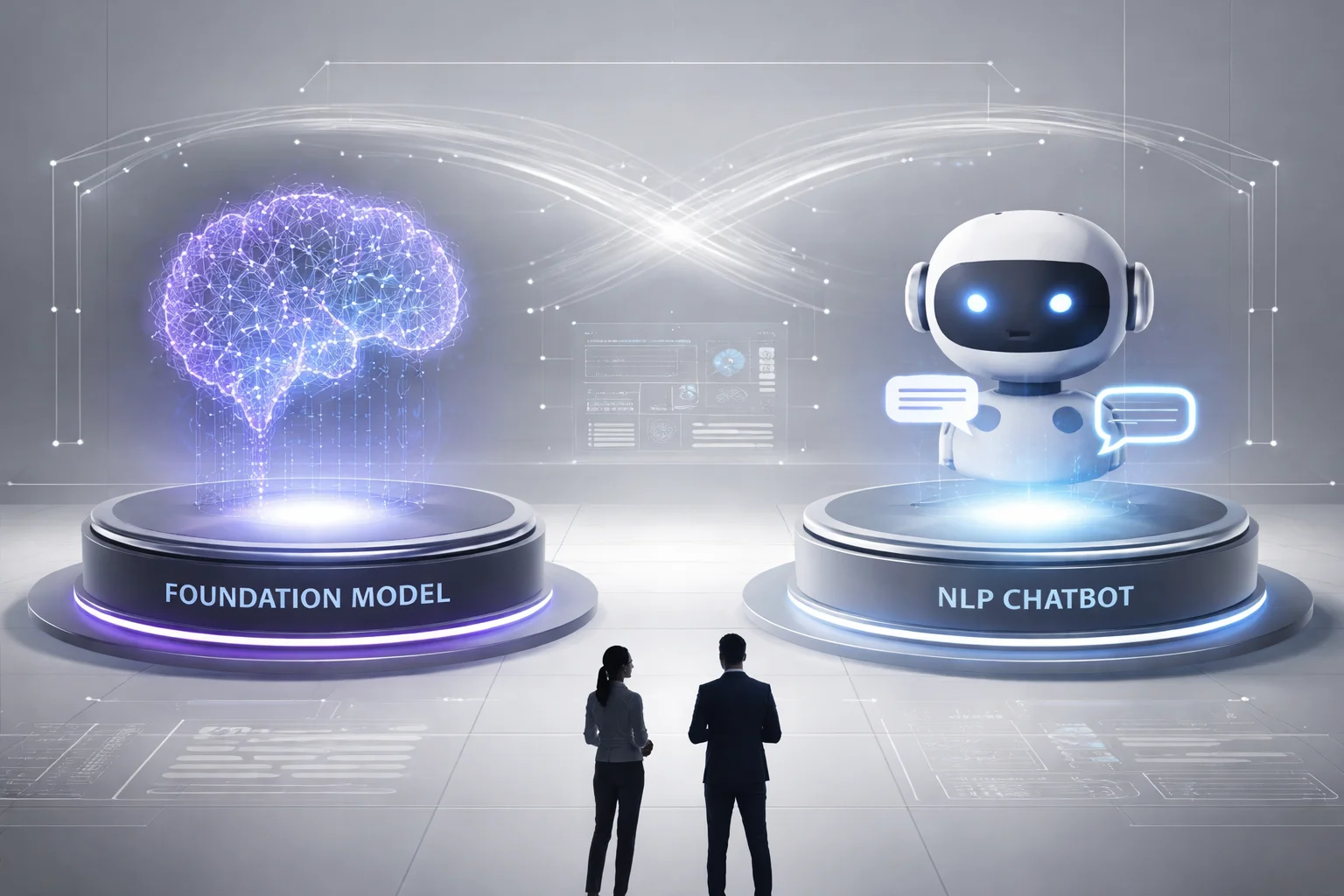
That’s the part people love to show in demos. Messy wording. Half-finished thoughts. Two typos and no punctuation. Foundation model chatbots are usually better at that than classic intent trees, especially in support triage, sales discovery, internal knowledge search, and any workflow where 500 people ask the same thing 500 different ways. They don’t need every variation hand-mapped into dialog management just to stay upright.
I think this is where teams get seduced. They see broader language range and assume they’ve solved accuracy.
They haven’t.
Real-user accuracy isn’t a benchmark chart or a polished vendor prompt. It’s somebody on a phone before coffee, typing fast, getting impatient, leaving out context, and expecting the bot to keep up. Foundation models usually do keep up better there. Until they don’t. Until two customers get different answers to the same question because one asked cleanly and the other didn’t.
I’ve watched teams act like this is some grand battle between foundation model chatbots and legacy NLP chatbots. It’s not. It’s systems design. You’re picking your failure mode. Language coverage or control. Flexibility or predictability. Newer isn’t automatically better, and I’d argue that mistake keeps costing teams months.
The ugly part is inconsistency across users.
MIT News cited a 2026 MIT Media Lab-based study saying state-of-the-art AI chatbots were less accurate and less truthful for users with lower English proficiency, less formal education, and users outside the United States. That should make any CTO nervous. A bot can look brilliant in an internal demo and still fail real customers in patterns your dashboard won’t catch unless you test for them on purpose.
Legacy NLP chatbots don’t feel magical. Good. On narrow jobs, magic is overrated.
If you need entity extraction for policy numbers, dates, ZIP codes, or claim IDs, deterministic pipelines still tend to beat generative guesswork. Same story with tightly scoped intent recognition like password reset versus account lockout versus billing dispute. Boring categories. Expensive mistakes. One bad route can create a compliance mess or dump a paying customer into the wrong queue.
That’s why old-school NLP still matters in NLP chatbot development. Expensive errors hate improvisation.
Adaptability changes the mood fast. Legacy systems keep charging the same tax: add intents, write training phrases, update routing logic, patch edge cases, repeat until everyone’s tired of opening the project board. During NLP chatbot modernization, that maintenance load gets ugly faster than most teams expect, especially once language starts shifting across web chat, WhatsApp, email intake, and voice transcripts. Foundation-model systems usually hold up better under paraphrase drift because they generalize from broader language patterns instead of relying on every wording variant your team remembered to label.
The market behavior lines up with that tension. Citrusbug reported the NLP market growing from USD 27.9 billion in 2022 to USD 47.8 billion in 2024, which it lists as a 33.1% CAGR. Azumo’s cited 2026 figures show Google Gemini market share moving from 5.4% to 18.2% to 21.5%. Buyers aren’t declaring one permanent winner. They’re running side-by-side tests because conversational AI transition has become an operating decision tied to cost, risk, speed, and support load.
The work involved isn’t mysterious either.
- Legacy stack: more labeled intents, more entity rules, more hand-built dialog management design.
- Foundation model stack: less intent labeling upfront, more prompt design, evaluation work, safety review, and fallback planning.
- Hybrid stack: deterministic extraction and routing where mistakes are costly; model-based language understanding around those fixed rails.
Latency has a way of ruining abstract debates. A tuned legacy flow is often faster for transactional work because there’s less inference overhead sitting in the middle of every response. If the bot only checks order status or collects a fixed set of form fields, classic architecture may be the smarter business choice even if nobody in the room calls it exciting.
A practical chatbot capability assessment usually comes down to this:
- Choose foundation models first if requests are varied, multi-turn, ambiguous, or heavy on knowledge retrieval.
- Choose legacy NLP first if responses must be deterministic, auditable, and low-latency.
- Choose hybrid design if you want natural conversation up front but strict extraction and workflow enforcement underneath.
I’ve seen hybrid setups cut rework simply because they stop forcing one system to do everything badly. Let the model handle flexible conversation. Let deterministic components verify policy IDs like machines are supposed to.
If that sounds close to your roadmap, look at Ai Chatbots. The strongest systems right now aren’t picking sides out of ideology. They’re deciding exactly where each approach pays rent. If you had to choose your bot’s worst mistake in advance, which kind could you actually live with?
How to Transition NLP Chatbot Development
Ask around and you'll hear the same recycled advice: retire the old bot, roll out the new one, call it modernization.

Sounds clean. Exec-slide clean. Real-life messy.
I think that whole “swap the stack and move on” idea is outdated, mostly because it confuses migration with replacement. Those aren't the same job. One is careful. The other is how teams accidentally rip out the boring parts that were doing real work — cutting support volume, keeping compliance off their backs, answering repetitive questions at 8:07 a.m. before the queue explodes — and replace them with something shinier that folds under pressure.
The market itself gives away the truth. Azumo puts the U.S. chatbot market at $407.54 million in 2025, growing to $2.36 billion by 2035 at a 19.18% CAGR. That kind of growth doesn't happen because everybody picked one perfect architecture and moved in lockstep. It happens because companies patch, test, mix systems, keep some pieces, rebuild others, and avoid setting fire to what still works.
That's the part people miss.
The smartest conversational AI transition usually looks a lot more like asset management than reinvention: keep what performs, fix what fails, put controls around anything that can hurt you.
1. Start with traffic, not diagrams
Architecture diagrams lie by omission. Production logs don't.
A real chatbot capability assessment means looking at six to twelve months of live conversations and sorting them by task type, containment rate, escalation rate, rephrase frequency, and failure cost. Not “how modern does this look.” Not “which model are we excited about.” What actually happened?
A password reset flow clearing successfully 94% of the time shouldn't be first on your rewrite list. Leave it alone. A support bot that's missing intent recognition, botching entity extraction, and bouncing users into fallback loops every third turn? That's where you go. I once watched a team spend an entire quarter arguing about model selection while their billing assistant kept creating hundreds of avoidable escalations each week. Brutal waste.
This is how you figure out which parts of your natural language processing stack are still earning rent.
2. Pick the job before you pick the model
A lot of teams do this backward because model demos are fun and use-case reviews aren't.
Bad trade.
Not every workflow needs foundation model chatbots. Some tasks should stay narrow because predictability beats personality every single time.
- Keep legacy flows for order status, balance checks, appointment confirmations, and policy lookups.
- Move first to foundation-model layers for discovery conversations, internal knowledge assistants, triage, and multi-part customer questions.
- Use hybrid design when open-ended user input needs to hand off into deterministic systems of record.
This is where NLP chatbot modernization either stays disciplined or starts chewing through budget for no good reason.
3. Go after painful middle-ground problems
People love extremes. Replace the easiest thing fast or chase the biggest moonshot first.
I'd argue both are usually wrong.
The best starting point is often the uncomfortable middle: interactions where legacy NLP chatbots break down because users paraphrase too much or ask compound questions that old dialog management logic can't hold together. That's where foundation models tend to show obvious gains without forcing you straight into your most regulated workflow.
Leave high-performing low-complexity flows alone. Don't start with the process that triggers legal, security, operations, and three mystery stakeholders who only show up to say “not yet.” Replace by business risk, not hype.
4. Fix your content before the rollout embarrasses you
A better model won't save bad source material. It'll just repeat it faster and with more confidence.
If your help center is stale or two policy documents contradict each other, the bot won't magically reconcile them. It'll confidently serve the mess back to users as if it's settled fact.
Create a clean content layer first: standardize names, owners, update cycles, access controls, and answer sources. Then log feedback aggressively from day one. GeeksforGeeks points out that modern chatbot systems improve over time through continuous learning from user interactions and feedback. Fair enough. Post-launch tuning isn't some nice extra for later. It's part of the build.
5. Keep old components that still outperform new ones
This part never gets applause because it doesn't sound bold.
Don't throw away components just because they're old.
Your existing intent recognition may still be better for routing. Your entity extraction rules may still beat a generative model at pulling account IDs or dates cleanly. Your dialog management layer may still be the safest way to enforce approvals or disclosures. During migration, those become control points around newer conversational behavior rather than relics you feel pressured to delete.
If you want a practical example of that approach, Buzzi AI’s AI chatbot virtual assistant development services fits it well: not “replace everything,” more “keep what proves itself.”
The strange part is a strong transition plan often leaves some old NLP in place on purpose — not out of nostalgia, out of quality control. So why are so many teams still acting like maturity means tearing out everything that already works?
Capability Assessment for Current Relevance
So what actually makes a chatbot “current” in 2025?
Not the demo. Not the vendor pitch with the perfect canned prompt and the smiling dashboard. I’ve watched too many teams get hypnotized by a slick assistant answering five rehearsed questions while the real support queue keeps choking on password resets, order updates, and policy lookup requests.
Then you look at the market pressure and it gets harder to dodge. North America alone accounts for about 30.72% to 38.72% of the global chatbot market, according to Azumo. That’s not some abstract trend line. That’s where a lot of companies are feeling the heat first, in weekly ops reviews and budget meetings where somebody eventually asks why a competitor replies in 12 seconds while their own team still opens tickets manually.
And the pressure isn’t small anymore. A 2025 Primotech report says 25% of organizations already use chatbots as their primary customer service channel. One in four. I think that’s the number that changes the mood in the room, because once that happens, this stops being a side experiment and starts sounding like hesitation with a price tag.
The answer is simpler than people want: relevance depends on fit. But that’s where it gets messy.
A lot of legacy NLP chatbots are still doing perfectly good work. Plain natural language processing, intent recognition, entity extraction, tightly controlled dialogue flows — none of that suddenly became useless because a newer foundation model can improvise better in a board presentation. If your bot handles claims status, order tracking, password resets, or policy lookups with low error rates and clean audit trails, replacing it just to look modern can be a terrible call. I’d argue some teams are way too eager to tear out systems that are quietly doing their job.
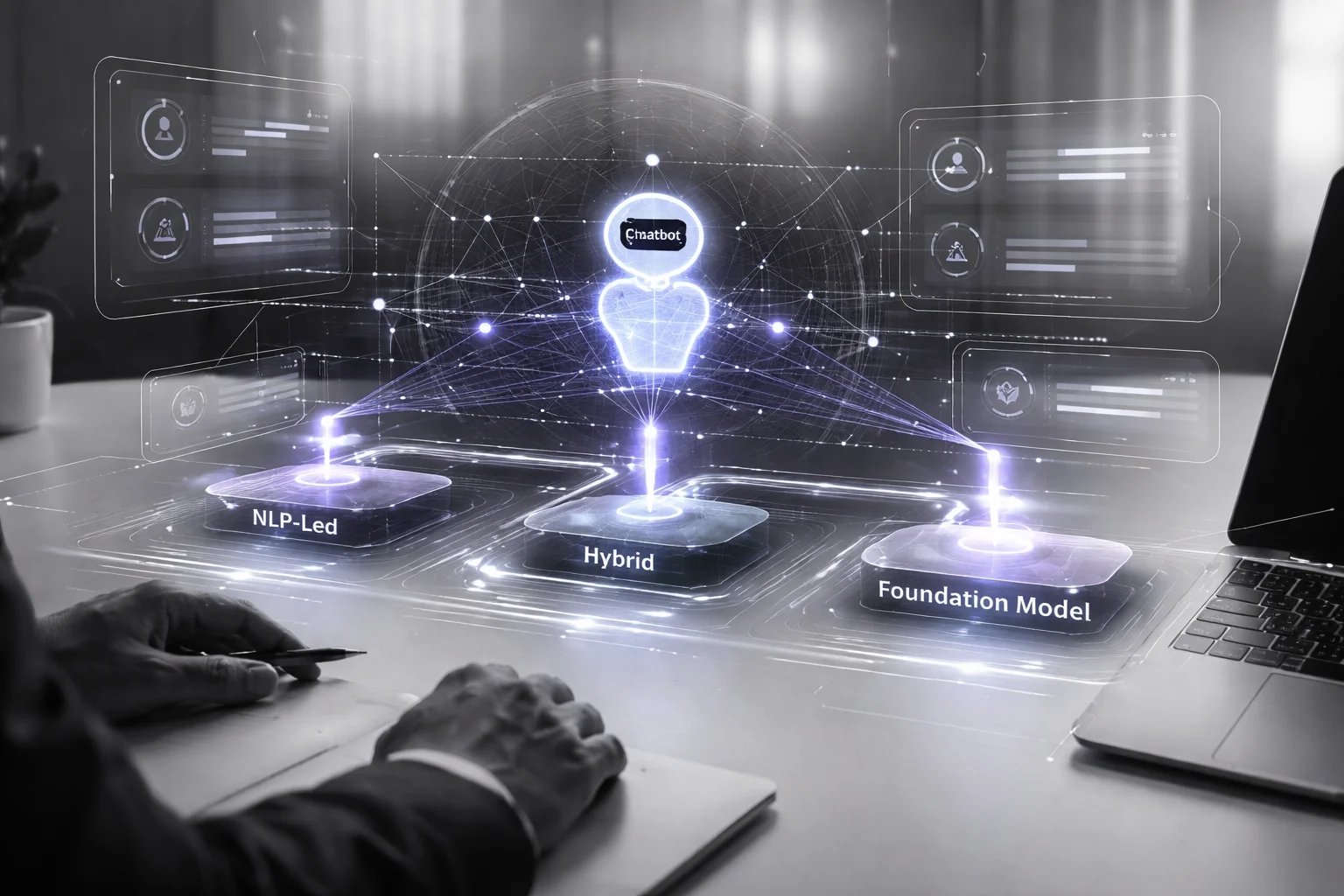
- Stay NLP-led if the work is narrow, repeatable, and sensitive enough that auditability matters more than style. Claims status is an easy example. Order tracking fits too.
- Go hybrid if customers ask messy questions but execution still depends on strict routing, deterministic entity extraction, or approval logic before anything actually happens.
- Move to foundation model chatbots if conversations run across multiple turns, vary heavily from user to user, and rely on enough knowledge that old-school intent matching keeps failing.
Most teams obsess over architecture diagrams. Fair enough. But that usually isn’t what hurts them first. Governance tolerance matters. Cost ceilings matter. UX standards matter. I once saw a support group spend six weeks testing a flashy assistant and only after crossing roughly 40,000 conversations did anyone ask the obvious stuff: what should escalation language sound like, what happens on failure, who approves fallback behavior, and what monthly spend cap are we willing to live with? By then they had screenshots. They didn’t have control.
If your NLP chatbot development roadmap skips governance tolerance, cost limits, and clear UX standards, I don’t think that counts as modernization. It’s expensive theater with better visuals.
If you need a practical benchmark while figuring out where your system belongs, Buzzi AI’s AI chatbot virtual assistant development services is looking in the right place. Not because every company needs to pick a side in conversational AI. Because some bots still earn their keep, some plainly don’t, and somebody has to be honest about the difference. So — what’s your bot earning right now?
Where this leaves us
NLP chatbot development isn't dead, but the version built around brittle intent trees and endless rule upkeep is becoming legacy fast.
Your next move isn't to rip everything out. It's to run a hard chatbot capability assessment, keep the narrow flows that still perform well, and move complex conversations to foundation model chatbots with guardrails, knowledge base integration, and evaluation metrics that actually measure truthfulness, containment, and business outcomes.
You should also watch for the failure modes people love to ignore: hallucinations, uneven performance across user groups, rising operating cost, and weak dialog management once real-world traffic gets messy. The teams that handle this well treat NLP chatbot modernization as a staged conversational AI transition, not a big-bang rewrite.
Most people get this wrong by framing it as old NLP versus LLMs. The better way to think about NLP chatbot development is system design: keep what is reliable, replace what is limiting, and judge every layer by the job it does.
FAQ: NLP Chatbot Development Is Becoming Legacy
What does NLP chatbot development mean now?
NLP chatbot development used to mean building intent recognition, entity extraction, and dialog management by hand. Now it usually means deciding where classic natural language processing still helps, and where an LLM handles understanding, generation, and context better. Your job has shifted from training narrow classifiers to designing retrieval, guardrails, evaluation, and human escalation.
Why are traditional NLP chatbots becoming legacy?
They still work for narrow tasks like password resets, order tracking, and fixed FAQ flows. But they break down when users ask messy, multi-part questions or expect the bot to remember context across turns. That gap is why many teams now treat legacy NLP chatbots as stable but limited systems, not the default path for new conversational AI.
How do foundation models change chatbot development?
Foundation model chatbots reduce the need to script every path in advance because they can generalize across phrasing, topics, and follow-up questions. That changes the build process from flow design first to system design first, including prompt engineering, knowledge base integration, retrieval augmented generation (RAG), safety controls, and response evaluation. You spend less time mapping utterances and more time controlling behavior.
Does a chatbot still need intent recognition and entity extraction with foundation models?
Yes, sometimes. If your chatbot triggers backend actions like refunds, claims, bookings, or compliance workflows, explicit intent recognition and entity extraction still make the system easier to audit and safer to run. In many modern stacks, the LLM handles open-ended conversation while structured NLP components validate key fields before anything important happens.
Can you transition an existing NLP chatbot to a modern LLM-based system?
Usually, yes. The smartest path is often hybrid: keep proven workflows, APIs, and high-confidence dialog flows, then add an LLM layer for broader understanding, summarization, and retrieval over your content. That lets you modernize in stages instead of throwing away years of business logic.
What is the best approach to modernize an NLP chatbot without rebuilding everything?
Start with a chatbot capability assessment, not a rewrite plan. Look at containment rate, fallback rate, escalation volume, failed intents, knowledge gaps, and where users abandon sessions. Then replace the weakest layer first, which is often answer generation or retrieval, while keeping working integrations and regulated decision paths intact.
How should you implement RAG to improve accuracy and reduce hallucinations?
RAG works best when your knowledge base is clean, chunked well, permission-aware, and tied to clear source documents. Retrieve only the most relevant passages, pass them into the model with strict instructions, and require citation-style grounding for sensitive answers. If the system lacks enough evidence, it should say so and route to a human instead of guessing.
What metrics should you use to measure chatbot relevance after the transition?
Don't stop at deflection rate. Track answer accuracy, groundedness, task completion, escalation rate, latency, cost per resolution, user satisfaction, and failure patterns by audience segment. You should also test for hallucination mitigation, safety policy adherence, and whether the chatbot performs worse for users with different language proficiency or phrasing styles.