ML Development Services That Don’t Include MLOps Are a Trap
ML development services fail in production when MLOps is optional. Learn the integrated checklist—CI/CD, monitoring, retraining, governance—and how to vet providers.
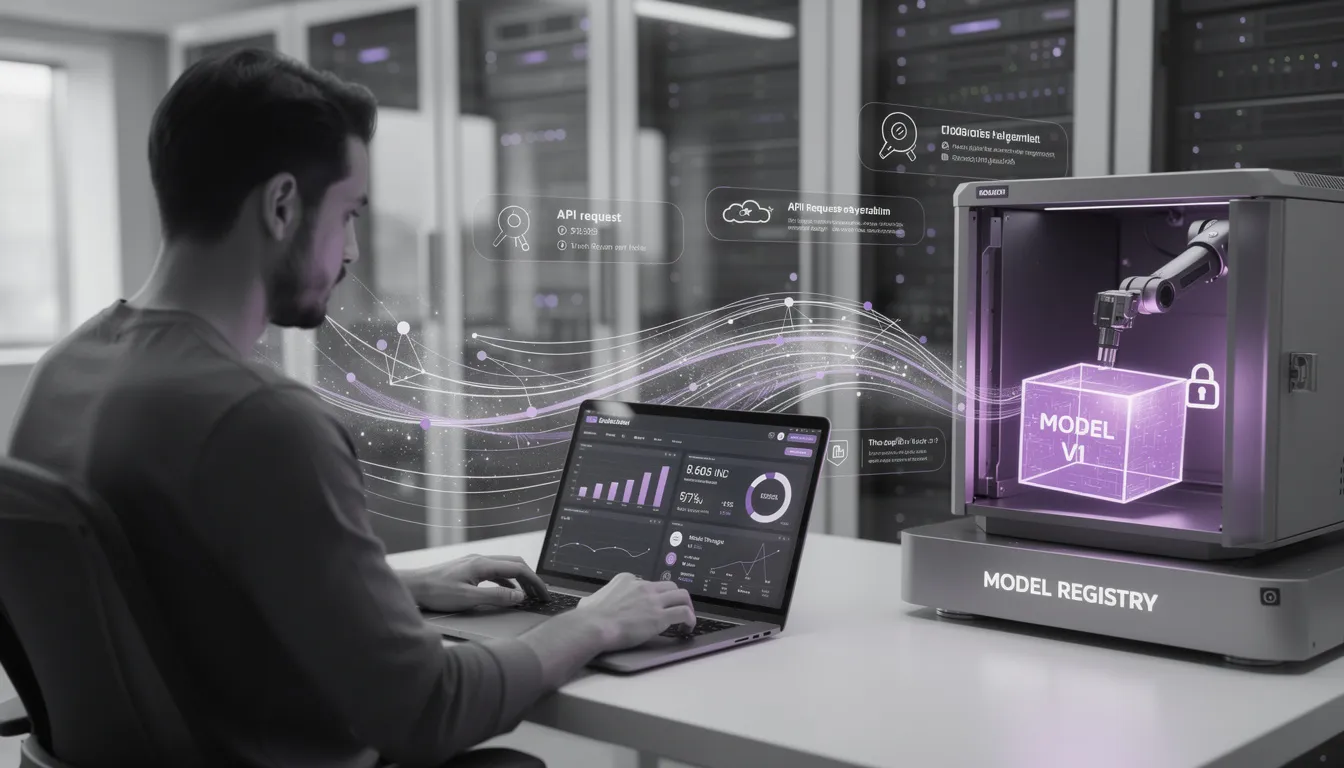
If your ml development services proposal treats MLOps as “phase two,” you’re not buying a production system—you’re buying a demo with a maintenance bill attached. That sounds harsh, but it matches what happens in real companies: a model looks great in a notebook or POC, it ships, and then it quietly degrades or loudly breaks when it meets messy reality.
The failure is rarely “the model is bad.” The failure is the hidden handoff: data science “delivers a model,” engineering “operates it,” and in between sits a gap where drift, broken pipelines, missing features, and undocumented releases live. The first time something goes wrong is usually a Friday night, and the first signal is usually a confused salesperson or an angry customer, not a monitoring alert.
This guide gives you a concrete, non-optional integrated checklist for production ML systems: ML CI/CD, observability and monitoring, retraining pipelines, and governance. You’ll also get a buyer scorecard with questions and SOW-level acceptance tests, so you can vet providers based on operations—not just offline accuracy.
At Buzzi.ai, we’re production-first. We ship models as operational services, not artifacts you have to babysit. If you’re a CTO, Head of Data, or ML leader buying external ML engineering services, the goal is simple: a model that keeps working after go-live, inside a workflow, under real constraints.
Why ML development without MLOps collapses in production
In software, “it runs on my machine” is a joke. In machine learning, it’s a business risk. The reason is straightforward: ML is not only code—it’s code plus data plus assumptions about the world. And the world changes on you.
When ml development services focus on training and evaluation but skip MLOps, you end up with something that can be shown, not something that can be relied on. That’s the difference between a prototype and a production ML system: the latter has to survive variability, updates, and operational pressure.
The “notebook-to-nightmare” gap: what changes after go-live
In a notebook, the data is clean(ish), the schema is stable, and latency doesn’t matter. In production, upstream systems ship late, fields go missing, and a “rare edge case” becomes tomorrow’s top segment. Even the act of joining data at inference time introduces new failure modes: timeouts, partial records, and inconsistent IDs.
Accuracy in validation is not the same thing as reliability in production. A model can hit an AUC target and still be unusable if it times out, if features are null 12% of the time, or if a downstream system expects a score by 200ms and you deliver it in 2 seconds.
Most importantly, the model isn’t a standalone artifact anymore. It becomes embedded in a workflow: retention campaigns, credit decisioning, inventory reorders, fraud checks. That means model incidents become operational incidents—missed revenue, wrong customer contact, incorrect decisions, and escalation to leadership.
Consider a churn model that looks strong in a notebook. In production, upstream product events arrive late on weekends, so features like “last 7 days activity” are incomplete. Your model flags the wrong customers, retention campaigns burn budget, and the team spends Monday doing forensics instead of improving the product. That’s “productionization of machine learning” in the wild: the model didn’t fail academically; it failed operationally.
Failure modes buyers pay for later (even if the model is “good”)
Buyers often get sold a model, and then later discover they actually bought a queue of future work: manual checks, retrains, firefights, and reliability engineering that was never scoped. The pattern repeats because these problems don’t show up in a demo.
Here are concrete failure symptoms that appear in production ML systems when MLOps is missing:
- Silent performance degradation because the population shifts and no one is running data drift detection or model performance tracking.
- Training-serving skew: features computed one way in training and another way in production; the model “works” but not as expected.
- Schema drift: a column type changes, a field is renamed, or a new category appears; the pipeline fails or (worse) coerces incorrectly.
- Dependency rot: libraries update, containers change, base images get patched; without tests and pinned environments, reproducibility disappears.
- No rollback path: a bad model version gets deployed manually and the team can’t revert quickly because “deployment” is a one-off script.
- Monitoring blindness: you learn about problems from customer complaints, not from ML observability dashboards.
- Label leakage / missing labels: outcomes aren’t captured consistently, so you can’t evaluate or retrain on real-world results.
Notice what’s missing: none of these are “the model architecture is wrong.” These are operations problems—model deployment, model versioning, data contracts, and monitoring.
This is why the paper Hidden Technical Debt in Machine Learning Systems remains so relevant: ML systems accumulate debt not just in code, but in data dependencies and glue logic. A provider that doesn’t plan for that debt is simply shifting it onto you.
The structural problem: split ownership between build and operate
The hardest part is not technical; it’s organizational. One team is incentivized to “deliver the model,” another team is incentivized to keep systems up. Delivery is measured in milestones; uptime is measured in incidents. Those incentives diverge at the exact place production ML systems fail.
“We’ll hand over documentation” is not an operating model. Documentation doesn’t page anyone at 2 a.m. Documentation doesn’t catch drift. Documentation doesn’t roll back a bad release. Production ML needs runbooks, dashboards, and clear ownership over the ML lifecycle.
Here’s the simple org-chart scenario that creates the gap:
- Data Science: builds model, reports offline metrics, moves to next project.
- Engineering: owns APIs, infra, and releases, but doesn’t own model behavior or retraining.
- Analytics/Business: depends on outputs, but has no tooling to see when outputs degrade.
An integrated contract fixes this by making the provider responsible for the end-to-end ML lifecycle: build, deploy, monitor, retrain, document, and support—with explicit acceptance tests and SLAs.
What modern ML development services should include (beyond models)
Modern ml development services are not “we train a model and give you a pickle file.” They are “we deliver a living production ML system.” That system has release processes, monitoring, and retraining the same way a modern SaaS product has CI/CD, observability, and incident response.
If you want a quick sanity check, ask: does the provider talk more about algorithms, or about operating the model? A serious team will explain the ML lifecycle—data, training, deployment, monitoring, and improvement—without treating operations as an afterthought.
ML CI/CD: from code tests to data + model release gates
ML CI/CD is continuous integration for ML plus continuous delivery for ML. The twist is that you’re not only testing code. You’re testing data contracts, feature transformations, reproducibility, and the conditions under which a model is allowed to be promoted.
At a minimum, ML CI should include:
- Unit tests for feature logic (e.g., handling nulls, category mapping, time windows).
- Schema validation and data quality checks (types, ranges, missingness thresholds).
- Reproducibility checks (pinned dependencies, deterministic training where possible).
- Training pipeline tests (a small “smoke train” on sample data).
- Evaluation checks (baseline comparisons, segment-level regressions, calibration).
And ML CD should include:
- Packaging model artifacts and metadata into a model registry with versioning and stages.
- Staging deployments with shadow runs (compare predictions without affecting users).
- Canary rollout criteria (latency, error rate, prediction distribution, drift checks).
- Automated rollback if acceptance criteria fail.
A useful framing is: we don’t “deploy a model,” we release a model the way we release software—with gates and evidence. For a practical overview of how this looks end-to-end, Google’s guidance on MLOps: Continuous delivery and automation pipelines is one of the clearest public references.
Observability: monitoring that catches silent failures early
There are two kinds of monitoring: system health and model health. You need both. System metrics tell you if the API is fast and available. ML metrics tell you whether the predictions are still meaningful.
A monitoring plan for production ML systems typically includes:
- System metrics: latency p50/p95, throughput, error rates, timeouts, CPU/GPU utilization.
- Data quality: missing values, schema drift, out-of-range values, category explosions.
- Data drift detection: distribution changes (e.g., PSI/JS divergence) and feature drift by segment.
- Prediction monitoring: score distribution shifts, calibration changes, abnormal confidence patterns.
- Outcome monitoring: where labels exist, track real performance (AUC, precision/recall, MAE) by segment.
Alerts are where teams get it wrong. If everything pages everyone, people mute alerts and drift becomes invisible again. Good alert design includes thresholds tied to business impact, burn-rate thinking (is this trending worse?), and a clear “who owns this” path.
Example alert: if PSI for a top feature exceeds a threshold for 3 consecutive days, trigger an investigation ticket; if it exceeds a higher threshold, pause automated promotions and consider retraining. That is ML observability as a practice, not a dashboard screenshot.
Retraining pipelines: continuous training (CT) without chaos
Retraining is the most misunderstood part of MLOps. “We’ll retrain monthly” sounds comforting, until you realize no one defined where labels come from, how datasets are versioned, or who approves new models. Without a pipeline, retraining turns into a recurring crisis.
There are three common retraining triggers:
- Schedule-based: weekly/monthly retrains; simple but can retrain unnecessarily.
- Drift-triggered: retrain when drift metrics cross thresholds; more adaptive but needs robust monitoring.
- Event-triggered: retrain after product changes, policy shifts, or market events; requires operational awareness.
In practice, mature model retraining pipelines combine these. For a demand forecast model, for example, you might retrain weekly, but also trigger a retrain when major promotions occur or when drift spikes. Every run gets logged with experiment tracking, and every promoted model has a clear lineage trail.
Safe promotion matters: backtesting, champion/challenger, and rollback need to be part of the design, not something you improvise after a bad release.
Governance: auditability, access control, and compliance by design
Governance is where ML becomes enterprise software. You need to answer basic questions: What data trained this model? Who approved it? When did it ship? What changed between version 12 and 13? Without governance, “end-to-end” becomes “end-to-excuse.”
A practical model governance checklist includes:
- Lineage: data sources, training dataset version, feature code version, hyperparameters, and evaluation results.
- Access control: least privilege for data, secrets management, and logging of access.
- Approval workflows: human-in-the-loop gates for high-risk models and clear roles (builder, reviewer, approver).
- Documentation: model cards, intended use, limitations, and monitoring plan.
- Retention policies: how long you keep training data snapshots, artifacts, and logs.
If you operate in a regulated environment (or you simply want to be a serious company), it’s worth aligning governance practices with frameworks like the NIST AI Risk Management Framework. You don’t need to over-bureaucratize; you do need auditability.
A model you can’t explain operationally—how it was built, deployed, monitored, and changed—is a liability disguised as innovation.
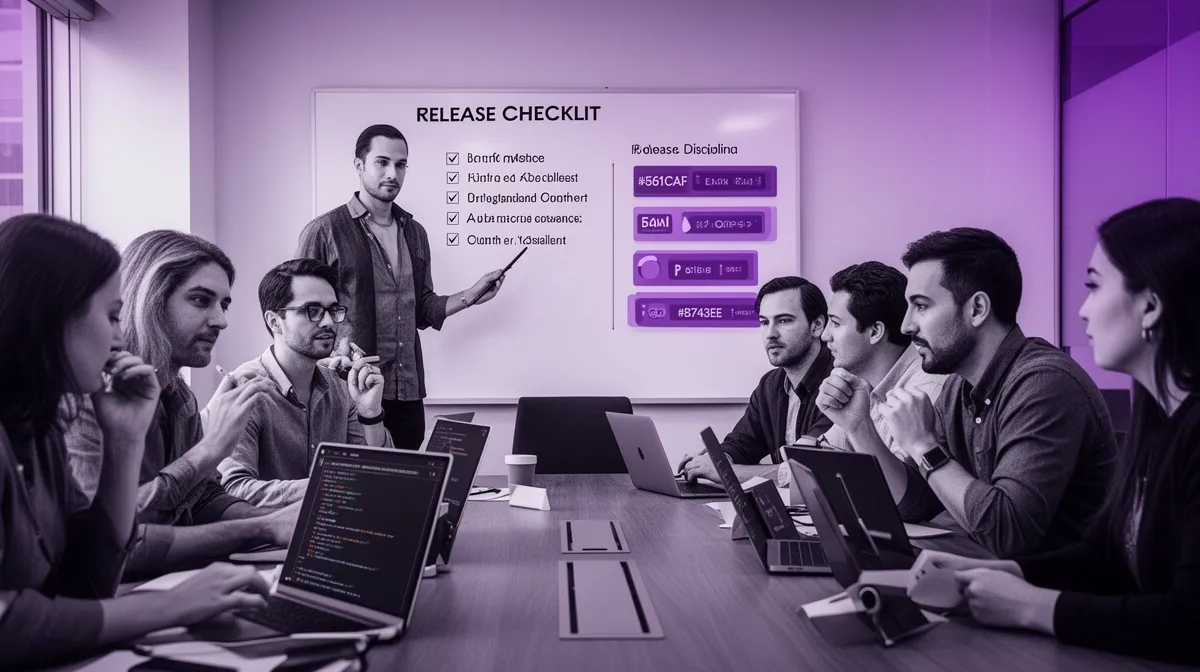
The integrated MLOps stack: minimum components (and what to avoid)
Teams love to argue about tools. Buyers should argue about capabilities. An integrated MLOps stack is a set of building blocks that make production ML repeatable: you can train, deploy, observe, and improve without heroics.
The non-optional building blocks
Here’s a “minimum viable stack” for MLOps driven machine learning development services that works across cloud and on-prem environments, without requiring any specific vendor:
- Source control for code and configuration, with branching and reviews.
- Environment management: containers plus infrastructure-as-code for reproducible training/serving.
- Experiment tracking for runs, metrics, parameters, and artifacts.
- Artifact storage for datasets, models, and evaluation outputs.
- Model registry with stages (dev/staging/prod) and approval metadata.
- Orchestration for training/retraining plus data validation and testing.
- Serving layer (batch or real-time) with scaling and rollbacks.
- Monitoring + alerting for system and ML metrics, tied to on-call processes.
Where does a feature store fit? Sometimes it’s essential; sometimes it’s overkill. Treat “feature store” as a feature management layer: do you need consistent offline/online features across multiple models and teams? If yes, invest. If no, don’t buy complexity.

Integration patterns with real enterprise systems
Production ML systems are ultimately integration systems. The model is only valuable when its outputs reliably land inside the places work happens: CRM, ERP, customer support tools, product services, and data warehouses.
Three common integration patterns (and when they fit):
- Nightly batch scoring to CRM: Great for lead scoring, churn risk, or next-best-action lists where latency isn’t critical and governance is easier.
- Real-time inference API: Necessary for fraud checks, dynamic pricing, or personalization that must respond within tight latency budgets.
- Event-driven/streaming: Useful when signals arrive continuously (clickstream, IoT), and decisions must react to events rather than schedules.
The hard part is feature parity: ensuring the same transformations happen in training and serving. The easiest way to break a model deployment is to re-implement features twice—once in a notebook and once in production code. Integrated MLOps designs reusable feature code, shared validation, and contracts that upstream teams can’t violate silently.
Security and identity also matter. Real enterprises need SSO/IAM integration, network boundaries, and auditable access—especially for managed ML development and MLOps platform services. If a provider can’t speak clearly about IAM, secrets, and logging, they’re not ready for production.
For cloud-native reference points, the public docs from major platforms are helpful baselines: Azure MLOps and MLOps on AWS explain typical components and responsibilities.
Red flags: “end-to-end” that isn’t
Most “end-to-end” promises are actually “end-to-handoff.” If you’re evaluating best ML development services for production MLOps, you want vendors who can show operational rigor, not just a tech stack slide.
Paste this red-flag checklist into your RFP:
- They describe “deployment” as a script, not a release process with gates, rollbacks, and environments.
- No plan for data drift detection, labels, or feedback capture.
- No model registry/lineage; artifacts are emailed, shared in folders, or stored ad hoc.
- Manual, person-dependent releases (“our engineer logs in and updates it”).
- Operations are handed to you with no runbooks, dashboards, or SLA conversation.
- No discussion of integration patterns (batch vs API vs streaming) tied to your workflow.
If the provider can’t explain how the model behaves on Friday night, you’re funding their demo, not your business.
Buyer scorecard: how to choose ML development services with MLOps
Choosing ml development services with integrated mlops is less about finding the “best data scientists” and more about finding the team that treats production as the default. Your scorecard should surface whether a vendor has done real ML model operations—or only shipped notebooks.
The 12 questions that expose shallow offerings
Use these questions in vendor calls. For each, you’ll see what a good answer sounds like versus a hand-wavy one.
- How do you promote a model from dev to prod?
Good: “Model registry stages, automated gates, canary/shadow, rollback.”
Hand-wavy: “We deploy it when it’s ready.” - What are your release gates?
Good: “Offline metrics vs baseline, latency tests, bias checks, drift checks, approval sign-off.”
Hand-wavy: “We check accuracy.” - How do you ensure offline/online feature parity?
Good: “Shared feature code, validation tests, contracts, and monitoring for skew.”
Hand-wavy: “Our engineers will implement features.” - What drift metrics do you use?
Good: “PSI/JS divergence, segment drift, prediction distribution; thresholds and playbooks.”
Hand-wavy: “We monitor drift.” - Where do alerts go and who responds?
Good: “On-call rotation, paging rules, escalation, incident runbooks.”
Hand-wavy: “We’ll inform your team.” - How do you track model performance in production?
Good: “Outcome capture, delayed labels, segment performance tracking, dashboards.”
Hand-wavy: “We’ll evaluate periodically.” - What triggers retraining, and who approves?
Good: “Schedule + drift + events; approvals for high-risk; backtesting.”
Hand-wavy: “We can retrain if needed.” - How do you version datasets and features?
Good: “Dataset snapshots, lineage, experiment tracking, reproducible runs.”
Hand-wavy: “We keep data in S3/Blob.” - What does your model registry contain?
Good: “Metadata, lineage, evaluation, approvals, deployment history.”
Hand-wavy: “We store model files.” - How do you handle dependency updates and security patches?
Good: “Pinned deps, container rebuilds, CI tests, staged rollouts.”
Hand-wavy: “We’ll update libraries.” - How do you manage inference cost and performance?
Good: “Cost per 1k inferences, scaling policies, batching, model optimization.”
Hand-wavy: “Cloud will scale.” - Can you show a runbook and incident postmortem template?
Good: “Yes, here’s how we respond; here’s what we log and learn.”
Hand-wavy: “We’ll provide documentation.”
If you’re asking how to choose ML development services with MLOps, this list works because it forces vendors into specifics. Real operators have muscle memory here.
What to demand in the SOW: deliverables, SLAs, and acceptance tests
A strong SOW turns MLOps from a promise into measurable deliverables. Don’t accept “model delivered” as the finish line. Define acceptance around reliability, observability, and lifecycle readiness.
Example acceptance criteria (adapt to your context):
- Latency: p95 inference latency ≤ X ms under Y RPS (for real-time systems).
- Uptime: ≥ 99.9% for the inference service, with defined maintenance windows.
- Monitoring coverage: dashboards for system + ML metrics; alert routing to agreed channels.
- Drift monitoring: defined drift metrics and thresholds; weekly drift report.
- Retraining automation: retraining pipeline runs in staging; promotion requires gates and approvals.
- Rollback: documented rollback procedure tested in staging; ability to revert model version within X minutes.
- Governance artifacts: registry entries, lineage, model card, access control documentation.
Also require operational milestones (30/60/90 days): what is live, what is monitored, what is automated, what is documented. If a vendor resists SOW-level operational acceptance tests, they’re telling you they don’t want to be accountable for production ML systems.
Total cost of ownership: why “cheap build” becomes expensive run
The cheapest proposal is often the most expensive system. The cost shows up later because manual ML operations scale linearly with incidents, not with revenue. Every missing automation becomes a recurring tax.
TCO for enterprise ML development and MLOps services usually breaks into three buckets:
- People time: manual data checks, reruns, hotfixes, ad-hoc retrains, debugging feature parity.
- Cloud spend: inefficient serving, no batching, no autoscaling policies, oversized instances.
- Business risk: wrong decisions, compliance exposure, lost revenue from degraded predictions.
Opportunity cost is the silent killer: teams stop shipping new ML because they’re maintaining old ML. Integrated MLOps reduces that drag by making operations predictable and reusable.

How Buzzi.ai delivers production-first ML (development + operations together)
We built Buzzi.ai around a simple belief: you shouldn’t have to choose between “fast ML delivery” and “reliable operations.” The point of ml development services is not to produce a model artifact. It’s to produce a system that keeps delivering value as data and reality change.
Engagement model: discovery → build → operate → improve
We start with the decision or workflow, not the model. What outcome are you driving? What’s the latency requirement? Where does the prediction land—CRM, product API, operations dashboard? Those answers determine architecture as much as algorithm choice.
From day one, we design the ML lifecycle: data contracts, ML CI/CD, monitoring, and a retraining plan. We prefer shipping an early “production slice” with telemetry over a big-bang launch. That gives you real signals about data quality, latency, and stakeholder adoption.
For teams looking for production-ready predictive analytics and forecasting services, this approach avoids the common trap of “accurate model, unusable system.” We build and run with you until the system is stable—and then we make it cheaper to operate.
What ‘integrated’ means in practice: your team can run it after go-live
“Integrated” means the operational pieces are part of the deliverable, not optional add-ons. You receive reproducible pipelines, documented runbooks, and clear escalation paths. Your model registry and monitoring dashboards are real, populated, and tied to alert routing.
Picture day 30 after launch. You have dashboards showing latency, error rates, drift metrics, and prediction distributions. You have alerts that fire when something meaningful changes, and a runbook that explains what to check first. You have a retraining pipeline that can run in staging, with approvals and rollback ready.
That’s what model monitoring and model governance look like when they’re designed in, not stapled on.

Where we fit best (and when we’ll say no)
We fit best when you want reliable production ML systems, not just experiments. That often means mid-market or enterprise constraints: multiple data sources, real integration needs, stakeholders who care about auditability, and teams that can’t afford constant firefighting.
We’ll also say no when prerequisites are missing. Common blockers include:
- No realistic data access plan or upstream ownership.
- No plan to capture outcomes/labels (or no owner for that process).
- A purely vanity POC goal with no workflow integration.
If you’re early, that’s fine—start with AI discovery to validate data, risk, and ROI before you build. The fastest path to production is often a short phase that removes uncertainty.
Transition playbook: from notebook-first to production-grade ML in 30–90 days
Most teams don’t need a perfect platform to start. They need a sequence that reduces risk quickly. This playbook is a practical way to move from notebook-first work to productionization of machine learning, with ML pipeline automation that compounds over time.
Weeks 1–2: stabilize data and define contracts
Start by treating data like an API. Identify the critical features and their upstream owners. Then define contracts: expected schema, acceptable missingness, freshness, and latency.
Checklist for this phase:
- Document feature definitions and ownership (who changes what upstream).
- Add schema checks (types, enums, nullability) and basic quality tests (ranges, duplicates).
- Establish a versioned baseline training dataset and evaluation protocol.
This is where continuous integration for ML becomes real: your pipeline should fail fast when upstream data breaks, not fail silently in production.
Weeks 3–6: ship the first production slice with telemetry
Now package the model with a reproducible environment. Deploy it in shadow or canary mode so you can observe real inputs and outputs without immediately changing decisions. This is how you de-risk model deployment while learning about production data.
Define “first slice” narrowly: one workflow, one integration path, one dashboard, one alert route. Avoid big-bang launches. A small production slice with ML observability is more valuable than a large unmonitored rollout.
By the end of this phase, you should have:
- A deployed service (batch or real-time) with clear latency and reliability targets.
- Dashboards for system health + ML metrics.
- Alert routing and defined on-call expectations.
Weeks 7–12: automate retraining + governance and scale to more use cases
Once the first slice is stable, you automate what you’ve been doing manually: retraining triggers, approvals, and promotion gates. You improve registry hygiene and documentation so governance isn’t a scramble later.
Then you template the pipeline so the next model is cheaper. A simple mini-example: the second model (say, upsell propensity) reuses the same data validation, CI/CD gates, monitoring dashboards, and deployment pattern. That’s where the real leverage of MLOps comes from: not one model, but a repeatable factory.

Conclusion
ML development services that omit MLOps create predictable production failures: drift, brittle deployments, and expensive manual maintenance. Modern machine learning development has to include ML CI/CD, monitoring and ML observability, retraining automation, and governance artifacts—because that’s what turns a model into a system.
The fastest way to de-risk a vendor is to demand SOW-level deliverables and acceptance tests for operations, not just model metrics. Integrated ownership reduces total cost of ownership and increases the usable lifespan of every model you ship.
If you’re evaluating ml development services, use the scorecard above and ask vendors to show—not tell—how they operationalize ML. If you want a production-first partner, talk to Buzzi.ai about building and running an MLOps-enabled ML system from day one.
Explore how we deliver production-grade ML systems and what “integrated” looks like in practice.
FAQ
Why are ML development services without integrated MLOps risky?
Because the first problems you hit won’t be about model architecture—they’ll be about operations: broken data pipelines, schema drift, and silent degradation in production. Without MLOps, you typically lack monitoring, automated release gates, and rollback paths, so issues surface as business incidents. You end up paying later in firefighting time, lost trust, and repeated “urgent retrains.”
What does “integrated MLOps” actually include in an ML engagement?
Integrated MLOps means the provider owns the full ML lifecycle: reproducible training, model deployment, monitoring/alerting, retraining pipelines, and governance artifacts. It includes a model registry, CI/CD-style release gates, dashboards that track both system and ML metrics, and runbooks for incident response. Most importantly, it’s scoped as deliverables and acceptance tests—not optional tooling.
What are the minimum CI/CD requirements for machine learning systems?
At minimum, you need automated tests for feature logic, schema validation, and training pipeline smoke tests, plus reproducible environments (containers and pinned dependencies). On the delivery side, you need a model registry with versioning and promotion stages, staging deployments (shadow/canary), and rollback procedures. If a vendor can’t describe these gates clearly, they’re not operating production ML systems.
How do you monitor ML models in production beyond latency and errors?
You monitor data quality (missingness, schema drift), data drift (distribution shifts), and prediction behavior (score distribution, calibration) in addition to system health. Where labels exist, you also track real outcome performance by segment to catch “silent failures.” Good monitoring ties metrics to alerts and runbooks so the team learns early and reacts consistently.
What’s the difference between data drift and concept drift—and how do you detect them?
Data drift is when the input feature distributions change (e.g., customer demographics shift, new categories appear, missingness increases). Concept drift is when the relationship between inputs and the target changes (what used to indicate churn no longer does). You detect data drift with statistical measures like PSI/JS divergence and segment checks; concept drift usually requires outcome monitoring once labels arrive and comparing performance over time.
How should retraining pipelines be triggered: schedule, drift, or events?
Schedule-based retraining is simple and reliable, but it can waste compute and sometimes retrain on noise. Drift-triggered retraining is more adaptive, but only works if your drift metrics and thresholds are well designed. Event-triggered retraining handles known changes (product launches, policy updates), and many mature teams combine all three with approval gates and safe promotion/rollback.
Do we need a feature store, and when is it overkill?
You need a feature store (or feature management layer) when multiple models and teams must share consistent feature definitions across offline training and online serving. It’s often overkill for a single-model system where features are simple and tightly scoped, because it introduces operational complexity. The right question isn’t “feature store or not,” it’s “how do we guarantee feature parity and versioned transformations?”
How can we tell if a vendor truly offers MLOps vs just deployment support?
Ask for artifacts: a runbook, a model registry example with lineage fields, a monitoring dashboard, and a description of their on-call/escalation process. A real MLOps provider will talk about drift thresholds, release gates, retraining triggers, and acceptance tests in the SOW. If you want a production-first path, start with AI discovery to validate data, risk, and ROI before you build—it quickly reveals whether operational realities are being addressed.