Hybrid Chatbot Development: Build Intelligent Routing That Never Feels Random
Learn hybrid chatbot development with intelligent routing, AI-to-human handoff best practices, and metrics to build trustworthy customer support automation.

Most teams say they’re doing hybrid chatbot development when they plug a bot into their live chat tool and let customers type “agent” to escape. Technically, that is a hybrid chatbot: AI plus a human channel. But from a customer’s point of view, it often feels like roulette, not automation.
Routing is usually driven by queue availability or crude triggers, not by whether AI or a person is actually better suited to the problem. That’s why so many “hybrid” experiences bounce people between chatbot and human with random-seeming AI to human handoff. The result: lower CSAT, frustrated agents, and leadership wondering if customer service automation was a mistake.
A good hybrid chatbot is fundamentally a routing engine, not a UI mashup. It decides, in real time, who should do what based on capability and context: what the issue is, who the customer is, and what your AI can reliably handle. In this guide, we’ll walk through how to design intelligent routing for hybrid chatbots, concrete handoff patterns, capability assessment, and the metrics that keep everything honest.
Along the way, we’ll draw on how we at Buzzi.ai build AI agents and hybrid chatbot development for WhatsApp, web, and full support stacks. If you’ve ever wondered how to build a hybrid chatbot with human handoff that actually improves CX instead of hiding it behind automation, this is your blueprint.
What Is a Hybrid Chatbot and Why Routing Quality Defines It
Beyond “bot plus live chat”: a routing-first definition
When people ask, “What is a hybrid chatbot and how does routing work?”, they usually picture a chatbot widget with a live chat button bolted on. In reality, a hybrid chatbot is a system where AI and humans share conversations under a unified routing engine. The interface the customer sees is just the front door.
A standard chatbot is AI-only: it either answers or fails. Live chat alone is human-only: every conversation hits an agent queue. A real hybrid chatbot sits between the two, continuously deciding whether the AI should respond, whether a human in the loop should take over, or whether AI should assist the human with summaries and suggestions—what we can call AI-assisted support.
Imagine a customer asking a basic FAQ: “What are your opening hours?” A pure bot with a small knowledge base answers instantly. A pure live chat agent answers too, but after a queue delay. A hybrid chatbot answers with AI, logs the intent, and might never involve a human. The routing is invisible, but deliberate.
Now consider a billing dispute with unclear history. A simple chatbot might offer unhelpful FAQ responses; a barebones live chat system pushes it to the first free agent. In a routing-first hybrid system, the conversation classification, intent confidence, and customer tier all push that interaction to the right human—perhaps with AI-generated context—to protect revenue and trust.
The hidden failure mode: random or availability-based routing
The most common failure mode of a hybrid customer support chatbot with human escalation is simple: routing that feels random. The bot escalates when the user types “agent”, when a timer expires, or when a support queue finally clears. None of those are about the customer’s actual need.
This is bad CX optimization. Low-value, simple conversations end up on agents’ plates while high-stakes issues languish in the bot trying the same answer three times. From an operations view, it wrecks support queue management: some queues are swamped, others sit underutilized, and forecasting becomes guesswork.
Customers feel this as “getting bounced around”. They start with a bot, repeat their question, get told to wait, then finally reach an agent who asks for the same information again. The experience is opaque; there’s no clear logic for why they were stuck with the bot for five minutes and then suddenly escalated.
Research on human-in-the-loop AI in customer support shows that outcomes improve when humans and AI are paired with clear task boundaries, not ad hoc rescue missions. For example, work summarized by MIT and industry partners has found that structured AI–human collaboration can raise resolution quality and customer trust compared to unmanaged automation handoffs.
A better mental model: routing by capability and context
The right way to think about hybrid chatbot development is as conversation routing design. The bot interface is just the surface; the real asset is your conversation routing logic. That logic decides who should own each turn in the conversation.
Two concepts matter most: capability and context. Capability is what your AI can confidently handle: which intents it can classify, what workflows it can execute end-to-end, how good its retrieval is. Context is who the customer is, their history, their channel, and their urgency.
In an availability-based system, the first question is “who is free?” In a capability- and context-based system, the first question is “who is best?”. The AI might lead with routine workflows but know when a specific team should take over, and under what intelligent routing rules it should stay involved to assist.
Throughout the rest of this article, we’ll treat your routing engine as a kind of operating system for support: mapping capabilities to contexts. It’s why we talk about a context-aware chatbot, not just a FAQ widget. If you design this layer well, adding new channels or upgrading your AI models becomes far easier—and far less risky.

Step 1: Assess What Your Chatbot Can Actually Handle Reliably
Inventory your top contact reasons and workflows
Before you change any routing, you need a capability assessment grounded in real demand. Start by pulling your top intents from chat logs, tickets, and CRM data: usually the top 20–30 reasons customers contact you. This is basic conversation classification, but applied to routing design rather than dashboards.
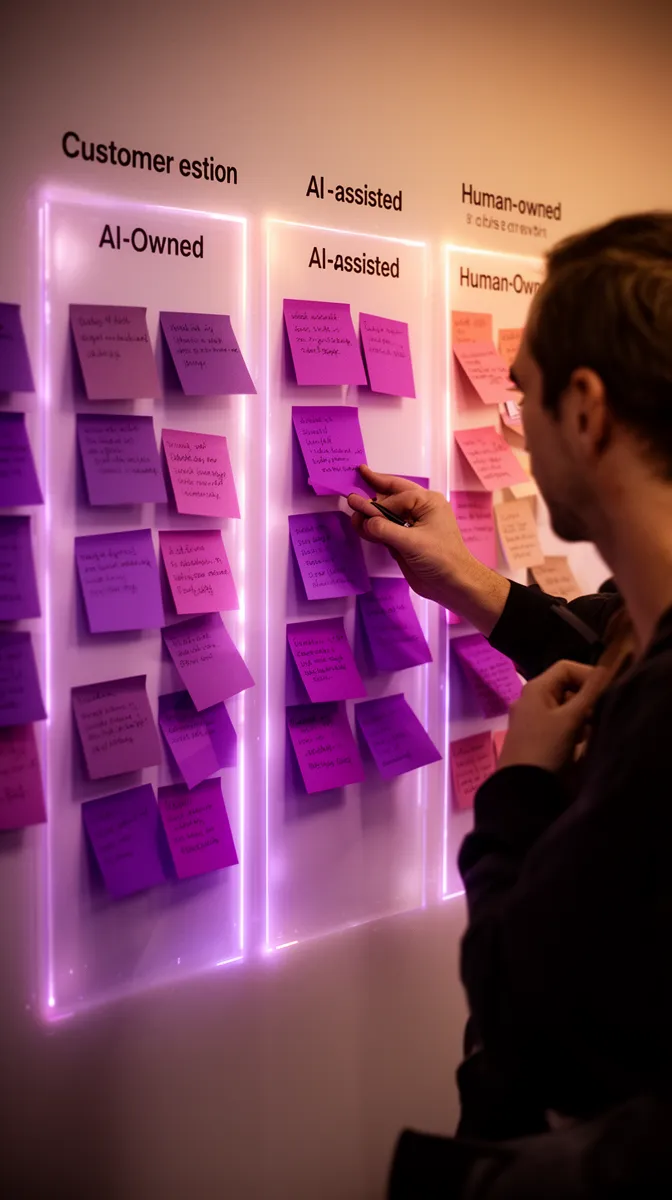
For each contact reason, decide whether it’s transactional, investigative, or emotional. Transactional requests are structured and repeatable (“reset my password”, “track shipment”). Investigative issues require digging into ambiguous data or systems. Emotional conversations involve frustration, fear, or high stakes—like outages or churn threats.
This matters because ticket deflection works best on transactional flows. For investigative and emotional topics, AI may still play a role, but as triage or assistant rather than owner. You’re designing your future routing rules around proven demand, not hypothetical chatbot demos.
For a SaaS team, a simple list might look like: login issues, billing questions, feature how-tos, bug reports, contract renewals, and security incidents. An ecommerce team might track: order status, returns and refunds, product information, payment failures, shipping problems, and loyalty program questions. Each of these categories will later map to AI-owned, AI-assisted, or human-owned lanes.
Rate AI readiness: complexity, structure, and data availability
Once you have your intents, score each one for AI readiness on a simple 1–5 scale. Consider three dimensions: complexity of the reasoning, structure of the request, and availability of data and integrations needed for resolution. This is where hybrid chatbot development services earn their keep.
For example, an intent like “order status” is low complexity, highly structured, and typically has clean data behind an order API. That might be a 5: clearly “AI-owned” once you connect the chatbot to your systems. A query like “explain our enterprise SSO setup” might be medium complexity and semi-structured: perfect for NLP-based chatbot retrieval with human reviews, so “AI-assisted”.
By contrast, “legal threat over contract clause” is high complexity, unstructured, and risky; it’s a 1 and clearly “human-owned”. Documenting which intents are AI-owned, AI-assisted, and human-owned steers your later AI model development investments. It also keeps you honest: if AI can’t see the necessary CRM, billing, or logistics data, it cannot own the workflow, no matter how strong the language model.
Describe this in a simple mental table. Take three intents—“reset password” (score 5, AI-owned), “billing dispute” (score 3, AI-assisted), “legal complaint” (score 1, human-owned). Map who starts the conversation, who can act, and which intent detection signals will move a conversation between lanes. That’s your first draft of a routing matrix.
Define guardrails and exclusions up front
Some conversations should always go to humans, regardless of how good your AI gets. Defining these guardrails is a core part of responsible AI to human handoff. Think legal threats, medical concerns, signs of vulnerable customers, security incidents, and high-risk VIP churn signals.
Codify these as explicit escalation rules instead of tribal knowledge. For example: any message mentioning “lawyer”, “lawsuit”, or “regulator” triggers immediate escalation to a specialist queue. Or: any VIP account with renewal in 30 days that expresses strong negative sentiment goes straight to retention.
This is how you practice AI governance instead of ad hoc risk management. Clear exclusions and guardrails make routing explainable and defensible to legal, compliance, and operations. They also reassure agents that automation won’t put them—or your brand—into situations AI should never handle alone.
Step 2: Design Intelligent Routing Logic for Hybrid Chatbots
Core routing signals: intent, confidence, sentiment, and value
With your capabilities mapped, you can start designing intelligent routing for hybrid chatbots. The most important signals are: intent classification, model confidence, sentiment/emotion, and customer value or tier. Together, these power the routing engine that sits under your hybrid chatbot platform for customer service teams.
Intent tells you what the user is trying to do; confidence thresholds tell you how sure the model is. Sentiment analysis flags frustration or delight. Customer value adds another dimension: free user versus enterprise, trial versus renewal. These signals combine into routing decisions that respect both customer needs and business priorities.
A simple rule might be: if intent is “billing dispute” AND confidence < 0.6 AND customer is Enterprise tier, then immediate human handoff with all context. For a low-value, low-risk FAQ, the rule might allow the AI two attempts at clarification before escalating. Contextual signals—channel, time of day, backlog, and SLA commitments—further adjust how aggressively you escalate or deflect.
Avoiding arbitrary handoffs: explicit, testable decision trees
The antidote to random AI routing rules is explicit decision trees. Instead of scattering “if user types ‘agent’ then escalate” conditions across your configuration, define a clear routing policy: a tree that decides when AI owns, when AI assists, and when humans own. That’s your conversation routing logic.
Think in prose, not code. Start with: “If intent is in AI-owned list and confidence > 0.7 and sentiment is neutral or positive, keep with AI.” Next: “If intent is AI-assisted or confidence is between 0.4 and 0.7, ask clarifying questions. If still low after that, escalate.” Finally: “If guardrail triggers or sentiment is very negative, escalate regardless of confidence.”
Each decision should be logged with a reason code: which rule fired, what thresholds were applied, and what the outcome was. Version your routing policies like you version models. This makes your routing engine inspectable and improvable, rather than a tangle of one-off exceptions that nobody fully understands.
Orchestrating workflows across tools and channels
In reality, no one runs a chatbot in isolation. Intelligent routing has to work across omnichannel support: web chat, in-app, WhatsApp, voice, email-to-chat bridges, even social DMs. Your hybrid experience breaks if one channel has smart routing and another just dumps everything to a queue.
This is where workflow orchestration matters as much as AI itself. The routing engine must integrate with CRM, ticketing systems like Zendesk or Freshdesk, and workforce tools. When the AI escalates, it shouldn’t just ping an agent; it should create or update a ticket with full context so the human doesn’t start from scratch.
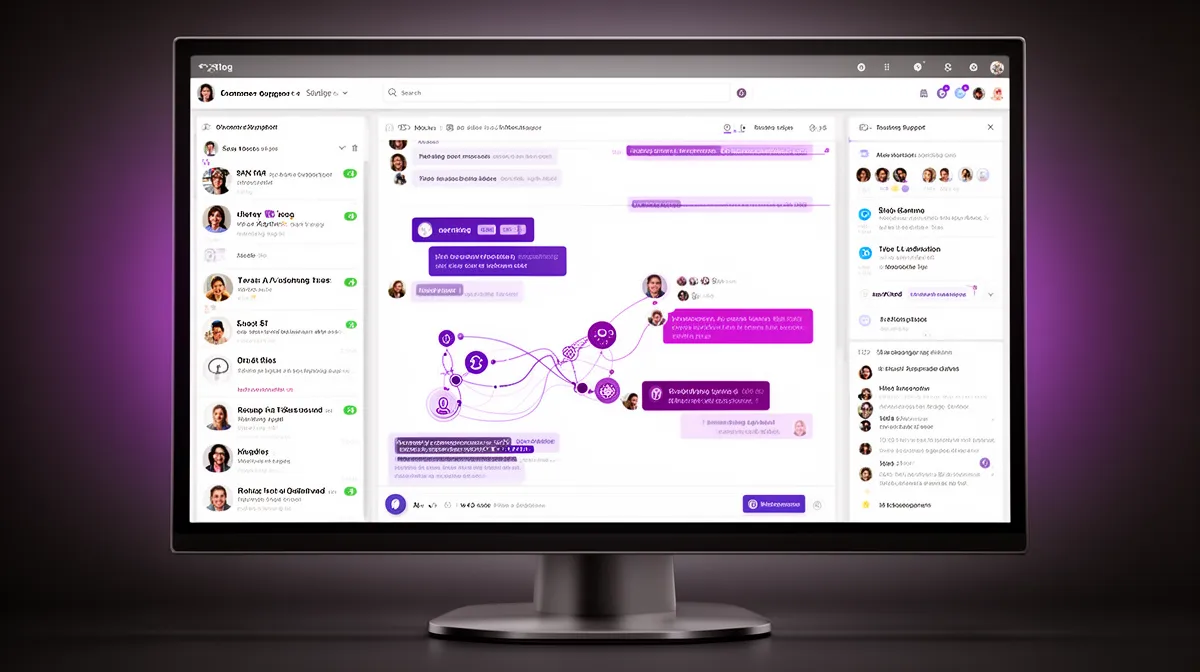
Picture a WhatsApp AI assistant that recognizes a complex shipping issue. It stays in-channel—the customer never has to switch to web chat—but routes to the right human queue and opens a ticket with the last 10 messages attached and summarized. That’s a hybrid chatbot platform for customer service teams in action: multi-channel, but powered by one brain.
At Buzzi.ai, we often pair this with our workflow and process automation services, so the same routing logic can trigger downstream actions: refunds, follow-up sequences, or proactive updates. The point is not just smart replies; it’s a coherent system that knows how to move work to the right place, every time.
Proven Routing Patterns for AI–Human and Human–AI Transitions
Confidence-based handoff with progressive clarification
Let’s move from principles to patterns. The first pattern is confidence-based handoff with progressive clarification, a cornerstone of best practices for AI to human handoff in chatbots. Instead of escalating at the first sign of doubt, the AI tries to reduce uncertainty—then escalates if needed.
Here’s how it works. The model detects intent and calculates confidence; if confidence is high, it proceeds. If confidence sits between two confidence thresholds (say 0.4 and 0.7), the AI asks 1–2 clarifying questions: “Are you asking about a refund or an exchange?” Only if confidence stays low after this conversation triage step does it hand off.
From the router’s perspective, this pattern reduces unnecessary AI to human handoff while still protecting customers from bad AI guesses. From the user’s perspective, it feels like a careful assistant trying to understand, not a gatekeeper refusing to connect them. When escalation happens, the human sees the clarifying Q&A plus a quick summary, so they can jump in fast.
Imagine a chat: the customer says, “I want to cancel my recent order.” The AI is unsure whether this is cancellation before shipping or a return after delivery. It asks, “Has your order already shipped?” Based on the answer, it either processes the cancellation or routes to an agent because the order is already at the warehouse. Under the hood, the router is comparing confidence scores before and after clarification to decide.
Sentiment and friction-based escalation
The second pattern is sentiment- and friction-based escalation. This is crucial for any hybrid customer support chatbot with human escalation that doesn’t want to wait for the word “agent” as a distress signal. The idea: your bot watches for repeated friction and negative sentiment, then proactively offers human help.
Friction signals include multiple rephrasings of the same question, long delays between replies, or users abandoning mid-flow. Layer that with sentiment analysis—detecting increasing negativity in tone—and you have powerful CX early-warning signals. Combined with CX optimization goals, you can calibrate how sensitive these triggers should be.
In a well-designed UX, the bot doesn’t just dump the user into a queue. After two failed attempts, it might say, “It looks like this is more complex than usual. I can connect you to a human specialist now.” This is still live chat escalation, but it’s driven by system signals, not user frustration boiling over.
This is where a solid industry case study helps. Companies that use sentiment-aware hybrid chatbots have reported significant CSAT improvements because customers feel “rescued” rather than ignored. The routing engine sees that negative sentiment plus high account value equals high-priority escalation—something a human-only triage team can rarely do at scale.
Value-based and lifecycle-based routing
The third pattern routes by value and lifecycle. Not every customer or conversation should get the same treatment, and a smart hybrid chatbot platform for customer service teams can encode that. This is essentially skills-based routing upgraded by AI.
For support, a low-value, low-risk query like “download my invoice” might always stay with AI, even for enterprise customers. But a renewal at risk, or a complaint from a strategic customer, should get human attention faster. That’s how AI for sales automation and support automation begin to converge: routing by customer value.
Consider two examples. A high-value renewal customer writes: “We’re evaluating alternatives because of recurring outages.” The hybrid router sees the account tier and lifecycle stage, combined with negative sentiment, and routes to a retention specialist immediately. A low-value, simple billing query—“Can I update my card?”—gets a self-service flow with optional human help, preserving agent capacity.
Done well, this kind of routing doesn’t just prioritize revenue; it creates fairness. High-effort, low-impact work gets automated, freeing agents to spend more time where they have the greatest impact on customers and the business.
Bi-directional routing: safely returning from human back to AI
Most teams obsess over AI → human, but ignore the other direction. The fourth pattern is bi-directional routing: once the core issue is resolved by a human, AI can pick up routine follow-ups. That’s where human in the loop design and workflow orchestration really pay off.
The crucial rule: never push someone back to AI while the main emotional or complex issue is unresolved. Humans own the “hard part”; AI handles predictable next steps. This is a form of AI-assisted support that respects both the customer and the agent’s time.
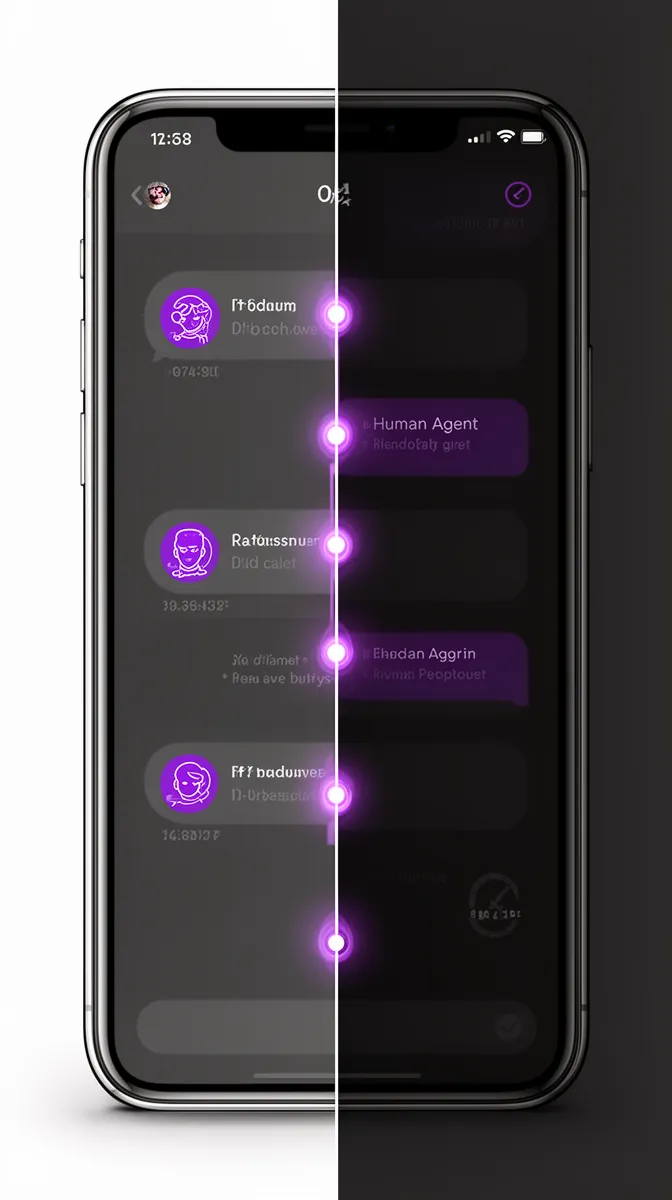
For example, an agent solves a tricky shipping dispute and wins back the customer’s trust. At the end, the agent clicks a “hand back to AI” action. From there, the AI can track the package, send proactive updates, ask for a satisfaction survey, or suggest related products. The customer experiences a seamless blend; the routing engine sees a clear phase change from human-owned to AI-owned tasks.
Metrics, Experiments, and Governance for Hybrid Routing
Core metrics: resolution, satisfaction, and routing quality
Without the right metrics, your routing engine is just guesswork. You still need the usual CX metrics—first-contact resolution (FCR), CSAT, average handle time, containment rate, escalation rate—but you also need routing-quality metrics. These tell you if your hybrid design is working.
Routing-quality metrics include: percentage of escalations where the human makes substantial changes (suggesting AI misrouted), percentage of bot hand-backs that agents accept, and cases where conversations ping-pong between AI and humans. For support queue management, you can also track queue depth by intent type and ticket deflection rate over time.
A typical Head of Support dashboard might show: FCR and CSAT trends, AI containment rate by intent, average time-to-agent after escalation, and re-escalation rate back from human to AI. Industry reports from platforms like Zendesk consistently show that organizations with clear hybrid routing see higher CSAT and lower handle time than those with ad hoc handoffs.
Running safe pilots and A/B tests on routing rules
Routing should evolve through experiments, not big-bang switches. Start with safe pilots: limited intents, specific customer segments, or restricted hours. This lets you trial new AI routing rules and conversation routing logic without risking your entire support operation.
Then layer on A/B tests. For example, you might test two different confidence thresholds for escalation: group A escalates to humans when confidence < 0.55, group B at 0.7. Compare CSAT, FCR, containment, and agent feedback. Over time, you’ll find the sweet spot that balances automation gains with customer and agent satisfaction.
Always keep human overrides in the loop. Agents should be able to pull a conversation away from AI instantly or push it back when they see a pattern. Supervisors should have dashboards to adjust routing parameters within guardrails. This is what mature AI transformation services look like: not just deploying a model, but running an ongoing optimization program.
Making routing explainable for compliance and stakeholders
As AI takes on more front-line conversations, leadership wants to know: who is in control? AI governance consulting best practices suggest you treat routing logic as policy, not just configuration. That means human-readable rules, decision logs, and clear ownership.
Every routing decision should be explainable: which signal fired which rule, and why. Access controls should limit who can change routing policies, and audit trails should capture each change with timestamps and approvers. This is the foundation of responsible AI consulting in customer service contexts.
At the board or exec level, you don’t need to expose every rule. Instead, summarize: “For transactional intents with high AI confidence, AI leads. For ambiguous or high-risk intents, humans lead. Sentiment and customer value can always override in favor of a human.” That kind of routing policy gives stakeholders clarity while preserving flexibility for your routing engine to evolve.
Implementation Playbook: From Design to Production with Buzzi.ai
Aligning CX, product, and data teams on routing policies
Turning all of this into reality starts with alignment. CX, product, and data teams need a shared view of why you’re investing in hybrid chatbot development, which guardrails matter, and what success looks like. This is where good AI strategy consulting blends business goals with technical constraints.
In a kickoff, you’ll answer questions like: Which intents are we targeting first? What is our risk appetite for AI-led conversations? When should agents always take over? How often will we review metrics and routing rules? This avoids “shadow routing rules” that agents invent under pressure because official policies are unclear.
We often treat this like an AI discovery workshop: map contact reasons, score AI readiness, define exclusions, then draft routing policies in plain language. This ensures that when you start building, everyone—from frontline managers to legal—understands the intent of the system. It’s the foundation of durable enterprise AI solutions for customer service automation, not just a chatbot experiment.
Integrating routing with your existing support stack
Next comes integration. The goal is a hybrid chatbot development project that fits naturally into your stack rather than forcing a rip-and-replace. That means connecting to your live chat, CRM, and ticketing platforms—Zendesk, Salesforce, Freshdesk, or others—so routing decisions show up where agents already work.
This is where ai integration services and workflow orchestration come together. The hybrid chatbot sits on top of your channels (web, mobile, WhatsApp) and uses APIs to create, update, and route tickets and tasks. Documentation from platforms like Salesforce Service Cloud or Zendesk gives you the hooks for routing and escalation that your AI layer can call.
A typical rollout path starts with web chat—often the easiest place to pilot—and reuses the same routing logic when you later add WhatsApp or voice bots. With Buzzi.ai, for example, we can extend the same policies to an AI chatbot integration with WhatsApp Business, ensuring that an enterprise customer gets the same level of care whether they message you on your site or on their phone.
How Buzzi.ai designs, pilots, and scales intelligent hybrid chatbots
At Buzzi.ai, our approach to hybrid chatbot development services follows a consistent pattern. We start with discovery and capability assessment, design the routing logic, then build a pilot focused on a handful of high-impact intents. From there, we iterate based on metrics and agent feedback before scaling.
Because we specialize in AI agent development and voice/chat bots for emerging markets, we’ve seen complex routing challenges play out in real time: flaky connectivity, multilingual conversations, and WhatsApp dominated ecosystems. The same principles apply: clear routing rules, smart handoffs, and strong integration with existing tools. When needed, we add our AI chatbot and virtual assistant development services or workflow process automation services to extend what AI can own.
Consider a support organization that started with a basic bot forwarding everything slightly complex to humans. By reworking routing around capability and context, we helped them cut escalations on simple workflows by 40% while raising CSAT. Agents spent more time on genuinely complex work; customers got faster answers and more consistent treatment across channels.
Conclusion: Turn Your Hybrid Chatbot into a Routing Advantage
Hybrid chatbots fail when they’re treated as UI glue. They succeed when hybrid chatbot development is treated as designing a routing engine based on capability and context. When AI and humans share conversations under clear rules, automation feels like help, not avoidance.
The prerequisites are straightforward but non-negotiable: a realistic capability assessment of your intents, clear guardrails and exclusions, and reusable routing patterns—confidence-based clarification, sentiment triggers, value-based prioritization, and safe bi-directional flows. Add metrics, experiments, and governance, and routing becomes an ongoing program, not a one-time configuration.
If your current “hybrid” setup still feels random—if AI to human handoffs are opaque, if agents don’t trust escalations, if customers keep saying “just give me a person”—it’s time for a routing audit. We’d be happy to help you map where your hybrid chatbot is today, design an intelligent, governed routing layer, and turn it into a real driver of CSAT and agent productivity.
FAQ
What is a hybrid chatbot and how does its routing work?
A hybrid chatbot is a system where AI and human agents share conversations under a unified routing engine. The routing logic decides, turn by turn, whether AI should respond, assist, or hand the conversation to a human. Done well, this routing is based on intent, confidence, sentiment, and customer value—not just queue availability.
How is a hybrid chatbot different from a normal AI chatbot or live chat?
A normal AI chatbot either answers or fails; pure live chat sends everything to agents. A hybrid chatbot blends the two with explicit rules for when AI owns a workflow, when it assists, and when a human must lead. This creates a more scalable and trustworthy experience than either approach on its own.
What signals should drive AI-to-human handoff decisions in a hybrid chatbot?
Key signals include intent classification, model confidence, sentiment or emotional tone, and customer tier or value. Guardrail triggers, such as legal or safety-related language, should immediately route to humans regardless of confidence. Combining these signals lets you prioritize high-risk or high-value conversations for faster human attention.
How do I stop my hybrid chatbot from escalating too many conversations to agents?
Start by tuning confidence thresholds and adding a progressive clarification step before escalation. Let the AI ask one or two follow-up questions to improve its understanding, rather than handing off at the first sign of uncertainty. Measure escalation and re-escalation rates and adjust rules so that routine, low-risk queries remain with AI whenever safely possible.
How can I safely move a conversation from a human agent back to AI?
Design a clear “hand-back” pattern where agents explicitly choose when the core issue is resolved and routine tasks can resume with AI. Limit AI to predictable follow-ups—such as sending updates, collecting feedback, or sharing documentation—after the human has handled the emotional or complex parts. This keeps control with the agent while still gaining efficiency from automation.
What are the best practices for AI to human handoff in chatbots?
Best practices include clear triggers based on confidence and sentiment, passing full context and summaries to agents, and signaling to the user when a human is joining. Avoid abrupt switches or asking customers to repeat themselves. Over time, test and refine your handoff rules using CSAT, FCR, and agent feedback to ensure the balance between automation and human care is right.
Which metrics show whether my hybrid chatbot routing is actually working?
Look beyond basic CSAT and handle time to routing-specific metrics like containment rate by intent, escalation rate, and re-escalation between AI and humans. Measure how often agents make substantial changes to AI-handled cases, and whether AI reduces queues on simple workflows without hurting satisfaction. Benchmarking against industry reports, such as Zendesk’s CX trends, can help you set realistic targets.
How should routing differ between sales and customer support use cases?
Support routing focuses on resolution quality, risk, and fairness; sales routing emphasizes speed to human contact for high-intent and high-value leads. In sales, you may want human reps involved earlier for strategic accounts, with AI handling qualification and FAQs. In support, AI can safely own many transactional workflows, with humans focusing on complex and emotionally charged issues.
Can I implement intelligent routing with my existing CRM and helpdesk tools?
Yes. Most major CRMs and helpdesks, such as Salesforce or Zendesk, expose APIs and routing hooks that an AI layer can use. A well-designed hybrid chatbot can sit in front of your existing stack, orchestrating conversations and creating or updating tickets so agents keep working in the tools they already know. Buzzi.ai specializes in this kind of integration, especially for WhatsApp and web channels.
How does Buzzi.ai approach hybrid chatbot development and routing design?
We start with discovery and capability assessment, map your intents, and define routing policies and guardrails in plain language. Then we build and pilot a hybrid chatbot with intelligent routing, integrating it into your existing tools and measuring impact on CSAT, FCR, and agent productivity. You can learn more about our approach in our AI chatbot and virtual assistant development services overview.