Generative AI Development Services That Start From Prompts, Not Models
Discover why generative AI development services live or die on prompt engineering quality, and how to evaluate vendors for consistent, production-grade outputs.

Most “advanced” generative AI development services fail for a surprisingly low‑tech reason: no one treats prompts as part of the product. They’re treated as throwaway strings in a notebook or hidden inside a prototype, then forgotten until something breaks in production.
Meanwhile, the sales conversation is all about model names, GPU counts, and fine-tuning pipelines. The reality on the ground? Hallucinations, off-brand responses, policy violations, and frustrated users who quietly abandon the shiny new tool.
In enterprise settings, the difference between a fragile demo and a reliable system rarely comes down to model choice. It comes from prompt engineering, output refinement, and the quality assurance process wrapped around them.
In this article, we’ll reframe how you think about generative AI development. You’ll see a concrete, prompt-centered methodology, a QA and metrics framework, and a practical checklist to evaluate generative AI services. Along the way, we’ll show how we at Buzzi.ai operationalize prompt engineering with process, not just clever hackers.
What Generative AI Development Services Really Do Today
From Model-First Pitch Decks to Workflow Gaps
Most buyers first encounter generative AI development services through a model-first pitch. The vendor talks about access to the latest large models, proprietary fine-tuning pipelines, or cloud partnerships with the big providers. It sounds impressive because it’s framed as cutting-edge ai product development.
Under the hood, these offers look similar: some discovery sessions, picking a large language model, wiring it into your stack, and shipping a UI. In theory, this checks all the boxes of modern large language model development. In practice, it often yields a great demo and a fragile production system.
Demos succeed because the vendor controls the script. They use carefully chosen questions and ideal data. But once you put the same system in front of real agents or customers, your enterprise AI solutions start hitting edge cases, ambiguous requests, or messy workflows the demo never covered.
Imagine a customer service chatbot POC. In the demo, it answers curated FAQs with perfect fluency. In production, agents forward more complex tickets: exceptions to policy, multi-step issues, or angry customers. Suddenly the bot hallucinates refunds, gives inconsistent policy answers, or writes in a tone your brand team hates. The issue is not the model—it’s the vague prompts and the absence of a robust prompt engineering process.
Analysts have started to document this pattern. A recent McKinsey report on enterprise gen AI adoption notes that most failures stem from poor problem framing and integration, not lack of access to advanced models (source). Prompts are where the problem framing hits the model, yet most vendors barely document them.
Typical Enterprise Generative AI Implementation Pattern
Look at a typical enterprise generative AI implementation for a moment. The pattern is remarkably consistent across industries:
- Discovery: high-level use case scoping conversations and ROI estimates.
- Data integration: connect to knowledge bases, ticketing systems, or document stores.
- Model selection: choose a model and maybe consider fine-tuning.
- UX: design chat interfaces, widgets, or workflow surfaces.
- Testing and deployment: internal pilot, then gradual rollout.
Where does prompt design appear in this timeline? Often at the very end, as a late-stage tweak done by a single engineer or data scientist. There is no systematic documentation, no standardized enterprise generative AI implementation and prompt design practice, and no shared understanding of why a given prompt looks the way it does.
The missing pieces are critical: structured prompt testing, clear evaluation metrics, and versioning across dev, staging, and production. Without them, your generative AI development services for enterprises look model-centric on paper but behave like ad-hoc experiments in production.
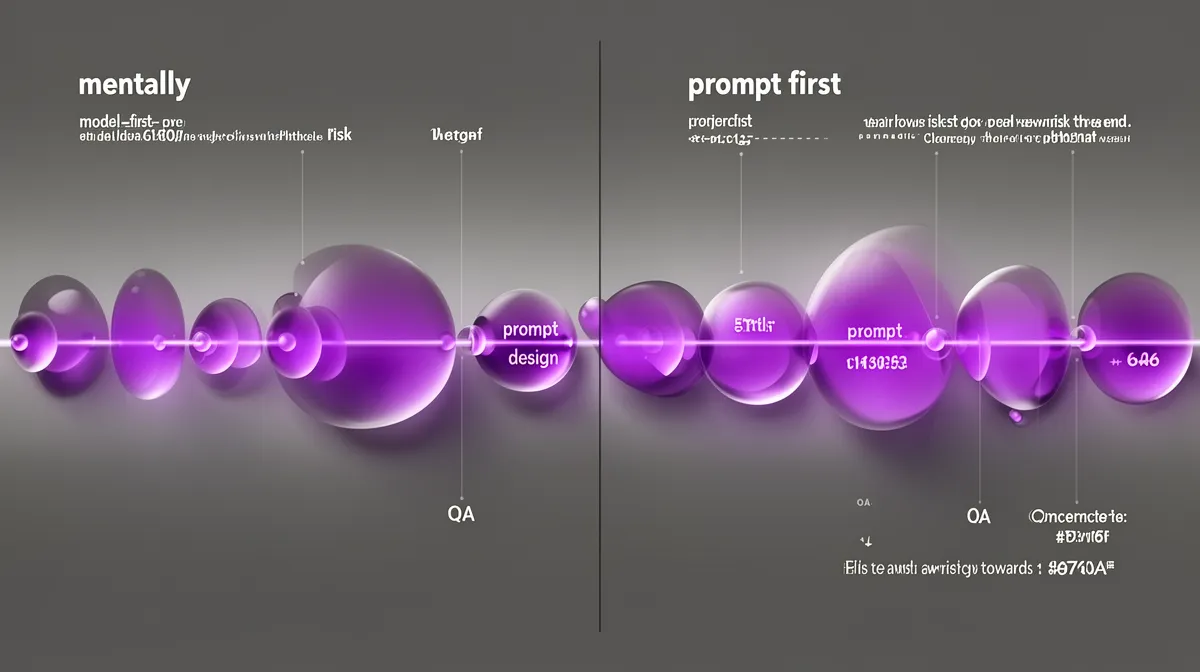
We prefer a different framing: prompt-centered vs model-centered projects. In a model-centered project, the model is the hero and prompts are an afterthought. In a prompt-centered project, prompts are treated as the primary interface and control surface, with models as interchangeable engines behind them. The rest of this article assumes the latter.
Why Prompt Engineering Outweighs Model Choice in Enterprise Use Cases
It’s tempting to believe that picking the “right” model is the lever that will make your gen AI project succeed. But for most enterprise problems, you’re already starting with extremely capable base LLMs. The marginal gains from switching models are often smaller than the gains from better prompt design, evaluation, and QA.
The Demos Work, the Workflows Don’t
Most failure stories we see are not about underpowered models. They’re about unclear task framing, missing constraints, and absent guardrails. When you ask a model to “help answer customer questions,” it will do exactly that—sometimes with made-up policies and invented facts.
Consider a support assistant deployed to deflect low-complexity tickets. The first version uses a general support prompt: “You are a helpful customer service assistant…” plus some basic instructions. It works fine in demos. But in production, hallucinations spike and agents escalate many tickets because they don’t trust the responses. CSAT drops, and leadership considers switching models.
Instead, the team redesigns the prompts. They break the monolithic prompt into task-specific ones: classification first, retrieval next, then response generation with strict constraints. They specify allowed sources, disallowed actions, escalation rules, and explicit refusal behavior. No model change, no fine-tuning—just structured prompt engineering.
The results are meaningful: hallucinations drop, escalation patterns stabilize, and user trust recovers. This is why why generative AI projects fail without proper prompt engineering isn’t a theoretical question. It’s a budget and reputation question for anyone running production systems.
Fine-tuning still has a place, especially for highly specialized domains. But it’s slower, more expensive, and harder to roll back than prompt-level changes. A prompt-first approach gives you cheap, fast iterations and better ai output consistency before you consider training custom models.
Prompt Engineering as Product Design, Not Just Prompt Hacking
We need to stop thinking of prompt engineering as clever phrasing or “prompt hacking.” In enterprise contexts, it’s much closer to interaction design. You’re designing a structured conversation between humans, systems, and models.
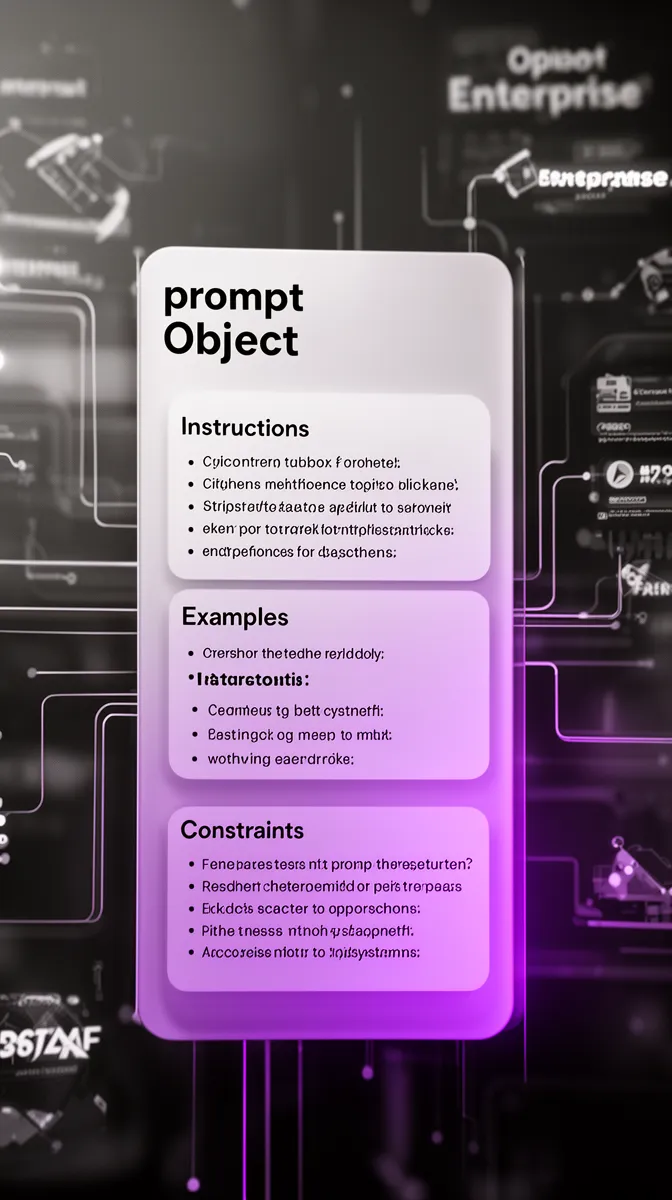
A high-quality enterprise prompt often includes several elements: a clear role (system prompt), detailed instructions, in-context examples, explicit constraints, and escalation rules. It encodes guardrails and policies: what the assistant may and may not do, how it should defer, and what to log for audit. This is the backbone of robust enterprise generative AI implementation and prompt design.
Those guardrails don’t live only in the model. They’re enforced by orchestration: role separation (e.g., one prompt for retrieval, another for generation), tool-calling prompts, policy-checking prompts, and oversight prompts that watch for risky output. The result is a system where prompts act as the “policy engine” for behavior.
Importantly, designing these prompts is a cross-functional job. Domain experts define what “good” answers look like. Compliance and legal teams define what’s off-limits. Brand owners define tone and style. Prompt engineers translate all of this into concrete system prompts and orchestrated flows. That’s what mature generative AI development services should be selling—not just API wrappers around models.
Academic and industry research is catching up here. Several studies show that well-structured prompts and examples can match or outperform fine-tuning for many tasks at a fraction of the cost (example paper). It’s not magic; it’s design discipline.
A Structured Prompt-Centered Generative AI Development Methodology
If we take prompts seriously, we need a methodology that puts them at the center. Think of it as prompt engineering focused generative AI development: prompts are the unit we design, test, and govern over the life of the system.
Step 1: Use Case Scoping and Failure Mode Discovery
We start from decisions and workflows, not features. What must the system reliably do? What must it reliably avoid? This is classic use case scoping, but expressed in terms of risks and behaviors rather than UI widgets.
In discovery workshops, we sit with domain experts and frontline users to list critical tasks, edge cases, and unacceptable failures. For an HR assistant, “must-succeed” scenarios might include explaining leave policies, summarizing performance review guidelines, and routing complex questions to HR. “Never allowed” behaviors might include giving legal advice, disclosing salary bands, or speculating about promotions.
Those discussions naturally translate into prompt-level requirements: tone (e.g., neutral and supportive), sources (official policies only), disclaimers (“this is not legal advice”), and escalation conditions (e.g., any question involving disputes goes to a human). These are the raw materials for robust prompts, and they emerge long before any model is chosen.
This is also where a good ai implementation partner earns their fee. They know which failure modes to ask about because they’ve seen them before. At Buzzi.ai, our AI discovery and use case scoping services make this systematic, but the principle is general: start from failures and constraints, not just happy paths.
Step 2: Designing Prompt Architectures, Not Single Prompts
Next comes architecture. Instead of a single giant prompt, we design a prompt architecture: a set of coordinated prompts for different steps in the workflow. This is where custom generative AI application development services differentiate themselves from simple chatbots.
A typical architecture might include: a classifier prompt to understand intent, a retrieval prompt to fetch relevant documents, a response-generation prompt to craft answers within constraints, and a validation prompt to double-check outputs for policy violations. Each prompt has a specific job and can be optimized independently.
We also avoid hardcoding everything into static strings. We create prompt templates with parameters for language, region, product line, or brand tone. This supports model-agnostic workflows, so you can swap models later without rewriting your entire system. It’s how we design model-agnostic workflows that survive vendor and model churn.
Consider an invoice processing assistant. The flow might look like this:
- Classification prompt: “Is this document an invoice, receipt, or something else?”
- Extraction prompt: “Given this invoice, extract vendor, date, line items, and totals.”
- Validation prompt: “Compare extracted totals with system-of-record data and flag discrepancies.”
- Summarization prompt: “Summarize this invoice in plain language for approval.”
Each of these prompts can be tuned, tested, and governed independently. That’s prompt architecture, and it’s foundational to scalable generative AI prompt engineering consulting services.
Step 3: Building Evaluation Datasets and Test Cases Up Front
Once we know the use cases and prompt architecture, we build evaluation datasets before writing a line of production code. These are curated sets of prompts plus expected behaviors across typical and edge scenarios. They anchor your ai evaluation pipeline.
We co-create these datasets with frontline users and subject-matter experts to ensure realism. For our HR assistant, that might mean 200 real questions pulled from historical tickets, covering routine requests, rare edge cases, and “trick” questions that previously caused issues. Each test case has an expected outcome and a severity level.
A simple mental model is a table with columns like: Input, Context, Expected Behavior, Acceptable Variation, and Severity. For example, “Employee asks about maternity leave in a different country” might be labeled as high severity if incorrect guidance could trigger legal risk. These cases become the backbone of your automated prompt testing.
We differentiate automated test cases (run regularly in CI-like pipelines) from exploratory manual testing (where experts try to break the system). Both are essential to any serious quality assurance framework for prompts.
Step 4: Implementation, Integration, and Human-in-the-Loop Loops
Only now do we move into full implementation and integration. Prompts travel from notebooks into production workflows: chat interfaces, ticketing systems, CRM screens, WhatsApp bots, or internal tools. This is classic llm application development, but driven by prompts rather than UI-first thinking.
In production, human-in-the-loop review becomes critical. Agents or specialists see AI-suggested responses, approve or edit them, and occasionally override them entirely. Each decision is an opportunity to collect feedback.
We capture that feedback systematically: tagging outputs as good or bad, recording corrections, and linking each event back to the exact prompt version and context that produced it. Over time, this becomes a goldmine for prompt iteration, better workflow integration, and even future fine-tuning if needed.
Documentation from major AI providers, like OpenAI’s guidance on RLHF-style data collection, underscores the importance of human feedback loops in achieving robust behavior (example). A mature partner for generative AI prompt engineering consulting services will treat this as table stakes, not an optional extra.

How to Manage Prompts Like Code: Versioning, Governance, and Environments
Once prompts are central, you need to manage them with the same rigor as code. That means documentation, versioning, governance, and environment separation—all under a formal prompt engineering QA process for generative AI systems.
Prompt Documentation and Version Control Basics
Every production prompt should be documented with its intent, owner, and change history. At minimum, you want to know: what this prompt is for, who is responsible for it, and why it changed over time. This is essential both for debugging and for audit.
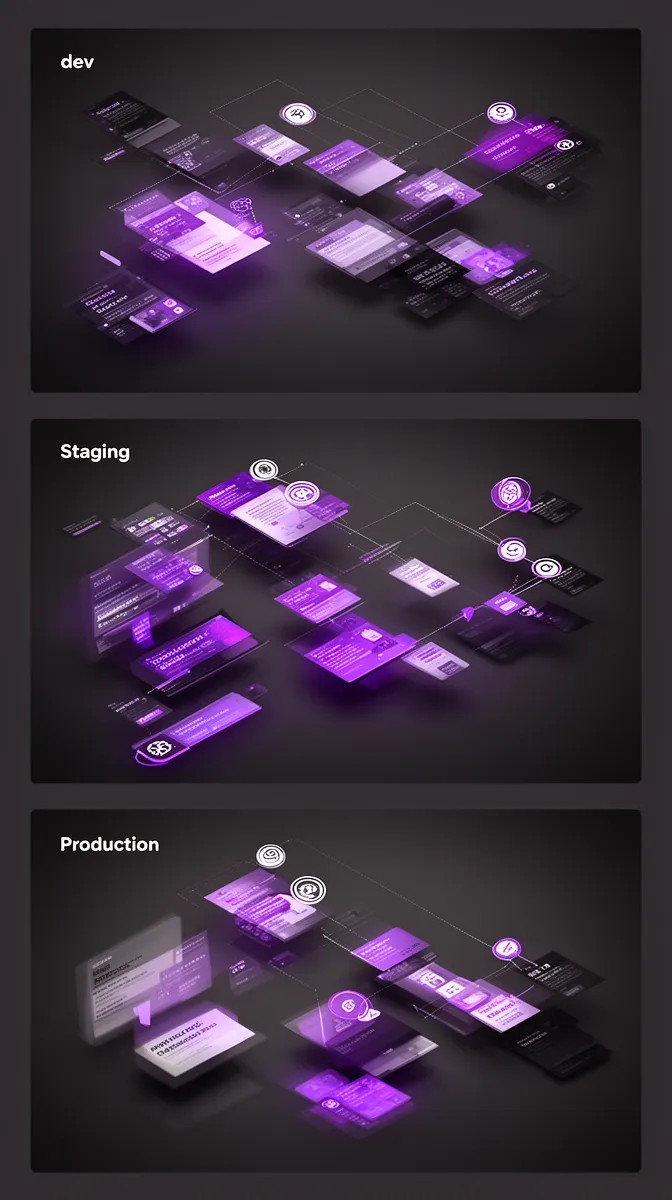
We typically store prompts in a repo or configuration management system, with separate branches or folders per environment (dev, staging, prod). Each change is a commit with a message like: “Tightened escalation rules for refund requests based on Q3 incident review.” This provides traceability from any output back to a specific prompt version.
A useful example of a change log entry might look like: “v1.3 – Updated system prompt to require explicit deferral for tax advice. Reason: legal review flagged prior wording as ambiguous. Approved by: Legal Ops, CX Lead.” That level of detail aligns with ai governance and audit requirements in regulated industries.
Guardrails, Policies, and Approval Workflows
Guardrails and policies shouldn’t live only in PDFs or policy wikis. They should be encoded directly into system prompts and orchestration logic. That’s how you consistently reduce hallucinations and off-brand responses.
For critical prompts—those handling financial, legal, or safety-sensitive content—you need clear approval workflows. Who can propose changes? Who must sign off? How do you record that sign-off? This is where enterprise risk and compliance teams plug into your gen AI stack.
Imagine a scenario where the model once suggested partial refunds beyond policy. The fix isn’t just “tell the team to be careful.” It’s a prompt update: more explicit instructions around allowed actions, stricter language on when to escalate, maybe an extra validation step. Legal and risk teams review and approve the change, and that approval is logged. This is what practical ai governance consulting looks like in a prompt-first world.
Frameworks like the NIST AI Risk Management Framework explicitly call out the need for controls at multiple layers of an AI system, including interaction surfaces like prompts (source). Treat prompts as one of those control layers.
Regression Testing Across Environments
Any meaningful prompt change should trigger automated regression tests against your evaluation datasets. If you’ve taken Step 3 seriously, you already have those data. Now you use them as a guardrail for prompt testing before promoting to production.
We run comparison tests: old prompt vs new prompt across the same test set, scoring responses with consistent evaluation metrics. Did task success improve? Did tone regress in any language or segment? Did refusal behavior change unexpectedly? Only when the answers are acceptable do we promote the new version.
Consider a French support flow where tone matters greatly. A seemingly harmless change to the English system prompt inadvertently affects how the assistant answers in French. Regression tests catch a drop in tone scores before deployment, preventing a brand issue. That’s the value of a structured quality assurance framework for prompts.
Measuring Generative AI Output Quality: Metrics That Actually Matter
You can’t manage what you don’t measure. If you want the best generative AI development services for consistent outputs, you need a metric layer that connects what metrics to use to measure generative AI output quality with real business outcomes.
Quantitative Metrics for Response Quality and Consistency
At the system level, we track a few key response quality metrics: task success rate (did the AI achieve the intended outcome?), factual accuracy proxies (e.g., retrieval overlap, reference compliance), refusal correctness (refusing when it should), latency, and escalation rate. Together, these tell you whether the AI is actually helping.
We often combine automated metrics with pairwise preference scoring, where human raters compare two responses and pick the better one according to a rubric. Over time, this produces a rich dataset for understanding ai output consistency by language, customer segment, or channel.
Picture a simple dashboard: for each use case, you see success rates, hallucination incidents, and escalation patterns. That’s more actionable than abstract model benchmarks. Resources like the OpenAI and Anthropic evaluation guides provide useful starting points for building such evaluation metrics (example).
Qualitative Rubrics and Brand Alignment
Numbers alone are not enough. We also use qualitative rubrics to score tone, clarity, helpfulness, compliance, and brand alignment. These are especially important during pilots, when you’re still discovering what “good” looks like.
A typical rubric might rate tone from 1 to 5: 1 = robotic or rude, 3 = neutral and adequate, 5 = warm and on-brand. Compliance might be 1 = policy violation, 3 = technically correct but unclear, 5 = accurate and explicitly aligned with policy. These scores tell you whether to adjust prompts, training data, or policies.
Because human-in-the-loop review is baked into the process, you can attach rubric scores to real interactions, not just synthetic tests. This becomes an input into your quality assurance framework and a signal for when prompt iteration is needed vs when deeper model work is warranted.
Linking Metrics to Business Outcomes
Ultimately, generative AI development services for enterprises must justify themselves in business terms. That means linking AI quality metrics to KPIs: handle time, first-contact resolution, NPS/CSAT, revenue per session, error rates, and so on.
We encourage buyers to demand clear measurement plans from vendors. If the vendor only talks about BLEU, BERTScore, or generic benchmarks, but not your KPIs, they’re optimizing for the wrong objective. That’s a red flag when you think about how to evaluate generative AI development vendors.
Consider a support assistant where better prompts reduce hallucinations and improve classification. Ticket deflection rises from 20% to 35%, CSAT ticks up, and average handle time falls. That’s ROI driven by prompt engineering, not a model swap—one of the hallmarks of the best generative AI development services for consistent outputs.
Budgeting Time and Resources for Prompt Engineering vs Model Work
All of this raises a practical question: how much time and budget should you allocate to prompts vs models? In true prompt engineering focused generative AI development, the answer is: much more than you probably are now.
A Realistic Allocation for Enterprise Projects
For a typical 12-week enterprise project, a healthy allocation might look like: 40–50% on prompt design and testing, 20–30% on integration and UX, 10–20% on model work (selection, possibly fine-tuning), and the rest on governance, data plumbing, and change management. In other words, prompt work is a first-class workstream, not a side task.
A sample plan might dedicate weeks 1–3 to discovery and failure mode mapping, weeks 2–5 to prompt architecture and evaluation datasets, weeks 4–8 to integration and human-in-the-loop tooling, and weeks 7–12 to iterative ai project planning with regression tests and governance reviews. The specific numbers vary, but the shape holds.
Leadership often worries that spending this much time on prompts will slow things down. In reality, the opposite happens. Investing early in prompt design and QA reduces rework, mitigates incidents, and prevents expensive rollbacks. It’s one of the easiest ways to control ai development cost without sacrificing quality.
Red Flags: When Vendors Underinvest in Prompts
When you evaluate generative AI development services, watch for red flags. No dedicated prompt engineers. No documented QA process. No evaluation datasets. Metrics that sound impressive but have no link to business outcomes. Heavy emphasis on model brands and fine-tuning, light emphasis on workflows and prompts.
In sales conversations, listen for how they describe failure modes and governance. If the discussion is all about “we use the latest model” and nothing about escalation rules, off-brand responses, or why generative AI projects fail without proper prompt engineering, be cautious.
Here are a few concrete questions to ask in an RFP or vendor interview:
- Who on your team owns prompt design, and how is their work documented?
- How do you version prompts across dev, staging, and production?
- What does your prompt-level QA process look like?
- Can you show examples of evaluation datasets you’ve built for other clients?
- Which evaluation metrics do you track in production, and how do they map to business KPIs?
- How do you decide when to change prompts vs when to change models?
- How do you ensure ai output consistency across languages and channels?
A vendor who answers these clearly is far more likely to deliver the best generative AI development services for consistent outputs than one who only talks about “state-of-the-art LLMs.” That’s the core of how to evaluate generative AI development vendors.
How Buzzi.ai’s Prompt-First Generative AI Development Reduces Risk
Everything we’ve described so far is how we actually build systems. Our generative AI development services are designed from the ground up to be prompt-first and evaluation-driven, with risk reduction as a central goal.
From Discovery to QA: Our Prompt-Centered Delivery Model
We start with structured discovery workshops that look a lot like failure mode discovery. We map decisions, workflows, and unacceptable behaviors. Then we design prompt architectures, evaluation datasets, and regression suites before touching production systems. This is the backbone of our generative AI development services for enterprises.
Throughout, we work cross-functionally with your domain experts, operations, and governance teams. For a WhatsApp voice bot or support assistant, that might mean joint sessions with contact center leads, compliance, and brand teams to encode policies directly into prompts. For workflow automation, we align prompts with your existing control points.
One enterprise deployment illustrates this. A support organization initially piloted a generic chatbot that hallucinated policy details and caused agent frustration. We replaced it with a prompt-architected system: task-specific prompts, retrieval constraints, and human-in-the-loop review. Without changing the underlying model, we cut hallucination incidents dramatically and improved ticket deflection—classic workflow automation gains driven by prompts.
If you’re exploring AI for customer service, sales, or internal operations, our generative AI agent development services package this approach into a repeatable delivery model.
What Enterprises Should Expect From a Prompt-First Partner
Even if you never work with us, you can use this as a benchmark. A true prompt-first partner should offer: a written prompt methodology, sample prompt architectures, QA playbooks, and clear reporting on metrics. They should integrate with your governance processes, not work around them.
Deliverables should include more than code: prompt libraries with version history, evaluation datasets, dashboards that show AI performance over time, and runbooks for handling incidents and prompt changes. This is the tangible output of serious enterprise AI solutions and custom generative AI application development services.
When you see this level of discipline, you can be confident that your vendor isn’t just experimenting—they’re building systems designed to last. And because prompt-first methods allow faster iteration, they often accelerate time-to-value compared to model-obsessed approaches. That’s the quiet advantage behind the best generative AI development services for consistent outputs.
Conclusion: Treat Prompts as Product, Not Afterthought
In enterprise settings, model sophistication is a solved problem. What isn’t solved is how we design, test, and govern the interfaces between those models and our businesses. That’s where prompt engineering and QA drive far more value than swapping one foundation model for another.
If you treat prompts as disposable strings, you’ll get disposable systems. If you treat them as product—versioned, governed, tested like code—you’ll get stable assistants, agents, and tools that people actually trust. Clear quantitative and qualitative metrics then become the bridge between AI behavior and business outcomes.
When you evaluate vendors, look for their prompt maturity: methodologies, artifacts, metrics, and governance. Anyone can call an API; not everyone can run a disciplined prompt engineering QA process for generative AI systems.
If you’d like to audit your current or planned initiatives against a prompt-first checklist, we’re happy to help you design a roadmap. Start with our AI discovery work or speak with us about a prompt-centered deployment through our AI agent development services. The models are ready; the question is whether your prompts are.
FAQ
What are generative AI development services in an enterprise context?
In an enterprise context, generative AI development services cover the end-to-end work of scoping use cases, selecting and integrating models, designing prompts, and deploying production systems. They should include governance, evaluation, and ongoing optimization, not just proof-of-concept demos. The best providers treat AI as part of your operating model, not a one-off experiment.
Why do generative AI projects fail without proper prompt engineering?
Many generative AI projects fail because they rely on vague, undocumented prompts that don’t reflect real workflows, risks, or brand requirements. Without structured prompt design, systems hallucinate, violate policies, or behave inconsistently across use cases. Proper prompt engineering encodes guardrails, examples, and escalation rules that keep powerful models within acceptable boundaries.
How can I tell if a generative AI vendor takes prompt engineering seriously?
Ask to see their prompt engineering methodology, including how they document prompts, version them, and test changes. Look for dedicated prompt engineers, evaluation datasets, and clear QA processes, not just model brand names in a slide deck. Vendors who can’t explain their prompt workflows in detail are unlikely to deliver robust, production-grade systems.
What does a structured prompt engineering QA process look like?
A structured QA process starts with evaluation datasets and test cases that cover typical and edge scenarios. It includes automated regression tests whenever prompts change, plus human-in-the-loop review during pilots and early rollout. Results are tracked with clear metrics and tied back to prompt versions, so you know exactly what changed and why.
Which metrics should I use to measure generative AI output quality?
Useful metrics combine system-level and human judgments: task success rate, factual accuracy proxies, correct refusals, latency, and escalation rate, plus rubric scores for tone, clarity, and compliance. These should be segmented by language, channel, or product line to catch hidden issues. For more structure, you can adapt evaluation approaches from providers like OpenAI or Anthropic, or work with partners like Buzzi.ai to build a tailored framework.
How should prompts be documented and versioned across environments?
Prompts should live in version-controlled repositories or configuration systems, with clear metadata: purpose, owner, dependencies, and change history. Maintain separate versions for dev, staging, and production, and require approvals for changes to high-risk prompts. This allows you to trace any problematic output back to the exact prompt version responsible.
How often should we revisit and update prompts in production systems?
In the first 3–6 months after launch, you should expect to iterate frequently—weekly or even daily for high-traffic systems—as you learn from real-world interactions. Over time, the change cadence slows, but you should still schedule regular reviews tied to product updates, policy changes, or new markets. The key is to base updates on data from your evaluation metrics and human feedback loops, not ad-hoc intuition.
Can prompt engineering alone reduce hallucinations and off-brand responses?
In many cases, yes. By constraining sources, specifying allowed behaviors, and designing multi-step workflows with validation, you can dramatically reduce hallucinations without changing models. For brand alignment, detailed tone and style instructions in system prompts, reinforced with examples, often resolve issues that would otherwise be blamed on the model.
How much project time should be budgeted for prompt design vs model work?
A reasonable starting point is to allocate 40–50% of effort to prompt design, testing, and QA, and only 10–20% to model selection and tuning. The rest goes to integration, UX, governance, and change management. This mix reflects the reality that prompts and workflows, not models, usually determine whether a system succeeds in production.
How does Buzzi.ai’s prompt-first approach improve generative AI ROI?
Our approach focuses on designing prompt architectures, evaluation datasets, and human-in-the-loop feedback loops before scaling usage. This reduces rework, incidents, and low adoption that often plague gen AI rollouts, leading to faster time-to-value. If you want to see how that could work in your context, explore our AI agent development services or reach out via our site.