Enterprise AI Deployment That Stays Healthy After Go‑Live
Rethink enterprise AI deployment as an operating model, not a project. Learn how enablement, governance, and MLOps keep AI valuable long after go-live.

Most “successful” enterprise AI deployment efforts start dying the day they go live—not because the models are bad, but because the organization isn’t prepared to operate them. You get the big demo, the executive emails, the dashboard screenshots… and then, over the next 6–18 months, the value quietly decays. People route around the system, performance drifts, and the AI that once looked strategic becomes “that thing we tried.”
If you’ve lived through this, you know it isn’t about one bad algorithm. It’s about treating enterprise AI implementation as a technical event instead of a change in how the business actually runs. AI operationalization is closer to standing up a new business capability than installing software: it touches decisions, workflows, roles, incentives, and governance.
In this article, we’ll reframe enterprise AI deployment as an operating model problem. We’ll walk through why go-live is misleading, the common failure patterns, and a pragmatic framework that integrates deployment, operations, enablement, and governance. Along the way, we’ll show how capability building and knowledge transfer keep AI healthy long after launch.
At Buzzi.ai, we build AI agents and systems designed to survive contact with reality—not just pass a pilot. What follows is the approach we wish more enterprises used before spending millions on AI that quietly stalls out.
What Enterprise AI Deployment Really Is (and Why Go-Live Is Misleading)
Beyond technical launch: deployment as socio-technical change
When most teams talk about enterprise AI deployment, they mean something very specific: code in production, endpoints live, monitoring wired up, dashboards refreshing. In other words, the technical plumbing is connected and the model is reachable. That’s necessary, but it’s only about a quarter of the real work.
A sustainable deployment is when the AI system is embedded in how decisions get made and work actually flows. That means business processes, roles, escalations, and incentives have changed to reflect the presence of AI. For production AI systems, the real milestone isn’t “service is up,” it’s “people rely on this to do their jobs and trust what it’s doing.”
AI is different from traditional IT deployments because it’s probabilistic, data-dependent, and evolving. A rules engine behaves the same way tomorrow as today unless you change the rules; a model will change its effective behavior as the underlying data and business context shift. That makes ai deployment strategy fundamentally a question of how your organization learns and adapts, not just how you deploy containers.
Think of a predictive maintenance system in a manufacturing plant. The pilot looks great: it flags likely failures ahead of time, a small team of champions adjusts schedules, and downtime drops in that pilot cell. But after go-live across the plant, maintenance planners keep using their old spreadsheets, supervisors don’t adjust shift plans based on AI alerts, and the central ops dashboard becomes a side-screen. The model “works,” but deployment failed because workflows and roles never really changed.
This is why serious AI operationalization forces you to treat deployment as socio-technical change. The moment the model hits production is the start of real risk, value, and friction—not the end.
Why most enterprise AI deployments quietly deteriorate
Many enterprises experience a common pattern: the first few months after launch look fine, then something feels off. Performance dips, business KPIs wobble, and people start hedging their bets with manual checks. But because there’s no robust ai performance monitoring in place, nobody can say exactly when things went wrong.
Under the hood, you usually see several failure modes stacking up:
- Model drift as data and behavior change, but no one owns model lifecycle management or retraining.
- No budget or process for post-deployment support, so fixes turn into side projects.
- Ambiguous ownership between data science, IT, and business teams.
- Shadow processes where teams keep parallel spreadsheets or manual checks “just in case.”
- Gradual reversion to pre-AI ways of working when the system becomes annoying or untrusted.
Consider a churn prediction model in a subscription business. It launches at 82% precision and the sales team gets a weekly list of “at-risk” customers. For a quarter, results look good. Then the company changes pricing, launches new plans, and enters a new segment. The model hasn’t seen this data distribution before, and its accuracy erodes to 60%, then 55%—but nobody notices until renewal rates drop and leadership runs a post-mortem.
Most post-mortems blame the tech: “The model was wrong,” “The vendor overpromised,” or “AI isn’t ready for our business.” In reality, the root causes are almost always organizational: no clear ownership, no dedicated ai model monitoring, and no explicit process to respond when the world changes. The ai adoption story breaks because the operating model was never designed for ongoing care.
Industry data supports this picture. McKinsey has repeatedly found that only a minority of companies manage to scale AI beyond pilots, and many cite organizational and process gaps rather than algorithms as the blockers (State of AI report).

Common Failure Patterns in Enterprise AI Deployment
Once you stop treating go-live as the finish line, the failure patterns in enterprise AI deployment become much easier to see. They’re mostly organizational, not technical—and they repeat across industries.

Treating AI deployment as a one-off IT project
Traditional project-mode thinking is the enemy of sustainable AI. A lot of organizations still fund AI as a fixed-scope, fixed-end-date project: build the model, integrate it, hand it over to operations, close the ticket. That mental model works for a website redesign; it breaks for a living system that learns.
The “throw it over the wall” pattern is common: a data science team trains a great model, IT wraps it in APIs, and then it’s tossed to support or a generic ops team with a thin runbook. There’s no product owner, no roadmap, and no explicit opex for improvements—only the initial capex line item. This is the opposite of what you need from enterprise AI deployment services or any serious ai operating model.
Imagine an enterprise that funds customer support automation as a capital project. Budget covers a chatbot, some integrations, and the launch campaign. But there’s zero allocation for tuning intents based on real conversations, updating flows when new products launch, or retraining models as language patterns shift. Within a year, containment rates fall, agents stop trusting suggestions, and the AI is labeled a failure—when the real failure was in how it was funded and owned.
A credible ai roadmap assumes continuous learning costs: human, technical, and financial. Without that, even the best model is on a slow decline curve.
No clear ownership or accountability for AI in production
Another pattern: everyone is involved in building the AI system, but no one clearly owns it in production. Data science claims they “own the model,” IT owns the infrastructure, and the business owns the outcome—but when something goes wrong, each group assumes it’s someone else’s problem. You get slow incident response and lots of meetings.
This is where ai governance and operating model work become critical. Sustainable AI deployments designate specific roles: model owner, data owner, service owner, and business sponsor. Someone is explicitly accountable for performance, change approvals, and risk decisions. Many organizations formalize this via an AI Center of Excellence or federated governance board informed by an ai readiness assessment.
Consider a scenario where a major performance issue crops up: a pricing model starts suggesting unusually low prices under certain conditions. IT notices logs spiking, sales complains anecdotally, but nobody feels empowered to approve a rollback or change. Weeks pass while committees convene. Confidence in the system nosedives—not because the problem was unsolvable, but because escalation paths were never defined.
Deloitte’s State of AI in the Enterprise reports frequently highlight governance and ownership gaps as top barriers to realizing AI value. The tech is rarely the limiting factor.
Enablement as an afterthought: training-as-a-checkbox
The third failure pattern is treating enablement as a checkbox. Many enterprises run a single training workshop before go-live, send around a slide deck, and declare users “enabled.” When adoption lags, they blame “resistance to change” instead of their own approach.
But user enablement is not a broadcast event; it’s a process of capability building. People need repeated exposure, embedded support, and real-world practice. Documentation is necessary but not sufficient; it doesn’t tell you what to do when the system makes a weird recommendation five minutes before a major customer call.
Contrast two approaches. In the weak version, users sit through a 90-minute webinar, get access to the AI tool, and are told to “explore.” In the strong version, there’s a structured ai training program that includes co-design workshops, shadowing sessions where users watch experts operate the system, live office hours, and battle-tested runbooks. Knowledge transfer is baked into daily work instead of being outsourced to a single “enablement day.”
Without this level of investment, AI systems get quietly sidelined. Vendors sometimes even use poor enablement to lock clients into additional services: “It’s too complex for you to run.” Robust knowledge transfer and enablement turn that dynamic on its head.
High-profile governance and enablement failures in the news—like biased recruitment tools or misused risk scores—often trace back to this pattern: people weren’t adequately trained on how to interpret, challenge, and operate the AI system responsibly (example of recruitment AI controversy).
An Enablement-Inclusive Framework for Enterprise AI Deployment
So if the usual patterns fail, what does a better enterprise AI deployment framework for sustainable operations look like? It starts by expanding the scope: from “deploy a model” to “stand up a managed AI service the business can safely rely on.” That requires four integrated lenses.
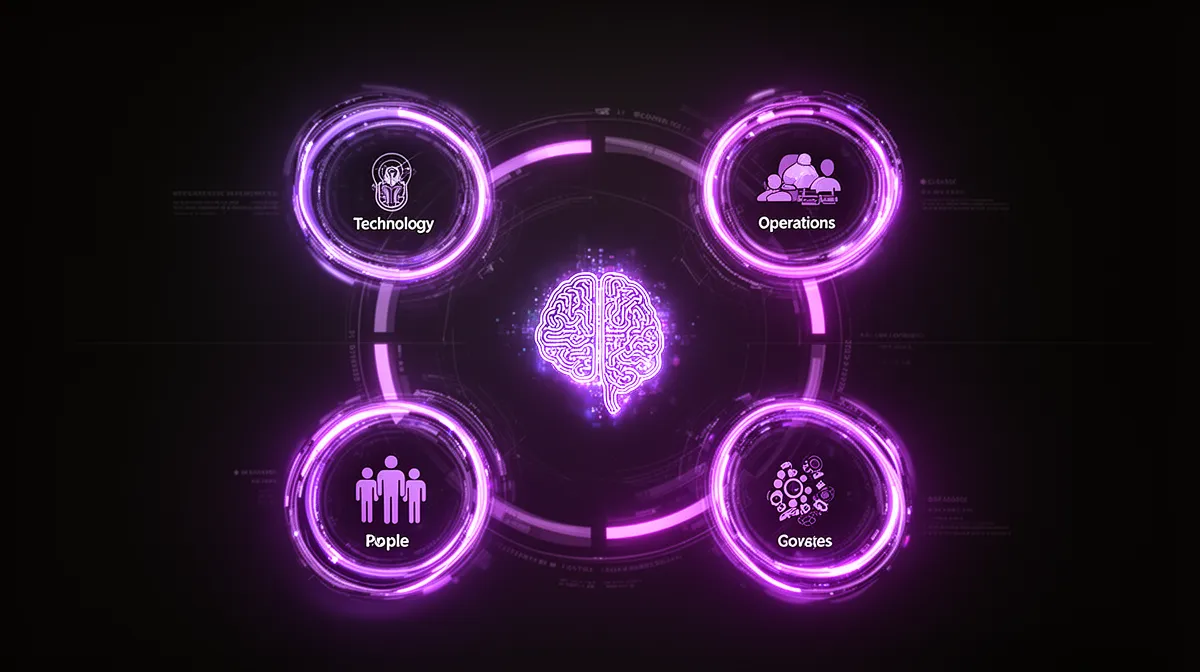
Four lenses: technology, operations, people, governance
We recommend designing every deployment through four lenses: technology, operations, people, and governance. Each lens has its own success criteria, decisions, and activities. A credible ai deployment strategy touches all four; if your plan is mostly about tech tasks, it’s incomplete.
At a high level, the lenses look like this for sustainable AI operations:
- Technology: models, data pipelines, APIs, mlops tooling, observability. Decisions: which performance metrics matter, what thresholds trigger alerts, how versioning and rollbacks work.
- Operations: runbooks, SLAs, support tiers, incident response. Decisions: who handles alerts at 2am, how often retraining happens, what “normal” vs “degraded” service states mean.
- People: roles, skills, training, support structures. Decisions: who can override AI, who can change configurations, how frontline and management interact with the system.
- Governance: risk controls, compliance alignment, auditability. Decisions: what needs formal approval, how bias and fairness are monitored, how regulators or auditors are engaged.
Best practices for enterprise AI deployment and enablement treat these as a single integrated design problem. You don’t bolt governance on after the fact or hope that “operations will figure it out.” You design the operating cadence up front.
From project to product: AI as a managed service line
A powerful mental shift is to treat each significant AI use case as a product or service line, not a project. That means accepting that there is a lifecycle: discovery, alpha, beta, general availability, growth, maturity, and potentially sunset. Model lifecycle management is simply applying product thinking to AI behavior over time.
In a product mindset, you maintain a backlog: feature requests, bugs, performance improvements, and new ideas informed by users. You have a release cadence, even if it’s modest. Governed, regular change becomes expected instead of scary. MLOps provides the technical backbone—automated testing, deployment, monitoring—but you still need product and operations muscles around it.
Take a customer service routing AI. In a project world, you would “implement” it, route tickets, and walk away. In a product world, you publish release notes when triage logic improves, collect agent feedback on misrouted cases, prioritize new intents based on volume, and adjust SLAs across channels. This is ai operationalization as a living practice, not a one-time event.
When enterprises make this shift, ai scaling strategy improves as well. Lessons from one AI product feed into the next; reusable components and patterns emerge. You’re building a portfolio, not a grab bag of disconnected pilots.
Embedding enablement into every deployment stage
Enablement shouldn’t be a final workstream added right before launch; it should run in parallel with technical delivery from day one. If you map your deployment into phases—discovery, design, build, pilot, scale—each has specific enablement activities attached.
In discovery, you’re defining roles and responsibilities, not just use cases. In design, you’re running co-design sessions with end users to understand where AI fits their reality. In build, you’re drafting playbooks and runbooks while engineers write code. During pilot, you’re doing paired operations (“you run it while we watch”) and refining training based on real incident patterns. At scale, you’re training trainers and seeding internal champions.
This is what we mean by best practices for enterprise AI deployment and enablement: the human and process workstreams get funded and tracked like technical ones. If your Gantt chart has 40 lines of technical tasks and two lines of “training,” it’s a red flag. True enterprise AI implementation and knowledge transfer is a multi-month, structured program, not a webinar.
Over a 6–9 month deployment, the timeline might look like this: months 0–2 focus on discovery and design with heavy stakeholder workshops; months 2–5 on build and early pilot with joint ops; months 5–9 on full pilot, wider training, and handover. Enablement threads through all of it, from early exposure to hands-on practice and eventually leadership of day-to-day operations by internal teams.
Structuring Capability Building and Knowledge Transfer
If deployment is socio-technical change, then capability building and knowledge transfer are the core levers. The goal isn’t just to make people aware of the new AI system; it’s to make them capable of operating, improving, and governing it over time.

Designing enterprise AI capability, not just features
Many AI rollouts stop at feature-level training: “Here’s where you click to see the prediction.” That’s necessary but far from sufficient. Enterprise AI capability means people understand how the system behaves, where it’s strong or weak, and what levers they can safely pull.
A useful way to think about enterprise AI implementation is through a capability matrix. Frontline staff should be able to interpret AI outputs, use feedback mechanisms, and follow runbooks when something looks wrong. Managers should be able to monitor KPIs, adjust thresholds within guardrails, and escalate issues. An AI CoE should manage models, monitor risk, and coordinate improvements. IT should maintain infrastructure and integrations.
This is where the concept of an AI Center of Excellence (CoE) or a federated equivalent earns its keep. The CoE doesn’t hoard control; it defines standards, supports teams, and ensures knowledge flows across the organization. A well-run CoE is a capability amplifier, not a bottleneck, and is central to ongoing ai training programs.
Effective knowledge transfer patterns for AI deployments
Slide decks and PDFs are the weakest form of knowledge transfer. They’re necessary documentation, but they don’t create operational confidence. For that, you need embedded patterns: shadowing, joint operations, and gradual handover.
We’ve seen a “three-wave” pattern work well for enterprise AI implementation and knowledge transfer:
- Wave 1 – Vendor-led: external partner runs the AI system with client observers. Focus is on transparency and explanation, not magic.
- Wave 2 – Joint ops: vendor and client teams operate together. Client leads some tasks (e.g., triage) while vendor backs them up, refining runbooks and playbooks.
- Wave 3 – Client-led: client runs daily operations, vendor shifts to periodic health checks, complex changes, and new use cases.
Throughout these waves, you’re building concrete artifacts: operational playbooks, escalation matrices, failure-mode libraries, and decision trees. These make up the backbone of your ai operating model. They also ensure that domain knowledge flows both ways—business experts help improve AI behavior, and AI specialists help business teams understand what’s possible.
Without this kind of structured post-deployment support, enterprises end up dependent on the vendor for trivial changes. With it, they gain internal confidence and agility.
Making business users operators, not passive consumers
AI systems fail when business users are kept at arm’s length. If the only thing a supervisor can do is “view the model output,” they’ll never fully trust or embrace it. Sustainable ai adoption depends on making business users active operators within safe bounds.
That means exposing meaningful, governed controls and feedback loops. For example, contact center supervisors might be allowed to adjust routing thresholds within predefined ranges, tag bad predictions, and see how those tags feed into future improvements. Sales managers might be able to override lead scores with justifications that get reviewed and used as additional signal.
Training then becomes scenario-based, not theory-based. Instead of generic tutorials, you run workshops on real situations: “Here’s an AI-suggested action that conflicts with your judgment—what do you do? How do you record that? How does it get reviewed?” This is what robust ai training programs look like when they’re designed for sustainable AI operations, not compliance.
The payoff is faster iteration and reduced vendor dependence. When business users are trusted operators, your organization can evolve AI behavior in weeks instead of quarters.
Governance, MLOps, and Operating Model for Sustainable AI
Technology alone can’t keep AI healthy in production. You need an operating model that combines day-to-day ai governance, robust mlops, and clear organizational structures. Think of this as the scaffolding that keeps your AI services upright as the business and environment change.
Operationalizing AI governance day to day
Most enterprises now have some form of AI or data ethics policy. The challenge is turning those documents into daily habits. Operationalized governance looks like rituals and workflows, not just PDFs.
Typical practices include approval workflows for model changes, exception review boards for high-risk decisions, and periodic risk assessments. Clear roles matter: model owners, data owners, risk/compliance leads, and business sponsors with defined responsibilities. These structures align with emerging regulatory expectations around responsible AI and ai compliance, from GDPR to sector-specific guidelines.
A practical example: a monthly “AI performance and incident review” meeting with a standing agenda—metrics review, incidents and near-misses, upcoming changes, and risk discussion. Over time, this simple ritual becomes the backbone of your ai governance consulting practice internally. Frameworks like the NIST AI Risk Management Framework offer a strong reference model for what these practices should cover.
How MLOps fits into an enablement-focused strategy
In business terms, mlops is the engineering discipline that makes AI repeatable, observable, and safe in production. It includes automated testing, CI/CD for models, data and model versioning, and monitoring. But its real power in an enablement-focused strategy is how it surfaces information and controls to non-technical stakeholders.
Good MLOps doesn’t drown business users in ROC curves; it exposes business-level metrics: conversion rates, SLA breaches, false positives with dollar impact. It provides alerts when those metrics drift, not just when a latency threshold is crossed. That’s modern ai performance monitoring and ai platform integration done right.
Crucially, MLOps is necessary but not sufficient. You can buy tools and still fail if nobody owns the alerts, if governance is unclear, or if business users don’t know how to respond. The tools support your operating model; they don’t replace it.
Designing an AI operating model that can scale
As AI spreads from one use case to many, ad-hoc structures stop working. You need an explicit ai operating model. Broadly, organizations choose among three patterns: centralized CoE, hub-and-spoke, or embedded teams.
A centralized CoE makes sense early: one team builds and operates most AI solutions, setting standards and proving value. As adoption grows, a hub-and-spoke model often emerges: the central hub defines patterns and platforms, while domain “spokes” in business units own specific AI products. Fully embedded models, where every team has strong AI capability, are rare and usually a later-stage outcome of a mature ai scaling strategy.
Over 24 months, a company might start with a centralized team launching a flagship use case, then gradually create spoke teams in sales, operations, and customer support as they adopt multiple AI services. Throughout, the organization relies on partners who provide enterprise AI deployment services that include operating model design, not just technical implementation. This is also the phase where operationalizing enterprise AI solutions across workflows becomes a strategic priority.
Research from leading practitioners on production AI reliability and MLOps (e.g., papers from major cloud providers and large-scale AI adopters) consistently shows that organizations that formalize operating models and governance see far fewer incidents and higher value realization.
A 12–24 Month Roadmap for Enterprise AI Deployment and Enablement
One reason expectations go sideways is that leaders secretly hope for transformation in 3–6 months. In reality, learning how to deploy AI at enterprise scale is a 12–24 month journey. The good news is that you can structure that journey into clear phases with tangible wins along the way.
Phase 1 (0–3 months): readiness and design
The first phase is about understanding where you are and designing where you want to go. A rigorous ai readiness assessment looks at data quality, platform maturity, governance structures, and organizational capacity. The output isn’t a score; it’s a map of constraints and opportunities.
In parallel, you select high-leverage use cases with clear value hypotheses and measurable outcomes. This is where a well-structured ai roadmap starts: rank potential use cases by impact and feasibility, but also by learning value—what will teach your organization the most about AI operationalization? Partners like Buzzi’s AI readiness assessment and discovery offerings often plug in here.
Finally, you design an initial operating model: who will own the first AI product, what governance forum will exist, what enablement plan runs alongside the technical architecture. This is still enterprise AI deployment, just at the blueprint level.
Phase 2 (3–9 months): pilot, enablement, and proof of value
Phase two is about building, deploying, and operating your first production-grade AI use case with strong guardrails. This is your proving ground for operationalizing enterprise AI solutions. The goal isn’t perfection; it’s safe learning under observation.
You run joint operations: vendor and client teams sitting (physically or virtually) side by side. You execute a structured knowledge transfer plan while the system runs in a constrained but real environment. You track metrics that reflect both technical and business health: adoption rates, cycle time reduction, leading financial indicators, and user satisfaction.
This is also where you validate your post-deployment support model. Are alerts going to the right people? Are runbooks clear? Is governance able to move at the speed of change? Early successes and failures here shape your broader ai value realization story and inform the next wave of ai training programs.
Phase 3 (9–24 months): scale, standardize, and internalize
By phase three, you’re moving from one flagship use case to a portfolio. The priority becomes reuse and standardization. You leverage shared MLOps stacks, governance patterns, and enablement templates to scale faster and more safely. This is the heart of how to deploy AI at enterprise scale without chaos.
You standardize playbooks, runbooks, and governance rituals across use cases. “Train-the-trainer” programs turn early adopters into multipliers. At the same time, you consciously shift responsibility from external partners to internal teams; the partner focuses on complex improvements and new capabilities, while your teams handle day-to-day operations.
By month 18 in a well-run journey, we often see organizations running several production AI systems with shared tooling, rituals, and governance. That’s what sustainable AI operations look like in practice—and it’s the outcome of a deliberate ai scaling strategy and ai roadmap, not just ad-hoc experimentation. Industry playbooks from major cloud providers (e.g., AWS, Azure, Google Cloud) outline similar maturity paths for AI operating models.
How Buzzi.ai Approaches Enterprise AI Deployment for Longevity
All of this theory matters only if it shows up in how deployment is actually done. At Buzzi.ai, we design our enterprise AI deployment services around one principle: if the system isn’t healthy 18 months after launch, we didn’t really succeed.
Deployment and enablement as a single integrated offering
We don’t sell “just models.” Our ai implementation services combine technical build, operating model design, enablement, and governance from day one. That means co-defining roles, SLAs, escalation paths, and training plans alongside architectures and data pipelines.
We favor co-building over black-box delivery. Embedded team patterns—where your staff work alongside ours—are standard. This is how we approach operationalizing enterprise AI solutions in realistic environments, whether that’s multi-channel customer engagement, back-office workflows, or domain-specific agents. Over time, the center of gravity shifts from our team to yours.
In practice, that might look like a six-month journey where Buzzi.ai leads early operations of an AI service, then gradually hands control to your team as runbooks mature and confidence grows. By the end, we’re focused on complex changes and new capabilities; you’re running the day-to-day.
Runbooks, playbooks, and ongoing support structures
We put a lot of emphasis on concrete artifacts: runbooks for operations teams, playbooks for business users, governance checklists, and clear escalation paths. These are the backbone of enterprise AI implementation and knowledge transfer. They make your AI services understandable and governable, not mysterious.
Typical runbooks include sections on daily checks, weekly performance reviews, incident handling procedures, change request workflows, and audit trails. Business playbooks cover how to interpret outputs, when to override, how to provide feedback, and how AI fits into existing processes. Together, these support sustainable AI operations long after the initial team moves on.
We also offer ongoing options: health checks, periodic model and governance audits, and enablement refreshes. The aim is not to keep you dependent, but to keep you confident. Over time, our goal is to reduce your reliance on external support as your internal capabilities grow. If that vision matches how you want to operate AI, our enterprise AI deployment services are designed for you.
Conclusion: Make Enterprise AI Deployment an Operating Discipline
The pattern is clear: enterprise AI deployment fails when it’s treated as a technical event instead of an ongoing operating discipline. Go-live is the starting gun, not the finish line. Without enablement, governance, and a product mindset, even great models will decay.
A sustainable approach uses an enablement-inclusive framework that spans technology, operations, people, and governance. It embeds capability building and knowledge transfer into every phase of deployment, and it follows a realistic 12–24 month roadmap that aligns expectations and resources.
If you’re planning or rescuing an AI initiative, now is the moment to reframe it through the lens of long-term operations. Design your operating model, enablement, and governance with as much care as your models. And if you want a partner who builds for durability, not just demos, you can talk to Buzzi.ai about your enterprise AI deployment and what sustainable success could look like.
FAQ
What is enterprise AI deployment beyond just taking a model live?
Enterprise AI deployment goes far beyond shipping a model to production. It includes changing workflows, roles, and governance so that the organization can reliably use, monitor, and improve the AI over time. In other words, it’s about creating a managed AI service the business can trust, not just a technical endpoint.
Why do many enterprise AI deployments deteriorate 6–18 months after launch?
Most deployments deteriorate because there’s no clear ownership, limited monitoring, and no budget or process for ongoing improvement. As data and business context shift, model performance drifts, but nobody is accountable for retraining or adjusting the system. Over time, users lose trust, create workarounds, and the AI quietly stops delivering value.
How can we design an enterprise AI deployment framework that supports sustainable operations?
A sustainable framework looks at four lenses simultaneously: technology, operations, people, and governance. You define success criteria and activities for each—models and MLOps, runbooks and SLAs, roles and training, risk controls and approvals. Treating enterprise AI deployment as an operating model design problem, not just a tech project, is what keeps systems healthy after go-live.
What are best practices for capability building and knowledge transfer in AI projects?
Effective capability building uses embedded patterns like shadowing, joint operations, and phased handovers instead of one-off training sessions. Strong knowledge transfer produces tangible artifacts—runbooks, playbooks, escalation paths—and gives different roles clear responsibilities. Over time, the goal is to make internal teams confident operators who can evolve and govern AI systems without heavy vendor dependence.
How should business stakeholders be enabled to operate and improve AI systems?
Business stakeholders should be treated as governed operators, not passive consumers of model outputs. That means giving them safe controls (like thresholds or routing rules) and feedback mechanisms, plus scenario-based training using real business examples. When stakeholders can interpret, challenge, and fine-tune AI behavior within clear guardrails, adoption and value realization increase dramatically.
What role does MLOps play in an enablement-focused enterprise AI deployment?
MLOps provides the technical backbone for reliable, repeatable AI in production—versioning, testing, deployment, and monitoring. In an enablement-focused strategy, it also surfaces business-friendly dashboards and alerts that help non-technical teams understand and act on AI performance. But MLOps must be paired with clear governance and training, or you simply end up with better tools that nobody is accountable for using.
Which governance and operating model changes are critical for AI at scale?
At scale, you need explicit roles (model owner, data owner, business sponsor), approval workflows for model changes, and regular performance and risk reviews. Structurally, most organizations adopt a centralized AI CoE that evolves into a hub-and-spoke model as more business units use AI. These changes turn ad-hoc experimentation into a coherent AI operating model that regulators, executives, and users can all understand.
How do we measure the ongoing health and success of enterprise AI deployments?
Beyond technical metrics like accuracy or latency, you should track adoption rates, business KPIs influenced by AI, incident frequency and severity, and user satisfaction. Healthy deployments show stable or improving performance, consistent usage in core workflows, and manageable incident patterns. Periodic health checks—potentially with a partner like Buzzi.ai—help validate that your systems are still delivering the intended outcomes.
What does a realistic 12–24 month roadmap for enterprise AI deployment look like?
A realistic roadmap has three phases: 0–3 months of readiness assessment and design, 3–9 months for building and piloting the first production use case, and 9–24 months to scale, standardize, and internalize capabilities. Each phase includes technical work plus enablement, governance, and operating model design. This timeframe reflects the reality of organizational change, not just model development.
How does Buzzi.ai’s enterprise AI deployment approach reduce long-term vendor dependence?
Buzzi.ai’s approach integrates capability building and knowledge transfer from the start, with embedded teams, joint operations, and detailed runbooks and playbooks. Over time, responsibility shifts from our team to yours, with us focusing on complex improvements rather than daily operations. This model is designed to leave you with sustainable AI operations, not a black box that only the vendor can maintain.