Dedicated AI Development Team: Avoid the Ivory Tower
Most AI teams fail for a stupid reason: they’re built like a lab, not a business. A dedicated AI development team sounds smart on paper. In practice, it often...

Most AI teams fail for a stupid reason: they’re built like a lab, not a business. A dedicated AI development team sounds smart on paper. In practice, it often turns into an ivory tower that ships impressive demos nobody needs, trusts, or can maintain.
I’m going to make that case plainly. The evidence is already sitting there. DORA warns that top-down platform teams create shadow IT. Raise Summit argues a federated hub-and-spoke model works better. And the Institute of AI Product Management calls out the same old mistake, teams tuning model benchmarks without talking to users. It’s kind of like trying to run a restaurant by only hiring food critics. Not a perfect analogy, but you get the problem.
What Is a Dedicated AI Development Team?
People usually say a dedicated AI development team is simple: a full-time group assigned to one AI initiative, usually some mix of data scientists, ML engineers, software engineers, and a product lead. That description isn’t false. It’s just too thin to help anyone make good decisions.

Look at the market and the gap shows up fast. In 2024, TechSverige, via Ework Group, projected an annual shortage of 18,000 tech workers in Sweden through 2028. That number wrecks the nice little fantasy that you’ll hire every specialist one by one, build the perfect org chart, and have the whole machine humming by next quarter.
What companies do instead is usually messier. I’ve seen a team hire two strong ML engineers, declare that AI is “covered,” and move on. Six months later the demo works, leadership claps, production users hate it, and everyone blames the model. I think that diagnosis is lazy.
The missing piece is the operating layer in the middle. Problem framing. Training data decisions. Workflow fit. Stakeholder approvals. Deployment calls. Monitoring after launch. Feedback loops. The ugly question nobody wants to own: does this thing move a business KPI or not?
I once watched a project hit 92% model accuracy in testing and still fall apart because nobody had decided who would review edge cases after customers started using it. Three weeks later support tickets piled up, confidence vanished, and the model got tagged as the failure. Clever output. Broken system.
That’s why a strong AI development team structure usually reaches past model builders. You need product management, engineering leadership, data science talent, ML engineers, software developers, QA or platform support, and access to domain experts who can stop bad ideas before they ship. An insurance claims lead saying, “That answer sounds polished but would never survive a real claims workflow,” is often more valuable than another notebook experiment.
A general software squad can survive on stable rules and feature delivery for quite a while. An AI team can’t. It lives with probabilities, shifting data quality, human-in-the-loop review, and outcomes that need tighter AI project governance. That’s the real dividing line to me. Not whether machine learning appears somewhere in the stack. Whether the team is built to handle uncertainty without pretending it isn’t there.
Speed makes this more obvious now, not less. Microsoft reported 1 billion annual commits in 2025, up 25% year over year. Shipping fast isn’t unusual anymore. Bad operating design gets exposed faster too. If your dedicated AI development team doesn’t have clear ownership boundaries and shared rules for decision-making, speed won’t rescue you. It’ll just get you to the wrong answer sooner.
The setup I keep coming back to is the one called out in the 2026 Raise Summit report: a federated hub-and-spoke model. Central teams own standards and shared platforms. Embedded teams bring domain knowledge into actual workflows where money, risk, and service levels are on the line. That hybrid AI team model matters because central excellence by itself too often turns into an ivory tower — neat decks, polished components, almost no effect on frontline work.
The practical move is boring and effective. Don’t start by collecting titles like you’re filling squares on a bingo card. Start with ownership. Who frames the problem? Who decides whether training data is good enough? Who owns deployment? Who watches drift? Who connects outputs to revenue, cost reduction, risk exposure, or service performance? Build your AI team collaboration around those answers first. Add roles where they remove an actual bottleneck.
If you’re sketching this out now, this Ai Team Blueprint Hiring Sequencer is a good way to pressure-test who you really need first — because most teams don’t have a resume problem yet. They have an ownership problem.
Why Dedicated AI Teams Become Ivory Towers
Why does a company spend a quarter building an AI feature, show off prettier metrics in the board deck, and still end up with a product people barely use?

You can see why leaders make the bet. Ring-fence a dedicated AI development team. Give them budget. Give them executive cover. Let the specialists work without interruptions. On paper, it looks like discipline. It looks like seriousness. I've watched companies do this and feel very pleased with themselves by week three.
The lab usually does its part. Accuracy climbs from 89% to 93%. Latency drops from 800 milliseconds to 300. Experiment tracking is clean. The benchmark slides look sharp enough for a quarterly review at Salesforce or JPMorgan. Smart people did smart work. Nobody's lying about that.
The weird part shows up later. Six months later, sometimes nine. Operations still has the same bottleneck it had before the model existed. Sales still can't explain the output to customers without sounding evasive. Engineering is still bending product decisions around a system that arrived before anyone got painfully clear on the actual problem.
That's the answer. The data science team optimized the system and drifted away from the business that had to carry it.
But I'd argue most companies tell themselves the wrong story after that. They say the model just wasn't good enough. Sometimes, sure. A lot of the time, that's cover for something less glamorous: technical optimization replaced business contact.
Leaders miss the second hit because specialization feels productive. A separate dedicated AI team must be better, right? I don't buy that by default. Separation has a tax bill, and it doesn't arrive on day one. It arrives three quarters later as rework, weak adoption, duplicate tooling, and those miserable ownership fights where five people are in the meeting and nobody can say who gets veto power.
DORA has been pretty blunt about this in its warning on the “ivory tower” platform model. Central groups set standards from above, collaboration drops, developers feel boxed in, shadow IT creeps in through side doors. Same movie here. If your AI development team structure lets one ML group dictate tooling, data contracts, review rules, and delivery order without real cross-functional collaboration, downstream teams stop trusting the setup and route around it.
I've done this wrong myself. Weekly model reviews. Spotless notebooks. Clean experiments. All the stuff smart teams love to brag about over coffee and dashboards. Product barely showed up to the room. Platform owners came in too late. Eleven weeks in, we had a better model and a worse product. I still remember one engineer muttering, “Cool demo, shame we can't ship it.” Brutal lesson.
The risk is worse now than it was even two years ago because user expectations moved fast. The 2026 Vention Teams / State of AI 2026 report says 61% of American adults used AI in the previous six months. That's not abstract demand modeling. That's your buyer using ChatGPT on Tuesday, Grammarly on Wednesday, Copilot on Thursday, then opening your feature and wondering why your carefully engineered workflow feels slower and less helpful than tools they adopted on their own for $20 a month.
No stakeholder contact, same ending every time.
No steady input from product leads means no product management alignment. No consistent involvement from platform owners means your MLOps pipeline gets bolted on late instead of designed from day one. No active engineering leadership means deployment friction gets mislabeled as model complexity, which is often just an org chart problem wearing math's clothes.
I think the restaurant analogy works because it's painfully ordinary. A kitchen can obsess over sauce ratios for four weeks straight and still get crushed on opening night if nobody studied what customers order at 7:15 p.m., what confuses servers, what gets sent back, what happens when twelve tickets hit at once. AI teams do this all the time: perfecting internals while ignoring operating reality.
The fix isn't “stop specializing.” Too neat. Wrong target. You still want concentrated expertise. You just can't let decisions drift too far from the people who live with the consequences every day. A strong hybrid AI team model, backed by real AI project governance, handles that tension better than a sealed-off center of excellence ever will.
If you're already seeing these signs, don't hire three more specialists and hope structure sorts itself out somehow. Map roles against decision rights first. This Ai Team Blueprint Hiring Sequencer helps expose where AI team collaboration is going to crack before your roadmap does.
When a Dedicated AI Development Team Is the Right Choice
I watched a team burn nearly 12 weeks pretending an AI build could survive as a side quest. Same product squad. Same backlog. Same people trying to juggle roadmap commits, support escalations, and an ML system that needed actual care. We called it “lean.” It was just split attention with better branding.

The result wasn't subtle. The model shipped late. The integration was brittle enough that one upstream change broke outputs in staging twice in the same month. And the MLOps pipeline sat in that dangerous no-man's-land where everyone touched it and nobody owned it.
A lot of leaders still talk about AI like it's a smart add-on. That doesn't square with reality anymore. Nearly 1 in 5 American adults uses AI every day, according to the 2026 Vention Teams / State of AI 2026 report. Daily use changes the stakes. If your system fails, it doesn't fail quietly.
Tuesday morning is where this gets real. Not the strategy deck. Not the board slide with arrows and market size estimates. Tuesday morning, when a model drifts, evals get sloppy, and bad decisions start piling up one by one.
I've seen companies get this right with a hybrid AI team model — but only in a narrow kind of job. One contained AI feature. One business owner. Limited operational risk. Shared specialists can absolutely work there if they're tied closely to product and engineering and if cross-functional collaboration is protected instead of treated like a calendar suggestion. Palo Alto Networks has talked openly about this in its product approach: researchers aren't locked away in some separate lab, they're embedded inside product organizations so the work stays connected to customer problems.
That's the good version.
The bad version shows up fast once complexity creeps in.
What broke, exactly
The first crack is ownership. If your system depends on custom model behavior, heavy evaluation work, or tight loops between application code and ML performance, shared staffing starts to wobble. Then it snaps. You need stable ownership across the data science team, ML engineering, platform engineering, and QA. Not borrowed time on Thursdays. Real ownership.
A fraud detection engine is the obvious example. So is an underwriting copilot analysts use all day long. Daily-use systems create daily exposure. If quality slips at 9:00 a.m., you're not dealing with a minor bug by lunch — you're stacking weak decisions hour after hour.
The part people mislabel as “just another feature”
I think this is where teams fool themselves most often: platform work gets dressed up like feature work because feature work sounds cheaper.
If you're building reusable model services, internal AI gateways, evaluation frameworks, or governed data access layers, that's not a normal ticket flow. That's infrastructure mixed with policy mixed with delivery. Treating it like an ordinary sprint item is how you end up rewriting core pieces three times.
Same story in security-heavy environments. If access controls, audit trails, approval workflows, and model behavior reviews matter — and in regulated settings they absolutely do — then clear AI project governance matters too. I've seen companies rotate this kind of work across squads like dish duty. Bad call. That's how you get three different approval patterns, two conflicting review paths, and nobody eager to put their name on the risk register.
The framework I'd actually use
Forget org-chart theory for a second. Use failure cost.
- Create a dedicated AI team if the system serves 3 or more business units.
- Create one if failure creates legal, security, or material revenue risk.
- Create one if success depends on deep product management alignment plus sustained engineering leadership.
- Don't create one yet if the use case is still proving basic value inside one workflow.
There's another trap here: shared capability across business units sounds efficient right up until four departments depend on the same retrieval layer or document intelligence service and no single team owns the roadmap, quality bar, or incident response. Sales wants speed. Finance wants accuracy. Support wants reliability. Operations wants scale. At that point, central ownership usually pays for itself.
Not central isolation. Central ownership. Big difference.
I'd argue leaders overcorrect in both directions. They either scatter responsibility across every squad and hope coordination magically appears, or they build some detached AI island that nobody trusts because it lives too far from product reality. Both models create political drag before they create technical progress.
The lesson isn't that every AI initiative deserves its own org chart and headcount plan on day one. It's simpler than that: match team design to failure cost.
If you're unsure where your line is, use this Ai Team Blueprint Hiring Sequencer to pressure-test the right AI development team structure before you build something heavier than you need. Better to answer that early than after your shared squad ships late and somebody asks who owned what — because honestly, will anyone have a clean answer?
Structural Designs That Keep AI Teams Connected
Friday afternoon. Claims review backlog climbing, Slack lighting up, and somebody proudly posts that the model just beat its benchmark by 2.3%.

Great. Except the operations team is still stuck cleaning up exceptions by hand because half the weird cases never made it into training data, and the reviewers don't trust version two any more than they trusted version one.
I've seen that movie before. Teams of 8. Teams of 80. Same ending.
21% of the world uses AI tools every day. That's KPMG's 2025 study, later cited in the 2026 Vention Teams / State of AI report. I think that number should make any company nervous if it's still treating AI like a protected side lab with badge access, polished demos, and very little contact with product, operations, or actual customers.
People aren't waiting for your org chart to mature. They're already building daily habits around AI. If your dedicated AI development team sits off to the side, isolated from product decisions and business mess, you're not being disciplined. You're just slow.
The Institute of AI Product Management calls this the ivory tower team. Fair name. These teams tune benchmarks, chase cleaner scores, talk mostly to each other, and avoid the ugly parts: user feedback, product context, business impact. Nice metrics deck. Weak adoption.
The answer isn't mysterious. You build the opposite on purpose.
Put AI people inside product pods, not in a central ticket queue
A floating central team can look efficient on a planning slide. Then it turns into a service desk with better math.
The better AI development team structure is a pod tied to one product, one workflow, and one outcome people can feel in their day-to-day work.
Give that pod a product manager, an ML engineer, a software engineer, plus direct access to the data science team and a domain expert who knows where reality gets ugly.
Claims automation is a good example because it's always messier than kickoff makes it sound. Claims ops brings edge cases nobody documented. Product sets success criteria. Engineering leadership keeps integration from turning into a science project. The model gets judged on throughput, exception-rate reduction, and reviewer time saved — not just whether it nudged a benchmark upward by 2.3%.
That's cross-functional collaboration. Forced a little. Good.
Keep a business liaison in every sprint
Your dedicated AI team needs someone whose entire job is dragging business reality into planning, reviews, and prioritization. Call them an operations lead, domain owner, or workflow manager. I don't care about the title. I care that they're in the room every sprint.
If underwriting managers show up once a quarter, the team will optimize whatever's easiest to measure: model accuracy, deployment speed through the MLOps pipeline, maybe latency if somebody's feeling ambitious that week.
The real problems usually sit somewhere less glamorous: undocumented approval rules, exception handling that breaks on Fridays, front-line staff who got burned six months ago and now ignore recommendations even when they're right.
I tried this once with a workflow team convinced it had an ML problem. It didn't. It had an approvals problem wearing an ML costume. Three weeks went into tuning before anyone admitted the ops rulebook had 47 manual overrides.
Rotate domain ownership before people start guarding territory
A practical hybrid AI team model rotates technical leads across business domains every quarter or every two quarters.
Not because constant motion is fun. It isn't.
Because fixed ownership hardens fast. Leave one ML lead on support forever and another on finance forever and watch local assumptions become sacred truth. Bad data gets normalized. Strange decision logic becomes untouchable because "that's just how this team works."
A rotation breaks that spell. Fresh eyes ask better questions about data quality, user pain points, and process logic everyone else stopped noticing months ago.
You also get better AI team collaboration. People stop acting like tiny monarchs defending their dashboards and edge-case collections.
Run roadmap governance in one room with one scoreboard
AI project governance falls apart when it happens in pieces: product here, engineering leadership there, platform owners somewhere else, business stakeholders catching up later from slides nobody wanted to read anyway.
Put everybody together. Monthly is fine. Every six weeks is often better if releases are messy and half the roadmap keeps slipping.
Track three groups of metrics every time: model quality, operational health inside the MLOps pipeline, and business KPIs. If one of those disappears from review, I'd bet that's where your next failure starts growing teeth.
One rule should stay non-negotiable: no roadmap item gets approved unless someone explicitly owns post-launch user feedback collection.
If you're setting this up now, I'd do this before hiring more specialists: map pods, assign liaisons, plan rotations, define governance. That's where connection usually breaks first — not in tooling, not in talent density, in structure.
This Ai Team Blueprint Hiring Sequencer can help pressure-test it.
That 21% figure isn't trivia. It's a warning shot. Connected teams ship things people actually use. Disconnected teams produce expensive trivia dressed up as progress. Which kind are you building?
Hybrid AI Team Models: Excellence Without Isolation
Here’s the mistake I see over and over: companies think putting all the smart AI people in one central group will create quality. Usually it creates a queue.
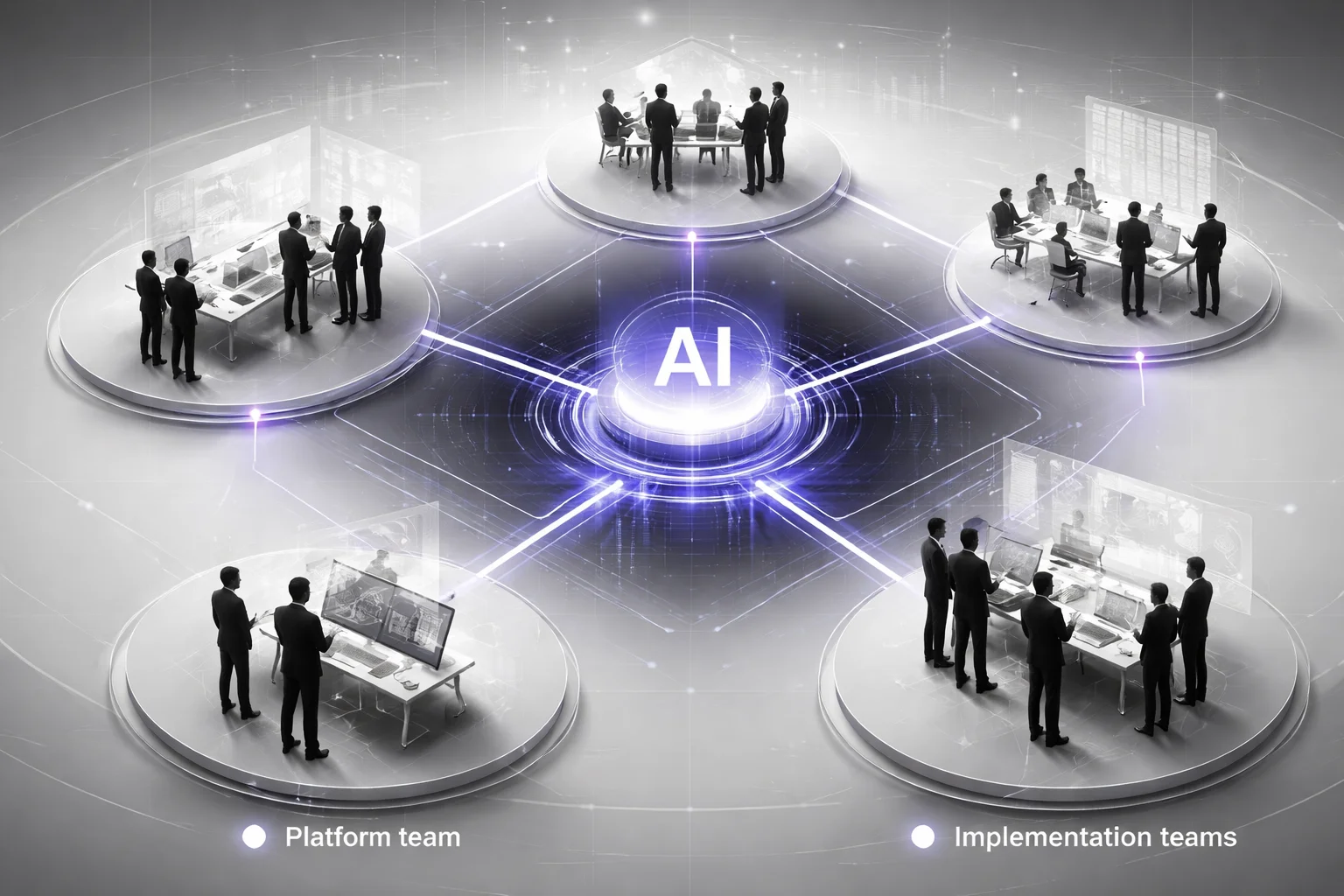
I sat in a planning session where that exact move blew up. The company pooled the expensive AI specialists, the tooling budget, and every approval step into one central team, then told product teams to go fast. Six weeks later, nobody could ship without waiting on the same three people. One team had built a sidecar script to dodge the process. Another was tracking model issues in a spreadsheet because they couldn’t get access to the shared monitoring setup. So much for control.
Leaders do this because scarcity makes them nervous. AI talent is expensive. Tooling is expensive. Risk feels expensive too. They lock it all down and assume alignment will somehow appear later. It won’t. I’d argue that’s fantasy dressed up as governance.
The pressure isn’t theoretical anymore. A 2025 KPMG study, cited in Vention Teams’ State of AI 2026 report, says 66% of the world’s population uses AI tools at least every few months. That changes the baseline. Employees expect AI inside real work, not tucked away in a lab demo. Customers expect fast responses, messy-system compatibility, and systems that don’t fall over during ordinary use.
The fix is less dramatic than most executive slides make it sound: keep a small center of excellence, then embed delivery pods inside the business. That’s the hybrid AI team model that tends to hold up under actual pressure. Not a giant command center. Not total decentralization either. Split responsibilities badly and you get the worst combo possible: central bottlenecks and local chaos at the same time.
What belongs in the center, and what absolutely doesn’t
The center should own standards, shared tooling, and platform reliability. That’s it. Model evaluation standards. Security rules. Reusable components. Vendor selection. The shared MLOps pipeline. Those things get better with consistency.
Let every pod invent its own deployment path or monitoring stack and your AI project governance turns into archaeology. Half-finished scripts. Mystery dashboards. Alerts nobody trusts. I’ve seen teams with four different definitions of “model failure” in the same company, which is a ridiculous way to run production.
The embedded team owns something else entirely: use-case delivery, workflow fit, and business outcomes inside one domain. Product manager, engineers, domain lead, often someone from the data science team. They decide whether the problem deserves solving in the first place, how users should interact with outputs, which tradeoffs are acceptable, and whether adoption is real or just demo applause.
This is where companies fool themselves most often. They treat implementation like plumbing work. It’s not. The hard part might be whether a claims adjuster trusts the output enough to use it on a Tuesday afternoon while juggling 14 open cases and getting pinged by three managers.
Pilots shouldn’t run like platforms
Porsche Consulting has this part right: innovation pilots should live inside an agile interdisciplinary unit with 100% end-to-end responsibility. Yes. That works. Early experiments die quickly when five committees all “support” them from a safe distance.
That pilot setup still can’t be your forever structure for everything you launch. Once a use case proves value, some parts should move into shared infrastructure and some parts need to stay close to the business team using them every day. Companies stumble right there, at handoff.
I’ve watched teams keep prototype ownership inside the same experimental group long after launch. Nine months later they were still operating like a skunkworks while trying to support production traffic across multiple departments. Bad idea. A restaurant test kitchen can invent next season’s menu; it shouldn’t be running national supply chain operations.
The split that tends to work
- Platform team: shared data access patterns, CI/CD rules, observability, security guardrails, model monitoring.
- Experimentation pod: rapid prototyping, hypothesis testing, evaluation design, early user feedback.
- Implementation pod: production integration, workflow changes, stakeholder training, KPI ownership.
This structure protects speed without trashing standards. It also makes AI team collaboration less political because decision rights are clearer: who sets guardrails, who tests ideas, who owns outcomes once something is live.
If you’re sketching an org chart right now, use the Ai Team Blueprint Hiring Sequencer to map a cleaner AI development team structure. Most companies don’t need more genius hires nearly as much as they need sharper borders, tighter cross-functional collaboration, real product management alignment, and enough engineering leadership to keep the center useful instead of just impressive-looking on a slide.
The unexpected part? The best hybrid setups usually feel almost boring once they’re working well. Fewer heroics. Fewer approval dramas. Just teams shipping without begging permission from the same three people every Tuesday.
Metrics That Prove Business Impact, Not Just Model Performance
Two Tuesdays after launch, the dashboard finally told the truth. The demo had gone great. Accuracy target hit. Clean slides. Smiles all around. Then the usage logs came in, and they were ugly: hardly anyone was using the tool, and the few who did kept punting weird cases back to humans because the exception handling fell apart. I've seen that exact mess before, right down to the celebratory meeting followed by silence.

That's the part teams don't like talking about. Model scores are tidy. Business results aren't. Accuracy, precision, F1—they're useful, sure. But they don't mean much if the system lands in production and people don't trust it enough to change how they work. A model can look brilliant in testing and still be dead weight once real users get their hands on it.
I think too many companies stop at benchmark wins because benchmarks make nice charts. Real value shows up somewhere less glamorous: work gets done faster, costs drop, errors shrink, and fewer tasks boomerang back for manual cleanup.
The frame I'd use is brutally simple: did the business actually get time back? A 2026 Raise Summit report said B2B professionals using AI tools save at least one workday per week. That's the number I care about first. Time returned. Work completed. Friction removed. Not whether your dedicated AI development team squeezed out another 3 points of F1 and put it in a quarterly review deck.
If that team can't tie delivery to hours saved, shorter cycle times, or more completed tasks, you're probably not funding a product. You're funding a very polished science project.
Six measures matter before almost anything else:
- Adoption: weekly active users, repeat usage rate, opt-out rate.
- Cycle time: time from request to completed outcome.
- Task completion: percentage of workflows finished with AI assistance.
- Revenue lift: upsell conversion, win-rate improvement, faster quote turnaround.
- Cost reduction: hours avoided, vendor spend cut, lower handling cost per case.
- Exception handling quality: escalation accuracy, reviewer agreement, time-to-resolution for edge cases.
A couple numbers make this obvious fast. If a sales ops team cuts quote turnaround from 48 hours to 6, that's real impact. If support handling cost drops from $7 per case to $4 because routine tickets stop bouncing between agents, that's real too. But if weekly active users stall at 12% by week four and opt-outs keep climbing after month one, then no—you don't have adoption, no matter how slick the dashboard looks or how good the launch email sounded.
This is where AI project governance, cross-functional collaboration, and product management alignment stop sounding like filler somebody copied into an org chart. They turn into measurement discipline. Your data science team should watch model behavior inside the MLOps pipeline. Product and ops leads should own workflow outcomes. Your engineering leadership needs to care about both sides, because someone has to connect technical performance to operational results instead of pretending those are separate conversations.
Microsoft reported 43 million pull requests merged each month in 2025, up 23% year over year. Fine. Lots of code shipped. I'd argue that number means almost nothing on its own. Shipping bad AI faster still means you're shipping bad AI faster. It's like bragging that plates leave the kitchen every 90 seconds while half of them come back untouched.
If you want a cleaner way to assign ownership for these metrics across roles, use the Ai Team Blueprint Hiring Sequencer. The right AI development team structure, even a hybrid AI team model, only works if somebody is explicitly responsible for proving value showed up in the business. Otherwise what are you really measuring?
The question worth sitting with
A dedicated AI development team only works if it stays close to the people, workflows, and business KPIs it’s supposed to improve, because isolation kills value faster than weak model performance ever will.
So if you're building one, don't just hire specialists and call the org chart done. Set up AI project governance that forces real stakeholder communication, product management alignment, and feedback loops from day one. Watch for the quiet warning signs too: benchmark wins with no adoption, polished demos with shaky handoffs, and an AI development team structure that looks efficient on paper but acts like a sealed lab.
It's kind of like trying to run a restaurant by perfecting the stove while never talking to the dining room. Not a perfect analogy, but you get it. If your team is getting smarter every sprint but your business isn't getting better, what exactly are you scaling?
FAQ: Dedicated AI Development Team
What is a dedicated AI development team?
A dedicated AI development team is a group focused full-time on designing, building, deploying, and improving AI systems for your business. It usually includes machine learning engineers, data scientists, product stakeholders, and platform or MLOps support. The mistake is treating that team like a lab instead of a business unit with clear outcomes.
Why do dedicated AI teams turn into an “ivory tower”?
They drift when they optimize for model benchmarks, research output, or technical elegance while losing contact with users, operations, and revenue goals. According to DORA, rigid top-down standards without collaboration often create shadow IT workarounds instead of alignment. It's kind of like trying to coach a team from the parking lot, which isn't a perfect analogy, but you get the problem.
How should you structure a dedicated AI development team so it stays connected to the business?
The best setup is usually a cross-functional team with product management alignment, engineering leadership, and direct access to domain experts. A central AI governance or platform group can set standards, but delivery teams need embedded business context and shared ownership of business KPI alignment. According to a 2026 Raise Summit report, a federated hub-and-spoke model works best for scaling AI without creating an ivory tower.
When is a dedicated AI development team the right choice?
It's the right choice when AI is core to your product, operations, or margin, and the work can't survive as a side project owned by already-busy engineers. If you need ongoing model monitoring, human-in-the-loop workflows, and continuous integration and deployment (CI/CD), you need a team with real focus. If you're only testing one small use case, a lighter pilot squad may be smarter first.
What is a hybrid AI team model, and when should you use it?
A hybrid AI team model combines a central group for standards, tooling, and AI project governance with embedded specialists who work inside product or business teams. It works well when you need consistency across data, security, and MLOps pipeline decisions, but you also need local context to avoid building something nobody uses. This model is especially useful in larger companies running multiple AI initiatives at once.
What metrics prove business impact for AI projects beyond model accuracy?
Start with business outcomes: cycle time reduction, conversion lift, support cost savings, forecast accuracy tied to planning decisions, or hours returned to staff. Then connect those to operational signals like adoption rate, decision override rate, feedback loops, and requirements traceability from model output to business action. According to a 2026 Raise Summit report, B2B professionals using AI tools report saving at least one workday per week, which is the kind of impact executives actually care about.
How should business stakeholders participate in AI development and validation?
They shouldn't just approve funding and disappear. Business stakeholders need to help define success, review edge cases, validate outputs, and join regular decision checkpoints so the data science team doesn't guess what “good” means. The healthiest AI team collaboration happens when operators, product leaders, and technical teams share the same roadmap and the same feedback loops.
How do MLOps, monitoring, and governance keep a dedicated AI development team aligned over time?
MLOps and model monitoring keep AI systems tied to reality after launch by tracking drift, failures, latency, cost, and downstream business effects. AI governance adds risk management, approval paths, and ownership so issues don't sit in a Slack thread until they become expensive. Without that discipline, technical debt management gets ugly fast and the team slowly disconnects from the outcomes it was hired to improve.