Conversational AI Consulting That Says “No” When It Should
Learn how objective conversational AI consulting tests solution fit first, avoids hype-driven projects, and protects your CX budget from wasted AI spend.

Most conversational AI consulting quietly assumes the answer is always “yes, you need a bot.” The most valuable consulting does the opposite: it works hard to prove itself wrong before you commit budget, customers, and political capital to another AI project.
If you’re reading this, you’ve probably already felt the downside of the default yes. A previous bot that under-delivered. Internal pressure to “do AI” for your next board deck. Demos that look magical, then run into policy, data, and real customers.
This article makes a simple argument: the highest-value conversational AI consulting services act as a gatekeeper. Their job is to say “no” or “not yet” when conversational AI is a poor fit—before you spend on licenses, integration, and change management. They start with your problems and constraints, not with a pre-selected tool.
We’ll walk through concrete frameworks for solution fit analysis, readiness assessment, and conversational AI strategy that compare AI against simpler customer experience automation options. You’ll also get specific questions to pressure-test whether a consultant is truly objective.
At Buzzi.ai, we structure our work so we can explicitly recommend “no bot” when that’s the right answer. We’ll reference our approach as one example—not as a sales pitch, but as a pattern you can demand from any partner.
What Conversational AI Consulting Should Actually Do
Consulting vs. Implementation: Two Very Different Jobs
Most buyers lump “conversational AI” into one bucket, but chatbot consulting and chatbot implementation are fundamentally different jobs. Consulting is about decisions; implementation is about delivery.
Done properly, conversational AI consulting services are tool-agnostic. They focus on your strategy, use case selection, solution fit analysis, and an AI implementation roadmap. The work product is clarity: where automation makes sense, where it doesn’t, and what order to tackle opportunities in your broader digital customer service transformation.
Implementation is different. It’s about building and integrating: configuring intents, designing dialog flows, connecting APIs, and hardening systems. Implementation teams live inside specific stacks—vendor X’s platform, your existing IVR, your CRM—which naturally narrows their field of view.
When the same team is paid primarily for delivery, strategy becomes a prelude to selling what they already build. A “strategy workshop” might feel independent, but if every road leads to the vendor’s platform, is it really strategy?
Consider two scenarios. In one, a vendor kicks off with a “visioning” session that maps your journeys on sticky notes—and somehow, every arrow ends at their bot. In the other, a truly neutral advisor starts by asking whether a simpler web form or better email templates could solve 60% of your problem before touching AI. Only the second is real consulting.
The Hidden Revenue Bias in Most AI Consulting
The bias isn’t usually malicious; it’s structural. Large system integrators and platform vendors earn the vast majority of their revenue from implementation, not advisory. That means every “assessment” is sitting on top of a strong incentive to build something—anything.
This shows up in subtle ways. Discovery workshops jump quickly from pain points to features: “Our NLP can handle that,” “Our omnichannel routing solves this.” The resulting roadmap just happens to align perfectly with the vendor’s stack, from chatbot to analytics to workforce management.
Even procurement reinforces the bias. Many RFPs bundle advisory and build in a single consulting engagement, with success defined as shipping a solution, not making the right call. It becomes politically and financially impossible for the partner to say, “Based on our findings, you shouldn’t implement a bot right now.”
What you actually need is technology agnostic consulting that can recommend no project, a smaller project, or even a competing product without blowing up its own revenue model. That’s also why AI vendor selection should be a downstream step, not the starting point.
Research backs the need for more discipline. Gartner has noted that while many enterprises experiment with chatbots, a significant portion fail to reach scale or deliver expected ROI because they were justified on hype, not fit and readiness.[1]
A Working Definition of Objective Conversational AI Consulting
So what does an objective conversational AI consulting firm actually do? At minimum, it’s paid to maximize your outcomes, not its implementation volume. It is explicitly technology-agnostic and includes non-AI alternatives in every engagement by design.
Practically, that means focusing on a few core activities. First, structured use case discovery and use case prioritization across journeys and channels. Second, rigorous solution fit analysis that scores conversational AI against other tools. Third, ROI modeling versus alternatives, and finally, a governance and operating model for any automation you do deploy.
An objective conversational AI audit and advisory services engagement should be perfectly happy to end with “no new bot.” Imagine an assessment where the team discovers that 70% of your failure demand stems from confusing policy language in emails and a bad search experience. The right outcome might be rewriting templates and improving search relevance, not launching a new assistant.
At Buzzi.ai, we separate assessment from build for exactly this reason. In some projects, we’ve recommended simpler automation—like workflow tools and clearer forms—rather than deploying a conversational interface. The business value was higher, the risk lower, and the trust we earned far more durable.

Do You Actually Need Conversational AI? Start With Problems, Not Tools
Map Your Customer Journeys and Pain, Not Channels and Tools
The biggest mistake we see is starting with “we need a chatbot” instead of “we need to fix this specific customer problem.” If you care about digital customer service transformation, you start with journeys and pain—not channels and tools.
Map your key journeys: onboarding, billing, returns, support, renewals. For each, identify concrete failure points: long wait times, repeat contacts, inconsistent answers, dropped handoffs between teams. These are the raw material for customer experience automation and self-service design.

Then dig one level deeper. High call volume is a symptom; the cause might be broken processes, poor knowledge management, or policy complexity. A bot on top of a broken process just automates frustration faster.
In one CX review we’ve seen, NPS was low after billing changes. At first glance, a bot seemed promising: handle “What happened to my bill?” queries. But a simple test showed that rewriting the email notification, adding a clear comparison table, and surfacing a better FAQ solved more than half of the issue. Self-service automation doesn’t always mean AI—it often means better content.
Concrete Cases Where Conversational AI Is Not the Right Answer
There are clear patterns for when not to use conversational AI in customer service. The first is highly emotional interactions: complaints, cancellations, grievances, or sensitive financial and health issues. Here, the risk of perceived indifference or tone-deaf responses is high, even if the bot is technically accurate.
Second, rare or high-variance issues with many edge cases tend to defeat even sophisticated voice bot strategy and intent recognition. If every case is “it depends,” scripted or learned dialogs struggle, and containment rates are low.
Third, unstructured back-end processes or the absence of a single source of truth make automation fragile. If your agents rely on tribal knowledge and Slack to figure out correct answers, a virtual assistant will mostly learn your chaos, not your policy.
Finally, there are sectors where regulatory or brand risk is asymmetric. Misstated advice in financial services or healthcare is usually worse than a slower but accurate human interaction. We’ve seen high-profile chatbot failures lead to customer backlash and regulatory scrutiny when bots made misleading claims or mishandled complaints.[2]
A disqualifying example: a complex B2B contract renegotiation process. The issues are high stakes, the parameters unique, and the emotions strong. Trying to push those customers through a bot isn’t innovative; it’s reckless. Better to focus your automation efforts on low-risk, high-repeat use cases elsewhere.
Alternatives You Should Rule In Before You Rule In AI
Before you greenlight any assistant, ask: what simpler options have we tried? There’s a whole spectrum of automation opportunities and customer experience automation that don’t require conversational interfaces.
Start with knowledge: a well-structured knowledge base, better onsite search, and more transparent policies. Add proactive communication—status updates, reminders, and alerts—to reduce inbound demand. Then look at form and workflow automation, RPA for back-office steps, and IVR improvements that route more intelligently.
Only after you’ve benchmarked these should you position conversational AI as part of your AI process automation toolkit. It’s powerful when you have structured processes, clear intents, and repeatable tasks. It’s overkill or risky when you don’t.
An internal matrix can help. Plot options like knowledge base improvements, RPA, better IVR, and conversational AI on two axes: cost/complexity and impact. In many organizations, knowledge work and small workflow tweaks sit in the high-impact, low-complexity quadrant, while bots are higher on both axes. Demand that any consultant explicitly compares these alternatives before putting a chatbot on your roadmap.
A Practical Conversational AI Fit Framework for Businesses
Step 1: Clarify Outcomes and Constraints Before Talking to Vendors
The right conversational AI fit framework for businesses starts with outcomes, not architecture. Before you talk to vendors, define what success looks like and what’s off-limits.
For service operations, typical metrics include average handle time (AHT), call deflection or containment, CSAT/NPS, first contact resolution, and cost per contact. Decide which ones matter most, and by how much you need to move them to justify investment in any conversational AI strategy or alternative automation.
Then spell out constraints: compliance rules, tone of voice, supported languages, channels (web, app, WhatsApp, voice), and integration boundaries. If your data engineering team can’t support real-time updates, that dramatically narrows what’s realistic for contact center automation.
As part of the business case for AI, do back-of-the-envelope math. Suppose you get 100,000 password reset calls a year at $3 per call. If a solution—bot or otherwise—could deflect 10% of those reliably, that’s $30,000 in annual savings. If your projected benefit is smaller than the fully loaded cost of building and running a system, think twice.
Step 2: Score Use Cases on Fit Dimensions, Not Hype
Once you have outcomes and constraints, list candidate use cases: password resets, order status, address changes, basic troubleshooting, etc. Then score each use case on a few core dimensions.
For a robust conversational AI fit framework for businesses, we like: volume, repeatability, language complexity, emotional load, back-end automation readiness, and knowledge base quality. You can add finer-grained factors like expected intent classification performance, multilingual needs, or the maturity of your conversation design capabilities.
Use a simple 1–5 scale. A high-scoring use case might be “check order status”: very high volume, highly repeatable, low emotional load, good APIs, and a clear system of record. A weaker candidate might be “cancel subscription with retention attempts”: lower volume, highly emotional, requires complex negotiation.
Imagine three use cases:
- Password reset: Volume 5, Repeatability 5, Emotion 1, Back-end readiness 4, Knowledge 4 → Great fit.
- Order status: Volume 4, Repeatability 5, Emotion 2, Back-end readiness 4, Knowledge 4 → Great fit.
- Account cancellation: Volume 2, Repeatability 2, Emotion 5, Back-end readiness 3, Knowledge 3 → Weak fit.
Even if cancellation is a high-pain area, your framework should flag it as a poor candidate for automation. That’s what objective solution fit analysis looks like.
Step 3: Compare Conversational AI Against Non-AI Alternatives
Scoring tells you where conversational interfaces could work; it doesn’t yet say they’re better than alternatives. The next step in any credible framework is to compare AI options against non-AI solutions using basic ROI modeling.
For each high-fit use case, outline 2–3 options: process fix only, process fix + knowledge improvement, knowledge + simple automation (forms, IVR), and full conversational AI. Estimate implementation cost, operating cost, time-to-value, and risk for each.
Then evaluate qualitative factors: impact on CX, brand risk, agent experience, and ease of change management. In many organizations, cleaning up content and workflows outperforms bots on ROI, especially in the first 6–12 months.
We’ve seen cases where a structured knowledge base overhaul reduced repeat contacts by 25%, with far less investment than a new assistant. A fit framework is only objective if it can conclude “don’t use conversational AI” with confidence, even when the technology is exciting.
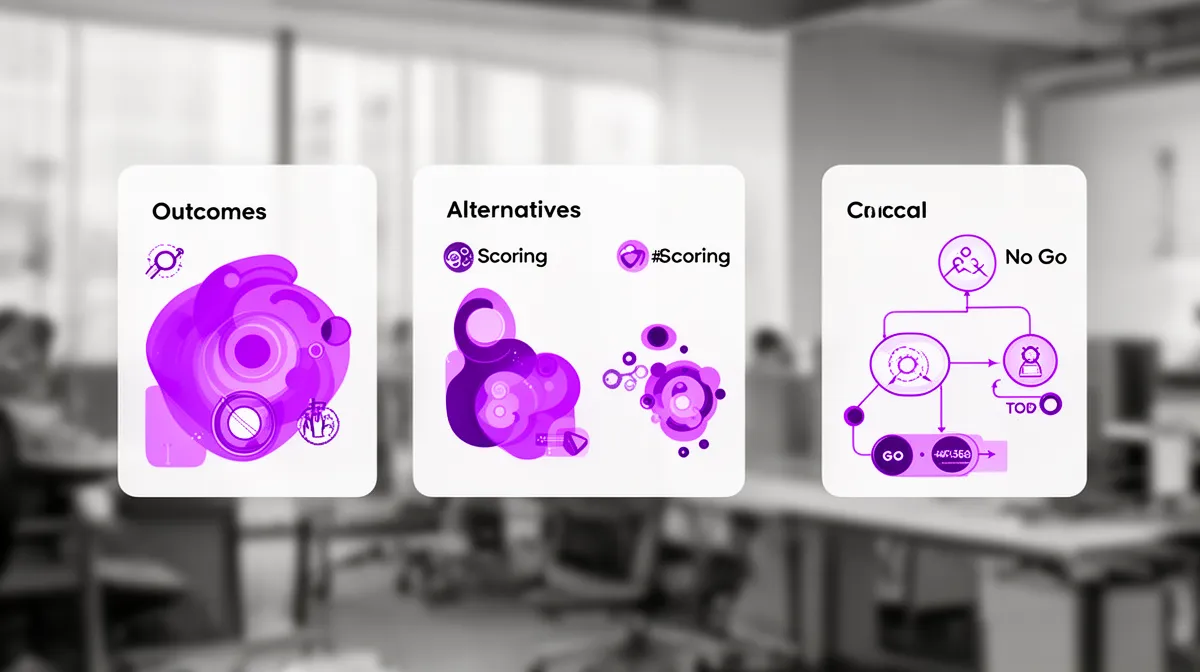
Step 4: Decide What Not to Automate
An underrated part of strong conversational AI strategy is drawing hard boundaries. Your plan should explicitly define “human-only” zones in the customer journey.
These are typically high-emotion, high-judgment interactions: fraud disputes, life events (bereavement, serious illness), major financial decisions, or escalations involving regulatory complaints. Strong ai governance frameworks, like those discussed by NIST and OECD,[3] recommend careful human oversight in such areas.
Governance isn’t just policy—it’s operational detail. When should an agent override automation? What triggers an immediate transfer to a human? How do you monitor for harm and bias in automated decisions? Your cx consulting partners should be as focused on these questions as they are on dialog flows.
Take a bank that automates balance checks, transaction history, and card activation, but keeps fraud disputes human-led. That line in the sand protects trust. Ironically, the most powerful part of a conversational AI strategy may be its clearly defined no-go zones.
Designing a Readiness Assessment That Isn’t Rigged for AI
What a Technology-Agnostic Readiness Assessment Looks Like
Many “assessments” are thinly veiled sales funnels. A real conversational AI readiness assessment consulting engagement looks very different. It asks: “Are we ready for automation and self-service?” not “Which bot should we buy?”
Scope should cover data and knowledge maturity, process standardization, CX metrics and reporting, governance, and change management capacity. The goal is to understand your baseline, not to force-fit a tool. A strong readiness assessment will often recommend prerequisites—like knowledge base cleanup—before any bot build.

In a good discovery workshop, the first day is about current journeys, pain points, and data flows—not vendor demos. Participants map real-world scenarios, identify where information comes from, and document how often policies change. Only later do you explore which automation patterns might help.
If your data engineering is immature or your knowledge lives in scattered PDFs, an honest advisor might recommend focusing on data engineering for AI and content first. That’s still valuable consulting; it sets the stage for more sustainable automation later.
Key Questions That Reveal Whether You’re Ready for Conversational AI
You don’t need a 100-slide deck to gauge readiness. A short diagnostic checklist can tell you a lot about whether your organization is ready for bots—or should phase investments.
Some powerful questions for conversational AI strategy consulting for enterprises include:
- How often do our policies and offers change, and how are those changes communicated to agents today?
- Do we have a single source of truth for answers, or do agents improvise from multiple systems?
- Can we reliably automate the back-end actions needed for our top use cases?
- What languages and channels matter most, and how mature are they today?
- Do we have established owners for knowledge, automation, and ai governance?
If your answers are mostly “it depends” or “we’re not sure,” you’re not alone—and you’re not doomed. It just suggests a phased AI implementation roadmap: stabilize data and processes first, then layer on bots. A consultant who glosses over these questions is not doing you a favor.
Structuring Assessments So They Can Honestly Say "Not Yet"
Objectivity isn’t just about mindset; it’s about commercial structure. To get honest answers, you need conversational AI consulting engagement models that don’t assume implementation as the finish line.
One approach is fixed-fee assessments with clearly defined scope and deliverables, independent from any build contract. Success is measured by decision quality—clarity of roadmap, quantified opportunities, and identified risks—not by project size.
Avoid SOWs that bundle conversational AI consulting services with implementation in a way that presumes a build. Instead, stage-gate your work: assessment first, then a separate decision on build. At Buzzi.ai, our AI discovery and advisory services are explicitly structured this way. A “no-go” or “not yet” outcome is counted as a success if it protects your budget and reputation.
We’ve seen engagements where a candid assessment concluded: “Delay bots for 12 months. Invest in content, knowledge management, and IVR improvements first.” The client avoided a likely failure, and when they revisited automation later, they did so from a stronger foundation.
Conversational AI Consulting Engagement Models That Reward Honesty
Separate Assessment from Implementation
The simplest way to reduce bias is to separate who decides from who builds. Either use different firms for advisory and delivery, or make sure they operate under distinct contracts and P&Ls.
This is especially important for conversational AI consulting engagement models where the advisor is positioned as an objective conversational AI consulting firm. If their bonus depends on bot licenses sold, their objectivity is compromised, no matter how smart they are.
One company we worked with engaged an independent advisor to run the initial assessment and AI vendor selection. Only after the assessment recommended a specific path did they run a competitive RFP for implementation. The result: they avoided a misfit platform that a prior preferred vendor was pushing and chose a stack better aligned with their architecture.
If your organization insists on one partner, at least ring-fence separate teams for assessment and build. They should have distinct incentives, so the assessment team is rewarded for correct calls, not project volume.
Use Milestone-Based Fees Tied to Decisions, Not Lines of Code
Fee models drive behavior. If your partner makes money only when they ship more features, you’ll get more features—whether or not they’re needed. To shift toward honest assessment, tie fees to milestones and decisions.
For example, structure work so that an 8-week discovery and fit analysis has a fixed fee, independent of any build. A portion of the fee can be linked to the clarity of savings identified through ROI modeling and risk avoided, not just to a signed implementation contract.
In this model, conversational AI consulting services, broader ai consulting services, and ai discovery are products in their own right. The engagement is successful if it produces a defensible roadmap—whether that leads to bots, simpler automation, or a “pause.”
Imagine an assessment that finds $500k in potential annual savings through a combination of knowledge base improvements and limited automation. The consultant’s value is in surfacing and structuring those savings, not in writing the code themselves.
Design Pilots and Proofs of Concept That Can Conclude "Don’t Scale"
Many proof of concept projects are more like marketing demos. The success criteria are subjective (“stakeholder excitement”), and the outcome is pre-committed: rollout. That’s the opposite of scientific.
A proper pilot project treats conversational AI as a hypothesis. You define falsifiable hypotheses (“A bot can contain 60% of order-status queries with CSAT ≥ 4.3”), clear success thresholds, and explicit stop criteria (“If containment < 50% or CSAT < 4.0 after X interactions, we do not scale”).
This is where strong conversational AI audit and advisory services and contact center automation expertise matter. The pilot must be designed to learn about fit, not to impress in a demo environment. That means realistic traffic, real policies, and honest reporting.
Best-practice guides on enterprise pilots emphasize this experimental design: independent metrics owners, pre-registered criteria, and steering committees who commit in advance to act on the data.[4] Your consultants should help you design pilots that can legitimately conclude “don’t scale” without anyone losing face.
How to Vet a Conversational AI Consulting Partner for Objectivity
Red Flags: Signs Your Consultant Is Pushing Tools, Not Outcomes
How do you tell if you’re dealing with the best conversational AI consulting for unbiased assessment—or just a sophisticated pre-sales team? Start by watching their behavior in early conversations.
Red flags include: the platform is effectively decided before any serious assessment; decks focus heavily on features and roadmaps, but lightly on your specific problems; non-AI alternatives barely get a mention; and every success story centers on a platform, not on the business decision that led there.
We’ve seen vendors respond to every pain point with the same generic bot template, ignoring obvious process issues. In one case, they tried to deploy a virtual assistant to “fix” a billing problem that was mostly caused by inconsistent policy communication. The result would have been a friendlier interface for the same underlying confusion.
If a supposed objective conversational AI consulting firm can’t explain when not to use AI, they’re not objective. Look for partners that are as comfortable talking about process redesign and cx consulting as they are about chatbot consulting.
Hard Questions to Test for Outcome Focus
You can shift the power dynamic by asking better questions in RFPs and interviews. This is how to how to choose a conversational AI consultant in practice, not theory.
Some questions worth asking:
- “Tell us about a time you recommended not building a bot, or delaying it.”
- “How do you compare conversational AI against non-AI options in your assessments?”
- “What percentage of your revenue comes from advisory versus implementation?”
- “Can you share a framework for how you prioritize use cases and define no-go zones?”
- “How are your teams incentivized when a project results in ‘no build’?”
Strong consultants will have specific stories and frameworks ready. They’ll describe engagements where they helped a client avoid a bad investment, including how they used conversational AI consulting engagement models and broader ai consulting services to stay objective.
For example, a good answer might sound like: “We advised a telecom to focus on improving IVR routing and process documentation first. Only after their containment improved did we pilot a bot for order tracking.” That’s a partner thinking about your system, not just their SKU.
How Buzzi.ai Structures Conversational AI Consulting Differently
At Buzzi.ai, we’ve built our approach around these principles. Our first job is to understand your problems and context; only then do we explore whether conversational interfaces make sense at all.
We separate conversational AI consulting, conversational AI audit and advisory services, and ai discovery work from implementation. When a build does make sense, our AI chatbot and virtual assistant development services step in—but that’s a second decision, not a foregone conclusion.
In one engagement, a client came to us asking for a new customer-service bot. Our assessment showed that 60% of their volume came from confusing confirmation emails and missing self-service forms. We recommended fixing the knowledge base, updating templates, and adding small workflow automation instead of a bot. Their repeat contacts dropped, CSAT improved, and when they eventually piloted conversational AI, it was on a much cleaner foundation.
Our goal is simple: help you build durable CX and operational outcomes, not chase the latest AI fad. Sometimes that means building agents and assistants. Sometimes it means saying, “Not yet.”
Conclusion: Treat Conversational AI as a Hypothesis, Not a Destiny
Conversational AI is powerful, but only when it fits. The most valuable conversational AI consulting treats it as a hypothesis to test, not a destiny to march toward. In that world, a “no-go” decision can be the highest-ROI outcome.
A clear fit framework and honest readiness assessment let you compare bots against simpler, lower-risk moves: better processes, better content, and lighter-weight automation. When you do choose AI, you do it for the right reasons, in the right places, with the right guardrails.
That requires conversational AI consulting services and engagement models designed to say “no” or “not yet” without penalty. It means asking hard questions about incentives, past no-go decisions, and governance—and being willing to walk away from partners who can’t answer them.
If you’re planning your next initiative, consider treating it as a structured experiment. Engage an advisor who is structurally free to be honest—including us at Buzzi.ai. If you want to explore that kind of engagement, start with a conversation about your context and goals via our AI Discovery service.
FAQ: Objective Conversational AI Consulting
What is conversational AI consulting, and how is it different from chatbot implementation services?
Conversational AI consulting focuses on strategy, fit, and governance: deciding whether to use conversational interfaces, where they belong, and how to design them responsibly. Implementation services, by contrast, focus on building and integrating the solution you’ve already chosen. The healthiest approach is to separate these phases so your strategy isn’t biased toward what a given team knows how to build.
How can I tell if my organization really needs conversational AI or just better processes and knowledge management?
Start by mapping journeys and failure points, then ask what’s driving them. If most pain comes from unclear policies, inconsistent answers, or manual handoffs, then content, process fixes, and knowledge management may deliver more value than a bot. If instead you see high-volume, repeatable, low-emotion queries with reliable back-end systems, conversational AI can be a strong candidate.
What are the clearest warning signs that a conversational AI consultant is biased toward selling implementation?
Common signs include walking in with a preferred platform before understanding your context, focusing early conversations on demos and features rather than outcomes, and rarely mentioning non-AI alternatives. If their success stories are all about specific tools, not about decisions (including “we advised against a build”), that’s another red flag. You want a partner whose incentives don’t depend on a particular implementation path.
What objective criteria should I use to evaluate whether conversational AI fits a specific customer service use case?
A practical fit framework scores use cases on volume, repeatability, language complexity, emotional load, back-end automation readiness, and knowledge quality. High volume, high repeatability, low emotion, and strong systems of record point toward good automation candidates. Low volume, high variance, high emotion, and weak data are strong signals to keep the interaction human or to fix processes before adding AI.
How should a conversational AI readiness assessment be structured to avoid technology bias?
An unbiased assessment looks at automation and self-service readiness broadly, not just “bot readiness.” It covers data, knowledge, processes, metrics, governance, and change management, and it’s commercially decoupled from any commitment to build. Ideally, it’s delivered as a fixed-fee engagement with clear deliverables and a legitimate “not yet” outcome, rather than being bundled into a pre-committed implementation contract.
What alternative solutions should be considered before investing in conversational AI for customer service?
Before deploying bots, consider cleaner options: rewriting confusing communications, improving your knowledge base and search, simplifying forms and workflows, enhancing IVR routing, and training agents better. Often these fixes address the bulk of the issue at lower cost and risk. Conversational AI should be evaluated alongside these alternatives, not treated as the default solution.
How can conversational AI consulting engagement models be designed to reward honest assessment instead of project size?
Engagements that reward honesty usually separate assessment from build and rely on fixed-fee or milestone-based pricing for advisory work. Success is defined as a clear, evidence-based roadmap and quantified opportunities and risks, not as a guaranteed implementation. When “no build” or “not yet” is an acceptable, paid-for outcome, consultants are far more likely to recommend it when appropriate.
What does a practical conversational AI fit framework look like in a real enterprise?
In practice, a fit framework is often a simple scoring model applied to a list of candidate use cases. Teams rate each one on factors like volume, repeatability, emotion, data readiness, and knowledge quality, then compare high-scoring cases against non-AI options using basic ROI estimates. That yields a prioritized shortlist where conversational AI is both technically feasible and likely to outperform simpler solutions.
How can I measure the real ROI of conversational AI compared with simpler automation options or process fixes?
To measure real ROI, you need baselines and clear metrics: contact volumes, AHT, containment, CSAT, and cost per contact before and after changes. Then compare the cost and impact of different interventions—e.g., policy rewrite vs. IVR tweak vs. bot deployment—over a defined period. A good consulting partner will help you build this comparison and may show that non-AI moves deliver higher, faster returns.
What questions should I ask a potential conversational AI consulting partner to test their objectivity and incentives?
Ask about past no-go recommendations, how they compare conversational AI to non-AI solutions, and how much of their revenue is advisory versus implementation. Request a sample of their fit framework and governance model, and probe how they get paid if a project doesn’t proceed to build. Objective partners, like Buzzi.ai with our AI discovery and advisory services, will be transparent about these points.
How can I structure a pilot or proof of concept so it can legitimately conclude that conversational AI is not the right solution?
Define the pilot as an experiment with specific, measurable hypotheses and pre-agreed success thresholds for metrics like containment, CSAT, and error rates. Document explicit stop criteria—conditions under which you’ll decide not to scale—and get stakeholder buy-in on those before launch. Make sure reporting is transparent and owned by a cross-functional group, not just the project team.
How does Buzzi.ai’s approach to conversational AI consulting differ from implementation-first firms and platform vendors?
Buzzi.ai is structured to be assessment-first and tool-agnostic. We separate discovery, fit analysis, and strategy from build, and we’re comfortable recommending simpler automation or process changes instead of bots when the data points that way. Our focus is long-term CX and operational outcomes, not just deploying another piece of technology.