Stop Chasing the “Best” AI Development Company. Find Fit.
Learn why the “best AI development company” is contextual, not absolute, and use a fit-based framework to choose the right partner for your enterprise.

Most enterprise AI failures don’t happen because leaders picked a bad vendor. They happen because they picked the wrong kind of “good” vendor for the work. The same big-name AI development company that ships a brilliant global platform for one client can quietly stall out on another company’s modest MVP—simply because the context is different. That’s why chasing the generic idea of the best AI development company is a subtle but expensive trap.
If you’re responsible for enterprise AI, you’ve probably felt the pressure: boards and executives want recognizable logos and political safety. Procurement loves clear winners. Analyst reports rank “top” AI development services like there’s a single leaderboard that applies to everyone. But AI isn’t a commodity; it’s closer to surgery. The right surgeon depends on the operation, your condition, and your hospital—not a universal “best doctor” list.
In this article, we’ll walk through a practical, fit-based way to choose an AI partner. We’ll explain why context—project type, domain, phase, and internal readiness—matters more than prestige, and we’ll give you a concrete framework you can take into your next vendor selection process. Along the way, we’ll also be transparent about where Buzzi.ai is and isn’t the right partner, because our goal isn’t to win a beauty contest for “best AI development company”; it’s to help you ship AI that works.
Why the “Best AI Development Company” Often Fails in Practice
The prestige trap: when brand name stands in for due diligence
In many enterprises, vendor selection starts from the wrong question: “Which brand will make this decision easiest to defend?” That’s how the search for the best AI development company for enterprises turns into a logo contest. Once a famous AI consulting firm is on the list, genuine due diligence can quietly stop.
Boards and executive teams understandably equate big brands with safety. If you hire a global consultancy that everyone recognizes, you’re unlikely to be blamed personally if things go sideways. Procurement teams reinforce this dynamic by defaulting to existing master service agreements and rate cards. The result is that the vendor’s reputation substitutes for a hard look at project fit, especially for complex enterprise AI initiatives.
Here’s a simplified but familiar story. A Fortune 500 retailer wants to modernize its demand forecasting and personalization. They bring in a top-three global AI consulting and strategy brand. After six months, they have beautiful slideware, a polished vision for AI-driven transformation, and a POC that demos well in a controlled environment. What they don’t have is anything running in production that store managers can actually use.
Nothing about this vendor was “bad.” They were world-class at executive alignment, program management, and thought leadership. But the retailer really needed targeted custom AI solutions for specific workflows, plus hands-on engineering to integrate with messy legacy systems. Paying transformation-level rates for generalized consulting when you need specialized ai vendor selection and implementation is how prestige quietly becomes a cost center.
Mismatch, not incompetence, is what kills most AI projects
When AI projects fail, it’s tempting to blame vendor incompetence. In reality, many of those vendors are technically very capable. The real problem is a mismatch between what the vendor is optimized to do and what your project actually requires in terms of ai implementation, domain depth, and delivery style.
Consider two extremes. On one side, a research-heavy lab that lives on cutting-edge generative models and novel architectures. On the other, a product-focused AI solution provider that ships hardened, end-to-end AI projects on tight deadlines. If your problem is a well-defined routing and triage workflow with clear success metrics and a fixed launch date, hiring the research lab is overkill. You’ll get experiments and papers when what you needed was stable software.

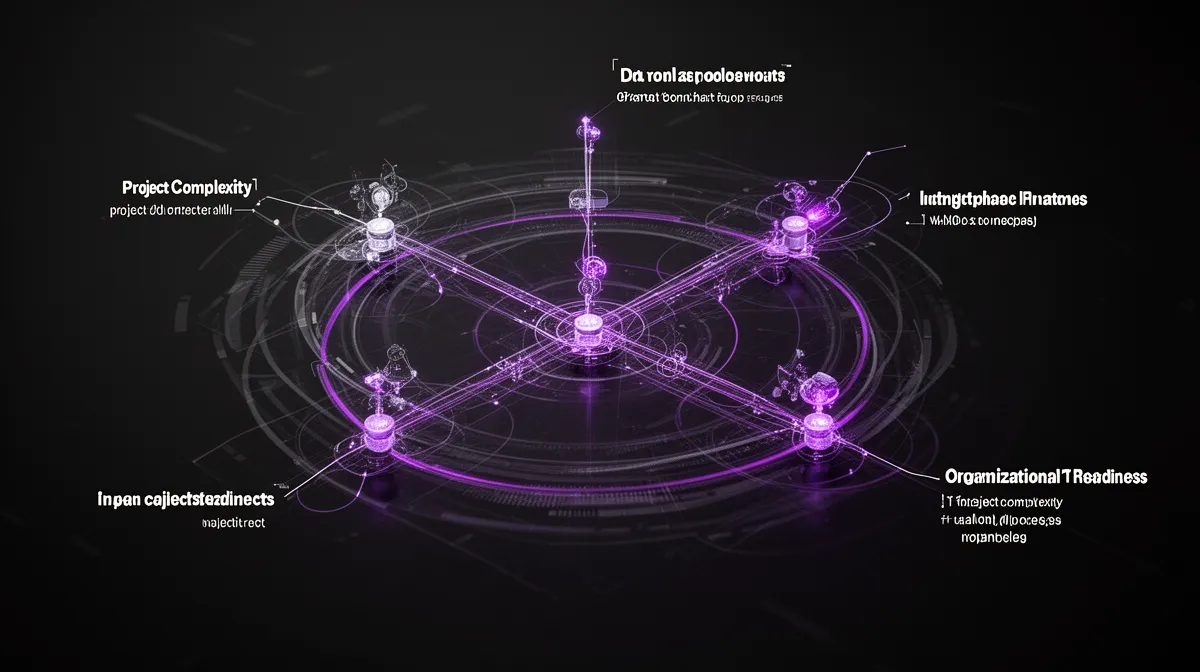
Most failures trace back to four axes of mismatch:
- Project complexity: You bring in a heavyweight partner for a problem that’s essentially advanced analytics, or a lightweight shop for a multi-system, multi-country roll-out.
- Domain: Your vendor has generic tooling but no understanding of your regulatory or operational reality.
- Project phase: A firm great at POCs but weak at industrialization, or vice versa, gets miscast.
- Organizational readiness: The vendor assumes strong data and DevOps maturity that simply doesn’t exist yet.
On paper, everyone talks about end-to-end AI projects and AI success metrics. In practice, they’re optimized for a particular slice of the lifecycle and context. Treating them as universally “the best” ignores that optimization—and you pay for it in time, money, and political capital.
The hidden costs of the wrong “best” partner
Choosing the wrong kind of “best” partner has visible and invisible price tags. On the hard-cost side, you see premium day rates, long discovery cycles, and frequent change requests as project realities collide with a one-size-fits-all delivery model. You may pay for expensive strategy decks when what you needed was focused ai development services, or for elaborate platforms when a lean mvp development would have sufficed.
The soft costs are often worse. Internal teams burn out sitting in endless workshops that don’t translate into shipped features. Stakeholders lose trust in AI as a concept after watching yet another proof of concept stall out. Your AI roadmap quietly slips by quarters or years because the first attempt poisoned the well.
Contrast two scenarios for a mid-sized insurer tackling claims automation. In Scenario A, they hire a marquee vendor at $3,000/day. After twelve months and $1.2M, they have a sophisticated but brittle POC that’s too complex for operations to own. In Scenario B, they hire a right-sized, domain-aware partner at $1,500/day. In six months and $450k, they ship a constrained MVP into production, learn from real usage, and iterate. The “cheaper” big name ends up costing more—not because they’re bad, but because they were a misfit for the job.
Industry data backs this up. Multiple studies estimate that a majority of enterprise AI projects never reach production or fail to generate positive ROI. McKinsey has reported that while AI leaders see outsized gains, many companies struggle to scale beyond pilots, and Gartner has echoed high failure and stall rates for enterprise AI initiatives. The difference isn’t “smart” versus “dumb” vendors. It’s fit versus misfit.
What Actually Makes an AI Development Company the “Best” for You
Define success in your terms, not the vendor’s portfolio
So if the generic search for the best AI development company is flawed, what should replace it? Start by defining success in your terms, not in the language of vendor case studies. Before you talk to anyone, be explicit about your AI strategy, constraints, and what “good” looks like for this specific project.
For some teams, success is time-to-first-value: shipping something in three months, even if it’s narrow, to prove that AI can work in their environment. For others, it’s strict adherence to a cost envelope, or de-risking compliance. Your AI roadmap should clarify whether this is a learning experiment, a flagship initiative, or a foundational platform bet. That, in turn, should shape your AI project scoping and AI success metrics.
Imagine two companies with the same use case: AI-assisted support ticket routing. Company A wants a robust, scalable system with 99.9% uptime because support is mission-critical. Company B wants a scrappy POC to show leadership a 20% handle-time reduction is plausible. The right partner for A might be a mature enterprise AI product development firm experienced in high-availability infrastructure. Company B might be better served by a lean, experimentation-friendly shop. Same use case, different definitions of success, different “best” partners.
Four dimensions of fit that matter more than rankings
When you strip away the branding, what really determines whether an AI development company can help you succeed? In practice, four dimensions matter far more than any leaderboard:
- Project complexity: Are you building analytics dashboards, classic predictive models, enterprise machine learning systems, or advanced generative AI agents?
- Industry domain: Are you in a heavily regulated sector like healthcare or finance, or a faster-moving space like ecommerce?
- Project phase: Is this a proof of concept, an MVP development effort, or a scale-up/industrialization stage?
- Organizational readiness: Do you have solid data pipelines and AI-savvy stakeholders, or are you just getting started?
Each dimension dramatically shapes your partner needs. A vendor perfect for a complex, regulated, high-readiness environment might flounder in a low-maturity, fast-moving context that needs lots of enablement. This is why thinking in terms of context—and not abstract rankings—is the only reliable way to get AI development services that actually work for you.
Best-fit vs best-in-class: different questions, different answers
This leads to a mindset shift: stop asking, “Who is the best-in-class vendor in AI?” and start asking, “Who is the best-fit AI development partner for us, on this project, right now?” The phrase we like is best-fit AI development partner vs best-in-class vendor. They’re different questions, and they yield different shortlists.
In many cases, boutique or mid-sized firms will beat global consultancies on focus, responsiveness, and willingness to adapt their playbook to your environment. A smaller AI solution provider that lives and dies by a handful of custom AI solutions in your domain can move faster and align deeper than a multi-service giant juggling hundreds of programs.
We’ve seen this play out repeatedly: a large consultancy spends nine months on design and stakeholder engagement, then struggles to land a working system. A smaller firm, brought in later, sits with frontline teams, ships a narrow slice in eight weeks, and iterates toward real adoption. The latter isn’t globally “better.” It’s just better for that situation.

A Fit-First Framework for Choosing Your AI Development Partner
Axis 1: Project and technical complexity
The first axis is project and technical complexity. Not every problem requires cutting-edge machine learning development or generative AI development, and not every vendor is set up to handle deeply complex, cross-system initiatives. Over-arming a simple project or under-arming a complex one are both expensive mistakes.
At a high level, you can think in tiers:
- Tier 1 – Analytics and dashboards: BI enhancements, descriptive and basic predictive analytics.
- Tier 2 – Classic ML models: demand forecasting, churn prediction, risk scoring, recommendation systems.
- Tier 3 – Generative AI and RAG: copilots, document Q&A, knowledge assistants grounded in your data.
- Tier 4 – Multi-agent and real-time systems: autonomous workflows, real-time decisioning, complex orchestration.
Each tier tends to align with different partner types. Tier 1 may suit a data engineering or BI-focused firm. Tier 2 fits many solid enterprise AI and AI product development shops. Tier 3 often needs teams with genuine LLM and RAG experience. Tier 4 may call for specialized research or systems-engineering partners. Map your use case honestly before you go shopping.
Consider three sample projects: a marketing attribution model (Tier 2), a customer-support copilot (Tier 3), and a cross-channel, multi-agent automation platform (Tier 4). A boutique ML shop could handle the attribution model well, a generative AI specialist is ideal for the copilot, and only a full-stack, systems-focused firm should attempt the automation platform. If you bring a Tier 4 partner to a Tier 2 problem, you’ll pay a premium and add unnecessary complexity; bring a Tier 2 partner to a Tier 4 system, and you risk failure.
Axis 2: Industry and domain specificity
The second axis is industry and domain specificity. In some spaces, deep domain expertise is nice to have. In others—healthcare, financial services, legal, insurance—it’s non-negotiable. Here, custom enterprise solutions must encode regulatory, risk, and workflow realities as much as algorithms.
Take a regulated financial-services project: building an AI assistant to help relationship managers respond to client queries. A generic AI solution provider might prototype a helpful chatbot, but without fluency in suitability rules, KYC/AML guidelines, and internal risk models, they can easily ship something that’s unusable in production. A partner that’s done multiple enterprise AI deployments in finance will bake compliance into design from day one.
That said, there’s a trade-off. Hyper-specific domain firms can be excellent but may be narrower in their tooling and slower to adopt new patterns. Broader AI development services providers might adapt quickly but need time to climb your domain learning curve. The right call depends on how sensitive your domain is to errors, how much in-house expertise you can lend, and how much you value creativity versus compliance on day one.
Axis 3: Project phase—POC, MVP, or scale-up
The third axis is project phase. It’s easy to say you want an “end-to-end” partner, but in reality, most firms are optimized for one or two phases:
- Proof of concept (POC): Answer “Is this technically possible and valuable?” in a constrained sandbox.
- MVP development: Ship a minimal, but end-to-end, version into production with real users and metrics.
- Scale-up / industrialization: Harden, integrate, and expand successful MVPs across geographies, products, or business units.
Each phase demands different strengths. POCs reward speed, creativity, and comfort with ambiguity. MVPs need disciplined engineering and product thinking. Scale-up favors robust operations, change management, and platform thinking. It’s rare for one vendor to excel equally at all three stages of end-to-end AI projects and AI implementation.
Picture an internal use case evolving over three years: Year 1, you run a narrow proof of concept with a lean team. Year 2, you engage a partner skilled in MVP development to take it into production for one region. Year 3, you either extend that partner’s mandate or bring in a larger firm to standardize and scale globally. Mapping partner strengths to this timeline upfront makes your portfolio of AI vendors intentional, not accidental.
Axis 4: Organizational and data readiness
The fourth axis is your own organizational and data readiness. Many AI failures are simply cases of vendors assuming a level of maturity that doesn’t exist. If your data pipelines are fragile, governance is ad hoc, and stakeholders are skeptical, you need a partner who can combine AI consulting, ai readiness assessment, and hands-on engineering—not someone who expects pristine inputs.
Key factors include data quality and availability, existing data engineering capabilities, security and governance practices, and the level of AI literacy among stakeholders. Some partners are excellent at “greenfield + enablement,” helping you build the foundations as part of the project. Others want to plug into an existing data platform and focus purely on models and AI implementation services.
Contrast a digitally mature tech company with strong engineering and MLOps versus a traditional manufacturer at the start of its data journey. The tech company might thrive with a narrowly focused ML partner plugging into an existing platform. The manufacturer might need a more holistic firm that can help with data modeling, change management, and basic infrastructure before AI can even be effective.
Turning the framework into a simple scoring rubric
To make this practical, turn the four axes into a simple scoring rubric. For each one—complexity, domain, phase, readiness—rate your project and your organization from 1 to 5. Then, rate each candidate vendor on the same scale. This gives you a structured way to compare partners instead of relying on gut feel or brand familiarity.
What might a “4” look like on each axis for you?
- Complexity 4: Multi-model, multi-system solution with real-time components and nontrivial data engineering.
- Domain 4: Highly regulated or specialized domain where minor errors carry outsized risk.
- Phase 4: MVP live, now preparing for big step-up in users, geographies, or feature breadth.
- Readiness 4: Solid data platform, some AI in production, stakeholders aligned, governance emerging.
A vendor who consistently scores at or above your level on each axis is a plausible AI development company for your needs. Patterns matter too: if you see strength in complexity but weakness in your specific domain, you can plan mitigations. This approach turns ai vendor selection from politics into a more evidence-based exercise—and directly supports finding the best AI development company for enterprises like yours, not in the abstract.
If you want help applying this framework, Buzzi.ai offers AI discovery and scoping services that walk through these axes with your team.
How to Evaluate AI Development Companies Beyond Their Pitch
Decode case studies: look for systems, not just success stories
Once you’ve defined your fit criteria, you need a way to evaluate vendors beyond their slide decks. Case studies are a good starting point—but only if you read them like an engineer, not a marketer. The question isn’t “Is this impressive?” but “Does this show they can handle a system like mine?”
Strong case studies describe context (industry, constraints), clear objectives, the technical and organizational approach, and long-term outcomes. You should see details about AI implementation, model deployment, and AI system integration, not just big numbers and adjectives. Weak case studies talk about “a leading client” and “cutting-edge solutions” with no mention of uptime, adoption, or iteration.
When you see a vague case study—“We built an intelligent assistant for a major bank, improving customer satisfaction by 30%”—treat it as an opening, not evidence. Ask: What exactly did you build? How was it integrated with core systems? What was the production environment? How long did it take to go live? What changed in months 3–12 after launch? Their answers will tell you whether there’s substance behind the story.
Ask about failures and what changed afterward
Every serious vendor has failed projects. The difference between a risky and a reliable partner is whether they can talk about those failures candidly and show how they improved. This is as true for an AI consulting firm as it is for a product-focused shop.
Ask questions like: “Tell us about a project that didn’t reach production. What went wrong, and what did you change in your process afterward?” Or: “Describe a time when your initial model underperformed in the field. How did you respond?” If the answers are evasive, blame only the client, or gloss over specifics, that’s a red flag for their AI strategy maturity and ai governance consulting attitude.
A healthy answer might sound like: “We underestimated data quality issues and stakeholder alignment. That taught us to add a discovery phase focused on data profiling and user interviews. Now, we won’t start build work until we’ve validated those assumptions.” You’re not looking for perfection; you’re looking for a vendor who learns.

Probe the team: who actually does the work?
Another key evaluation step is understanding who will actually be on your project. Great sales and solution-architecture conversations mean little if the day-to-day delivery is offloaded to overextended juniors or loosely managed contractors. You need clarity about the real data science team and engineering capacity behind the pitch.
Ask to meet the people who would staff your project—the tech lead, data scientists, ML engineers, and product managers. Clarify their experience with similar AI development services and AI product development. Understand how much time senior experts will spend on your account versus selling the next deal.
We’ve seen enterprises choose a vendor mainly on the strength of a charismatic principal, only to discover that principal isn’t involved after kickoff. In contrast, smaller or mid-sized firms often put their senior people directly on the work. They may lack the polish of a global brand, but their depth and continuity of attention can matter far more for project success.
Red flags that signal a poor fit for your specific needs
Finally, watch for red flags that indicate a poor fit along your four axes. Common ones include:
- One-size-fits-all proposals that look identical across clients.
- Refusal to challenge vague objectives or loose success criteria.
- No substantive questions about your data, infrastructure, or constraints.
- Skipping discovery or insisting it’s unnecessary for “standard” projects.
- Overpromising timelines for complex integrations or compliance-heavy work.
- Hand-wavy answers about post-launch support, monitoring, and iteration.
- Inability to explain how they handle handoffs between strategy and build teams.
- Silence on responsible AI, security, or governance topics.
If a vendor isn’t probing your project complexity, domain, phase, and readiness, they’re not really engaging with fit. Given the stakes of AI project scoping and AI use case discovery, that’s a reason to slow down. For further perspective, you can cross-check your expectations against frameworks like the NIST AI Risk Management Framework, which outlines best practices for responsible AI adoption.
Choosing Between Boutique, Mid-Sized, and Big-Brand AI Partners
Big-brand consultancies: when they truly make sense
Not every big consultancy is a prestige trap. There are scenarios where global firms are exactly the right choice. If you’re orchestrating a multi-country AI transformation, coordinating dozens of workstreams, and need deep integration with enterprise change management, a large consultancy can be the best AI development company for enterprises at that stage.
Their strengths lie in breadth of services, executive influence, and large-scale program management. They can align AI with finance, HR, compliance, and operations, and they’re often skilled at navigating complex vendor ecosystems. For organization-wide enterprise AI solutions and AI transformation services, those strengths matter.
The trade-offs are well known: higher cost, slower iteration cycles, and a tendency toward generalized, playbook-driven solutions. A global bank rolling out AI-powered risk and compliance tooling across 20 countries might absolutely need that kind of partner. A regional insurer testing one AI use case probably doesn’t.
Mid-sized specialists: the sweet spot for many enterprises
For a large portion of mid-market and even enterprise buyers, mid-sized specialists are the real sweet spot. These are focused AI development company players big enough to bring robust processes and governance, but small enough that senior people stay close to delivery. They often pair deep technical strength in enterprise machine learning with pragmatic, business-first thinking.
Advantages include hands-on senior teams, flexible engagement models, and closer collaboration with your internal staff. They can move faster than huge firms and offer more breadth and stability than tiny boutiques. For complex but not mega-scale initiatives, they’re often more effective than the so-called top AI development companies for SMB and mid-market that chase volume over depth.
Think of a mid-market manufacturer implementing predictive maintenance across a few plants. A mid-sized specialist can design and deploy models, integrate with shop-floor systems, and train internal engineers without the overhead of a global program office. Time-to-value shrinks, and the relationship feels more like a joint venture than a massive outsourcing contract.
Boutique and niche firms: precision tools for specific jobs
Then there are boutiques and niche firms. These can be ideal when you need a precision tool for a specific job: a computer vision team for defect detection, an NLP shop for contract analysis, or a research-focused group for cutting-edge experimentation. As AI software development becomes more modular, these niche capabilities slot into larger initiatives.
The risks are capacity limits, single-founder dependence, and limited breadth for very large programs. You wouldn’t ask a three-person boutique to manage your entire AI transformation, but you might absolutely hire them to solve a high-value subproblem as part of a broader custom AI solutions portfolio.
We’ve seen this in practice with global manufacturers that rely on a major integrator for overall program management while bringing in a computer vision boutique to nail a specific quality-inspection use case. The integrator provides scale; the boutique, depth. When you stop fixating on a single “best” partner, you can assemble the right mix.
Where Buzzi.ai Is the Best-Fit AI Development Partner
Our sweet spot across the four fit dimensions
Buzzi.ai isn’t trying to be all things to all people. Our sweet spot is clear: workflow-integrated AI agents, conversational AI, and automation—especially where customer experience and operations intersect. That includes AI voice bots for WhatsApp, omnichannel assistants, and AI agents embedded into existing business processes.
We’re a focused AI development company that thrives in industries like software and tech, financial services, ecommerce and retail, education, and emerging markets where CX is fragmented. Our AI development services cover ai agent development, ai voice assistant development, and workflow and process automation with an emphasis on measurable outcomes.
In terms of project phase, we’re often the best AI development company for proof of concept and MVP in our niche. We like to take a use case from discovery through POC and into a lean MVP that can credibly scale. For example, we’ve led WhatsApp AI voice bot projects from early ideation to a live system handling real customer interactions, then iterated toward increasing automation rates and better integration with CRMs and ticketing tools.
How we work with your readiness—not around it
Because organizational and data readiness vary wildly, we start with discovery. Our approach combines AI consulting services, ai readiness assessment, and design workshops to surface constraints before we write serious code. We look at your data sources, infrastructure, security requirements, and key workflows so we know where to aim.
On the build side, we collaborate closely with internal data and IT teams for AI implementation, data engineering, and deployment. That might mean integrating agents with your CRM, support desk, internal APIs, or telephony stack. We prefer pragmatic scope, clear milestones, and a relentless focus on time-to-first-value rather than heroic, one-shot launches.
For organizations earlier on their journey, we help shape the foundations as part of delivery. For those with mature platforms, we plug into what’s already there. Our goal is to leave you not just with a working system, but with patterns you can repeat.
If this is your context, we’re likely your best-fit partner
Based on the framework we’ve outlined, Buzzi.ai is likely a strong fit if you recognize yourself in scenarios like:
- Mid-market or enterprise business with fragmented CX channels in emerging markets, exploring AI agents for support automation.
- Software or SaaS company wanting to embed AI assistants into your product or sales workflows.
- Financial-services player aiming to pilot conversational AI for customer onboarding or service interactions.
- Ecommerce or retail business seeking AI agents to handle order status, FAQs, and simple support via WhatsApp and web.
- Organizations testing AI agents as a front door for internal help desks or HR queries.
If that sounds like you, our combination of AI development services, ai agent development, and ai automation services will likely map well to your needs. You can explore our AI agent development for real-world workflows and see an example in our AI-powered sales assistant use case. If your context is very different—say, large-scale research or core-risk modeling—you may be better served by another type of partner, and that’s okay.
Conclusion: Stop Optimizing for Brand, Start Optimizing for Fit
There is no universal best AI development company—only best-fit partners for specific contexts. What separates success from failure is not who has the biggest logo wall, but how well your partner aligns with your project complexity, industry domain, project phase, and organizational readiness. That’s where real ai development company value and ROI live.
A structured, axis-based framework helps you de-risk vendor selection and increase the odds that your investments reach production and deliver value. Evaluating vendors on failures, team composition, delivery history, and willingness to probe your constraints reveals far more than polished decks ever will. The real risk isn’t choosing the “wrong” brand; it’s choosing a misfit, no matter how famous.
If you’re planning or rescuing an AI initiative, we’d encourage you to map it across the four axes and then test your current or prospective partners against that map. If your context lines up with our sweet spot, we’d be happy to explore a structured, low-friction discovery engagement—just speak with the Buzzi.ai team to get started. And if another partner is a better fit for where you are, we’ll say so.
FAQ
What actually makes an AI development company the best fit for my project?
The best-fit AI development company aligns with your project’s complexity, industry domain, phase (POC, MVP, or scale-up), and your organization’s readiness. Instead of chasing a generic “best,” look for a partner whose strengths match those four axes. When fit is tight, you get faster time-to-value, fewer surprises, and better long-term results.
Why do big-name AI development companies sometimes fail on enterprise work?
Big-name firms usually fail not because they’re incompetent, but because they’re miscast. They may bring heavyweight processes, high-level strategy, and broad capabilities to projects that really need focused, hands-on delivery. If your needs don’t justify that machinery, you can end up overpaying for slow progress and underwhelming production outcomes.
How can I compare multiple AI development companies objectively?
Use a simple scoring rubric across four dimensions: project complexity, domain fit, project phase, and your readiness. Score your project and each vendor from 1 to 5 on each axis, then compare patterns rather than just totals. This approach keeps debates grounded in context instead of sales charisma or brand recognition.
What should I look for in an AI development company’s case studies?
Good case studies describe the client context, constraints, and success metrics, not just impressive results. Look for details on data challenges, integration work, model deployment, and post-launch iteration, as well as evidence of adoption and uptime. If case studies are vague, use them as prompts to ask specific questions during evaluation.
How do project phase (POC, MVP, scale-up) and partner capabilities need to align?
Vendors tend to be optimized for one or two phases—some excel at rapid POCs, others at building robust MVPs, and others at large-scale industrialization. You want a partner whose sweet spot matches your current phase, with a credible path to help with the next one. Misalignment here is a leading reason POCs never graduate to production.
How important is industry domain expertise when choosing an AI partner?
Domain expertise is critical in regulated or high-risk industries like healthcare, finance, and insurance, where mistakes can cause serious legal or reputational damage. In less regulated domains, a strong technical partner can succeed with help from your subject-matter experts. Always weigh the cost of domain learning curves against the risk of domain-blind mistakes.
What questions should I ask an AI development company about past failures?
Ask for concrete examples of projects that didn’t reach production or initially underperformed, and what the vendor changed afterward. Probe for lessons around data readiness, stakeholder alignment, technical architecture, and governance. A partner who can discuss failures openly and show improved processes is usually safer than one who claims a spotless record.
How does my organization’s AI readiness affect which vendor I should choose?
If your data infrastructure, governance, and AI literacy are early-stage, choose a partner who offers advisory and enablement alongside build work. For mature organizations, a highly specialized engineering partner may be more appropriate. Frameworks for assessing digital and AI maturity—such as those discussed by MIT Sloan’s work on AI maturity—can help clarify where you stand.
When should I choose a boutique AI firm instead of a large consultancy?
Boutique firms are ideal when you have a focused, high-value use case that demands deep expertise in a narrow area, like computer vision or legal NLP. They usually move quickly and can deliver very strong results on well-scoped problems. For broad transformations or complex change management, complement them with larger partners rather than expecting them to handle everything.
In what kinds of projects is Buzzi.ai likely to be the best-fit AI development partner?
Buzzi.ai is a strong fit when you’re building workflow-integrated AI agents, conversational AI, or automation in customer-facing or operational contexts. That includes WhatsApp voice bots, omnichannel support agents, and AI assistants embedded in sales, service, or internal processes. To see how we approach this, explore our AI discovery and scoping services as an on-ramp to right-sized, context-aware projects.