Automotive AI Development Services Built for SOP and Beyond
See how automotive AI development services must mirror RFQ‑to‑SOP milestones so ADAS and connected features stay validated, compliant, and current at launch.
In automotive, a 6‑week AI sprint is meaningless if your model is obsolete or unvalidated when SOP finally arrives four to seven years later. That’s the core tension at the heart of most automotive AI development services today: they move at startup speed while your vehicle development cycle moves at OEM speed.
On paper, the promise sounds compelling—rapid PoCs, agile sprints, constant iteration. In reality, the RFQ to SOP timeline for an OEM or Tier 1 supplier is measured in years, not quarters. ECUs evolve, sensor suites change, regulations update, and by the time Start of Production comes around, that impressive demo from year one often can’t be traced, certified, or even built anymore.
This is why so many AI pilots die before they ever ship in a car. PoCs are rarely designed for ASPICE, ISO 26262, cybersecurity, or homologation. Vendors optimize for a demo, not for a 10‑year automotive software lifecycle.
What we need instead are timeline‑native automotive AI development services for OEMs and Tier 1 suppliers—services explicitly aligned with RFQ, A/B/C samples, SOP, and post‑SOP operations. In this article, we’ll unpack why sprint‑only models fail, how AI must respect automotive gates, and what a gate‑aligned service model for ADAS, connected car, and ECU‑based AI actually looks like. Along the way, we’ll show how we at Buzzi.ai think about automotive‑grade AI agents and long‑cycle support.
Why Generic AI Development Fails in Automotive Programs
The Mismatch Between Sprints and 4–7 Year Vehicle Timelines
Most AI vendors are built around a simple cadence: two‑week sprints, quarterly roadmaps, and the freedom to pivot when a framework or model architecture falls out of favor. That works for SaaS; it collides head‑on with a four‑to‑seven‑year vehicle development cycle.
On the OEM side, the RFQ to SOP timeline is rigid. Concept, RFQ, sourcing, A‑sample, B‑sample, C‑sample, and finally SOP—each is a gate with defined deliverables, frozen hardware, and review boards. ECUs and domain controllers are planned 2–4 years out, long before software is fully stabilized.
Now imagine you commission a perception stack for ADAS in year one. The vendor chooses a hot, barely‑mature framework, optimized for GPUs that are trendy today. By year four, when the SOP (Start of Production) gate hits, that framework is no longer supported, the tooling chain has changed, and the ECU supplier has swapped silicon. The prototype that looked great in PowerPoint is effectively a fossil.
This is why why agile AI development fails for long automotive programs so often: the AI roadmap is decoupled from hardware, standards, and OEM program milestones. Long‑cycle automotive AI development service providers must instead treat AI like any other safety‑relevant component that has to stay viable for a decade.
PoCs That Impress Labs but Fail ASPICE, ISO 26262, and Cybersecurity
Most AI PoCs are built as if they’re lab experiments, not future automotive‑grade software. Requirements are sketched in slide decks, traceability is an afterthought, and test coverage focuses on accuracy, not safety envelopes or failure modes. That’s incompatible with functional safety expectations under ISO 26262 and ASPICE.
In an OEM program, every software component—even an AI block—must be traceable from requirement to implementation to test case. ASPICE expects rigorous process, V&V, and change control. ISO 26262 adds safety concepts, safety goals, and safety cases on top. A lane‑keeping assist PoC built on open datasets with unclear labeling provenance will almost certainly fail a serious safety and homologation and compliance review.
Cybersecurity makes this harder. Connected vehicles mean attack surfaces span ECUs, gateways, and cloud backends. An AI feature that hasn’t been assessed for secure data flows, model tampering, or OTA update risks can’t be considered automotive‑grade—no matter how impressive the demo. This is where generic AI vendors typically underestimate both the effort and the documentation load.
Short‑Term Engagements, No Lifecycle Ownership
There’s another structural issue: engagement length. Many AI vendors are optimized for short projects—build an MVP, hand over the repo, and move on. In automotive, that leaves OEM teams stuck with partial code, missing documentation, and no clear plan for long‑term software support.
The result is predictable. Data pipelines aren’t robust enough for continuous ingestion. There’s no defined retraining regime or governance for model updates. Fleet feedback, when it arrives, is handled manually or ignored. Without explicit automotive AI software lifecycle management services, OEM teams are forced to rebuild, retrofit, or replace the original solution just to reach B‑sample.
For true automotive AI development services, lifecycle ownership isn’t optional. It’s the core of the offering: design, implementation, validation, and years of operations, all tied to the RFQ‑to‑SOP and post‑SOP horizon. Long‑term software support must be a first‑class line item, not an afterthought buried in fine print.
Inside the Automotive Development Cycle: Gates AI Must Respect
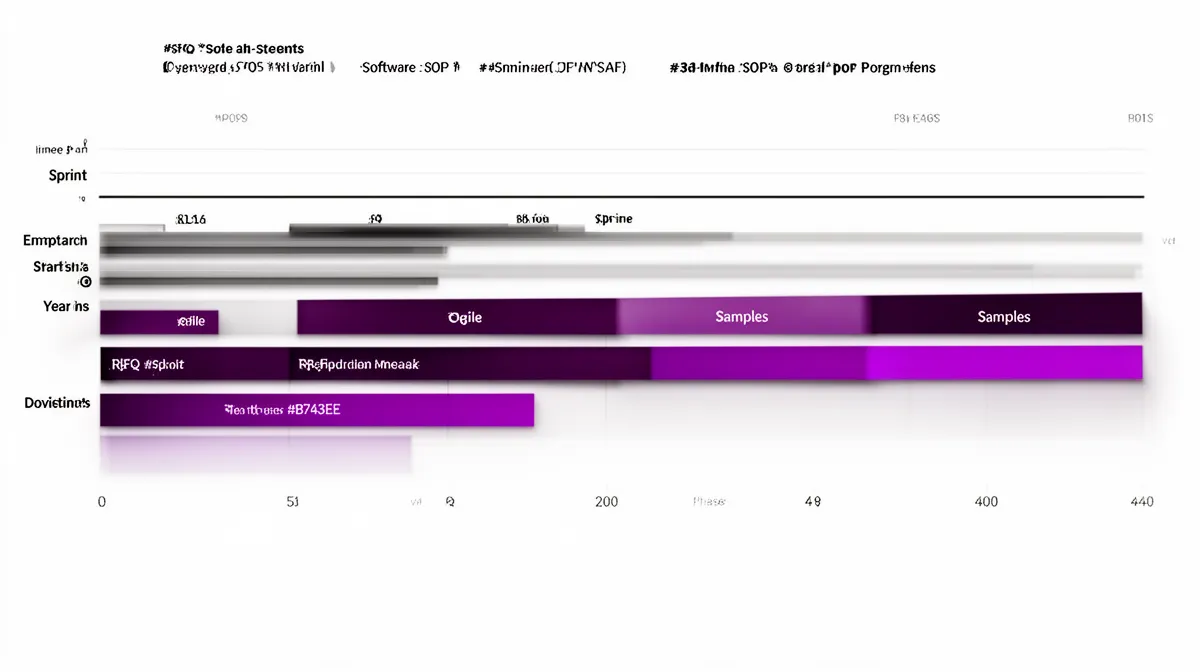
If you want AI to survive into production vehicles, you have to design it around OEM gates. Industry analyses of the typical RFQ to SOP timeline show just how structured the process is. The lesson for automotive AI development services for OEMs and Tier 1 suppliers is simple: respect the gates or miss the launch.

From RFQ to Sourcing: Where AI Requirements Are Locked
RFQ is where the future is priced. OEMs issue Requests for Quotation to Tier 1 suppliers with high‑level system requirements and expectations for compute, memory, and safety. For AI‑heavy ECUs and domain controllers, this is where AI architecture and constraints get effectively locked.
An ADAS ECU, for example, might need to run perception, sensor fusion, and path‑planning on a specific SoC with strict power and thermal limits. To respond credibly, the Tier 1 needs AI feasibility evidence: early models, approximate performance, and compute budgets. This is where automotive AI development services for OEMs and Tier 1 suppliers must provide architecture concepts, cost and compute estimates, and safety and cybersecurity concepts that can survive sourcing reviews.
Done well, this phase de‑risks the rest of the program. Done poorly, it leads to under‑quoted AI complexity, unrealistic performance promises, and costly redesigns when reality catches up during samples.
A‑Sample to C‑Sample: AI Maturity Tracks Hardware Maturity
Once sourcing is complete, hardware moves into A‑sample, B‑sample, and C‑sample phases. A‑samples are usually early prototypes—limited availability, evolving sensor configurations, and partially‑validated ECUs. B‑samples mature the hardware; C‑samples are close to production intent.
AI has to mature alongside this. Early on, sensor fusion algorithms may run partly in the cloud or on lab hardware. As ECU and domain controllers stabilize, models must be trimmed, quantized, and optimized to fit deterministic execution budgets. Hardware‑in‑the‑loop testing and digital twin simulation kick in to validate behavior before you risk real vehicles.
Consider a fusion pipeline that starts at A‑sample with limited radar and camera inputs. By C‑sample, the full sensor suite is locked, calibration is finalized, and latency budgets are strict. Your AI roadmap must anticipate this: modular components, adjustable architectures, and a clear path to production‑grade integration.
SOP and Post‑SOP: When AI Finally Meets Real Vehicles
SOP (Start of Production) is where everything becomes real. Software is frozen, homologation packages are assembled, and OEMs prepare to ship vehicles at scale. Any AI feature in that stack must have complete documentation, traceability, V&V evidence, and a clear cybersecurity posture.
But SOP isn’t the end of the automotive software lifecycle; it’s the middle. Now vehicles generate fleet data at scale. Predictive maintenance analytics identify patterns in failures. Driver‑assist features face real‑world edge cases and weather. Fleet data management becomes central to your AI story.
This is where long‑term value is either realized or lost. If your predictive maintenance analytics or driver‑behavior models can’t be monitored, retrained, and safely deployed, their performance will decay just as vehicles hit the road. Automotive AI development services must treat post‑SOP operations as a primary design constraint, not an afterthought.
Designing a Timeline‑Native Automotive AI Roadmap
To survive from RFQ to SOP (and beyond), you need an AI roadmap that assumes a long‑cycle environment by default. That’s where automotive AI software lifecycle management services come in: they focus on architectures, governance, and release planning instead of one‑off prototypes. In effect, you’re designing automotive‑grade AI development services aligned to vehicle SOP, not quick experiments.
Staying Current at SOP: Architectures, Not Fads
The first rule of long‑cycle AI is simple: don’t bet your program on a fad. Locking into a short‑lived AI framework or proprietary stack in year one is a recipe for pain when SOP arrives years later. The antidote is modular, portable architectures with a clear separation between data, models, and deployment code.
For example, ADAS perception models should be designed so that they can be re‑trained, pruned, or even swapped while still targeting multiple inference runtimes and ECUs. Instead of hard‑wiring to a single vendor’s SDK, treat the runtime as an adapter layer. This is how you ensure production‑grade AI models are still deployable and supportable when the vehicle finally rolls off the line.
Good automotive AI software lifecycle management services are opinionated here. They push for technology choices with credible long‑term support stories and emphasize versioning, migration paths, and test harnesses that can validate new model variants without destabilizing the system.

Balancing Agile Sprints with ASPICE and V‑Model Governance
None of this means abandoning agile. It means nesting agile inside a V‑model and ASPICE‑governed world. Sprints are how you explore, experiment, and incrementally improve models. The V‑model and ASPICE are how you ensure traceability, quality, and certification‑readiness.
In practice, that means mapping sprint outputs to gate artifacts. User stories and tickets roll up into requirements specifications. Experiment logs and model evaluations become part of design and V&V documentation. Every change triggers change control and configuration management, even if it was born in a scrappy two‑week spike.
This is why understanding ASPICE isn’t optional for long‑cycle providers. ASPICE guides how automotive software lifecycle activities should be structured, documented, and reviewed. Industry guidance on ASPICE makes one thing clear: process maturity is as important as code quality. That’s alien to many agile‑only shops but essential in automotive.
Aligning AI Releases to OEM and Tier‑1 Milestones
A timeline‑native roadmap starts by asking: what does each gate need from AI? At RFQ, you need feasibility, architecture options, and risk analysis. At sourcing, you need refined estimates and initial safety and cybersecurity concepts. At A/B/C samples, you need increasingly mature, calibrated, and validated implementations.
For an ADAS feature, for example, the release calendar might look like this: pre‑RFQ concept models on lab data; RFQ package with early benchmarks and resource estimates; A‑sample prototypes integrated into HIL rigs; B‑sample models optimized for target ECUs; C‑sample release candidates undergoing full V&V and on‑road testing. Each step produces artifacts that align with OEM program milestones on the RFQ to SOP timeline.
This is what distinguishes serious long‑cycle automotive AI development service providers from generic outsourcers. They don’t just ship code; they commit to releases mapped to your gates, with requirements, tests, and safety stories that can stand up in cross‑functional reviews.
Automotive‑Grade AI Validation, Safety, and Homologation
No AI feature belongs in a car until it survives the scrutiny of functional safety, V&V, and homologation. This is where automotive AI validation and homologation services matter most. They translate experimental AI into something a regulator, safety engineer, and cybersecurity team can all sign off on.
Functional Safety and ISO 26262 for AI Components
AI doesn’t get a free pass from functional safety. It has to fit into system‑level safety concepts and safety goals defined under ISO 26262. That means specifying what the AI block does, its assumptions, and how the system reacts when it fails or behaves unexpectedly.
For an AI‑based lane detection function, you’d define required detection rates, latency bounds, and known limitations (e.g., snow‑covered lanes). Safety mechanisms might include fallback strategies, driver alerts, or redundancy through traditional algorithms. Automotive AI validation and homologation services package this into safety requirements, design descriptions, and safety cases that can be reviewed by OEM safety teams.
The uncomfortable truth is that AI’s non‑determinism complicates this. That’s why rigorous data management, performance envelopes, and statistical guarantees become crucial. You’re not just shipping a model; you’re shipping a safety argument.
Verification & Validation: From Simulation to Vehicles
Verification and validation for AI must go far beyond a single accuracy metric. A credible V&V (verification and validation) strategy spans offline datasets, simulation, digital twin simulation environments, hardware‑in‑the‑loop testing, and on‑road trials. ADAS and autonomous driving features are perfect examples—corner cases emerge only under diverse conditions.
A robust program might start with massive synthetic datasets to probe rare weather or lighting conditions, then validate on recorded real‑world data. Sensor fusion algorithms are tested across combinations of degraded sensors, occlusions, and conflicting inputs. Research from OEMs and academia on ADAS validation using simulation, such as work published via IEEE, underscores how critical simulation‑based coverage is.
Regression testing is non‑negotiable. Every new model version must be compared against baselines, with coverage metrics and key scenarios tracked. This is how you prevent silent regressions from slipping into production vehicles.
Homologation, Cybersecurity, and Documentation OEMs Expect
Even the best‑validated AI won’t ship if it can’t pass homologation and compliance checks across regions. Regulations differ, but the pattern is consistent: prove safety, document behavior, and show that updates won’t introduce unacceptable risks. For connected car features, cybersecurity scrutiny is just as intense.
Connected car platforms and over‑the‑air updates raise hard questions: how are models protected against tampering? How do you ensure only approved versions run on vehicles? What’s your incident response plan if an exploit is discovered? Articles from organizations like SAE International detail just how challenging this is in practice.
A serious AI partner will be ready with a documentation and traceability package: safety case, cybersecurity concept, detailed test reports, software bill of materials, data management documentation, and clear process descriptions. These are the artifacts that convince OEMs, auditors, and regulators that your AI is truly automotive‑grade.

End‑to‑End Automotive AI Services from RFQ Through Post‑SOP
Putting this all together, what do end‑to‑end automotive AI development services actually look like? At Buzzi.ai, we think in terms of a continuum: RFQ support, development and integration through samples, SOP preparation, and post‑SOP operations. It’s the only way to offer credible automotive AI software lifecycle management services instead of fragmented projects.
RFQ and Concept Support: Architecture, Estimation, and Risk
Early in the program, the job is to make AI legible to sourcing and engineering teams. That means feasibility studies, concept models, and clear compute and memory sizing. For AI‑heavy ECU and domain controllers, you’re helping the Tier 1 answer the RFQ with grounded assumptions instead of wishful thinking.
Services here include lab‑grade prototypes, early safety and cybersecurity concepts, and integration sketches for embedded AI on ECU. For example, helping a Tier 1 evaluate whether an SoC can support both perception and driver monitoring AI under power and thermal constraints—and quantifying the tradeoffs. Automotive AI development services for OEMs and Tier 1 suppliers that start at RFQ create alignment from day one.
Development, Integration, and Testing Across Samples
Once the program moves into A/B/C samples, the focus shifts to robust engineering. Data pipelines are hardened, models are iterated, and integration into ECUs and connected car platforms begins in earnest. Bench setups and hardware‑in‑the‑loop testing make it possible to exercise edge AI workloads under realistic conditions.
Consider a predictive maintenance analytics pipeline that combines vehicle telemetry, cloud processing, and in‑vehicle anomaly detection. An end‑to‑end partner will handle data engineering, model development, and deployment across both the cloud and the automotive cloud and edge AI stack. Coordination with internal teams and the supplier network ensures compatibility across firmware, networking, and backend services.
This is also where interfaces between AI models and non‑AI modules get nailed down. Good integration practices here save months of debugging later and reduce the risk of surprise failures at C‑sample or SOP.
Post‑SOP Operations: Fleet Data, Retraining, and OTAs
After SOP, the vehicle is in the wild—but the AI story is just beginning. Vehicles generate streams of data; the question is how you turn that into continuous improvement without violating safety or cybersecurity constraints. That’s the realm of fleet data management, drift detection, and controlled retraining pipelines.
For example, you might detect changing failure patterns and update an anomaly detection model across the fleet. That demands a retraining process with approvals, regression testing, and clear criteria for when a new model is allowed to ship. Over‑the‑air updates have to be orchestrated carefully, with rollback plans and compliance checks. Industry reports from firms like Gartner underscore best practices in fleet data and predictive maintenance.
Long‑term software support and AI process automation around monitoring, alerting, and incident response are part of the package. This is where a true partner stays engaged for years, not months. If you want a sense of how we approach this, our automotive-grade AI development services page outlines how we structure such engagements across the lifecycle.
How to Evaluate Long‑Cycle Automotive AI Development Partners
Given all this complexity, how to choose an automotive AI development partner for multi‑year programs becomes a strategic question. You’re not just picking a vendor; you’re effectively picking a co‑owner for part of your software lifecycle. That demands a different evaluation lens than typical IT outsourcing.
Evidence of Automotive Program Experience and Compliance
First, look for evidence of real OEM and Tier‑1 experience. Have they survived RFQ‑to‑SOP on any program? Do they understand RFQ, A/B/C samples, SOP, and post‑SOP operations in practice, not just in theory? The best automotive AI development services for OEMs and Tier 1 suppliers will have war stories, not just slideware.
Ask specific questions about ASPICE, ISO 26262, and cybersecurity track records. Can they produce sample safety documentation, test reports, and traceability matrices? Do they offer automotive AI validation and homologation services as part of their core offering, or is that something they “figure out later”?
This is also where you separate teams that understand automotive‑grade process from teams that only know startup‑style development. Certifications and compliant processes are signals, but the real test is how they talk about gates, audits, and failure modes.
Lifecycle Ownership, SLAs, and Commercial Models
Next, probe how they think about lifecycle ownership. Are they proposing a short proof‑of‑concept with a vague idea of what happens next, or a multi‑year plan that spans RFQ, development, SOP, and operations? True automotive AI software lifecycle management services will come with clear responsibilities and SLAs.
Discuss engagement models and SLAs openly. For example, a blended model might combine fixed bids for gate‑specific deliverables (RFQ package, A‑sample integration, SOP validation) with a retainer for post‑SOP monitoring and support. The best long‑cycle automotive AI development service providers will be comfortable making that long‑term commitment because it’s how they de‑risk their own work.
Make sure you understand who owns data pipelines, retraining processes, and incident response. If those are “out of scope,” you’re likely headed for expensive gaps later.
Red Flags: When Agile‑Only Vendors Meet Automotive Gates
Finally, learn to spot red flags early. If a vendor shows no understanding of RFQ, A/B/C samples, SOP, or OEM program milestones, they’re not ready for your program. If their documentation story is light and they have no answer on safety, you’re looking at a sprint‑only shop misaligned with your gates.
Another warning sign is heavy dependence on niche frameworks or proprietary stacks with no long‑term support plan. When asked about why agile AI development fails for long automotive programs, they might blame “slow clients” instead of acknowledging process and compliance realities. That’s a hint they haven’t internalized what best automotive AI development services for ADAS and connected vehicles really require.
In short, prioritize timeline‑native providers who can talk fluently about gates, compliance, and lifecycle ownership over generic AI outsourcers promising only speed.
Conclusion: Build AI That Survives RFQ to SOP
Most sprint‑only AI delivery models are structurally incompatible with the RFQ‑to‑SOP reality of automotive. The gap between a six‑week demo and a six‑year vehicle development cycle is filled with gates, audits, and responsibilities that generic vendors aren’t set up to handle. That’s why so many PoCs die in labs instead of in vehicles.
To make AI truly automotive‑grade, you need automotive‑grade AI development services aligned to vehicle SOP: roadmaps mapped to OEM program milestones, ASPICE and ISO 26262 baked in from RFQ onward, and explicit planning for validation, safety, and homologation. The question of how to choose an automotive AI development partner for multi‑year programs is really a question of who is willing to own that full lifecycle with you.
At Buzzi.ai, we design automotive AI development services specifically for long‑cycle programs, from concept and RFQ through SOP and post‑SOP operations. If you’re re‑evaluating current initiatives or planning new ADAS and connected features, now is the moment to align your AI roadmap with your RFQ‑to‑SOP gates. You can schedule an RFQ-to-SOP AI roadmap session with Buzzi.ai to map your specific program milestones to an AI architecture, validation plan, and engagement model that will still be standing when vehicles reach the road.
FAQ
What are automotive AI development services and how do they differ from generic AI development?
Automotive AI development services are end‑to‑end offerings designed to build, validate, and operate AI software within the constraints of vehicle programs. They account for RFQ‑to‑SOP timelines, safety and compliance standards, and post‑SOP operations. Generic AI development usually stops at a PoC or MVP and rarely includes multi‑year lifecycle ownership or automotive‑grade documentation.
Why do sprint-only AI development models fail in long automotive programs?
Sprint‑only models assume technology, tools, and vendors can change freely every few months, which clashes with 4–7 year vehicle timelines. By SOP, frameworks may be obsolete, documentation is missing, and safety and compliance requirements were never embedded. The result is rework, delays, or cancellation of features that looked promising early on.
How should automotive AI development align with RFQ, A/B/C samples, and SOP milestones?
AI roadmaps should map specific deliverables to each gate: feasibility studies and architecture for RFQ, refined estimates and safety concepts for sourcing, maturing implementations across A/B/C samples, and fully validated, documented releases for SOP. Each phase should produce artifacts that support OEM reviews and audits. This alignment ensures AI features remain viable as hardware and regulations evolve.
What makes AI software truly automotive-grade in terms of safety and compliance?
Automotive‑grade AI software is built with functional safety, cybersecurity, and homologation in mind from day one. It comes with clear requirements, traceability, rigorous V&V evidence, and safety and cybersecurity cases that stand up to ISO 26262 and ASPICE scrutiny. It also supports controlled updates and long‑term maintenance within the automotive software lifecycle.
How can OEMs and Tier 1s keep AI models current and validated by SOP?
The key is to design for longevity: choose stable frameworks, modular architectures, and robust test harnesses that can validate new model variants. Plan explicit model refresh cycles aligned with program milestones so you’re not shipping a prototype from year one at SOP. Lifecycle‑oriented partners help maintain production‑grade AI models that are still supported and certifiable when vehicles launch.
What role do ASPICE and ISO 26262 play in automotive AI development services?
ASPICE defines process maturity expectations for automotive software development, while ISO 26262 sets the bar for functional safety. Together, they shape how requirements, design, implementation, and V&V for AI components must be handled and documented. Any credible provider of automotive AI development services must be able to operate within these frameworks and produce compliant artifacts.
How should over-the-air updates and continuous learning be handled safely in vehicles?
Over‑the‑air updates and continuous learning should be governed by strict safety and cybersecurity processes. That includes controlled retraining pipelines, regression testing, approval workflows, and clear criteria for when updates are allowed. Vehicles must be able to roll back problematic updates, and the entire process must be documented for regulators and OEM safety teams.
What end-to-end services should an automotive AI partner offer from RFQ through post-SOP?
An end‑to‑end automotive AI partner should cover RFQ support, architecture and estimation, development and integration across samples, validation and homologation, and post‑SOP operations. That includes fleet data management, retraining, monitoring, and OTA update planning. For an overview of how Buzzi.ai structures such services, see our AI agent development offering.
How can buyers evaluate and compare long-cycle automotive AI development service providers?
Buyers should look for proven OEM/Tier‑1 experience, evidence of ASPICE and ISO 26262 competence, and a concrete plan for lifecycle ownership. Ask about RFQ‑to‑SOP case studies, documentation samples, and post‑SOP support models. Providers that can’t speak fluently about gates, audits, and safety are unlikely to be good long‑cycle partners.
How does Buzzi.ai structure engagement models and SLAs for multi-year automotive AI programs?
We typically combine gate‑based project phases (e.g., RFQ support, A/B/C sample integration, SOP validation) with long‑term support options for post‑SOP operations. SLAs cover responsiveness, monitoring, and update processes aligned with safety and cybersecurity requirements. The goal is to give OEMs and Tier 1s confidence that their AI features will be supported across the entire program lifecycle.