AI Specialists for Hire: Match Roles to the Work, Not the Hype
Learn how to hire AI specialists for hire that actually match your use case, avoid costly mis-hires, and structure engagements that deliver real ROI.
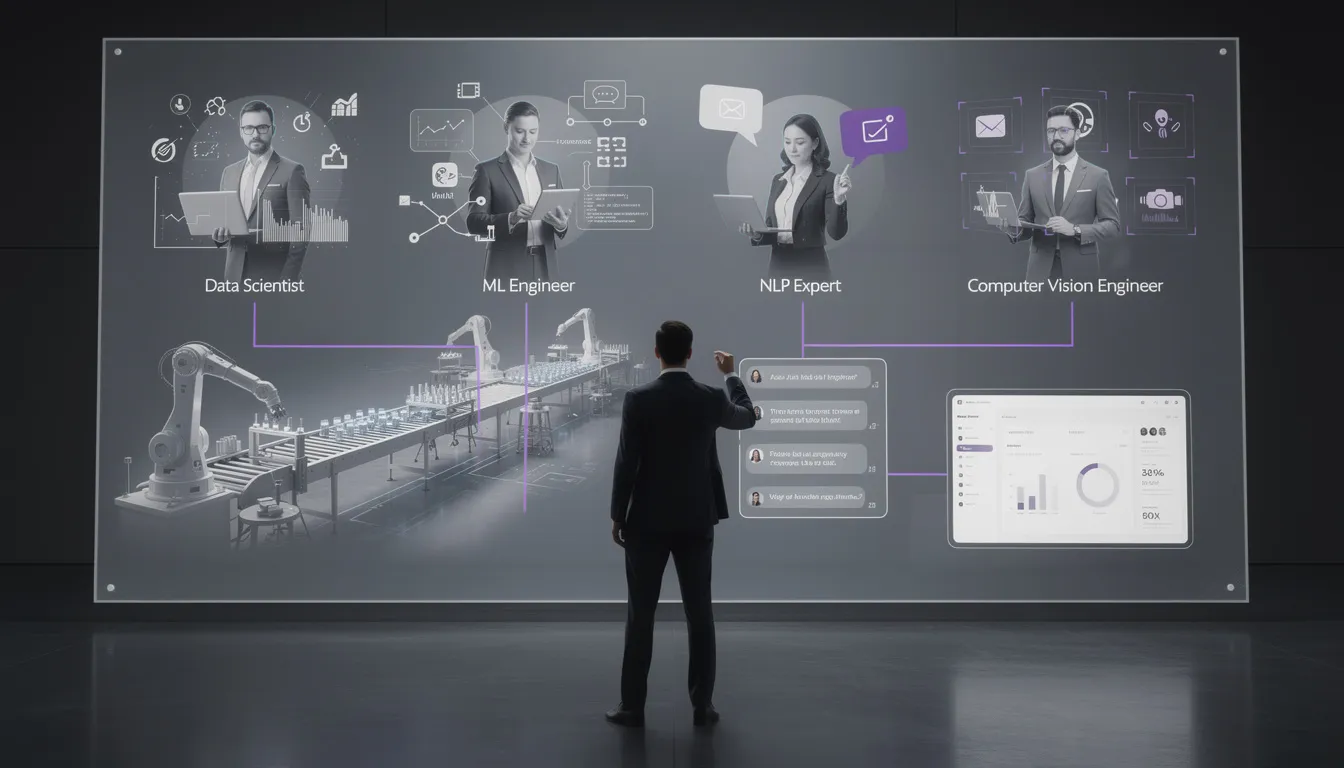
Most failed AI projects aren’t caused by a shortage of talent. They fail because companies bring in the wrong kind of AI specialists for hire for the work at hand. You hire a headline-worthy researcher when what you really needed was a pragmatic data engineer, or you search for an AI developer for hire when a demand-forecasting expert would have paid for themselves in months.
The pattern is predictable: vague mandates to “do something with AI,” fuzzy job descriptions like “hire AI specialist,” expensive pilots that never ship, and leadership left wondering whether AI is overhyped. The problem isn’t AI; it’s specialization mismatch. Titles don’t map cleanly to business needs, and most leaders aren’t supposed to be able to decode them.
In this guide, we’ll walk through a practical way to flip this dynamic. You’ll learn how to translate business problems into AI-ready use cases, map them to the right specialist roles, and design low-risk engagements that prove value before you commit. And we’ll show you how we at Buzzi.ai act as the matching layer between your goals and the specialized AI talent needed to reach them—without turning your organization into an AI recruiting firm.
Treat AI Hiring as a Specialization-Matching Problem
If you think of AI hiring as buying generic “AI capacity,” you’ve already lost. The right way to think about AI specialists for hire is closer to medicine: you don’t go to a neurosurgeon for a broken ankle, and you don’t bring in a generative AI engineer to fix a forecasting problem. The trick is understanding which kind of specialist aligns with which kind of work.
Why “AI Talent Shortage” Is the Wrong Diagnosis
We hear a lot about AI talent scarcity, but for most companies it’s the wrong diagnosis. The deeper issue is misaligned specialized AI talent. Leaders hire a brilliant NLP researcher when they actually needed a rock-solid data engineer plus an ML ops specialist to get existing models into production reliably.
AI roles are deep and narrow. A world-class NLP engineer can design a sophisticated language model for contracts yet be ineffective on a computer vision line-inspection problem. A celebrated AI engineer who built a chatbot at a unicorn might have no experience with time-series forecasting or routing optimization, which is what your logistics team actually needs.
The consequences show up as budget waste and stalled pilots. Bring in the wrong specialist and you get the wrong architecture, tooling, and priorities from day one. Instead of standardizing your data and instrumenting your workflows, they jump straight into model tinkering and "quick wins" that can’t be operationalized. This is where good ai project scoping and even light technical due diligence AI up front can save you six or seven figures over a multiyear roadmap.
Consider a mid-market ecommerce company that hired a famous AI researcher to design a “state-of-the-art recommendation system.” Six months later, they had a complex research-grade model and a stack of notebooks—but nothing in production and no lift in revenue. The missing piece wasn’t brilliance; it was the unglamorous mix of data engineering, ML engineering, and product thinking. They didn’t need a celebrity; they needed the right combination of specializations.

Three Failure Modes in AI Hiring You Can Actually Control
The good news is that you don’t need to be a technologist to avoid the most common AI hiring traps. You just need to recognize three controllable failure modes.
1. Over-hiring. Companies bring in a senior AI architect or expensive ai consulting team when a tight proof of concept with a focused specialist would have been enough. It’s like hiring a world-renowned architect to design your garden shed when a competent contractor would have been faster and cheaper.
2. Under-specifying. Job descriptions like “AI developer for hire” or “we’re looking to hire AI specialist to help with automation” are magnets for generalists. They don’t define whether you’re facing a prediction, perception, or language problem; they say nothing about data sources or deployment constraints. The result is a pile of resumes and interviews that never get specific about how to ship value.
Here are a few real-sounding snippets that create confusion:
- “Looking for an AI developer to help us leverage AI for our product.” (What product? What workflows? Prediction, perception, or language?)
- “We need a data scientist to build AI features into our app.” (Is this about experimentation and insight, or building production APIs?)
- “Seeking AI expert to automate processes with machine learning and chatbots.” (This bundles three different roles and disciplines into one line.)
3. Mis-sequencing. Many teams hire model builders before dealing with data readiness, MLOps, or domain expertise. They bring in a model expert when they should first fix the logging, integrate their CRM and ERP, or define clear labels for “churn” or “defect.” This is why strong ai strategy consulting and choosing the right ai implementation partner matters as much as choosing the right individual expert.
Once you see AI hiring as a sequencing and specialization problem, the next question becomes obvious: how do you frame your needs in a way that makes the right specialists obvious?
Step 1: Translate Business Problems into AI-Ready Use Cases
The first step to hiring the right AI specialist isn’t to post a job. It’s to turn fuzzy ambitions into clear, AI-ready use cases. This is where ai use case discovery and thoughtful ai project scoping earn their keep.
Start with Decisions and Workflows, Not Models
Instead of starting with models (“we need GPT-4” or “we should try computer vision”), start with decisions and workflows. Ask: What are the highest-value decisions we make repeatedly? Where do we have bottlenecks that slow revenue, margin, or customer satisfaction? This is the raw material for meaningful enterprise AI adoption and custom AI development.
A simple frame is to sort problems into three buckets:
- Prediction – scoring or forecasting a number or outcome.
- Perception – understanding images, video, or audio.
- Language – working with text or conversations.
Here’s how that plays out in practice in prose form:
A SaaS company wants to reduce churn. That’s a prediction problem: given current behavior and attributes, predict the probability a customer will leave. A retailer wants to optimize store staffing week by week. Another prediction problem: forecasting foot traffic and transactions by store and day. These steer you toward data scientists, predictive analytics experts, and potentially a machine learning consultant with production experience.
A manufacturer wants automatic defect detection on the assembly line from camera feeds. That’s a perception problem, squarely in computer vision. A call center wants to detect customer frustration in real time from audio. Again, perception (speech) with some language understanding layered on.
Then there are language-heavy problems. A bank struggling with document-heavy onboarding wants to automate KYC checks and form extraction. That’s language and document AI. A support leader wants 24/7 chat that can resolve the top 30 issues. That’s the territory of an nlp engineer and, if you’re thinking more advanced, an nlp AI specialist for hire to build chatbots that handle complex flows.
Once you label a problem as prediction, perception, or language, the question of how to hire the right AI specialist for my project becomes much less mysterious.
Assess Data Readiness Before You Talk to an AI Specialist
Before you speak to any specialist, you need one uncomfortable but essential conversation: is your data ready? Many leaders assume the answer is “yes” because they have a data warehouse or a CRM. In reality, this is often where projects stall, and where data engineering for AI and ml ops become your real first hires.
Start with a basic readiness checklist:
- Where does the relevant data live (CRM, ERP, logs, spreadsheets)?
- How clean is it—are key fields missing, inconsistent, or duplicated?
- Who owns it and can approve access?
- How often does it refresh, and how quickly do you need decisions?
- Do you have clear definitions for labels (e.g., what exactly is a “defect” or “churned user”)?
Take a company that wants to hire a machine learning engineer to predict churn. They imagine a sophisticated model, but when you peek under the hood, customer IDs are duplicated across systems, cancellation reasons are free-text notes, and there’s no consistent timestamp on key events. The real first move isn’t a model; it’s cleaning and unifying the data via a solid data engineer and perhaps an ml ops consultant. Only then does an AI specialist make sense.
Multiple industry studies have found that poor data quality is a top reason AI projects underperform. Gartner, for instance, has highlighted data quality and integration as core barriers to AI value realization in enterprises (Gartner AI report). Getting an ai roadmap and ai readiness assessment right up front massively reduces this risk.
If you want a guided version of this, our AI discovery and scoping services walk through these questions with your team and translate them into concrete use cases and data prerequisites.

Step 2: Map Problems to Concrete AI Specializations
Once you’ve framed your problems and assessed data readiness, you can map each use case to the right kind of specialist. This is where most conversations about AI specialists for hire finally become concrete. Instead of generic labels, you’re pairing “prediction problem with messy CRM data” or “language-heavy support workflows” to specific roles.
Core AI Roles Explained in Plain Language
Executives don’t need to know the math behind gradient descent, but they do need to understand who does what on an AI team. Here’s a plain-language map of the core roles.
Data Scientist. Think of the data scientist as an experimentalist and analyst. They explore data, build and evaluate models, and answer “what drives this KPI?” questions. They’re ideal when you need insight, experiments, and initial predictive models—but not necessarily hardened production systems. Academic and industry sources like the Harvard Data Science Initiative define the role around inference and experimentation more than large-scale systems (Harvard Data Science overview).
Machine Learning Engineer. A machine learning engineer takes models (from data scientists or off-the-shelf) and turns them into robust, scalable services. They worry about APIs, latency, monitoring, and model deployment. Stanford’s ML engineering guides emphasize this distinction: ML engineers sit at the intersection of software engineering and ML systems design.
AI Engineer. The term is fuzzy, but typically an ai engineer integrates AI capabilities into products or workflows. They might use existing APIs (like cloud vision or GPT) or fine-tune models, then connect them to your applications, backends, and UI. They’re often the right choice when you want to embed AI into a product feature quickly using existing building blocks.
Data Engineer. Data engineers build and maintain the pipelines that make data usable. They move, clean, and organize data across systems. Without them, even the best models are starved or misfed.
MLOps Engineer. An ml ops specialist focuses on the lifecycle: versioning models, automating training, managing deployment, monitoring drift and performance. They’re crucial when AI becomes more than a single experiment—when it’s a living part of your operations.
AI Solution Architect. An ai solution architect is the big-picture designer. They translate business needs into a system design: which data sources, what models, which services, how to integrate with existing IT. They don’t necessarily code all the pieces, but they make sure the whole hangs together.
So when should you hire a data scientist vs a machine learning engineer vs an AI engineer? For churn analysis and KPI exploration, a data scientist is your first call. For a new AI-powered feature in your product (like smart search), an AI engineer paired with a machine learning engineer is ideal. For a large-scale, always-on recommendation system, you’ll want both data scientists and ML engineers under the guidance of an AI solution architect.
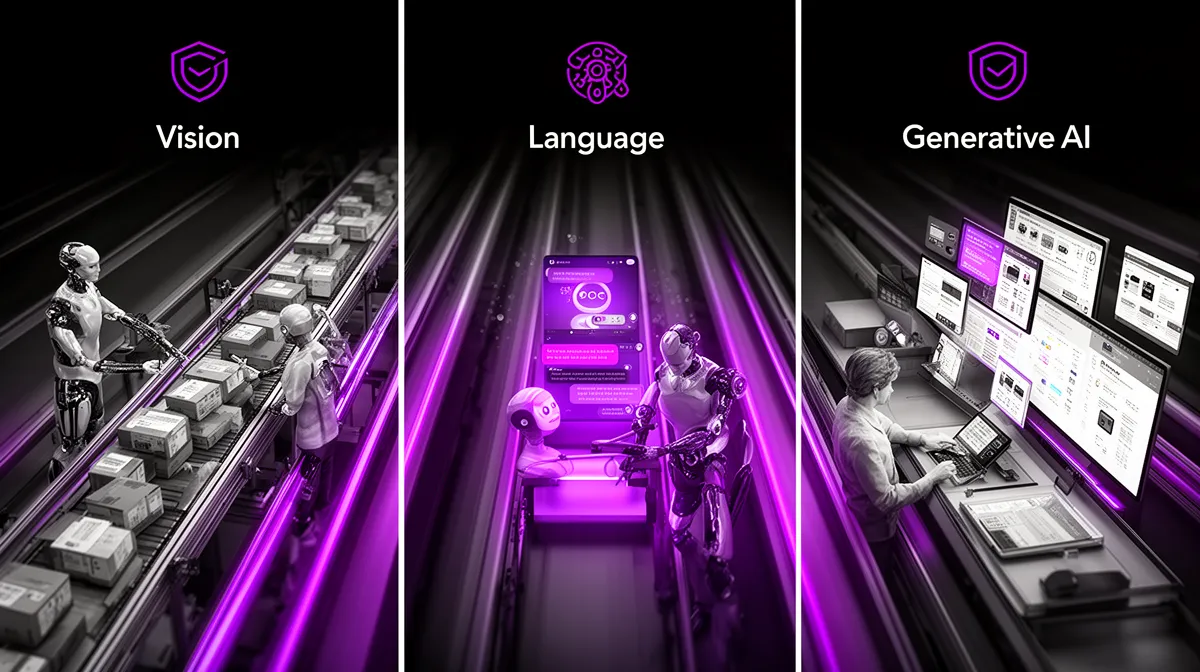
Specialists for Vision, Language, and Generative AI
Beyond these core roles, you have domain specialists focused on specific modalities or techniques. This is where the decision of how to hire the right AI specialist for my project intersects with your problem type.
Computer vision specialist. A computer vision specialist focuses on image and video understanding. When you’re evaluating computer vision AI specialists for hire for quality inspection, you’re looking for people who’ve shipped real systems for defect detection, safety monitoring, or OCR at scale. Industry case studies—from automated surface inspection in automotive to defect detection in electronics—show significant yield and cost improvements when vision systems are done right (McKinsey on computer vision in manufacturing).
Imagine a factory that wants to catch defects on a high-speed line. A generic “AI developer” will likely suggest generic tools. A real vision specialist will ask: what’s the lighting like, what’s the line speed, do we have labeled defect images, what’s the acceptable false positive rate, how will humans review edge cases?
NLP engineer. An nlp engineer designs systems that work with text and language: chatbots, routing, summarization, sentiment, document classification. If you’re looking for an nlp AI specialist for hire to build chatbots, ask about their experience with dialog design, retrieval-augmented generation, and integrating chat into your existing support stack. Evidence from real deployments shows NLP-powered chatbots can dramatically improve first-contact resolution and reduce handle time when done right (HBR on AI in customer service).
Consider a support team drowning in repetitive “where is my order?” questions. A true NLP specialist won’t just say “we’ll use GPT-4.” They’ll analyze your ticket taxonomy, knowledge base quality, and handoff process to agents, then propose a system tuned to your data and SLAs.
Generative AI engineer. A generative AI engineer designs systems that create content: text, code, images, or workflows. When you want the best AI specialists for hire for generative AI solutions, you’re really buying design of end-to-end workflows: prompt engineering, retrieval, safety and guardrails, UX integration, and measurement.
Think of a marketing team that wants auto-generated campaign copy, or a sales org that wants email drafts based on CRM context. The right generative specialist designs not just the model prompts, but the entire loop: inputs, human review, approval, and learning from outcomes. This is very different work from an image classifier on a production line.
Three quick mini-cases:
- Factory quality inspection: Hire a computer vision specialist with manufacturing experience.
- Support chat deflection: Hire an NLP engineer with a track record in routing and FAQ/chatbot systems.
- Marketing content workflows: Hire a generative AI engineer who has built workflow-integrated generation tools, not just toy demos.
Data Science vs Machine Learning Specialist: Which Do You Need?
Many leaders explicitly ask: data science vs machine learning specialist – which do I need? The answer depends on whether you’re trying to understand your business or automate decisions at scale.
Data scientists excel at exploratory analytics, experimentation, and hypothesis testing. They’re great when you need to understand what drives churn, which cohorts respond to pricing changes, or which features predict upsell. They’re the right first hire for questions like “what are the top three drivers of NPS?” or “which variables explain regional performance?” This is the world of predictive analytics in its early, insight-heavy phase.
Machine learning specialists (often titled ML engineers or senior ML practitioners) shine when you need those insights wired into live systems: real-time recommendations, fraud detection, dynamic pricing, or routing. They worry about latency, throughput, fallback logic, and ongoing model deployment and monitoring.
Consider two scenarios. In the first, you want to analyze churn over the last 24 months and identify risk signals to inform your Q4 strategy. A data scientist is the right answer. In the second, you want a real-time recommendation system that updates suggestions on every page view. Now you want a machine learning specialist or machine learning consultant who can design and deploy that system end-to-end.
Good research and industry practice (see, for example, Google’s ML Ops guides) consistently draw this line: data scientists ask and answer questions; ML specialists make those answers operational at scale.
Step 3: Decide How to Engage AI Specialists with Less Risk
Choosing the right specialist type is only half the game. The other half is deciding how to engage them: full-time hire, project-based, or through an ai consulting firm with specialized AI engineers for hire. The wrong engagement model can be as damaging as the wrong role.
In-House Hire vs Specialized AI Consultancy vs Fractional Expert
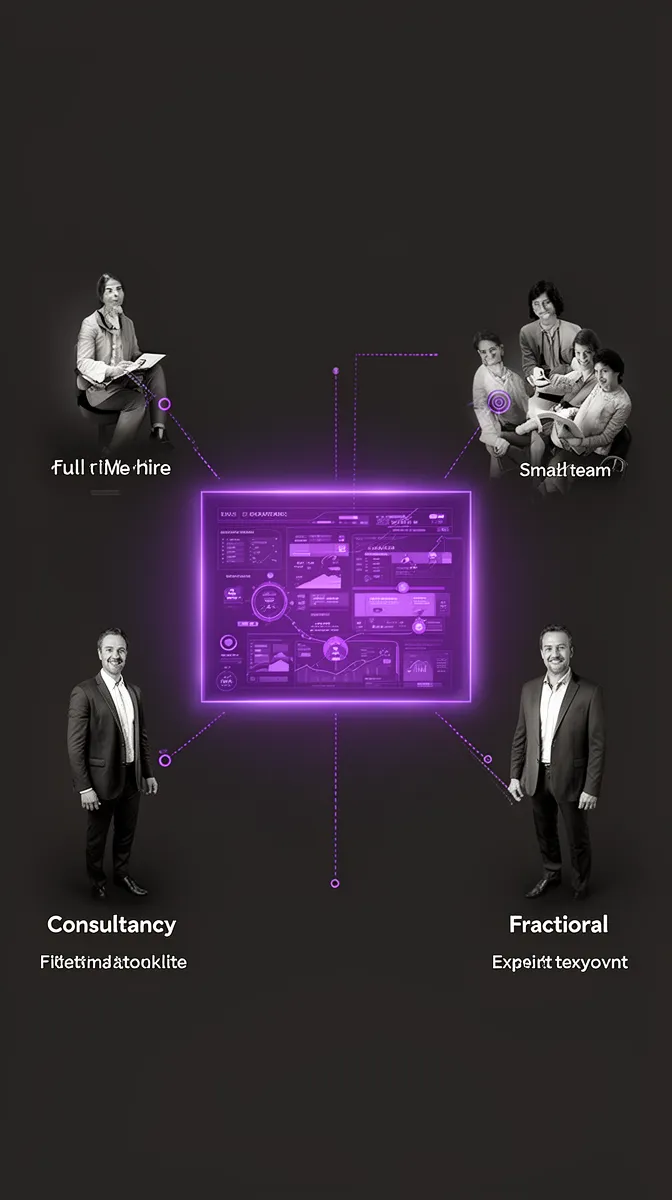
There are three primary engagement models, each with its own trade-offs for ai team augmentation and capability building.
1. Full-time in-house hire. Best when AI is core to your product or long-term strategy, and you have technical leadership to guide them. You gain continuity and domain depth, but you bear the risk of mis-hire and the cost of keeping them fully utilized.
2. Specialized AI consulting firm. An ai consulting firm with specialized AI engineers for hire can assemble multi-role teams quickly: data engineering, NLP, generative, MLOps, and domain experts. This is ideal when you’re at the start of your AI journey or when you need a full cross-functional team for a defined initiative. A good ai implementation partner orchestrates specialization, handles ai roadmap and architecture, and transfers knowledge back to your team.
3. Fractional or project-based experts. Useful when you have a solid internal team but need a specific specialization (say, a computer vision consultant) or a temporary boost (like a senior MLOps architect). This is flexible and cost-effective but requires you to manage integration and coordination.
Picture a mid-market logistics company planning its first AI initiative. They could hire a single full-time ML engineer (risky and narrow), engage a large generalist agency (broad but possibly shallow and generic), or partner with a focused ai consulting services firm that brings the exact mix of skills. Industry reports on build vs. buy vs. partner strategies regularly emphasize the partner route for organizations without mature AI leadership (Deloitte State of AI).
The right answer often isn’t “or” but “and then.” Use a partner to de-risk and learn, supplement with fractional experts as needed, then make permanent hires once the value and role definitions are clear.
Design Engagements Around Proof of Value, Not Headcount
The biggest lever you have to reduce risk isn’t the rate you pay or whether someone is a contractor or FTE. It’s how you structure the work. Design engagements around a clear proof of concept and explicit proof of value, not around vague “we’ll figure it out” headcount additions.
A practical pattern looks like this for ai project scoping and ai proof of concept development:
- Weeks 1–2: Discovery Sprint. Clarify goals, map workflows, inventory data, define success metrics, and finalize 1–2 priority use cases. Outcome: a concrete ai roadmap for the pilot.
- Weeks 3–6: Prototype Build. A small team (right specialists only) builds a thin end-to-end slice: data pipeline, model, and a simple interface or API. Outcome: working prototype and quantified early results on a sampled dataset or subset of users.
- Weeks 7–8: Decision Gate. Evaluate results against predefined metrics. Decide whether to harden and scale, pivot to a different use case, or stop. Outcome: go/no-go decision with business justification.
Notice what’s missing: there’s no commitment to a long-term bench of unspecified AI people. Instead, you buy clarity. If the prototype shows value, you have evidence to justify expanding the team or deepening the relationship with your ai consulting partner. If it doesn’t, you’ve learned cheaply and can redirect.
This proof-of-value mindset is how you keep AI experimentation disciplined instead of drifting into vanity projects with misaligned talent.
Step 4: Evaluate AI Specialists Without Being a Technologist
You don’t need to read research papers to evaluate an AI developer for hire. You just need a structured way to probe for relevance, depth, and outcome orientation. This is where leaders can avoid costly mistakes when they hire AI specialist talent in a domain they don’t personally master.
Questions to Ask Before You Hire Any AI Specialist
Here are questions that work across roles, from data scientist to generative AI engineer:
- “Tell me about a project similar to ours. What was the business goal, and what changed because of your work?”
- “What were the biggest data challenges? How did you handle them?”
- “Walk me through how your solution moved from prototype to production. What did you learn during model deployment?”
- “What trade-offs did you make (accuracy vs latency vs cost), and how did you explain them to non-technical stakeholders?”
- “In our case, what assumptions would you want to validate in a 4–6 week proof of concept?”
The goal is to surface whether this is someone who has shipped, not just experimented. Strong candidates give specific, outcome-focused answers; weak ones stay abstract.
For example, ask: “How did you measure success?” A vague answer: “We improved the model’s accuracy and stakeholders were happy.” A strong answer: “We increased same-session upsell revenue by 7% while keeping latency under 200ms and reducing manual review workload by 30%.” That’s someone who understands technical due diligence AI and real-world constraints.
Similarly, when evaluating an AI developer for hire, ask how they’ve worked with domain experts and product teams. Do they describe collaborative iteration, or do they sound like they throw models over the wall? That difference will decide whether they fit your culture and context.
Warning Signs You’re Talking to the Wrong Kind of AI Expert
There are clear red flags that you’re dealing with the wrong specialist—or with someone who is too generalist or tool-obsessed for your needs.
1. Tool-first thinking. If the first sentence out of their mouth is “we’ll just use GPT-4” or a specific framework before they’ve heard your data, constraints, and goals, be cautious. This suggests a one-size-fits-all mindset, not thoughtful ai strategy consulting.
2. Hand-waving on data quality. If they dismiss concerns about messy or incomplete data with “the model will figure it out,” walk away. Experienced specialists in serious enterprise AI adoption know that data quality issues can dominate project outcomes.
3. No production track record. If they have many demos but few live deployments, you’re likely dealing with a prototype specialist. That can be fine for exploration, but not if your goal is operational impact.
Picture a sales call where your business clearly has a perception-heavy problem: visual quality inspection. But the vendor keeps steering the conversation back to chatbots and content generation because that’s what they sell. They’re pushing generative AI when you obviously need computer vision. That’s a misaligned generalist agency masquerading as full-stack AI. Better to end the call early than try to force-fit them into a role they can't fulfill.
How Buzzi.ai Matches AI Specialists to Real Business Work
Everything we’ve described so far is how we run our own practice. Buzzi.ai isn’t a body shop of generic developers; we’re an ai consulting firm with specialized AI engineers for hire that starts from your business goals and backs into the specializations required. Our bias is toward specialized AI talent and small, high-leverage teams rather than big, unfocused projects.
Need Assessment: From Business Goal to AI Use Case
Our first step with any client is structured discovery. We unpack your goals (revenue, margin, experience, risk), map the key decisions and workflows behind them, and analyze the data landscape. We deliberately stay in business language at this stage; no model names, no premature architecture diagrams.
From there, we use the same prediction/perception/language framework you’ve just seen to identify candidate use cases and evaluate ai readiness. This is our flavor of ai use case discovery and ai strategy consulting: prioritize the smallest set of use cases that can prove value quickly and compound over time.
For example, with a retail client we might start from “increase repeat purchase rate by 10%.” Discovery reveals that the levers are churn prevention emails, more relevant recommendations, and better post-purchase messaging. That leads us to a mix of prediction (churn scores), language (automated outreach), and maybe perception (image-based recommendations) as the foundation for a focused ai discovery services engagement.
Specialization-Matched Teams, Not Generic AI Developers
Once we know what matters, we assemble the right mix of specialists. For a WhatsApp voice bot in an emerging market, that might mean an nlp engineer, a generative AI engineer, and a data engineer with telephony integration experience. For intelligent document processing or billing automation, it might be a computer vision/NLP combo with strong data engineering and MLOps.
Our work spans AI chatbots, voice assistants, workflow automation, predictive analytics, and more—but the throughline is the same: each engagement brings together the specific roles your use case demands. If you need a specialized AI agent development team, we provide that; if you only need a fractional MLOps expert to stabilize existing models, we can do that too.
Crucially, you don’t have to guess which roles to hire. We match the AI specialists for hire to your problems, run focused proofs of value, then help you decide what to insource, what to keep with us, and how to scale. That’s how we approach ai consulting services and ai team augmentation as a long-term partnership rather than a one-off project.
Conclusion: Hire AI Specialists for the Work, Not the Hype
Most AI hiring failures come down to specialization mismatch, not a global shortage of talent. If you start by translating business problems into clear use cases, check data readiness, and then map each problem type to the right role, you’re far more likely to hire AI specialist talent that delivers outcomes—not just impressive slide decks.
Remember the key moves: frame problems as prediction, perception, or language; decide whether you need data science, ML engineering, vision, NLP, generative, or MLOps expertise; and structure engagements around proof of value instead of abstract headcount. Treating ai specialists for hire this way turns AI from a buzzword into a disciplined part of your operating model.
If you’d like a partner to walk through this with you, we designed our AI discovery and matching process exactly for that purpose. In a low-commitment session, we’ll help you identify your highest-leverage use cases, assess data readiness, and design a proof-of-value engagement with the right specialist mix. Whether or not you work with Buzzi.ai long term, you’ll walk away with clarity about who you actually need to hire next—and why.
FAQ
What types of AI specialists are available for hire and how do they differ?
AI specialists span several distinct roles: data scientists, machine learning engineers, AI engineers, data engineers, MLOps engineers, AI solution architects, and modality experts like computer vision and NLP engineers. Each focuses on a different part of the lifecycle, from exploration to deployment. Matching their strengths to the right stage and problem type is what makes AI hiring effective.
How do I know which AI specialization my business actually needs?
Start by classifying your problem as prediction (forecasting, scoring), perception (images, video, audio), or language (documents, chat, email). Then assess your data readiness—where it lives, how clean it is, and how often it updates. This naturally points you toward specific roles like data engineering, computer vision, or NLP, instead of guessing at generic “AI” talent.
When should I hire a data scientist vs a machine learning engineer vs an AI engineer?
Hire a data scientist when you need to understand drivers of KPIs, run experiments, or build initial predictive models for analysis. Bring in a machine learning engineer when you’re ready to turn those models into robust, scalable services embedded in production. Choose an AI engineer when you want to integrate existing AI capabilities (APIs, foundation models) into your products and workflows quickly.
When is a computer vision specialist the right hire for quality inspection or defect detection?
A computer vision specialist is the right hire when your core signal is visual—images or video from cameras on a line, in a warehouse, or in the field. They’re essential if you need reliable defect detection, safety monitoring, or visual counting at scale. Look for people who’ve handled real-world challenges like lighting variation, camera placement, and labeling, not just lab demos.
When should I look for an NLP AI specialist for chatbots and document automation?
Look for an NLP AI specialist when your workflows are text- or conversation-heavy: support chat, email triage, routing, document classification, summarization, or knowledge-base search. They know how to combine language models, retrieval, and dialog design to hit real business metrics like resolution rate or handle time. If your goal is a robust chatbot or document engine, a generalist AI developer is rarely enough.
What questions should I ask an AI specialist before hiring them?
Ask for specific examples of projects similar to yours: business goals, data challenges, and production outcomes. Probe how they moved from prototype to deployment, what trade-offs they made, and how they measured success. Good candidates give concrete, metric-backed answers rather than generic statements about “using AI to improve processes.”
How can I tell if my data is ready before I bring in an AI expert?
Check where your data lives, how complete and consistent key fields are, who owns access, and how frequently it updates. If you can’t reliably answer basic questions like “How many active customers did we have last month?” your first step is likely data engineering and integration. Many organizations benefit from a short AI readiness assessment before committing to model-building work.
Should I hire an in-house AI specialist or work with a specialized AI consulting firm?
If AI is central to your product and you have strong technical leadership, building an in-house team can make sense. If you’re still exploring use cases or lack AI leadership, a specialized AI consulting firm with multiple roles on tap can de-risk your first projects and accelerate learning. A hybrid model—partner first, then selectively hire in-house—is often the most practical path.
What warning signs indicate that an AI specialist is too generalist for my needs?
Red flags include leading with tools instead of your problem, dismissing data quality concerns, and being unable to show production deployments similar to your domain. If they claim to “do everything with AI” without articulating specific modalities (vision, language, prediction) and constraints, they’re likely too generalist. In that case, keep looking for someone with a track record that matches your use case more closely.
How does Buzzi.ai ensure clients are matched with the right AI specialists for their projects?
Buzzi.ai starts with structured discovery to understand your goals, workflows, and data landscape before recommending any roles. We then assemble teams from our network of specialists—vision, NLP, generative, data engineering, MLOps—tailored to each use case. You can learn more about this approach in our AI discovery and scoping services, where we design low-risk, proof-of-value engagements before scaling.