AI Maintenance and Support: Stop Silent Drift
Most AI systems don’t fail with a crash. They fail while everyone’s still calling them “production-ready.” I’ve watched teams celebrate an on-time launch, then...
Most AI systems don’t fail with a crash. They fail while everyone’s still calling them “production-ready.” I’ve watched teams celebrate an on-time launch, then ignore the slow rot after deployment, silent drift, bad outputs, rising latency, and decisions nobody should trust.
That’s why AI maintenance and support isn’t a nice-to-have after launch. It’s the job. And the evidence is ugly. According to Cleanlab’s 2025 production survey, only 5% of AI agents in production have mature monitoring, even as Gartner expects task-specific AI agents to spread across enterprise apps by 2026. This article breaks down the 7 things you need to stop drift before it turns into cost, risk, and public embarrassment.
What AI Maintenance and Support Really Means
Hot take: a green dashboard can lie to your face.
I've watched teams celebrate 99.9% uptime while the model underneath was getting dumber by the week. No outage. No latency spike. No frantic Slack thread screaming that the API was dead. At 7:14 a.m., everything looked fine. Meanwhile a forecasting model trained on last year's buying patterns was already slipping because pricing changed, a supplier got shaky, or a new competitor showed up and bent demand in a different direction.
That's the part people miss.
AI maintenance and support means keeping model performance reliable in production, not just keeping the application online. I'd argue that's the real split between ordinary software maintenance and maintaining an AI product people actually use to make decisions.
The usual checklist still matters. Patch the app. Watch uptime. Fix bugs fast. Alert on crashes and latency. Do all of it.
It still isn't enough.
An AI system can answer in milliseconds and stay fully available while getting worse every single week without one bad deployment. The world moves. The model doesn't. That's silent drift. Sometimes it's data drift. Sometimes it's concept drift. Sometimes it's just plain model drift.
The nasty part is credibility. Bad outputs don't always look bad. They look plausible. A demand forecast that's off by 8% can still seem reasonable in a Monday meeting, which is exactly why people keep trusting it longer than they should.
AI maintenance and support has to include AI model monitoring, performance monitoring, and model drift detection. You're maintaining accuracy, calibration, relevance, and AI model currency. Servers and endpoints are just the wrapper.
Oracle puts it plainly with predictive maintenance: continuously monitor equipment data so AI can detect anomalies and predict failures before they happen. That's not some extra feature tacked on later. That's the work itself. In expensive environments, this gets ugly fast. Siemens data cited by iFactoryApp says an idle automotive production line can cost up to $2.3 million per hour.
Models don't stay sharp by magic. UptimeAI reports that adaptive models with feedback loops can cut false positives in maintenance alerts by 5–10x fewer than static setups. That's what solid AI support services are supposed to do in real life: watch live behavior, catch degradation early, feed back ground truth, and trigger retraining before users stop believing the system.
Do something different with your production AI. Keep the app patched. Keep uptime clean. Then check live predictions against real outcomes every week, especially after a price change or supplier issue. Track input distribution shifts after business changes. Review calibration on a schedule instead of waiting for complaints. Set thresholds that force a human review before mediocre output becomes everyone's new normal.
I think too many teams polish the shell and ignore the brain.
The weird part? Users usually won't tell you first. They'll just quietly route around the system, open a spreadsheet, and stop trusting the thing you thought was working perfectly. That's exactly where disciplined AI maintenance and support services begin: not with whether the app is up, but whether the model deserves belief.
Why Traditional Software Maintenance Fails AI
What does it mean when every dashboard is green and your product is still getting worse?
I don't mean a dramatic outage. No pager at 2:13 a.m. No database fire. I mean the quieter kind of failure, the one teams at big companies and tiny startups both miss because the graphs look polite and nobody wants to admit the machine is slipping.
I've watched this happen on a Monday morning review. 9:00 a.m., coffee in hand, P95 latency looked fine, failed jobs were basically flat, error rates barely twitched. If you'd walked in cold, you'd have called the system healthy in under 30 seconds.
Then support tickets started piling up.
Not the obvious kind. Users weren't saying "the app is broken." They were saying recommendations felt off. Summaries seemed thinner than they were in January. Answers sounded smooth, confident even, but somehow missed the point. That's the trap. AI can decay without looking broken.
I think this is where a lot of CTOs fool themselves. They keep running AI products with the same maintenance playbook they'd use for ordinary software: patch security holes, keep infrastructure stable, fix regressions, scale what's working. Fine. You need all that. But that's table stakes. It doesn't tell you whether the system is still making good decisions in the real world.
The New Stack said it more cleanly than most: observability can tell you whether a system is running, not whether its outputs are still correct or useful. That's not some weird corner case. That's the main problem.
The answer to that opening question is drift.
But "drift" gets thrown around so loosely that people stop hearing it, so let's make it concrete.
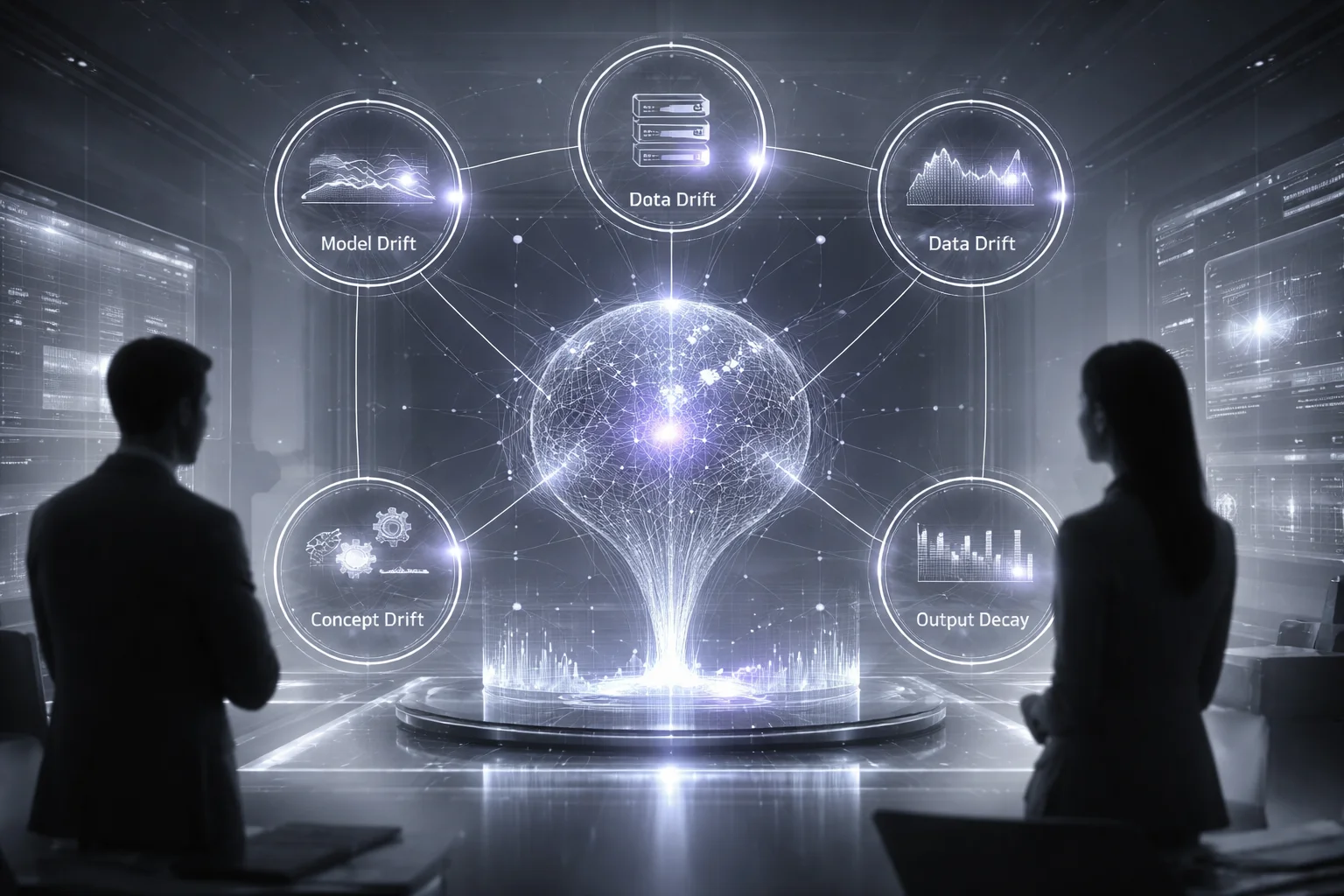
- Data drift: your inputs change while your model keeps pretending they didn't. Say you built a fraud model around one transaction pattern, then your company launches a new payment option and behavior shifts in two weeks.
- Concept drift: the meaning of the target changes. Churn signals that worked before stop working after pricing changes, a competitor enters the market, or internal policy moves.
- Model drift: performance falls because reality keeps moving away from the conditions in training.
- LLM performance degradation: outputs still read well while becoming less grounded, less accurate, or just less useful as prompts change, context windows shift, and user behavior drifts over time.
This is why "it's up" tells you almost nothing about an AI system. Silent failure doesn't smash through the wall like an outage. It leaks in slowly: bad approvals, weaker summaries, irrelevant answers, those strange moments where your own team starts second-guessing results they trusted six weeks earlier.
The ugly part is scale. According to Beam AI's citation of Gartner, by the end of 2026, 40% of enterprise applications will include task-specific AI agents, up from less than 5% in 2025. One year. Less than 5% to 40%. I'd argue that should make any operator sweat more than a red CPU graph ever could.
More AI in production means more places for invisible quality loss to hide behind cheerful status pages. A green dashboard becomes a lie if it's only measuring the shell around the model instead of the intelligence inside it.
So don't just ask whether the application works. Every single week, ask three harder questions: is the model current, is output quality holding up, and will your monitoring catch silent drift before users do? If your team can't answer those without hand-waving, your "AI support" probably isn't AI support at all. It's software support wearing an AI badge.
If you want to see that gap without the usual marketing fog—the space between shipping a model and actually operating an AI product—read Llm Development Company Model Vs App Reality. Strange question, maybe the only one that matters: if users notice decline before your dashboards do, what exactly are you monitoring?
The Drift Patterns That Quietly Degrade AI
Why does a model look healthy right up until the business starts complaining?
I've watched this happen in the most boring way possible. No outage. No scary Slack thread. No one getting dragged into a 2:13 a.m. incident call. Traffic holds steady, latency stays clean, outputs aren't obviously broken—and still something starts sliding. Approval rates soften. Recommendations get oddly repetitive. A summary skips the one clause legal needed highlighted. Everything runs. That's the trap.
Teams usually point at data drift first because it's easy to see and easy to say out loud. The chart moved, so there, case closed. I don't buy that. I'd argue concept drift and feedback loops cost more because they hide behind dashboards that still look respectable, sometimes for months.
Sama has called model drift a recurring production problem for exactly this reason: data changes, users change, operating conditions change, and clean failure signals often never show up. Beam AI pulled in a brutal stat from Cleanlab's 2025 survey: only 5% of AI agents in production have mature monitoring. That's not a small tooling gap. That's a trust gap.
Here's the answer: most AI systems don't fail like servers fail. They keep working while getting less right.
But even that's too neat, because "drift" gets treated like one villain when it's really a pile of different problems wearing the same coat.
Take the familiar one first. Input distribution shifts, or plain old data drift. A loan model trained mostly on salaried workers in 2022 gets deployed into a market where gig income shows up on half the applications. Nothing crashes. No red alert. The feature mix changes, accuracy drops anyway, and if you only watch uptime you'll miss the whole thing.
Label drift is worse because it changes what winning even means. Say your churn model learned old patterns about who leaves and why. Then pricing changes hit in July, customers start leaving for different reasons, and the model keeps flagging "risky" users based on stale logic that used to work. Inputs can still look normal. Targets moved underneath you. That's basically concept drift, and I've seen teams trust that kind of logic one quarter too long because the dashboard still looked polite.
Seasonal drift sounds harmless until inventory gets involved. Retail demand models can look great in spring and then miss badly during back-to-school or Q4 holiday spikes. Relevance slips, forecasting gets shakier, inventory bets get more expensive, and nobody gets the luxury of blaming one neat root cause.
Domain drift is what happens when rollout speed beats training coverage. A support classifier trained on U.S. tickets gets pushed into EMEA and suddenly it starts misreading urgency, intent, even product vocabulary. If you mash every region into one average score, performance may still look acceptable—which is exactly why AI model monitoring can't stop at one headline metric. Break it out by region, segment, use case. If Germany is failing and Texas isn't, the average will lie to your face.
The one I'd watch like a hawk? Feedback-loop distortion. A recommendation engine pushes certain products harder, users click what they're shown, and those clicks come back as if they were neutral truth. Monitoring looks fine at first. Actually worse than fine—it looks reassuring because the system is grading itself on behavior it helped create. I've seen merch teams celebrate rising click-through while conversion quality got weaker underneath it.
People want one culprit. They usually don't get one.
Real AI maintenance and support means going past basic model drift detection. Rank drift by business damage instead of technical visibility. Which pattern hurts raw accuracy? Which one kills relevance? Which one quietly creates LLM performance degradation or stale predictions while reported metrics still flatter everybody in the room? That's where good AI support services prove they're useful.
The ugly part is how ordinary the worst failures look while they're happening. So if your model seems calm—really calm—who's grading it, and can you trust them?
How to Monitor Drift Before Performance Drops
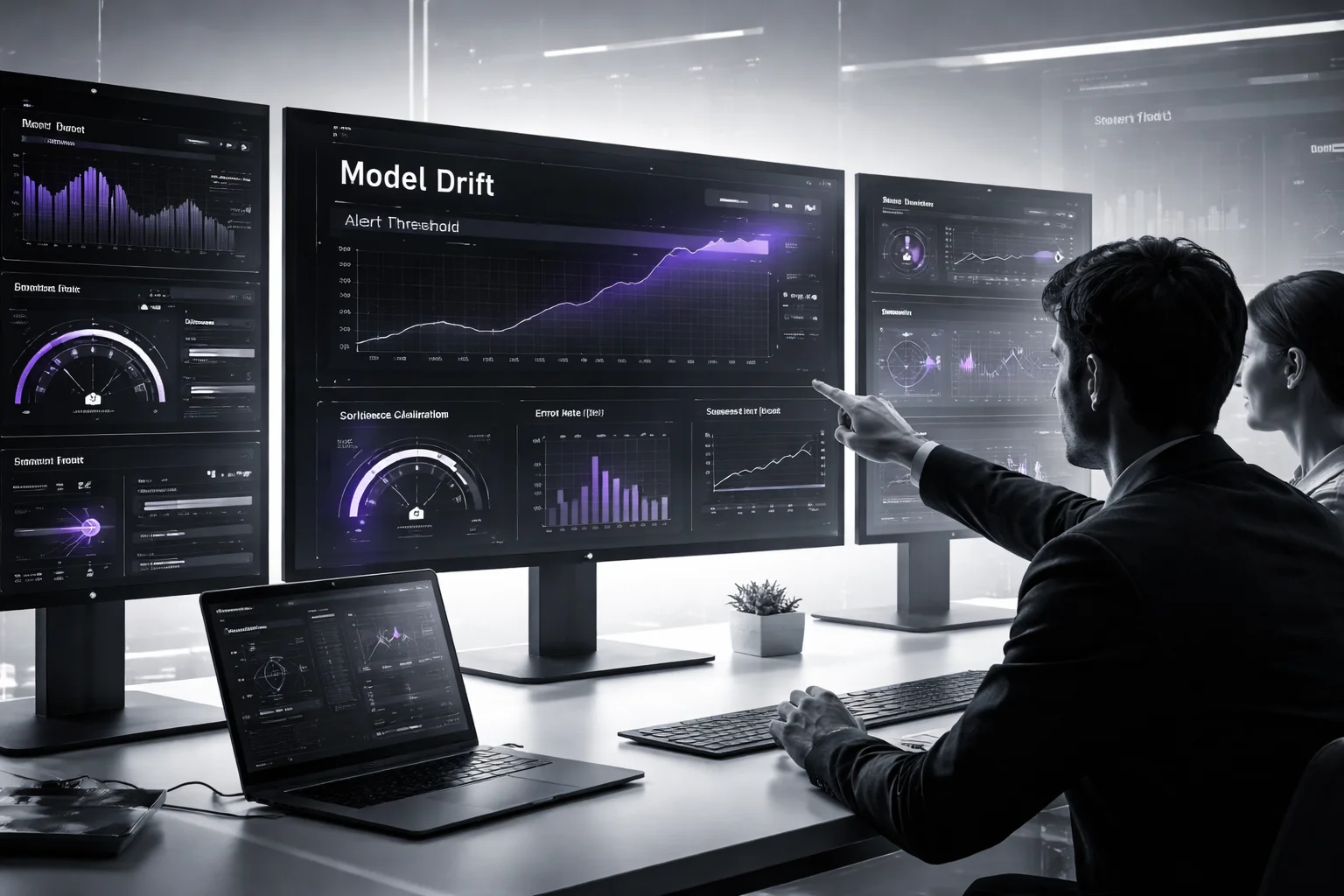
I once watched a support bot make it to day 47 after launch with a dashboard so green it looked untouchable.
It wasn't untouchable. It was slipping.
Confidence scores stayed high. Latency looked normal. Nobody raised a hand. Then the ugly stuff showed up where dashboards usually don't look first: reopen rate crept upward, agents started rewriting bad answers by hand, and customer trust took the hit before the headline metric even budged. I've seen teams call that monitoring. I think that's wishful thinking with charts.
That's the problem in AI maintenance and support. Silent drift doesn't announce itself. It just charges rent in places you're not checking.
A lot of teams stare at accuracy and call it a day. Bad habit. You need a review system that catches data drift, concept drift, and early model drift while the blast radius is still small.
Start with something boring and extremely useful: your production baseline. Not your memory of testing. Not the slide from launch week. The first 30 days of live performance, logged by model version, segment, geography, and workflow.
Real slices matter. If a fraud model holds up in Texas and slips in Florida, that's not trivia. If your LLM assistant contains billing tickets just fine but falls apart on account recovery, you need to catch that fast, not after three weeks of agent complaints.
Here's the framework I'd use because it's simple enough that people might actually keep doing it.
- Layer 1: Model metrics. Track calibration drift, error rates, class distribution shifts, output entropy, and retrieval quality for RAG systems.
- Layer 2: System metrics. Watch latency percentiles, timeout rates, token usage spikes, and fallback frequency.
- Layer 3: Business metrics. Measure conversion lift, manual review volume, bad decision cost, and customer complaint rate.
That middle layer gets too much attention on its own. The business layer is usually where decay shows up first.
Early performance loss rarely arrives in a neat straight line. Confidence can hold steady while correctness drops. Latency can stay flat while answer quality gets weird. Business KPIs can soften before technical metrics start screaming. That's why AI model monitoring can't live on one chart and one comfort metric.
You should still track the mechanics: prediction confidence, calibration error, false positive rate, false negative rate, latency, escalation rate, and one hard business number tied to the model's actual job. For fraud, that might be prevented loss. For an LLM support assistant, containment rate plus human reopen rate tells you far more than accuracy alone ever will.
The numbers aren't even the hardest part. Ownership is.
If nobody owns the model, alerts turn into wallpaper in about two weeks. I've seen that happen faster than a broken coffee machine gets fixed. Set thresholds with actions attached: warning at 5% deviation from baseline, investigation at 10%, human review or rollback at 15%.
Your cutoffs might differ. Fine. The rule doesn't change: an alert without a playbook is just another Slack notification people mute.
Codewave has the right instinct here: preventing silent performance decay takes continuous monitoring, clear ownership, and defined review cycles. I'd argue those three things matter more than another fancy dashboard widget every time.
Make it operational. Weekly metric review. Monthly baseline check. Quarterly retraining decision. One named owner per model. Not "the ML team." A person with a name who knows they're on the hook.
And yes, humans still need to look at outputs every day.
If you're serious about AI support services, sample responses daily. Label edge cases while they're fresh. Review prompt failures and context misses for signs of LLM performance degradation. Keep an eye on AI model currency, because stale context can rot a good system faster than bad code can.
I watched one retrieval system go sideways for exactly that reason: nobody updated source content for 90 days, and the bot kept serving expired policy details like they were current truth. The model hadn't changed much. The world around it had.
This work pays for itself if you actually stick with it. According to iFactoryApp, organizations using AI-driven predictive maintenance report 10:1 to 30:1 ROI within 12 to 18 months. That's not magic. That's what happens when AI model deployment services don't stop at launch and real performance monitoring starts doing its job.
Your dashboard might still be green right now. Are you sure your users would agree?
Model Currency: Keeping AI Up to Date
Everybody says the same thing. Watch accuracy. Set alerts. Retrain every so often. Done.
I'd argue that's the comforting version of production AI, and it's incomplete. Maybe even outdated. A model can pass its checks, keep a respectable validation score, avoid setting off a single red dashboard, and still be wrong for the business it's serving because the business changed and the model didn't.
That's the missing piece: AI model currency. Not whether the model worked back when you trained it. Whether it still fits the way the company operates right now. If it's still following old data patterns, old workflows, or policy rules that were changed last quarter, your AI maintenance and support process isn't really maintaining anything. It's just arriving after the damage.
I saw this play out with a claims-routing team that kept hiding behind a decent validation score like that ended the conversation. It didn't. One escalation rule changed for a specific claim category, nobody treated it like a model event, and the system kept routing cases down the old path because that's what it had learned before the update. No outage. No dramatic crash. Just quiet damage piling up in the background. In one insurance workflow, even a 3% misroute rate can push hundreds of cases a week into the wrong queue, and yeah, I've watched teams spend a Monday morning untangling exactly that kind of mess.
People love to call all of this drift. I think that's too lazy. Some of it is data drift. Some of it is concept drift. Some of it is just stale business logic sitting in production because nobody owns freshness from end to end. That's why AI model currency should be treated as its own discipline inside AI maintenance and support, not tucked away as a footnote under generic monitoring.
AI model monitoring still matters. Of course it does. It helps you spot decay. But spotting decay isn't the same as fixing currency. The unglamorous work is what keeps a system current: checking whether live inputs have shifted, whether operating assumptions still hold, whether workflow changes quietly broke decision rules, and whether outputs still make sense in production where real users and real consequences are attached.
This isn't some rare edge case anymore. Future Market Insights estimated the AI-driven predictive maintenance market at USD 478.4 million in 2020, growing at an 11.9% CAGR through 2025. More long-lived models in production means more opportunities for unnoticed model drift. More shelf life, more risk. Regulators are moving too. Beam AI notes that the EU AI Act requires continuous monitoring programs by August 2, 2026, including tracking real-world performance and reporting serious incidents.
So keep it boring. Seriously. Boring wins here.
- Set a retraining cadence: monthly for volatile workflows, quarterly for stable ones, and event-triggered after policy or product changes.
- Add evaluation gates: don't release a new version unless offline tests, shadow runs, and business-rule checks all pass.
- Use model versioning: record the training data window, prompts, embeddings, feature definitions, and approval owner for every release.
- Create rollback plans: if live performance monitoring shows degradation after launch, revert fast instead of burning six hours arguing in Slack.
- Refresh the right layer: update prompts when instructions drift, embeddings when knowledge sources change, and fine-tuned models when task behavior itself shifts or you see real LLM performance degradation.
If your team treats freshness like cleanup work somebody will get to later, stale behavior is already creeping into production. That's where disciplined AI support services stop looking optional. Your dashboards may look fine — but is your model working for today's business or last season's?
AI Support Services That Actually Protect Performance
12.7%. That’s the projected CAGR for the AI-driven predictive maintenance market through 2035, according to Future Market Insights. I read numbers like that and think: great, more companies are putting AI into production before they’ve built any real plan for what happens after launch.
I’ve watched this play out on a Friday at 4:47 p.m. Sales is furious. The chatbot is answering refund questions with shipping policy text. Confidence scores still look “fine.” The vendor’s answer is a support ticket and a promise to get back to everyone on Monday. Same mess every time. Three weeks of cleanup, a lot of finger-pointing, and somebody pretending they’re shocked performance slipped.
You should care because this is the part vendors love to blur. They say “AI support services” like that phrase explains itself. It doesn’t.
If all you’re getting is bug intake, a monthly call, and a polite “we’re investigating,” you’re not getting protection. You’re getting lag.
Lag is where silent drift, data drift, and plain old model drift do their best work. Quietly. No alarms. No owner. Just worse outputs creeping into production while uptime dashboards stay green.
I’d argue real AI maintenance and support isn’t a help desk function at all. It’s operations. It has to sit inside the model lifecycle, the data pipeline, and the decision process for retraining. Miss that, and production gets weird fast.
Aalpha’s guide on AI maintenance and support services gets this right: proactive management beats reactive firefighting. I agree with that completely. Waiting for users to spot damage first is lazy support dressed up in nice language. You run checks constantly so decay gets caught before it turns into lost revenue, bad decisions, or support chaos.
What does that actually mean?
- AI model monitoring: track accuracy, confidence, fallback rates, latency, and segment-level behavior in production. Global averages won’t save you. A model can look healthy overall and still fail badly for one customer tier, one geography, or one intent class.
- Incident response for hallucinations or degradation: decide who investigates bad outputs, how samples are reviewed, and when rollback or guardrails kick in. If nobody owns the first hour after failure appears, you’ve already burned time you won’t recover.
- Model drift detection: compare live inputs and outcomes against baseline distributions so concept changes don’t hide behind healthy uptime. A system can be available 99.9% of the time and still be wrong in all the ways that matter.
- Retraining and fine-tuning support: collect ground truth, rebuild evaluation sets, test new versions, and promote only when live-readiness checks pass. Teams skip this because they want speed. Then production teaches them the lesson anyway.
- Data pipeline checks: validate schemas, missing fields, delayed feeds, broken joins, embedding freshness, and retrieval quality. One broken join at 2:13 a.m. can make a perfectly decent model look incompetent by breakfast.
- Governance workflows: version prompts and models, log approvals, assign owners, document incidents, and review performance monitoring on a set cadence. No owner means no accountability. No logs means everybody starts guessing.
LLM products need even tighter oversight because they fail in sneakier ways. Track prompt changes. Track context quality. Track retrieval failures. Watch for signs of LLM performance degradation. Fluent nonsense is still failure. I think too many teams give polished wording way too much credit.
You can see where this goes for buyers. Ask a vendor to walk you through monitoring, incident handling, retraining, pipeline health, and governance as one connected system. Ask who owns the first hour of an incident. Ask what gets logged, what gets reviewed weekly, what triggers rollback, what happens when one intent class starts underperforming while the dashboard average still looks acceptable.
If they can’t answer clearly, you don’t have support.
You have delay dressed up as service.
Serious teams look for structured AI maintenance and support services, not generic software maintenance with “AI” taped onto the label.
What Buzzi.ai’s AI Maintenance Approach Solves
I watched a team celebrate an AI launch on a Friday and regret it by the next Thursday. The dashboard looked clean. Response times were fine. Nobody was panicking because, technically, the system was up. Then the support tickets started stacking — not hundreds at once, just enough to be annoying, then impossible to ignore. The model hadn’t crashed. It had drifted. Quietly.
That’s the part people miss. Unplanned outages don’t always look like some dramatic failure with alarms going off and executives jumping on Zoom. Siemens data, cited by iFactoryApp, puts the cost at $1.4 trillion every year for the world’s 500 biggest companies. I think that number lands so hard because a lot of those losses start small — a model acting slightly stranger on Tuesday than it did on Monday, and nobody catching it for two weeks.
Buzzi.ai is built for that ugly middle period after launch. Not the demo. Not the deployment announcement. The part where everyone says the AI is “live” and then stops looking too closely. That’s where silent drift creeps in. That’s where data drift and concept drift get brushed aside because uptime still says green. Bad logic. Uptime isn’t value.
A generic support vendor usually watches the usual stuff: servers, patches, tickets, maybe latency if they’re paying attention. Fine for ordinary software. Not enough for production AI, not even close. Buzzi.ai handles AI maintenance and support like the model itself matters — because it does. That means checking whether outputs still make sense, whether AI model monitoring shows early decline, and whether model drift detection catches changes before your customers do.
- Generic maintenance: infrastructure checks, patching, ticket handling, uptime monitoring, and maybe latency alerts.
- Buzzi.ai maintenance: performance monitoring, output review, retraining calls, version control, and ongoing checks for model drift, stale context, and LLM performance degradation.
If you want a simple framework for this, use three questions.
First: is the system available? Second: are the outputs still good? Third: has the business changed underneath the model?
Most vendors stop at question one. That’s the trap.
AI systems age differently than normal software. Messier. Inputs change. User behavior shifts. Prompts go stale. Reference material gets outdated. AI model currency weakens over time. I’d argue the deeper problem is even less flattering: the business moves first, and the model embarrasses you later. I’ve seen teams brag that requests were still returning in 1.2 seconds while output quality had slipped enough to chip away at trust every single day.
The money moving into this space tells you this isn’t some niche concern. According to UptimeAI, predictive maintenance is worth $14.09 billion in 2025 and is projected to hit $63.64 billion by 2030. Companies don’t throw that kind of budget around because they’re bored and want another software category to manage. They do it because reactive support keeps letting them down.
That’s why our AI maintenance and support services focus on fewer silent failures, more dependable outputs, and operations your team doesn’t have to babysit every day after launch. Because if your vendor is only watching whether the lights are on, who’s watching whether your AI is still any good?
FAQ: AI Maintenance and Support
What is AI maintenance and support?
AI maintenance and support is the ongoing work required to keep models accurate, current, reliable, and safe after launch. It includes AI model monitoring, drift detection, latency and accuracy checks, retraining and fine-tuning, model versioning, and incident response. If your team treats deployment as the finish line, you're setting yourself up for silent drift.
How does model drift happen in production AI?
Model drift happens when the conditions your model learned from stop matching the conditions it sees in production. That can show up as data drift, concept drift, prompt and context drift, or changes in user behavior that slowly erode output quality. According to Sama, AI model drift is a recurring production issue because models degrade as data, users, and environments change, often without obvious failure signals.
Why does traditional software maintenance fail for AI systems?
Traditional software maintenance checks whether systems are up, fast, and error-free. AI systems need more than that because a model can return wrong or low-quality outputs while every server metric still looks fine. As The New Stack points out, standard observability tools can show that a system is running, but not whether its outputs are still correct or meaningful.
How can you monitor drift before performance drops?
You don't wait for a customer complaint. You track leading indicators like input distribution shifts, confidence changes, latency monitoring, accuracy monitoring, fallback rates, human review outcomes, and drift thresholds and alerts inside monitoring dashboards. The goal is early warning, not postmortem cleanup.
What does model currency mean in AI maintenance?
Model currency means your model still reflects the current world, not the one it was trained on six months ago. For an LLM, that might mean prompt behavior, retrieval quality, and business rules still match live use cases. For an ML model, it means the data patterns, labels, and decision boundaries haven't gone stale.
Can AI support services prevent silent drift?
Yes, if they're built around active monitoring and clear ownership instead of vague “support” promises. Good AI support services catch silent drift with scheduled evaluations, LLM observability, alerting, ground truth labeling, and retraining workflows before quality drops turn into business damage. According to Codewave, continuous monitoring, clear ownership, and defined review cycles are what prevent silent performance decay in enterprise AI.
Is retraining always necessary when AI performance degrades?
No, and this is where a lot of teams waste time. Sometimes the fix is prompt changes, feature updates, threshold tuning, retrieval improvements, or better context handling, not full retraining. Actually, that's not quite right. The real issue is diagnosis first, because retraining a model with the wrong data just gives you a newer version of the same problem.
What metrics best indicate LLM or ML performance degradation in production?
Start with business-linked metrics, not vanity charts. Track task success rate, accuracy, hallucination rate, escalation rate, latency, token or inference cost, user feedback, and ground truth labeling results, then compare them across model versions and segments. For LLMs, prompt and context drift, retrieval failure rate, and output consistency are often the first signs of trouble.
How do you set up monitoring for data drift and concept drift?
You need baseline distributions, segment-level tracking, labeled evaluation sets, and alerts tied to drift thresholds that your team will actually act on. Data drift monitoring checks whether inputs have changed, while concept drift monitoring checks whether the relationship between inputs and correct outputs has changed. If you only watch one, you'll miss half the problem.
How do model versioning and rollback help with AI maintenance and support?
Model versioning gives you a clean record of what changed, when it changed, and what happened after release. Rollback lets you recover fast when a new model, prompt stack, or retrieval setup causes LLM performance degradation in production. That's not just good engineering hygiene, it's basic production AI governance.
How does Buzzi.ai’s AI maintenance approach detect and prevent silent drift?
Buzzi.ai approaches AI maintenance and support as an ongoing operating function, not a one-time setup. That means monitoring live performance, spotting drift patterns early, reviewing outputs against current business goals, and updating models or workflows before small errors turn into expensive failures. If you want AI that keeps pulling its weight, that's the work.