AI for Supply Chain Management That Teams Trust: Go Visibility-First
AI for supply chain management works best when visibility comes first. Learn a control-tower approach to build trust, adoption, and ROI—then optimize.

If your AI for supply chain management recommends expediting, reallocating inventory, or cutting orders—can anyone on the team explain why in 30 seconds from shared data? If not, the recommendation won’t survive the first planning meeting.
That’s the uncomfortable truth behind a lot of “AI-driven” supply chain projects: they ship impressive optimization outputs into an organization that can’t agree on the underlying state. When the inputs are opaque (or contested), even a statistically “better” model reads like a random number generator.
Our thesis is simple: visibility before optimization. End-to-end visibility isn’t a nicer dashboard; it’s a reconciled, timely, confidence-aware view of orders, inventory, shipments, and constraints that everyone can point to in the same meeting. Once you have that shared reality, optimization starts to compound instead of backfire.
In this guide, we’ll break down a visibility-first framework, a practical reference architecture, and decision-support patterns that planners actually adopt. We’ll also cover the minimum viable visibility data set, governance to keep recommendations auditable, and how to measure trust, adoption, and ROI without fooling yourself.
At Buzzi.ai, we build AI agents and decision-support systems that integrate with enterprise tools and prioritize explainability and adoption—not just model accuracy. The goal isn’t to “replace” planners; it’s to give them an instrument panel they trust before anyone turns on autopilot.
Why optimization-first supply chain AI fails in the real world
Optimization-first projects usually start with the best intentions: reduce expediting spend, improve OTIF, cut inventory, or smooth production. The logic is seductive—if we can forecast demand better and optimize decisions faster, we’ll beat volatility.
The problem is that supply chains are not a clean math problem sitting inside a single database. They’re a distributed system spanning ERP, WMS, TMS, supplier portals, email threads, spreadsheets, and tribal knowledge. When you apply optimization on top of fragmented state, you don’t get “better decisions.” You get false certainty.
In practice, teams don’t reject AI because they hate technology. They reject AI because they can’t defend it, can’t reconcile it, or can’t safely execute it.
The trust gap: planners can’t defend opaque recommendations
Planners live in a world of defensibility. Every meaningful decision has an audience: peers in the war room, managers who sign off on spend, finance who asks why premium freight went up, and suppliers who insist they shipped on time.
If a tool says “expedite 20 orders,” the planner immediately asks: Which customers? Which SKUs? What’s the projected service level impact? And—most importantly—what changed since yesterday? When the recommendation can’t be traced back to shared, trusted state, it feels arbitrary.
Here’s a common vignette. An AI engine flags 20 POs for expediting because ETAs appear late. But the ETAs are inconsistent: ERP shows one date, TMS shows another, and the supplier portal has no ASN. The planner rejects the batch recommendation—not because it’s wrong, but because it’s indefensible. The spreadsheet remains the system of record.
That’s the core adoption failure mode: AI becomes a side report. The real work stays in Excel.
Bad inputs amplified: fragmented systems create false certainty
Supply chain analytics depend on joins—linking orders to shipments, shipments to lanes, SKUs to locations, and suppliers to lead times. In the real world, those joins break constantly because identifiers drift and events arrive late or incomplete.
Typical fractures look boring, but they’re fatal to optimization:
- Duplicate SKUs created for the same item in different plants
- Inconsistent location codes between ERP and warehouse management system (WMS)
- Late or missing ASN signals from suppliers
- Partial shipment confirmations (quantities don’t match the PO)
- Carrier status updates that lag reality by 12–24 hours
Optimization magnifies these issues. A small error in inventory accuracy can cause a large swing in “optimal” allocation. An outdated lead time can trigger unnecessary expediting. A mis-mapped lane can make a perfectly normal transit look like a disruption.
What you actually need isn’t a cleverer optimizer. You need a single operational picture—a reconciled truth layer that makes uncertainty explicit instead of pretending it isn’t there.
Automation anxiety: people resist ‘hands-off’ supply decisions
Even when data is good, supply chain decisions are exception-heavy. Weather, port congestion, supplier yield issues, customs holds, production changeovers, and customer priority changes create a constant stream of “special cases.”
This is why human-in-the-loop matters for AI for supply chain management. Autonomy without auditability increases exposure: chargebacks, stockouts, OTIF penalties, and line stoppages don’t care that “the model said so.”
One illustrative failure: a procurement system auto-cancels an order based on a predicted demand drop, but it misses a constraint—this SKU is a shared component in a high-margin assembly line. The cancellation triggers a production halt. After that, nobody wants “auto-anything” again.
The fix is not to abandon AI. It’s to start with decision support, build trust, and automate only the repeatable slice where the cost of error is bounded.
Visibility vs optimization: the missing prerequisite layer
Most organizations talk about supply chain visibility as a dashboarding project. That framing is part of the problem: dashboards can display disagreement. They can’t resolve it.
Visibility-first AI is different. It’s about building situational awareness the way a cockpit does: shared instruments, consistent definitions, and confidence indicators. Only after that do you let an algorithm suggest (or execute) actions.
Define visibility in operational terms (not dashboards)
Supply chain visibility means a shared, timely, reconciled state of orders, inventory, capacity, and constraints—plus confidence levels. If the system can’t tell you whether it’s looking at fresh, complete data, it’s not visibility; it’s theater.
Operationally, we like to define visibility with three elements:
- State: What is true right now? (On-hand, in-transit, picked, held, delayed.)
- Trajectory: Where is it likely going? (Projected ETA, risk of stockout, forecasted demand.)
- Uncertainty: How confident are we? (Stale events, conflicting ETAs, missing scans.)
A mini-checklist helps. For an order, “visible” often means: confirmed → picked → departed → arrived → proof of delivery. For inventory, “visible” means more than on-hand: available-to-promise, in-transit, allocated, on quality hold, and pending returns—clearly separated.
That’s how you build end-to-end visibility: not by showing more charts, but by making the underlying state coherent.
What optimization is good at—once you can see
Optimization is excellent at tradeoffs: cost versus service level, expedite versus wait, allocate scarce inventory across regions, or consolidate loads without breaking delivery promises. It’s where AI for supply chain management shines after the basics are in place.
But optimization requires constraints and trustworthy state. If your “on-hand” includes held inventory, or your lead times don’t reflect real supplier performance, the optimizer will maximize the wrong objective in the wrong universe.
For example, inventory optimization across regions only works when you can accurately account for on-hand + in-transit + reserved + blocked inventory. Otherwise, you’ll reallocate inventory that isn’t actually available—and then the system will look “smart” right until it causes a stockout.
This is also where forecasting and prescriptive analytics belong: as layers atop a visibility foundation, not as substitutes for it.
A visibility-first success metric: fewer surprises, faster decisions
Visibility-first teams often change what they measure. Before chasing perfect cost minima, they reduce the “surprise rate”—how often reality diverges from plan without warning—and the “decision latency”—how long it takes to detect and resolve an exception.
That shift matters because adoption is a leading indicator of ROI. If planners and logistics managers actually use the system to manage exceptions, you’ll see improvements cascade: better ETA accuracy, fewer last-minute expedites, and faster recovery from disruptions.
Resilience isn’t a separate initiative. It’s what happens when end-to-end visibility lets you see disruptions early enough to act.
Industry research consistently connects digitization and resilience themes; McKinsey’s operations insights are a useful starting point for the broader context (https://www.mckinsey.com/capabilities/operations/our-insights).
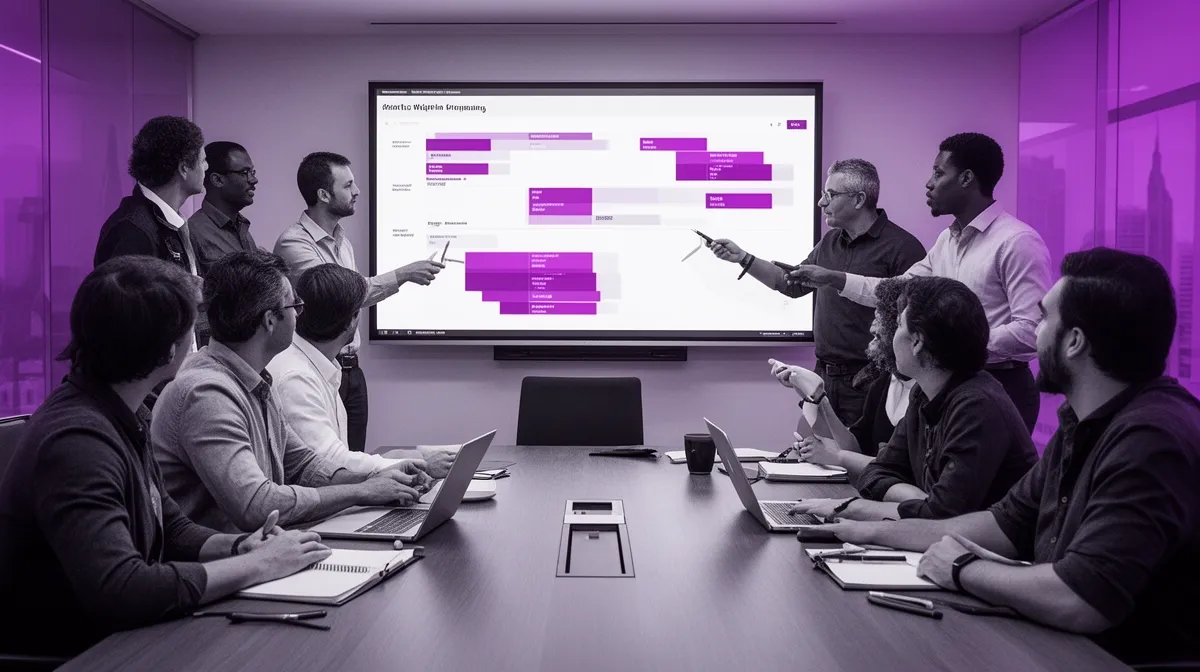
A visibility-first AI architecture for supply chain management
A good mental model is “instrument panel before autopilot.” The architecture isn’t primarily a machine learning problem; it’s an operational product problem. You’re building a control tower workflow that reconciles data, expresses uncertainty, and guides action.
Below is a pragmatic, layered approach we’ve seen work across manufacturing, retail, and logistics networks.
Layer 1 — Integration: build a reconciled ‘truth layer’
Start by integrating the systems that already run your supply chain: ERP, WMS, TMS, OMS, EDI messages, supplier portals, and (when relevant) telematics/IoT. The point isn’t to centralize everything forever; it’s to build a reconciled operational view that can be trusted today.
Two hard problems show up immediately:
- Entity resolution: orders, SKUs, locations, carriers, suppliers—matching them across systems despite master-data drift.
- Latency budgets: deciding what must be real-time vs hourly vs daily (and being explicit about it).
A written “data source table” is surprisingly effective in early phases. For example:
- ERP → POs, SOs, promised dates → issues: daily extracts, inconsistent promised date fields
- WMS → pick/pack/ship events, on-hand → issues: adjustments not synced, location code mismatches
- TMS → shipments, carrier ETAs, tender status → issues: ETA volatility, carrier data gaps
- EDI 856 ASN → supplier shipment confirmations → issues: late ASN, partial quantities
- Supplier portal → commit dates, capacity notes → issues: manual entry, missing timestamps
The goal is not perfection. The goal is to know what you know, know what you don’t, and have a consistent precedence model when systems disagree.

Layer 2 — Visibility model: state, timelines, and confidence
Once data is flowing, model the supply chain as events and states. Orders move through lifecycles. Shipments hit milestones. Inventory changes states (available, allocated, held, damaged, in-transit). This event-state model is the backbone of end-to-end visibility.
Then add the missing ingredient: confidence scoring. Stale data, conflicting ETAs, and missing scan events should reduce confidence, not get papered over. A confidence-aware system doesn’t just say “ETA is Friday.” It says “ETA is Friday with low confidence because the last scan was 72 hours ago and this lane has high variance.”
One concrete example is “ETA confidence.” You can compute it from a blend of:
- Recency and frequency of carrier updates
- Whether expected milestones are missing (missed scan at hub)
- Historical lane variance and seasonality
- Disruption signals (port congestion, weather alerts) when available
This is where the Gartner control tower concept becomes relevant. The point is not the label; it’s the shift from “reporting” to managing the operation through a shared model.
Layer 3 — Decision support: exceptions, what-if, and playbooks
This is the layer your team will feel. A visibility-first architecture should produce a decision support system that turns state into action—not by shouting alerts, but by structuring work.
Three patterns matter:
- Exception queue: a prioritized list of issues with ownership and SLAs.
- Recommendations with rationale: suggested actions plus “why” in operational language.
- What-if workspace: scenario modeling to explore tradeoffs before committing.
Consider a port delay scenario. The system detects a delay (trajectory), flags risk to customer orders (impact), and shows low confidence on the current ETA (uncertainty). It then proposes playbook actions—split shipment, rebook to a different carrier, reallocate ATP from another DC, or notify customer service—with a service/cost delta for each.
Critically, outputs map to roles. Planners don’t need logistics tender details; logistics managers do. Customer service needs customer-facing impact, not lane variance distributions. Decision support succeeds when each role sees the same state but different “next actions.”
Layer 4 — Optimization (selective): automate only the repeatable 20%
After visibility and decision support are working, optimization becomes safer—and more valuable. Start with constrained optimizations where uncertainty is low and guardrails are clear:
- Reorder point tuning for stable SKUs
- Safety stock policy adjustments within capped ranges
- Load consolidation suggestions that respect service-level constraints
- Rescheduling within fixed production/transport windows
Keep humans in the loop for high-impact, high-uncertainty decisions (expedite, cancel, reallocate scarce inventory). And build audit trails plus “what changed” explanations—counterfactuals that show which input shift triggered the recommendation.
Once visibility data is stabilized, this is also where advanced forecasting and risk scoring can compound. If you’re looking for support beyond integration, our predictive analytics and forecasting services are designed to sit on top of a clean visibility layer, not fight against it.
Decision-support patterns that planners actually adopt
Adoption doesn’t come from more machine learning. It comes from matching how supply chain teams work: triage, negotiate, escalate, document, and learn. The best AI for supply chain management products feel like workflow tools with intelligence, not intelligence tools with a thin UI.
Exception queues beat ‘daily AI reports’
Daily reports create a predictable failure: planners skim them, mentally triage, and then do the real work elsewhere. A good exception management queue does the opposite: it becomes the place where work happens.
Design matters. A usable queue includes severity, SLA clocks, ownership, and next-best-action suggestions. It also needs alert hygiene—deduplication, suppression rules, and thresholds that adapt to seasonality—so you don’t train the organization to ignore alarms.
Common exception types include:
- Inventory at risk of stockout within lead-time window
- Missed pickup or tender rejection
- Supplier late confirmation against required ship date
- Capacity shortfall (warehouse labor, dock doors, carrier capacity)
The moment you add collaboration—notes, assignments, escalations—you turn visibility into an operating rhythm.
What-if workspaces for S&OP and firefighting
S&OP planning and “day-of” firefighting look different, but they share a pattern: people want knobs. They want to explore tradeoffs: what if demand spikes 12% in week 3? what if a supplier lead time slips by 5 days? what if we prioritize customer tier A over tier B?
A what-if workspace supports scenario modeling without overpromising a perfect “digital twin of the supply chain.” You track assumptions, run comparisons against baseline, and keep the outputs interpretable: service impact, inventory implications, and expediting cost.
For example, a holiday spike plus one supplier disruption can be modeled as two shocks. The system can compare scenarios: reallocate ATP, expedite a subset, or accept backorders—showing OTIF and backorder days for each option.
Explanations that match how supply chain teams argue
Explainability isn’t an academic requirement; it’s how decisions survive meetings. Good explanations use operational language: which constraint is binding, what risk driver changed, and what the cost/service delta looks like.
They also show provenance: which systems and events drove the recommendation. When teams can click through to “what data did this use?”, they stop treating the tool as a black box.
A useful explanation snippet might read:
Recommend expedite because ETA confidence dropped from 0.82 → 0.41 after a missed scan at the hub; projected backorder risk increases to 3 days for customer tier A.
Finally, capture “planner reason codes” on overrides. If a planner rejects a recommendation because a supplier verbally confirmed an early ship, that’s not noise—it’s a signal that your data integration is missing an event stream, or that your thresholds need tuning.
For broader research on analytics-driven operations, MIT’s Center for Transportation & Logistics is a credible source of frameworks and studies (https://ctl.mit.edu/research).

Data you need for end-to-end visibility (and what to fix first)
End-to-end visibility fails less often because of “not enough AI” and more often because of unglamorous data issues: identifiers, latency, and missing events. The good news is you don’t need perfect data—you need minimum viable visibility and a roadmap for fixing the highest-leverage fractures.
Minimum viable visibility data set (MVV)
The MVV data set is about coverage and freshness, not perfection. You want the smallest set of signals that allows you to answer: what’s happening, what’s at risk, and what should we do next?
Most MVV sets include:
- Orders/POs/SOs with promised dates and customer priority
- Inventory positions by location and state (available, allocated, held)
- Shipment milestones (picked up, departed, arrived, POD)
- Supplier confirmations and commit dates (ASNs where possible)
- Lead times and their observed variance
- Capacity constraints (dock availability, production caps, carrier limits where relevant)
For manufacturers, prioritize signals tied to components and production constraints (BOM-critical items, line changeovers). For distributors, prioritize inbound ETA + DC availability + order fulfillment status. In both cases, start with the highest-value lanes/SKUs/customers, not the entire network.
This is exactly the foundation behind AI-powered supply chain visibility solutions for manufacturers: you don’t model the whole world—you model the part of the world where exceptions are expensive.
Common failure points: identifiers, latency, and missing events
Three categories account for most “why is the system wrong?” moments:
- Identifiers: SKU, location, and vendor IDs don’t match across systems, breaking joins.
- Latency: daily ERP extracts collide with real-time carrier pings, creating timeline conflicts.
- Missing events: shipments stuck “in transit” because scans didn’t happen or weren’t shared.
When events are missing, don’t hallucinate certainty. Flag low confidence and prompt action. Example: a shipment shows “in transit” for 9 days with no scans; the system lowers confidence, highlights lane variance, and suggests a follow-up workflow (carrier check, supplier confirmation, customer notification if needed).
Standards matter here. GS1’s work on identifiers (GTIN/GLN) is a useful reference when explaining why master data consistency underpins visibility (https://www.gs1.org/standards).
Pragmatic remediation: reconcile, then enrich
A common mistake is to jump straight into enrichment—ETA predictions, risk scores, demand sensing—before reconciliation is stable. Do it in the opposite order.
A pragmatic week 1–4 plan often looks like this:
- Week 1–2: reconcile top entities (SKUs, locations, suppliers); define precedence rules when systems disagree.
- Week 3: build event-state model for one workflow (e.g., late shipments); add confidence scoring for stale/conflicting signals.
- Week 4: add one enrichment module (e.g., ETA confidence or risk scoring) and a tight exception queue.
Log every rule, allow inspection, and make it easy for planners to say “this is wrong because…” That feedback loop is how you build a system teams trust.
How to measure trust, adoption, and ROI in SCM AI
Most ROI conversations about AI for supply chain management skip the leading indicators. They jump straight to cost savings, then wonder why the numbers don’t move. In practice, trust and adoption are the compounding layer that makes financial outcomes possible.
A useful way to think about measurement is: trust (leading) → adoption (behavioral) → ROI (lagging, financial).
Trust metrics (leading indicators)
Trust is measurable if you instrument your product and workflows. A few practical metrics:
- Recommendation acceptance rate by decision type (expedite, reallocate, reorder, reschedule)
- Override rate with reasons (captured via reason codes)
- Explanation engagement: how often users drill into “why” and “data provenance”
- Data confidence trends: stale/conflicting signal rates decreasing over time
For AI for supply chain management software with real-time visibility, the confidence trend is especially important: it shows your truth layer is getting healthier, which is prerequisite to scaling optimization.
Adoption metrics (behavioral)
Adoption is not “logins.” It’s whether decisions moved into the system of record.
Strong adoption signals include weekly active users by role, time in the exception workspace, and number of exceptions resolved end-to-end in the tool. Another hard-but-honest metric is spreadsheet displacement: which decisions stopped being made in Excel.
A good narrative adoption dashboard reads like: “Logistics managers handled 68% of missed pickup exceptions inside the queue this month; customer service used the shared state for 40% of proactive delay notifications; planners reduced ad-hoc expedite approvals by routing through the workflow.”
ROI metrics (lagging indicators tied to finance)
Once trust and adoption are real, ROI becomes easier to attribute. Typical lagging metrics include:
- Service: OTIF, fill rate, backorder days
- Working capital: inventory turns, safety stock, obsolescence
- Cost: premium freight, detention/demurrage, labor hours saved
A simple ROI story looks like: earlier exception detection reduced premium freight because teams acted when options were still cheap (rebook vs expedite). You don’t need magic; you need earlier, better decisions.
For process framing and KPI definitions, ASCM’s SCOR model overview is a solid reference point (https://www.ascm.org/learning-development/scor-model/).
Governance and human-in-the-loop: make recommendations auditable
Governance is where many AI initiatives quietly die—either because controls are too loose (risk) or too rigid (no adoption). Visibility-first implementations make governance part of the product: clear decision rights, clear guardrails, and clear audit trails.
Decision rights: who can do what, when
Start by mapping decision rights to how the organization already operates. If expediting above a threshold needs manager approval today, your AI tool should reflect that reality—not try to overwrite it.
Common guardrails include budget caps, customer tier rules, and compliance constraints. Role-based access and approvals are not bureaucracy; they are how you make AI-driven actions align with supply chain risk management.
A simple RACI example might be: planner proposes → manager approves (within 2 hours for tier-A customers) → procurement executes → logistics confirms. The key is time-bound SLAs so the workflow doesn’t become a parking lot.
Audit trails and postmortems: learn from every disruption
Every exception is a learning opportunity if you log it properly. Store: input state, recommendation, human decision, and outcome. Then run a monthly “exceptions review” that combines operations and data teams.
This is how tribal knowledge becomes explicit playbooks. Example: repeated late supplier confirmations trigger a postmortem that updates lead-time assumptions, changes alert thresholds, and escalates supplier performance management—without relying on memory.
From decision support to selective automation—safely
Automation should be earned. A good rule: automate when variance is low and the cost of error is bounded.
Use shadow mode first: generate automation suggestions but don’t execute them. Measure outcomes and risk. Then introduce execution with rollback and a kill-switch.
For instance, auto-create a carrier tracking ticket for low-confidence shipments immediately (low risk). Only after four weeks of shadow success do you auto-execute rebooking requests—and only under explicit guardrails.

Implementation roadmap: from spreadsheets to a control-tower workflow
The fastest path to a working supply chain control tower is not a big-bang platform rollout. It’s a visibility MVP anchored in one “golden” workflow that matters enough to change behavior.
Think in phases. Each phase expands coverage, deepens confidence, and earns the right to optimize more aggressively.
Phase 1 (0–6 weeks): visibility MVP with one ‘golden’ workflow
Pick a workflow where exception management creates immediate value. Good candidates include late shipments, stockout risk, supplier confirmation, or expedite approvals.
Then integrate the minimum data sources needed, build the exception queue, and ship explanations. Success looks like reduced time-to-detect and time-to-resolve—not a perfect forecast.
Concrete MVP menus by industry:
- Manufacturing: component stockout risk for BOM-critical SKUs; supplier confirmation workflow
- Retail/ecommerce: late inbound shipments impacting high-velocity SKUs; DC allocation exceptions
- 3PL/logistics: missed pickup and tender acceptance workflow with SLA-driven escalation
This is also where you evaluate the best AI platform for supply chain visibility and optimization for your context: not by feature lists, but by whether it can reconcile state, express uncertainty, and support your workflow end-to-end.
Phase 2 (6–12 weeks): scale coverage and add scenarios
Once the MVP is stable, expand coverage: more lanes, more sites, more SKUs, more suppliers. Add a what-if analysis workspace for weekly planning and S&OP planning so teams can explore tradeoffs rather than argue from gut feel.
At this phase, adding predictive analytics (ETA prediction, risk hotspots) starts to compound. You should also instrument adoption metrics so you can see whether usage is spreading across planning, logistics, and customer service—because shared state is the real prize.
A common “second workflow” is inventory reallocation tied to service level targets: when risk is detected early, you can reallocate with less disruption and less premium freight.
Phase 3 (quarterly): selective optimization and orchestration
Now you’re ready for selective optimization and supply chain orchestration. Introduce constrained optimization modules where data confidence is high, then integrate actions into ticketing and ERP workflows with approvals.
Examples of safer optimizations include safety stock tuning within guardrails and transportation consolidation suggestions that respect customer promise windows. Over time, audit trails and override reasons become a continuous improvement loop.
If you want to accelerate this journey, we recommend starting with a structured assessment. Our visibility-first AI discovery for supply chain teams helps you identify the best initial workflow, map data sources, define trust metrics, and build a realistic roadmap that teams will actually use.
Conclusion: make AI for supply chain management something teams can defend
Optimization without end-to-end visibility creates untrusted outputs that teams bypass. That’s not a model problem; it’s a product and data reality problem.
Visibility-first AI means a reconciled truth layer, confidence-aware state, and decision-support workflows built around exception management and what-if analysis. Those patterns match how supply chain work actually happens, which is why they drive adoption.
Measure trust and adoption before you declare ROI success. Then connect the dots to finance: improved service level, reduced premium freight, better inventory turns, and stronger supply chain resilience.
If you’re evaluating AI for supply chain management, start with a visibility-first assessment: pick one high-value workflow, map your data sources, and define the trust metrics that will prove adoption. Talk to Buzzi.ai about building a control-tower-style visibility layer and explainable decision support your planners will actually use via our AI discovery service.
FAQ: Visibility-first AI for supply chain management
Why do AI initiatives for supply chain management fail to gain planner trust?
They fail when recommendations can’t be defended from shared data. If ERP, WMS, TMS, and supplier portals disagree, the AI output feels “random” even when it’s mathematically sound. Planners also need auditability: what changed, which constraint bound, and what risk driver triggered the recommendation.
What’s the difference between supply chain visibility and supply chain optimization in AI tools?
Visibility is the reconciled operational state: where orders, inventory, and shipments are, plus how confident you are in that view. Optimization is the engine that chooses actions (allocate, expedite, consolidate) based on objectives and constraints. Optimization compounds value only after visibility makes the underlying reality coherent.
Why is end-to-end visibility a prerequisite before inventory or logistics optimization?
Because optimization assumes the system state is accurate. If “on-hand” includes held inventory or shipment ETAs are stale, the optimizer will optimize the wrong reality and produce brittle decisions. End-to-end visibility reduces surprises and creates a common baseline that lets teams execute recommendations confidently.
What does a visibility-first supply chain control tower architecture include?
It typically includes an integration layer (ERP/WMS/TMS/EDI), an event-state visibility model, confidence scoring for uncertainty, and a workflow layer for exception management and playbooks. The “control tower” value comes from managing work—ownership, SLAs, collaboration—not just displaying dashboards. Optimization modules come later and only for repeatable, well-bounded decisions.
How can AI improve real-time supply chain visibility across suppliers, WMS, and TMS?
AI helps by reconciling signals across systems, detecting conflicts, and predicting trajectories like ETA and stockout risk. The key is to attach confidence to predictions so teams know when to trust automation versus when to investigate. In practice, you start with the minimum viable visibility dataset and expand coverage as data quality improves.
What decision-support patterns work best for supply chain planners and logistics managers?
Exception queues, what-if workspaces, and recommendations with clear rationale tend to win. Queues turn alerts into owned work with SLAs and collaboration. What-if analysis fits S&OP planning and disruption response because teams can compare tradeoffs instead of arguing from assumptions.
How should human-in-the-loop governance work for AI-driven expediting and allocation decisions?
Define decision rights and guardrails that match organizational reality: thresholds, approval chains, and customer tier rules. Log every recommendation and outcome so you can run postmortems and refine the playbooks. If you’re building this approach, start with a structured assessment like Buzzi.ai’s visibility-first AI discovery to map workflows, data, and governance upfront.
Which data sources are essential for a visibility-centric SCM AI platform?
Most programs start with ERP (orders/promises), WMS (inventory and ship events), TMS (shipment status and tendering), and supplier signals (ASNs, commit dates). Then they add enrichment sources like telematics, carrier APIs, and external disruption data if needed. The critical step is consistent identifiers and explicit latency expectations across sources.
How do you measure adoption, trust, and ROI for AI for supply chain management?
Measure trust via acceptance rates, override reasons, and explanation engagement; measure adoption via exceptions resolved in-system and spreadsheet displacement. Then measure ROI via service (OTIF, fill rate), working capital (turns, safety stock), and cost (premium freight, detention). Leading indicators should move first; lagging metrics follow once behavior changes.
When is it safe to move from decision support to partial automation in supply chain AI?
It’s safe when variance is low, data confidence is high, and the cost of error is bounded by guardrails. Use shadow mode to test automation without execution, then add a rollback and kill-switch before scaling. The sequence matters: visibility → decision support → selective automation, not the other way around.