AI for Retail Analytics That Drives Action
Most retail dashboards are expensive wallpaper. They look busy, they impress people in meetings, and they still don't tell your team what to do next. That's...
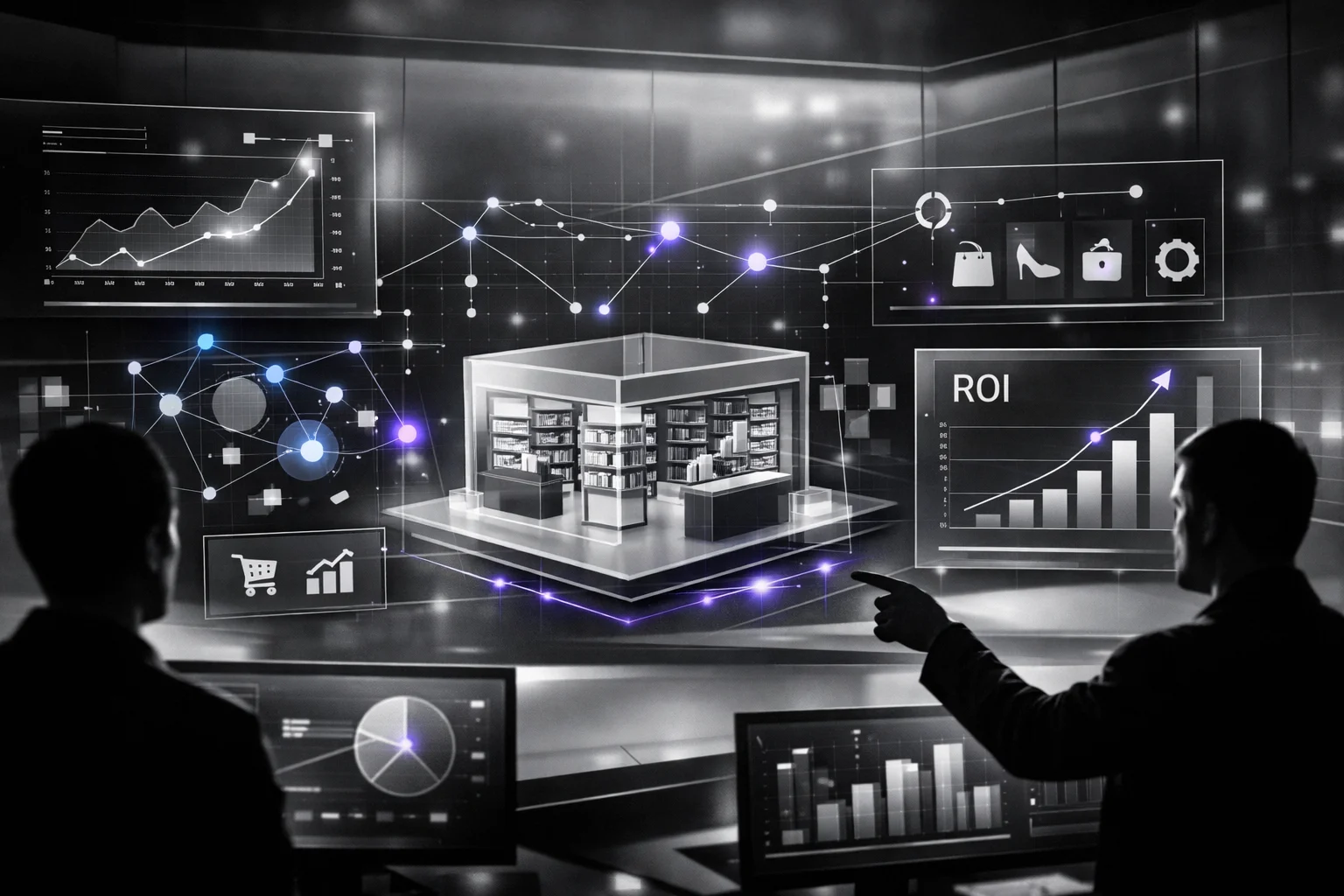
Most retail dashboards are expensive wallpaper. They look busy, they impress people in meetings, and they still don't tell your team what to do next.
That's the real problem AI for retail analytics is supposed to fix. Not prettier charts. Not another weekly report nobody trusts. Actual decisions, made faster, with fewer blind spots. A few years back, that gap was easier to ignore. It isn't now.
In this article, I'll show you where retail analytics AI earns its keep, where it quietly fails, and why the winners are building actionable retail dashboards tied to decision intelligence for retail, not vanity metrics.
What AI for Retail Analytics Really Means
75%. That’s the number that jumps out of valantic’s 2026 study: three out of four retail respondents said AI saved them time. Another 72% said it improved efficiency. 69% said quality got better. I think those numbers are useful and a little slippery, because “saved time” sounds great right up until you ask the only question I care about: did your team make better calls when it counted?
That’s where this gets real for you. Retail never had a dashboard shortage. It had a hesitation problem. Teams could see margin slipping in one category, stock building in another, foot traffic softening in a region, and still lose two or three days arguing about what to do. I’ve seen that movie before. Monday morning report. Thursday decision. By then, the moment’s gone.
AI for retail analytics is supposed to change that. Not prettier reporting. Not another KPI wall no one opens after the weekly meeting. A decision support layer that pulls from customer data, sales data, and operational signals in real time, then helps people act before the damage spreads or the opportunity disappears.
GrowthFactor makes the important point: current retail analytics AI goes past historical reporting into predictive and prescriptive work. That means it doesn’t stop at “demand dropped in region A.” It gets into retail forecasting, demand planning, inventory reallocation, pricing adjustments, and promotion timing. Indata Labs says much the same thing from another angle: real-time analysis that helps retailers predict demand, personalize promotions, and shift pricing as conditions move.
I’d argue this is the line most companies still blur. Insight generation tells you what happened. Action enablement tells you the next best move, where to make it, and how fast you need to move. Those aren’t the same thing. One gives visibility. The other gives decision intelligence for retail.
That’s why actionable dashboards beat decorative ones every time. Your dashboard should flag anomalies, rank likely causes, and tie straight into workflows across merchandising, allocation, and store operations. If it can’t help a planner decide whether to move inventory by 9 a.m., or help a pricing team react before the weekend promo window closes, it’s not enough. Looks nice. Still not enough.
Do something blunt with this. Audit every dashboard you’ve got and ask one question: does this help someone decide and act? If the answer’s no, tear into the setup and rebuild around actual decision moments. A smart next move is mapping your highest-value decisions first through an AI Discovery for retail use cases process, then designing from those moments outward instead of piling more reports on top of old ones.
Why Dashboards Alone Don’t Create Retail Value
Tuesday, 9:12 a.m., a store manager is standing near a front table of seasonal inventory that isn’t moving fast enough. The dashboard back at HQ already knows it. Sell-through is slipping in that region, competitor pricing shifted overnight, and foot traffic is softer than it was the same week last year. The screen is gorgeous. Nothing happens. Nobody has approval to mark the product down until Thursday’s call.

That’s the whole problem.
I think most retail dashboards are expensive wall art. Great in a boardroom. Great on a giant monitor with color-coded trend lines. Useless if replenishment still waits on spreadsheets, pricing still needs committee approval, and planners are still exporting CSVs before they change an order.
A lot of retailers have already done the hard integration work. POS data, foot traffic, mobile location signals, demographics, competitor pricing — all pulled into one place. GrowthFactor points out that this kind of unified dashboard setup is now common because teams want faster decisions. Sure. But I’d argue “faster decisions” doesn’t mean much if the actual operating rhythm hasn’t changed. If your store ops team still needs a weekly meeting to approve markdowns, you don’t have decision intelligence for retail. You’ve got reporting with nicer lighting.
That’s why so many retail analytics AI projects look incredible in the demo and then go flat six weeks later. They explain what’s happening. They don’t force a response. A model flags weakening demand in Phoenix or Birmingham or suburban Atlanta. Fine. Who acts on it? Merchandising? Inventory planning? The district manager? If nobody owns the move, predictive analytics turns into a very polished way to admire a problem.
LatentView gets this part right: retail customer analytics has to move past understanding shoppers and into influencing decisions tied to revenue, margin, and lifetime value through prescriptive analytics. That jump matters more than most teams admit. “Interesting” doesn’t pay for software licenses. “Do this next” does.
And “do this next” isn’t abstract stuff. It’s specific. Reallocate stock out of stores where sell-through is slowing and into stores where it isn’t. Reduce promotion depth on low-elasticity items instead of burning margin for no reason. Trigger a demand planning review when local conditions break pattern — weather shift, competitor discounting, event-driven traffic drop, whatever’s throwing the signal off.
The evidence isn’t in how modern the interface looks. It’s in whether behavior changes underneath it. According to NVIDIA’s 2024 survey as cited by Hypersonix, 69% of retailers reported increased annual revenue from AI adoption. Not dashboard adoption. AI adoption that changed what people actually did.
So build actionable retail dashboards backward from operating decisions, not forward from available data. Start with three blunt questions: what decision needs to happen, who makes it, and what action should trigger when a threshold breaks? If you care about retail forecasting and follow-through instead of just prettier charts, this is where predictive analytics forecasting services earn their keep.
Funny thing is, the best dashboard may be the one nobody stares at for twenty minutes during a Monday meeting because the system already pushed the next best action into pricing, replenishment, or store ops workflow. If your team still has to stop and interpret everything manually, what exactly did the dashboard fix?
How to Design Retail Analytics Around Decisions
Monday, 8:17 a.m. A regional merch lead sees margin slipping on one dashboard, weak sell-through on another, and labor variance buried in a store ops report. Three tabs. Four opinions. No one changes price, no one reroutes inventory, no one updates the task queue before lunch. I've seen that movie before. The charts were fine. The delay was the problem.
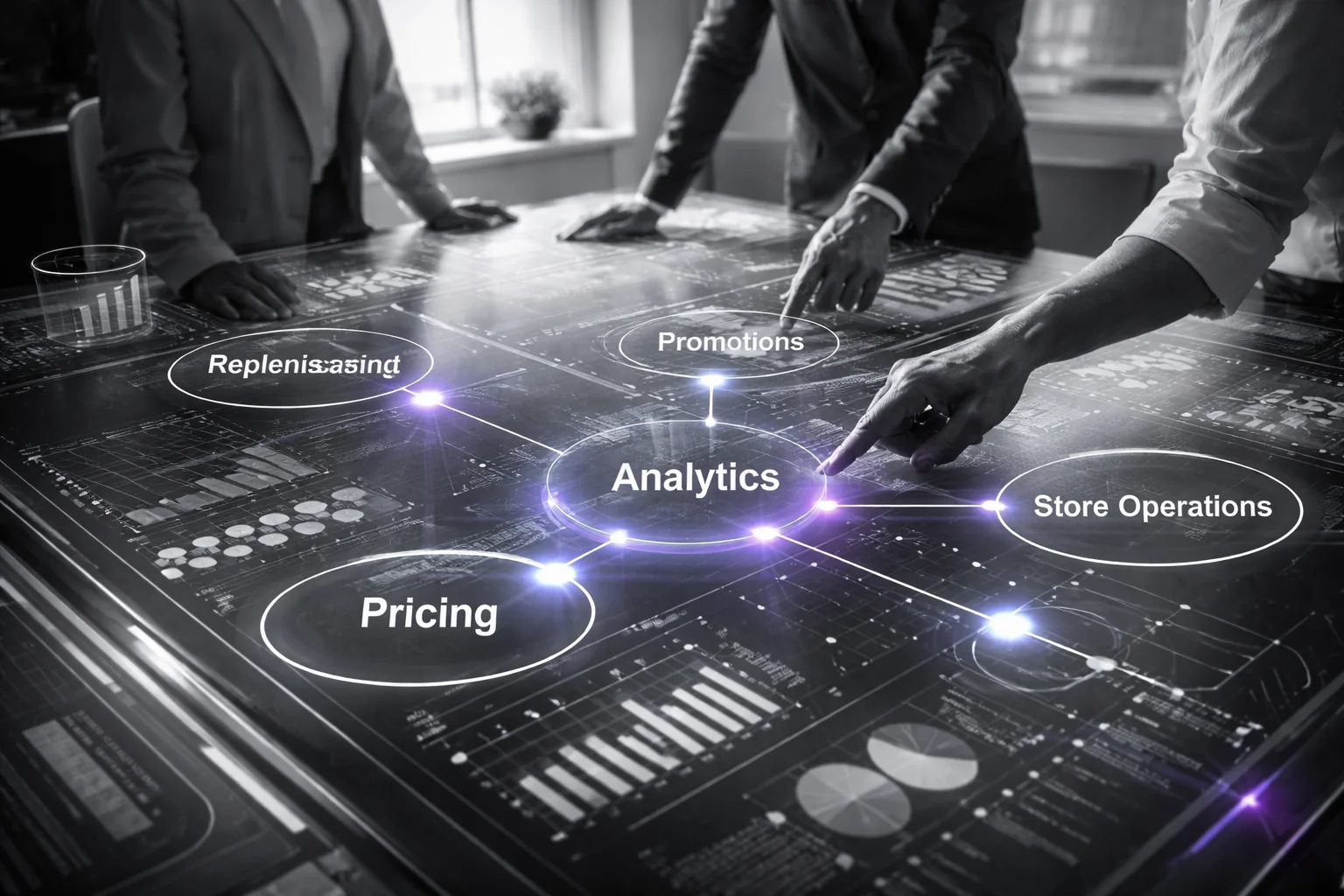
That’s why I’d argue “be data-driven” is lazy advice. It sounds smart and still leaves teams building layers of reporting around metrics while pricing, replenishment, promotions, and store ops crawl along at human-debate speed.
The fix isn’t mysterious. Design retail analytics AI around decisions, not visibility. A metric only earns its keep when it points to a named action, a clear owner, a threshold, and a response time.
This is where retail analytics AI usually falls apart. One dashboard shows margin pressure. Another shows declining sell-through. A third flags labor variance. Helpful? Sure. Enough? Not even close. If those signals don’t connect straight into a pricing rule, a replenishment workflow, or a store task queue, somebody still has to stop what they’re doing, interpret the signal, argue about it in Slack for 45 minutes, and manually push the next step. That’s where money leaks.
Xenia is on the right track here. The better retail platforms don’t just predict what’s coming; they help teams fix the issue before it turns into lost revenue or wasted labor hours. That’s the jump from predictive analytics to prescriptive analytics. Predictive says demand will miss plan in District 4 next week. Prescriptive says cut allocation on SKU group A by 12%, move units from two nearby stores, and pause the promo in one underperforming cluster.
You need a decision-integration model.
- Name the decision. Be blunt about it: price change, reorder quantity, promo timing, labor adjustment.
- Choose the leading signals. Sell-through rate, competitor price movement, weather change, footfall drop, stock cover days.
- Set thresholds. Not “keep an eye on it.” Real trigger points that force action.
- Assign ownership. Merchandising, planning, store ops, ecommerce. One team. Not five people half-owning it.
- Put the action where work already happens. ERP tasks, planner queues, approval workflows, mobile alerts in-store.
That last one gets ignored all the time. Insight lives in BI. Action lives somewhere else. Then people act surprised when decision intelligence for retail goes nowhere. Your actionable retail dashboards should send next-best actions into daily workflows so teams can move in minutes instead of waiting for Thursday’s meeting deck.
A few years ago that sounded expensive and ambitious. Not now. Delight.ai citing KPMG says AI adoption in retail is projected to jump from 33% to 85% by 2027. NVIDIA’s 2024 survey as cited by Hypersonix says 72% of retailers saw operating cost reductions from AI adoption. Not because they got prettier dashboards. Because execution changed.
If you’re building for retail forecasting and demand planning, this is the bar now: every model output should tie to a business decision and land with the team that owns that decision. That’s how AI for retail analytics stops being ornamental and starts being operational. If your setup still ends at reporting, start by tightening the decision map with AI Discovery for retail use cases.
Action-Enabling Patterns for Retail Analytics AI
Everybody says the same thing about retail AI: make the model smarter, add more signals, surface more insight. Sounds good in a boardroom. Falls apart at 7:58 a.m. when one planning team opens a screen full of noise and has to decide what to do before the first store call.
I know because I’ve watched it happen. We once built a genuinely sharp retail analytics view across stores, categories, and SKUs, and before 8 a.m. it handed one team 47 supposedly critical signals. Forty-seven. Not one person moved on any of them.
That wasn’t a modeling failure. I’d argue it was worse. It was a design failure dressed up as intelligence.
People like to talk about accuracy first. I think that’s incomplete. In retail, the missing piece is decision friction: whether an output fits a choice a human can make fast, with confidence, inside the tool they already live in.
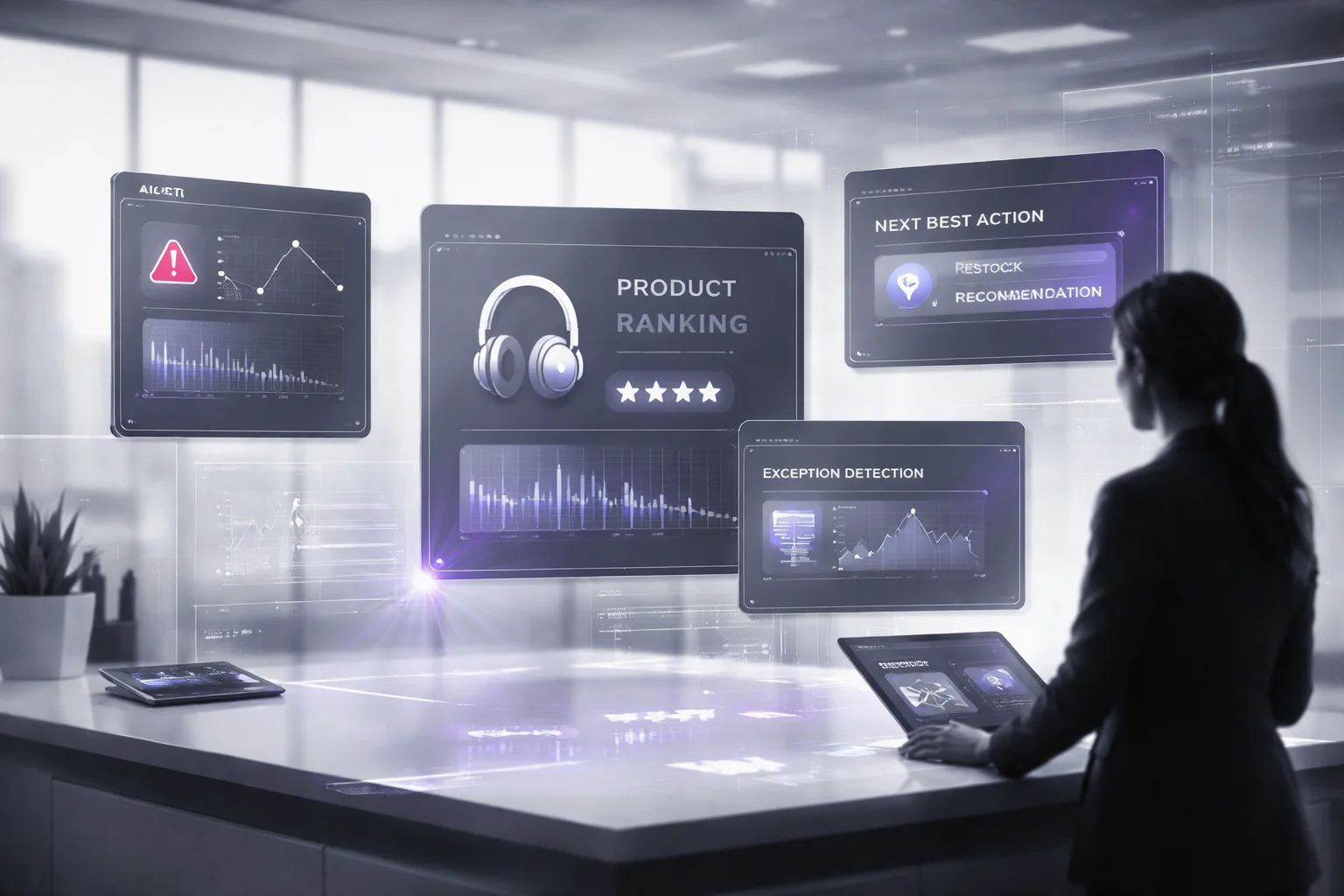
The pattern matters more than most teams admit. The four I keep coming back to are alerts, rankings, prompts, exceptions. Same data, different delivery, totally different result.
Alerts are for expensive waiting
If stock cover is going to drop below a threshold in 72 hours, nobody should have to click through three charts and debate color coding. They need one alert, one owner, one deadline.
This is where predictive analytics actually proves itself in retail operations: stockout risk, sudden demand spikes, promo underperformance, store-level sell-through anomalies. Delight.ai reports that retailers using AI-driven inventory management have cut forecasting error by 20% to 50%. That’s not trivia. Better forecasting makes threshold alerts less noisy, which is the only reason people trust them enough to act.
I’ve seen the opposite too — thresholds so loose they trigger 14 times before lunch. At that point the system isn’t helping; it’s training people to ignore it.
Rankings matter when there isn’t one obvious move
This is the part people usually bury under “recommendations,” which is too vague to be useful. Merchants rarely need a giant list of possibilities. They need the top few moves worth discussing.
Say you’re deciding allocation changes across 200 stores. Twenty-five options isn’t decision support; it’s homework. What helps is a ranked list of the top three actions by expected margin impact, inventory risk, and confidence level.
GrowthFactor has pointed out that common retail AI use cases include demand forecasting, inventory optimization, dynamic pricing, and customer segmentation. Exactly. Those domains produce lots of plausible actions. Ranking is what stops demand planning from turning into another meeting nobody wanted in the first place.
Prompts work when they show up where work already happens
Not on some dashboard tab everyone swears they’ll check later and then never opens after Tuesday.
If someone in CRM sees “send personalized offer to lapsed high-value segment,” that’s useful because it’s immediate. If a planner sees “reallocate 180 units from Store A to Store C,” same story. That’s prescriptive analytics earning its oxygen by connecting insight to action right at the point of work.
The timing matters because customer expectation has changed faster than internal process has. Aithority, citing Eagle Eye research from 2024, reported that 71% of consumers expect personalization. So no, teams don’t have time for an extra interpretation step before acting on customer signals.
Exceptions are how you survive scale
Most retailers can’t watch everything across every cluster, seasonality curve, return pattern, and pricing move. They just can’t.
Exception detection cuts out normal variation and flags what actually broke pattern: returns spiking in one cluster, competitor pricing drift, forecast variance on seasonal items. That’s what keeps operational analytics usable instead of turning into digital clutter with nicer fonts.
And this is where plenty of AI projects still go wrong. They assume visibility equals usefulness. It doesn’t. If you’re serious about building this stuff, map each pattern to an actual workflow first. Retail AI automation solutions only pay off when outputs reduce hesitation instead of creating more reading.
So when your system finds something important tomorrow morning, will it help someone act — or just give them item number 48?
Decision Integration Approaches That Improve Execution
Up to 50% fewer stockouts. That's a huge number, and honestly, it's the kind of stat that makes me roll my eyes for half a second before I pay attention. I've sat in too many retail meetings where people spent 45 minutes debating model lift while the real issue was painfully simple: nobody had connected the output to an actual decision anyone was responsible for making.
That's where this lives. Not in the model. Not in the demo. In the handoff between prediction and action, which is exactly where a lot of retail analytics work starts falling apart.
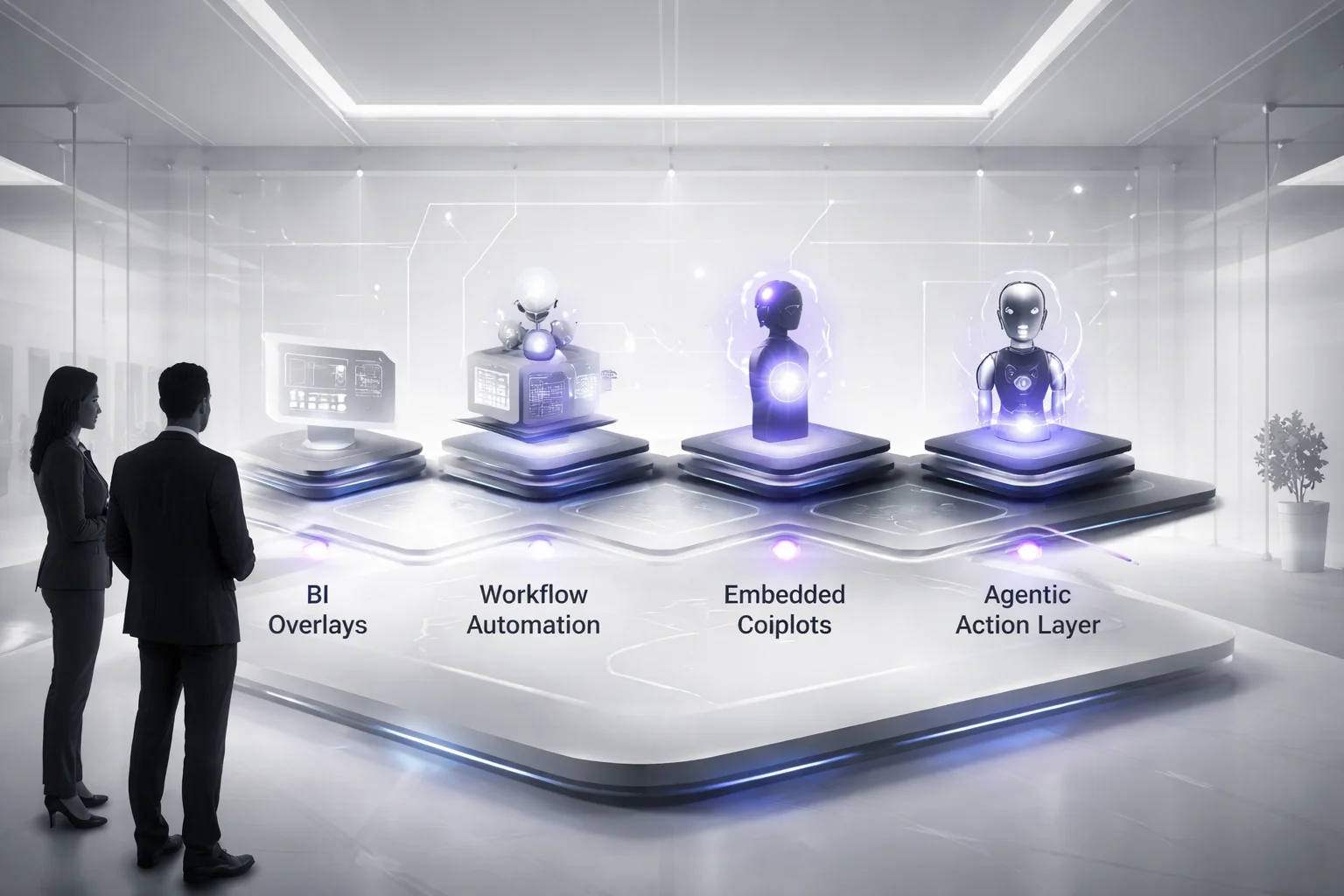
Retail teams love a polished dashboard. I get why. A BI overlay feels safe. You add predictive analytics and prescriptive analytics to dashboards people already know, then ask planners, merchandisers, or store ops leaders to take it from there. Easier governance. Fewer political fights. Lower risk. I'd argue it's also where speed goes to die if you're dealing with supply chain management or fraud detection, which valantic’s 2026 study says retailers rank as their highest-value use cases.
A dashboard can tell someone what matters. It can't make them look at it at 9:12 on a Tuesday when their inbox is on fire and fourteen other decisions are already stacked up.
That's why workflow automation usually earns trust faster than flashy analytics ever do. Reorder tasks. Exception queues. Approval flows. Replenishment triggers. The decision shows up inside the systems people already use, so action doesn't depend on somebody remembering to check one more screen after lunch. That's what turns retail operational analytics into something useful instead of something admired. Delight.ai reports that retailers using AI-driven inventory management see stockout reductions of up to 50%, and no, that isn't because an alert looked clever on a dashboard. It's because demand planning and retail forecasting outputs got tied directly to execution.
Copilots are interesting because they sit in the messy middle. Sometimes that's exactly right. They help users ask better questions, test scenarios, and get suggested next steps inside service or planning tools without forcing a totally new way of working. People tend to adopt them because they feel familiar fast. The catch is obvious once volume goes up: they still need a person to follow through every single time. Across hundreds of decisions, that's a bottleneck with nicer branding.
Agentic action layers are different. Faster too. They can execute inside guardrails instead of waiting politely for human approval on every routine move: adjust allocations, trigger investigations, launch recovery actions, escalate anomalies. For decision intelligence for retail, that's powerful when speed matters more than perfect agreement from six stakeholders who all want one more meeting.
I've seen this go sideways fast. One weak threshold can flood an operations team with junk escalations in under an hour. We saw a queue jump past 300 cases before lunch in one scenario like this. So no, I don't think more automation is always better. Bad rules scale just as efficiently as good ones.
The smarter move is sequencing these approaches by risk and repeatability instead of treating them like some permanent ideology. Start with visibility where trust is low. Put workflow automation where repeatability is high. Use copilots where human judgment actually adds something real. Push into agentic action where outcomes are measurable and rollback is clear. If you're sorting that path now, this is exactly where AI Discovery for retail use cases helps separate what should inform people from what should act for them.
There's another number people shouldn't ignore: 76% of consumers are frustrated when they don't receive personalization, according to Eagle Eye research as cited by Aithority. That hits harder than most teams admit. If your retail analytics AI can predict intent but can't push the next best action into campaign or service workflows, you're not personalizing anything meaningful — you're producing expensive insight that dies before it reaches the customer.
So start where delay hurts revenue or service most. Wire those decisions into the work itself, not another reporting layer people have to remember exists. If your system predicts well but still waits around for someone to notice it, what are you actually improving?
What Action-Designed Retail Analytics Looks Like in Practice
Everyone says the same thing: get the dashboard right, wire up AI, give every team their own clean view, and better decisions will follow. Sounds modern. Sounds sensible. It’s also where a lot of retail teams get stuck.
I’ve seen this movie. A multi-market retailer rolls out a polished analytics setup across dozens of stores, each function gets its own screen, and for a couple of weeks the place feels electric. Merchandising watches margin trends. Inventory gets forecasts. CX tracks campaign performance. Revenue ops reviews promo results. It looks slick enough to impress a boardroom at 9:00 a.m. on a Tuesday.
Then nothing really moves.
Sales don’t jump. Margin stays sleepy. The same stock issues show up again on Monday calls like nobody learned a thing. That’s the part people skip past when they talk about “better visibility.” Visibility isn’t control. Never was.
I think that old assumption is outdated now, maybe even lazy. Because once the charts exist, the real problem gets exposed fast: who does what by when, and how do you know it worked? Not in theory. In production. With names attached.
I learned that the hard way building exactly this kind of setup for a retailer with multiple locations. We had the forecasts, the trend views, the role-based dashboards, all of it. But when an insight popped up on screen, nobody could answer the ugly operational question that actually mattered after the meeting ended.
That missing piece sits in the middle of all this: action-designed retail analytics isn’t a reporting layer at all. It’s an operating model. Miss that and you wind up with expensive visibility and bargain-bin execution.
The framework I keep coming back to is almost stupidly plain: signal, owner, action, measure, repeat. Five words. That’s it. No magic trick. Just decision intelligence built so somebody has to move.
Merchandising
Merchants don’t need interesting observations. They need ranked actions they can approve or reject.
Say women’s outerwear misses plan for five straight days across two urban clusters. One cluster gets a recommended 10% markdown because demand has softened enough to act now. The other gets transfer recommendations because demand there isn’t gone, just uneven by location. Pricing stays put in stores where sell-through still looks healthy. That’s not “insight.” That’s a decision queue.
The merchant owns it. Then you measure sell-through lift, gross margin impact, and decision cycle time. If markdown approval on a seasonal item takes nine days, I’d argue you don’t have an analytics issue anymore. You’ve got an operating issue wearing an analytics costume.
Inventory
This is where retail demand forecasting AI either proves its worth or becomes shelf decor.
Picture a top SKU heading into the weekend with stock cover dropping inside 72 hours while demand rises faster than expected. Planning owns the response. They can expedite inventory, reallocate units from a slower region, or suppress promotional demand before stores get cleaned out by Saturday afternoon.
Those are actual moves. After that, check forecast error, stockout rate, and inventory turns. If those numbers don’t improve, the model alone isn’t the villain. Your thresholds may be wrong. Your response rules may be slow. Or both.
Customer experience
CX teams don’t need clever segments built for QBR applause. They need next-best-action prompts someone can use before lunch.
A useful case: high-value shoppers who bought running gear and then miss their expected repeat purchase window shouldn’t get tossed into some generic campaign blast with everybody else. They should get a personalized recovery offer based on what they bought and when they usually come back.
Nike has trained customers to expect relevance here; Amazon made timing feel normal years ago; retailers still sending one-size-fits-all blasts in 2026 are behind whether they admit it or not. Measure conversion lift, retention rate, and promo efficiency. If those stay flat, your “personalization” probably wasn’t personal enough to matter.
Revenue operations
Revenue ops should be running test-and-adjust loops constantly.
One region shows heavy discounting but weak unit velocity. That’s not subtle and it’s not something to admire from a dashboard tab. Revenue ops owns the fix: pull back promo depth on low-elasticity items, move budget toward bundles that actually get response, then track revenue per promotion dollar and weekly margin recovery.
I’ve watched teams stare at discount rates for months without asking the only question worth asking: did the extra spend create movement or just teach customers to wait for another markdown?
This is why the valantic study deserves more attention than it gets. In 2026, across research involving more than 100 retail and CPG managers within a broader sample of 1,000 executives and IT managers in DACH, retailers named time savings, efficiency gains, and quality improvements as top AI benefits. Not prettier charts. Not fancier filters. Time savings, efficiency gains, quality improvements — those come from repeatable improvement loops with clear owners attached.
If you want to build this without losing six months in theory-slide purgatory, start with predictive analytics forecasting services. Demand planning gets practical fast when every signal needs an owner and every recommendation has to earn its keep in numbers later.
So if an insight fires today in your business — at 10:14 a.m., say — who moves first?
FAQ: AI for Retail Analytics That Drives Action
What is AI for retail analytics?
AI for retail analytics uses machine learning and decision intelligence to turn retail data into predictions, recommendations, and actions. Instead of only showing what happened last week, it helps you forecast demand, spot anomalies, optimize inventory, and decide what your team should do next.
How does AI for retail analytics go beyond dashboards?
Most dashboards stop at reporting. AI for retail analytics pushes further by adding predictive analytics, prescriptive analytics, and next best action recommendations, so your team can respond before margin, stock, or service levels slip. That's the difference between seeing a problem and actually fixing it.
Why do retail analytics initiatives fail to drive action?
They fail because too many teams build reports around data availability instead of business decisions. A few years back, this was the same mess everywhere: pretty charts, no owner, no trigger, no workflow. If nobody knows what action follows a KPI change, your analytics stack is just expensive wallpaper.
How can retailers design analytics around decisions?
Start with the decision, not the model. Define the use-case clearly, like reorder this SKU, shift allocation between stores, change a promotion, or flag a pricing anomaly, then work backward to the data, thresholds, and approval flow needed to act. That's how decision intelligence for retail becomes operational instead of theoretical.
What data sources are needed to power action-enabling retail analytics?
You usually need more than POS data. Strong retail analytics AI pulls from sales, inventory, promotions, pricing, returns, supplier lead times, foot traffic, ecommerce behavior, customer segmentation data, and sometimes local events or weather. The point isn't collecting everything, it's connecting the data that changes a decision.
Can AI integrate with retail operations and execution workflows?
Yes, and if it can't, don't buy the pitch. The best setups connect recommendations to replenishment systems, merchandising tools, workforce workflows, ticketing, or store execution platforms so actions can be approved, assigned, and tracked. Without that link, actionable retail dashboards usually die in a weekly meeting.
Does AI for retail analytics improve inventory and demand accuracy?
Yes, if the models are tied to real operational decisions and refreshed with current data. According to Delight.ai, retailers using AI-driven inventory management report forecasting error reductions of 20–50% and stockout reductions of up to 50%. That's why retail demand forecasting AI keeps getting budget even when other analytics projects stall.
Is real-time AI retail analytics worth it for stores and supply chain?
Sometimes yes, sometimes no. Real-time analytics matters when the decision window is short, like stockout prevention, fraud detection, labor shifts, or promotion response, but plenty of retail operational analytics use-cases work fine with hourly or daily refreshes. Chasing real time for everything is one of those bad ideas people keep repeating because it sounds advanced.
How do you move from descriptive dashboards to prescriptive recommendations?
You add model outputs that answer three things: what is likely to happen, why it's happening, and what action should follow. That means combining predictive analytics, causal insights, business rules, and recommendation engines so the system can suggest actions like reallocating stock, changing markdown timing, or adjusting assortment. According to GrowthFactor, AI-powered retail analytics helps retailers move beyond historical reporting into faster, more accurate decisions.
How should retailers validate and monitor AI models for retail analytics?
Don't stop at model accuracy. You need to track KPI and performance measurement tied to business outcomes, like forecast bias, stockouts, sell-through, promotion lift, margin impact, and recommendation acceptance rates. Last month I saw another team brag about model precision while stores ignored the output, which tells you everything you need to know.
How can retailers measure ROI when AI analytics drives operational actions?
Measure the value of the action, not just the model. Compare before-and-after results on decisions like replenishment, allocation optimization, assortment optimization, or promotion optimization, and track revenue lift, margin improvement, lower markdowns, fewer stockouts, and labor time saved. According to Hypersonix citing NVIDIA's 2024 survey, 69% of retailers reported increased annual revenue and 72% saw lower operating costs from AI adoption.