AI for HR Automation: Bias Prevention Guide
Most HR AI tools don't fail because the models are weak. They fail because companies assume "automated" means "objective." It doesn't. I've seen teams roll out...
Most HR AI tools don't fail because the models are weak. They fail because companies assume "automated" means "objective." It doesn't. I've seen teams roll out screening systems that cut time-to-fill fast, then act surprised when fairness questions show up a month later (as if speed and scrutiny can't arrive together). That's why AI for HR automation bias prevention isn't a nice extra. It's the job.
And the evidence is already here. According to a 2026 SHRM report, nearly 1 in 4 organizations use automation or AI in HR, but only 2 in 5 employers say their vendors are very transparent about bias protections. This guide breaks down what goes wrong, what the law now expects, and the six-part framework you can use to catch bias before it scales.
What AI for HR Automation Really Means
A hiring team told me, with a straight face, that their new bot was just “administrative support.” Then I watched what it actually did. It screened applicants, pushed some people to the next round, buried others, and quietly shaped who a recruiter ever saw. Admin work? Come on. If a tool decides who gets noticed and who vanishes, it’s part of the hiring decision whether anyone likes that label or not.
People talk about AI for HR automation bias prevention like it’s a polish step, something you tack on once the workflow is humming. I think that’s exactly backward. The moment a system ranks applicants, flags resumes, recommends interview pools, parses employment gaps, or scores onboarding risk, it stops being a time-saver and starts influencing real careers.
The scale isn’t hypothetical either. SHRM reported in 2026 that nearly 1 in 4 organizations use automation or AI in HR-related work. More than 2 in 3 HR professionals using those tools said time-to-fill improved. Sure, that matters. Hiring faster is useful. Cornell Law School’s Journal of Law and Public Policy adds the part people tend to skip: talent acquisition is the top use case at 64%. Not leave requests. Not form routing. Hiring.
If your system drafts offer letters or routes onboarding documents, you’re mostly dealing with process efficiency. Different category. If it ranks candidates, predicts retention, recommends another interview, or reads an employment gap as a signal, you’ve stepped into high-stakes territory. That’s where fairness in AI hiring stops sounding academic. That’s where HR AI bias detection, algorithmic bias review, adverse impact checks, fairness metrics, bias audits, and model monitoring become management work, not side notes for the data team.
I’d argue the cleanest test is painfully simple: what does the tool influence? Vendors will call almost anything assistance if they think it calms legal nerves. Ignore the branding. Ask whether the system changes who gets seen, selected, advanced, delayed, or rejected. If it does, treat it like decision support with human consequences.
The law already sees it that way. PivotPoint Security’s summary of the New York City AI bias law makes this pretty plain: automated employment decision tools require annual bias audits, and the employer using the tool carries that responsibility rather than the vendor. I’ve seen teams assume the software company had this covered because there was a glossy sales deck and a one-page ethics statement. Bad bet. You’re still on the hook.
Do one practical thing first. Make an inventory of every HR tool touching hiring and onboarding. One spreadsheet is enough at the start. List each tool, what it actually does, what decision it affects, whether candidates are ranked or filtered, who reviews outputs, and how often results get checked for adverse impact. A list like that can expose more risk in 20 minutes than six months of vague “AI strategy” meetings.
Name tools by their effect, not by whatever harmless phrase showed up in procurement paperwork. That habit alone will do more for HR automation governance and legal compliance for HR AI than another dashboard ever will. Funny thing is, speed usually isn’t the most serious change these systems bring with them.
Ai Mvp Development Viability Thresholds
Why Bias Risk Changes the HR Automation Business Case
Nearly 1 in 4 organizations were already using automation or AI for HR-related work, according to SHRM’s 2026 reporting. That number should make people a little uneasy. It does me. Not because automation in HR is automatically bad, but because “common” has a way of getting mistaken for “safe,” and those are not the same thing.
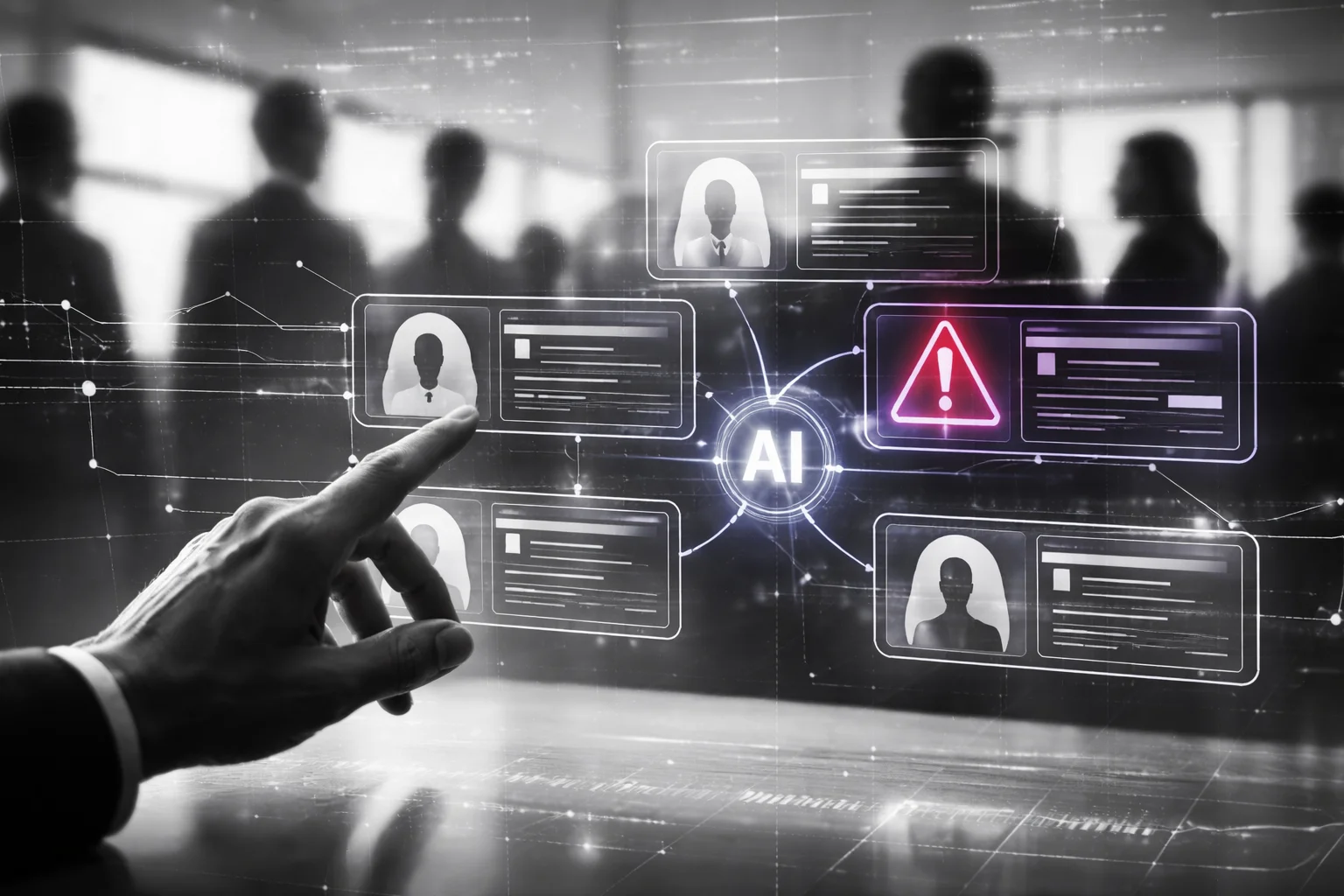
Here’s the trap. A vendor shows a hiring team a polished dashboard, points to a 62% drop in time-to-screen, celebrates that recruiters handled fewer resumes, and says the system is “working as designed.” Sure. Great. Everyone likes the green arrows.
Then the useful questions start.
Who quietly stopped making it through? Which schools vanished from the shortlist? Did older candidates get thinner in the pool by month two? Why was one group consistently ranked lower if nobody on the team could explain the logic in plain English without hiding behind model jargon?
I think this is where the whole business case flips. If a tool only cuts admin work, fine, judge it on efficiency. If it touches hiring, promotion, compensation, or termination, efficiency drops down the list fast. Risk moves to the top. The real headline stops being “we processed more applicants” and becomes “can we show this system isn’t producing discriminatory effects?”
A human recruiter can make bad calls one at a time. An unfair model can do it at scale before lunch. I’ve seen teams act like bias is some abstract ethics seminar topic until they realize a screening model touched 8,000 applicants in a quarter and nobody had set up a serious review process. That’s when speed stops sounding so impressive.
And the visibility into risk controls? Weak. SHRM also found that only 2 in 5 employers buying these tools from vendors said those vendors were very transparent about bias protections. So adoption is rising while clarity about safeguards lags behind. Bad mix.
You’re not just buying efficiency. You’re buying exposure.
Vendor confidence doesn’t mean much on its own. Honestly, once procurement gets charmed by sleek slides and vague claims about “fairness built in,” I trust confidence even less. If you can’t inspect fairness metrics, ask how adverse impact is measured, review the bias audit process, and understand how monitoring works after deployment, you’re not buying software with oversight. You’re buying blind spots with an invoice.
The ethical issue is obvious enough: people shouldn’t lose jobs or miss promotions because old discrimination got baked into training data and came back wearing math clothes.
The legal issue is where companies start kidding themselves. A policy PDF sitting in a shared drive from March 2024 won’t save anyone. Compliance for HR AI means being able to show that an automated candidate screening process was tested for discriminatory effects and that warning signs weren’t ignored after launch.
Sometimes reputational damage lands first anyway. Candidates talk on Reddit, Glassdoor, LinkedIn, private Slack groups, text chains with former coworkers. Employees compare stories faster than leadership expects. If a promotion model keeps rating one group lower quarter after quarter and managers can’t explain why, that won’t stay buried for long.
So redo the math. Put three lines right next to labor savings: audit cost, remediation cost, trust cost. I’d argue most teams still underwrite this backward. They’ll approve six figures for deployment and barely reserve anything for review, then act stunned when cleanup costs more than the original contract.
Do the boring grown-up work before rollout. Assign ownership. Run pre-launch fairness testing for AI hiring tools. Schedule recurring HR AI bias detection reviews after go-live. Require human sign-off for high-impact decisions involving hiring, promotion, compensation, or termination.
This looks less like productivity software and more like security tooling. Nobody sensible would deploy threat detection systems without ongoing oversight if those systems could create large-scale risk quietly in the background. Same logic here. Buzzi AI makes that broader point well in Cybersecurity Threat Detection Response: different problem set, same rule — if automation can cause harm at scale without making much noise, governance isn’t optional.
That’s what readers should do with all this: stop treating HR automation ROI as a speed story and start treating it as a control story too. If your vendor can’t show you how bias gets measured, audited, monitored, and escalated after launch, what exactly are you buying?
Common Bias Patterns in AI HR Systems
Everybody says the same thing first: let software handle hiring, cut down on gut calls, move faster, make it fairer. That's the sales pitch. Cleaner process. Better decisions. Shorter time-to-fill. If you sat through a 20-minute vendor demo in 2024 or 2025, you've heard some version of it.
And sure, part of that is real. SHRM's 2026 reporting says more than 2 in 3 HR professionals using automation or AI saw time-to-fill improve. That's not nothing. Recruiters under pressure care about days saved, and executives definitely care about dashboards that go from 41 days to 27.
But that's also where people stop thinking.
UC Berkeley Haas put the problem plainly: AI can reduce human subjectivity in HR and still absorb human and social bias, then repeat it at scale. I'd argue that's the missing piece most teams don't want to stare at for very long. Speed gets tracked every week. Damage usually doesn't show up until months later, after the recruiter left, the model got updated twice, and nobody can explain why one group kept advancing while another quietly vanished.
That's how bias usually appears in these systems. Not as one dramatic failure. More like a pattern you notice too late: the same resumes keep floating up, the same profiles keep getting filtered out, and six months later no one has a clean record of which threshold changed or why.
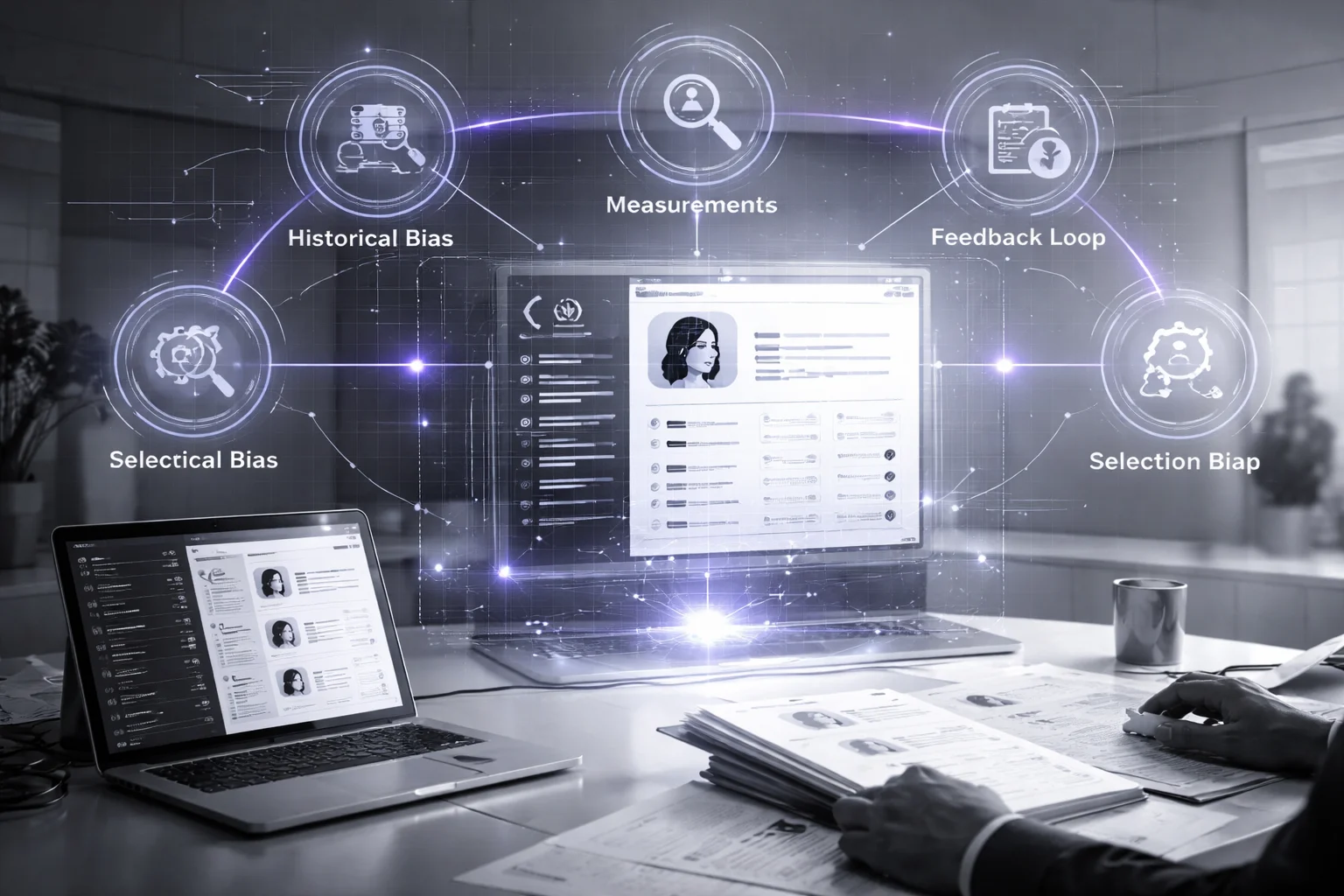
Historical bias
This is the old problem wearing new clothes. A model trained on past hiring or promotion decisions will learn past preferences fast, whether those preferences were fair or not. If a company spent ten years favoring candidates from a tiny cluster of schools or treating career gaps like a warning sign, automated screening won't correct that history. It'll copy it.
Amazon's scrapped recruiting tool is still the example people bring up because it earned that status. The system learned from historical resumes and ended up penalizing signals associated with women applicants. That's the point right there: models don't separate merit from history just because somebody put them behind a polished interface. They often confuse "people we hired before" with "best candidate."
I've seen this happen in smaller companies too. One team had roughly 12,000 old applicant records feeding a screening model, and almost all their top-ranked candidates came from the same handful of universities because that's who had been hired before. Nobody programmed "prefer these schools" directly. The system learned it anyway.
Measurement bias
This one's sneakier because it sounds scientific.
If you measure the wrong thing, the model gets excellent at chasing nonsense. An interview scoring tool that treats eye contact, speech pace, or vocal cadence as signs of "confidence" can end up penalizing disability, culture, accent, or language background instead of predicting job performance. An internal mobility model claiming to score "leadership potential" off manager ratings might just be converting manager favoritism into numbers.
Same bias. Better packaging.
I think this is where a lot of teams kid themselves. They see a score from 1 to 100 and assume they've captured something real. They haven't necessarily done that at all. They've just quantified an opinion and made it look expensive.
Proxy bias
A lot of people still think the fix is simple: remove race, remove gender, problem solved. That's outdated thinking.
You can leave out protected traits and still rebuild them through side channels without much effort at all. Zip code can stand in for race or class. College name can carry signals about wealth and network access. Employment gaps can reflect caregiving responsibilities or health issues. Even wording patterns on a resume can correlate with background in ways teams don't bother to test.
That's why proxy bias is such a mess in practice. A ranking model can look clean on paper because there's no explicit race field anywhere in the feature list, yet still produce adverse impact through correlated variables doing exactly what everyone pretends they aren't doing. I've watched teams proudly announce, "We don't use gender." Then you look closer and see school pedigree, location history, extracurriculars, gap length, prior title normalization — basically five side doors standing wide open.
Removing protected categories is table stakes. It doesn't settle anything.
Selection bias and feedback loops
The ugliest failures often start before any prediction gets made.
If your training data only includes people who survived the old hiring funnel, then your model never learns from qualified applicants who got screened out early by rushed recruiters, bad filters, arbitrary degree rules, or plain bias. The missing people disappear twice: first from consideration, then from the data used to define "qualified."
Then comes the loop. The model recommends a narrower pool. Recruiters hire from that pool. Those hires become fresh evidence that the model works. Six months pass and someone celebrates precision gains without asking who stopped being seen back in week two.
That's why fairness metrics, recurring bias audits, and monitoring tied to actual outcomes matter more than promises in a vendor deck full of pastel charts and words like "trusted intelligence." Buzzi AI makes a similar point in Ai Mvp Development Viability Thresholds: small errors don't stay small once you scale them through a system designed to look objective.
So yes, AI can speed up hiring. SHRM says many HR teams are already seeing that benefit. Fine. But if faster hiring comes from ranking logic nobody audits, labels nobody challenged, thresholds nobody documented, and feedback loops nobody interrupted — what exactly got better?
Bias Detection Frameworks for HR Automation
Here's the take people hate: a hiring model can look great and still be a liability.
Fast screening. Recruiters smiling. Leadership bragging that the funnel finally moves. I've sat in those meetings. Someone pulls up a clean dashboard, points at overall performance, and the room relaxes like the hard part's done.
That's usually where the real problem starts.
We reviewed an automated candidate screening system that had all the comforting signals. Solid surface metrics. Happy users. Faster movement from application to next step. Then we cut the outcomes by subgroup. Different story. One group was advancing at a much lower rate than the others.
Same tool. Same workflow. Very different result depending on who you were.
I think this is what most teams get wrong about bias detection in HR AI: they treat it like a general performance check, not a question about distribution. Who gets through? Who gets rejected? Who gets misread by the model over and over after launch?
Most companies don't have a framework. They've got a one-time test, a vendor assurance, and maybe six slides with green checkmarks.
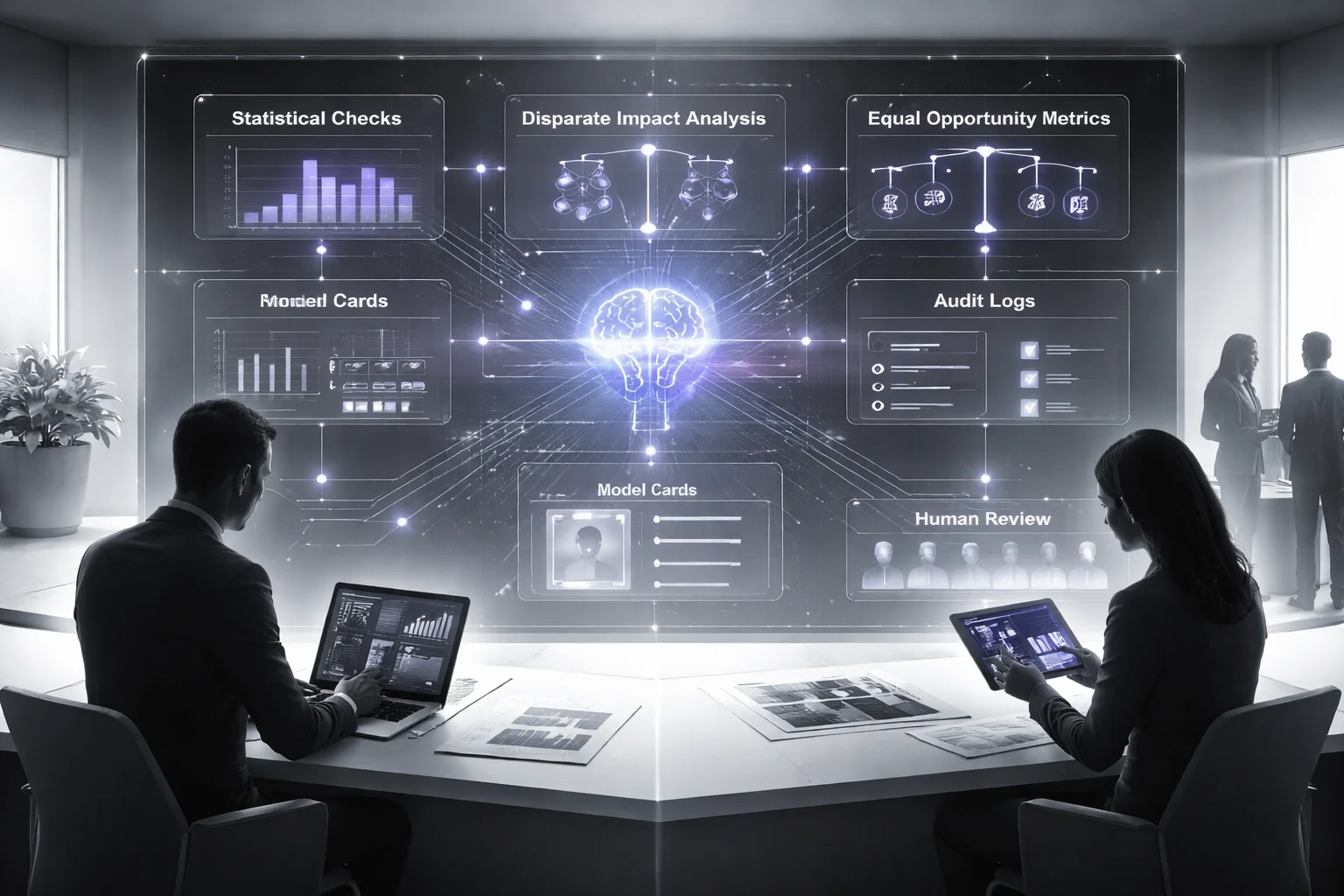
Start with selection rates. Not because it's sophisticated. Because it isn't. It's blunt enough to expose things quickly. Run statistical parity reviews anywhere applicants are advanced, flagged, or screened out. If 40% of applicants in Group A make it to interviews and 22% in Group B do, don't hide behind pipeline explanations or job-family trivia. Dig in. That's often where adverse impact shows up first, plain as day.
Legal teams care because disparate impact analysis turns hand-waving into evidence. Compare selection rates across groups. Check whether any group falls below your accepted parity threshold. That's the point where compliance stops being a nice intention and becomes something you can defend—or can't.
Parity won't save you by itself.
A model can push similar volumes across groups and still be worse at spotting qualified people from one subgroup than another. That's why equal opportunity metrics matter. Look at true positive rates by subgroup. If qualified applicants from one demographic are correctly identified 81% of the time and another lands at 64%, you've got a fairness problem inside decision quality itself, even if your top-line numbers look tidy.
You see it in resume ranking systems. Interview recommendation tools too. Internal promotion scoring might be the worst offender, because once software starts predicting "fit" or "success," people get weirdly trusting.
Aggregate accuracy is where bad systems hide.
Break results out by race, gender, age band, disability status where lawful and appropriate to assess, and intersectional groups when the sample size can support it. UC Berkeley Haas makes the uncomfortable point clearly: accurate data can still reflect an unjust society. So no, "the data is accurate" isn't much of a defense if your training set copied biased historical decisions or weak representation.
Check false positives and false negatives separately too. They hurt in different ways. A sourcing model that over-recommends one group wastes recruiter time on noise. A screening model that under-selects another group creates algorithmic bias with business risk and legal risk attached. I once saw a team celebrate precision north of 90%, then freeze when we found one subgroup was being rejected nearly 1 in 3 times more often despite similar qualifications.
Timing matters more than most people want to admit.
If you test once before deployment and never come back to it, that's not HR AI bias detection. That's a snapshot pretending to be governance. Review adverse impact ratios before launch, after major model updates, and on a recurring schedule while the system is live. Monthly makes sense for high-volume hiring tools. Quarterly may be enough if hiring volume is lower.
This is monitoring with teeth.
A 2026 SHRM report found only 2 in 5 employers buying HR AI from vendors said those vendors were very transparent about bias protections. That number should bother you more than any product demo ever reassures you. Your team needs its own audit routine because borrowed confidence disappears fast when outcomes drift.
The part nobody wants to build is usually the part that keeps the whole thing honest: governance around every result.
The framework falls apart without records, checkpoints, and rules for what happens when something breaks. Keep audit logs for inputs, outputs, score thresholds, overrides, reviewer actions, and model version history.
- Model cards: document intended use, excluded uses, training data limits, fairness metrics tested, known failure cases, and retraining dates.
- Human review checkpoints: require people to review low-confidence recommendations, edge cases, and any rejection decision above your defined risk threshold.
- Escalation rules: if adverse impact crosses your limit or subgroup performance drifts materially, pause automated use until remediation is complete.
I’d argue teams make this sound stranger than it is. It isn't mystical. It's an internal control system—boring phrase, sure, but dead accurate—and that same proof-over-promises discipline shows up in Ai Mvp Development Viability Thresholds. Write down what you tested. Watch what changes. Don't let a model make quiet mistakes at scale because everyone liked how fast it moved candidates on Tuesday morning.
If your hiring tool only looks fair from thirty thousand feet up, what exactly are you calling fair?
How to Build Fair HR Automation into the Workflow
I watched a team celebrate an hiring automation rollout on a Tuesday. By Thursday, they were trying to explain why the shortlist had shrunk in a way nobody could defend. Same dashboard glow, same talk about efficiency, same blind spot: they hadn't decided what "fair" meant before the system started cutting people out.

At 8:17 a.m., a recruiting lead can open the screen and see 1,200 applicants in and 146 moved forward. Looks tidy. Looks efficient. Then the ugly question shows up late: who got screened out, and why?
People act like bias appears after launch, like it slipped in through a side door. It didn't. It was there the minute fairness got treated like a product setting instead of part of the hiring process.
A 2026 Globalization Partners report said about 75% of HR professionals expect AI to raise the value of human judgment over the next five years. I think that's exactly right. It kills the lazy idea that you can buy fair hiring as a feature, switch it on, and let legal deal with the rest.
I've seen the split enough times that it feels almost boring. One group launches first and waits for adverse impact to show up after automated screening already filtered out real people. The other group sets rules before live candidates ever touch the system. Same category of software. Very different mess afterward.
The framework is simple: clean data, defend features, test thresholds, review edge cases, watch the live system
That's it. Not flashy. But this is where fair HR automation either holds up or falls apart.
Start with data curation. Not model tuning. That's where teams usually get cute and get burned.
Historical hiring data looks useful right up until you ask what it's actually measuring. Old preferences sit in there for years. Some groups barely show up. Labels sound solid until you inspect them.
"High performer" is a good example because it sounds objective and often isn't. I've seen that label come straight from manager reviews instead of actual job outcomes, which means the model wasn't learning performance so much as learning who managers already liked. That's not some technical footnote. That's the whole case.
Check whether training data really matches the candidate pool you're trying to assess. Remove features tied to old discrimination patterns. Audit labels before trusting them. Lockton's been clear on this for good reason: responsible HR AI needs data governance, fairness controls, human oversight, and ongoing measurement.
Then feature selection. This is where polite meetings hide bad decisions.
I don't trust rooms where the only question is whether a variable improves prediction accuracy. Wrong question. The better one is harsher: what behavior does this reward, and who gets punished for it?
A college name can quietly sort by class while pretending to be neutral pedigree data. An employment gap can punish caregiving, illness, military service, or just rotten timing in the job market. Those are proxy risks whether anyone admits it or not.
Write down every scoring feature you kept, every one you threw out, and why. If you'd hate reading that explanation out loud in court, don't use the feature.
Thresholds come next, and teams love underestimating this part because moving a cutoff line feels minor. It's not. I once saw a team shift a score threshold by two points because recruiters only had capacity for about 90 interviews that month instead of 110, and suddenly the slate changed far more than they expected.
One company sets pass thresholds based on recruiter bandwidth for the week and calls it practical decision-making. Another checks selection rates across groups, compares error rates, and looks for adverse impact before launch. You already know which one has a better shot at legal compliance for HR AI.
Run a bias audit before deployment. Every time threshold logic changes, treat it like a product change because that's what it is.
Don't slap "human-in-the-loop" on this and pretend you're done
Some decisions can stay automated without much risk. Some really can't.
Near-cutoff rejections need review. Unusual candidate profiles need review. Disability accommodation cases need review. Internal promotions definitely need review because internal data is often thin, inconsistent, and messy in ways nobody wants to admit.
A human approving whatever the system recommends isn't oversight. It's theater. Real oversight means someone can override the system and log a reason code explaining why they did it.
If you're not monitoring live models, stop calling it governance
Pre-launch testing catches yesterday's problems. Live monitoring catches today's.
Track subgroup selection rates. Track input drift. Track override patterns. Track downstream outcomes after people are hired too, because fairness at screening doesn't mean much if performance or promotion outcomes tell a different story later.
This is usually the part people skip because procurement meetings feel urgent and launch decks look impressive and nobody wants to budget for month-six reality checks. Then six months pass and they're staring at results they can't explain.
So what are you actually building here: a workflow with fewer places for bias to hide, or another dashboard that makes bad decisions look clean?
Governance, Compliance, and Legal Safeguards for HR AI
Tuesday morning, 9:12 a.m. A recruiting lead is on Zoom with a vendor demoing an automated candidate screening tool. Clean slides. Confident rep. Someone asks the obvious question: “Is it fair?” The vendor says yes, points to a dashboard, and the meeting moves on. Eight weeks later, legal asks who approved the model, what fairness metrics were tested, what notice candidates got, how adverse impact gets reviewed, and what happens if model performance slips after launch. Silence. I've seen that silence before.

People love to say the big HR AI risk is bias. Bad rankings. Skewed screening. Unfair outcomes.
True, but I'd argue that's usually the symptom people notice first, not the first thing that went wrong.
Most companies don't begin with a bias crisis. They begin with a governance mess. No owner. No recordkeeping. No review process. No contract language with teeth. Then the system starts making decisions about real people, somebody spots an ugly pattern, and suddenly everyone calls it a bias problem.
That's why the scope matters more than most teams admit. Cornell Law School's Journal of Law and Public Policy has made this plain: AI isn't tucked away in one hiring workflow anymore. It's showing up across recruitment, selection, onboarding, performance management, and training. Resume ranking gets the headlines because it's easy to picture. The actual exposure runs across the whole employee lifecycle.
The numbers aren't subtle either. SHRM reported in 2026 that 30% said automation or AI improved their ability to reduce potential bias in hiring decisions. Sounds promising until you put it next to the other number from the same report: 46% said they wanted more information or resources to identify potential bias. That's the gap. Interest is moving faster than practice.
The fix isn't glamorous. Good. It shouldn't be.
Governance is the part everybody wants to skip because it feels like paperwork. I've watched teams spend six figures on AI hiring software and then balk at creating a one-page escalation policy. That's backwards.
- Set policy controls: write down approved uses, banned uses, review triggers, retention rules, and exactly when a human can override the system.
- Keep documentation: save model cards, version history, validation results, bias audit records, and monitoring logs.
- Handle consent and notice clearly: tell candidates where AI is used, what decisions it affects, and how they can ask for review if law or company policy gives them that right.
- Push vendors harder: require evidence of HR AI bias detection methods, known limits in testing data, explainability support, and incident response commitments.
- Check compliance by location: legal rules for HR AI change by city, state, and country, so deployment can't be copy-paste across jurisdictions.
This can look like ethics work from far away. Up close, it's procurement work with legal teeth.
If your contract doesn't require fairness checks in AI hiring, audit access, and clear remediation timelines, you've already lost control of the system before launch day. I've seen internal teams use 30-day remediation targets for vendor issues because vague promises like “we'll address concerns promptly” mean nothing once something breaks.
A useful parallel shows up in Relationship Preserving Ai For Sales Automation. Different department, same lesson. If a system affects people, trust doesn't come from confidence alone. It comes from rules around how the thing operates when results are messy, disputed, or wrong.
Start small if you have to. Pick one workflow — candidate screening is usually where companies start — and answer five boring questions before rollout: who owns approval, what gets logged, what candidates are told, how adverse impact gets reviewed, and who can shut the tool off if drift shows up three months later. That's not bureaucracy for its own sake. That's operating discipline.
The funny part is good governance usually makes adoption easier. People trust systems they can question.
What to do this week
AI for HR automation bias prevention only works when you treat fairness, measurement, and accountability as part of the system itself, not a cleanup job after launch.
Start by mapping every place your tools influence people, especially automated candidate screening, ranking, and interview selection, then check for adverse impact with subgroup-level fairness metrics instead of trusting top-line accuracy. Ask your vendor hard questions about HR AI bias detection, explainable AI (XAI), training data representativeness, and audit access, because according to a 2026 SHRM report, only 2 in 5 employers say vendors are very transparent about bias protections. And keep a human-in-the-loop review where decisions carry legal or career risk, because legal compliance for HR AI isn't just a policy file, it's operating discipline.
This week, do three things:
- Pull one hiring workflow report and compare selection rate parity across demographic groups.
- Send your vendor a written request for its latest bias audit, model monitoring process, and explainability documentation.
- Name one owner for HR automation governance who signs off on changes to scoring rules, thresholds, and review procedures.
FAQ: AI for HR Automation
How can AI for HR automation bias prevention actually work in hiring?
It works when you treat bias prevention as a system, not a feature checkbox from a vendor. That means testing for algorithmic bias before launch, using fairness metrics like selection rate parity or equal opportunity, and keeping human-in-the-loop review for edge cases and rejections. AI can help reduce inconsistent human judgment, but it won't magically remove bias if your training data or rules are flawed.
What are the most common bias patterns in HR AI systems?
The usual problems are data bias, proxy variables, and uneven model performance across groups. For example, automated candidate screening can inherit past hiring preferences, penalize gaps in employment that correlate with caregiving, or score candidates differently because the training data wasn't representative. That's how adverse impact shows up even when nobody intended it.
How do you measure bias in automated candidate screening?
You measure outcomes by group, not just overall accuracy. HR teams usually compare selection rates, pass-through rates, false positive and false negative patterns, and other fairness metrics to spot disparate impact before the tool affects real applicants. If one group consistently advances at a lower rate, that's your signal to stop, investigate, and adjust.
What data preprocessing steps help reduce bias in HR automation workflows?
Start by checking training data representativeness, removing or limiting sensitive attributes and obvious proxies, and balancing samples where historical patterns skew the dataset. Then document every transformation, because "we cleaned the data" isn't much of a defense in an audit. Good preprocessing won't solve everything, but bad preprocessing can wreck the whole model fast.
Does HR AI need human review to reduce bias?
Yes, and this is one of those cases where the boring answer is the right one. Human-in-the-loop review helps catch context the model misses, question explainability issues, and prevent automated decisions from becoming unchallengeable. According to a 2026 Globalization Partners report, about 75% of HR professionals say AI will increase the value of human judgment over the next five years.
What governance safeguards should be in place for HR AI systems?
You need clear ownership, approval rules, bias audit procedures, model monitoring, and documentation that shows who reviewed what and when. Lockton's guidance is blunt on this point: responsible HR AI needs fairness controls, data governance, human oversight, and measurement over time. Put differently, if nobody owns the model after deployment, you don't have governance, you have hope.
Can you use AI for HR automation and still stay compliant with employment laws?
Yes, but only if legal compliance for HR AI is built into deployment, not bolted on later. You need to align the system with EEOC guidance, test for disparate impact, maintain explainable AI where possible, and document audits and review steps for hiring and promotion decisions. And well, actually, the company using the tool often carries the compliance burden even if a vendor built it.
How should HR teams handle model drift and ongoing bias monitoring?
They should assume drift will happen and set a schedule for retesting performance, fairness metrics, and adverse impact after deployment. Candidate pools change, job requirements shift, and models age badly when nobody watches them. According to a 2026 SHRM report, only 2 in 5 employers using vendor HR AI tools say vendors are very transparent about bias protections, which is exactly why your own monitoring can't be optional.