AI for Healthcare Solutions: Match Readiness
Most healthcare AI projects shouldn't start this year. That's not a cynical take. It's a math problem, and the numbers usually look ugly once you check...

Most healthcare AI projects shouldn't start this year. That's not a cynical take. It's a math problem, and the numbers usually look ugly once you check clinical AI readiness instead of admiring a demo.
Too many teams buy AI for healthcare solutions the way people buy a treadmill in January, full of optimism, light on operational truth. The analogy isn't perfect, but you get it. If your data readiness is weak, your clinical workflow integration is vague, and your governance model lives in someone's head, your healthcare AI ROI won't show up.
I'll show you the evidence, where leaders misread a clinical readiness assessment, and how to match ambition to AI implementation maturity across seven sections.
What AI for Healthcare Solutions Means Today
Why do so many healthcare AI pilots die in conference rooms instead of making it into patient care?
It usually doesn't look like failure at first. It looks expensive. A vendor walks in with a polished deck, a 94% accuracy claim, a logo slide full of health systems, and a promise that triage will move faster, notes will clean themselves up, and costs will bend in the right direction. I've sat in those meetings. Everybody's nodding by slide 12.
Then the room gets quieter. The model doesn't fit the real visit flow. The clinic's data turns out to be patchy, late, or buried in fields nobody trusts. No one decided who owns validation. No one decided what happens when the model misses something important. A month later, "AI for healthcare solutions" means six people on Zoom asking why nothing launched.
I've seen that movie more than once. In one case, the pilot budget was about $180,000 before anyone realized the nurses would've needed to leave their usual EHR path just to use the tool. That's where this goes sideways.
Most teams buy AI backwards.
They start with what the model can do instead of what the clinic can actually absorb. I'd argue that's the whole game. If you want clinical AI readiness, capability isn't the starting line. Fit is.
The rules around this aren't vague either. The FDA says software intended for medical purposes can fall under oversight requirements, including review of safety and effectiveness depending on intended use and risk target="_blank". HHS says HIPAA duties don't magically disappear because somebody put "AI" on the product page target="_blank". So no, implementation isn't plugging in a model and waiting for healthcare AI ROI to appear.
The useful split is pretty simple. Capability-first deployment asks, "What can this AI do?" Clinically grounded implementation asks, "Where does it fit in care, who trusts it, what data supports it, and what happens when it's wrong?" One path gives you a demo people clap for. The other gives you decisions you can defend when compliance, clinicians, and leadership all start asking hard questions.
Think about an ambulance with a race car engine crammed into it. Fast? Sure. Helpful in an emergency department parking lot at 2:17 p.m. on a Tuesday when handoff timing actually matters? Not really. Performance by itself is overrated. Reliability inside the care setting is the thing that counts.
A real clinical readiness assessment checks clinical workflow integration, data readiness, model validation, regulatory compliance, and whether FDA clearance matters for the use case at hand. It also looks honestly at your organization's AI implementation maturity. A health system with disciplined governance and strong EHR workflows can manage phased AI deployment one way. A clinic still untangling template sprawl inside Epic or Cerner is living in a different reality.
Start there instead. Match the tool to the care setting before you match it to a budget line. If you're comparing vendors, use this healthcare AI solutions provider selection guide. The funny part is that slower starts often lead to faster wins. In healthcare, excitement is cheap. Restraint usually pays better.
Why Clinical Readiness Determines AI ROI
Everyone says the same thing about healthcare AI: buy the best model, sign with the biggest vendor, and the returns will show up.

Sounds neat. It also leaves out the part where expensive tools crash into real clinical operations and stall there. I've seen systems get dazzled by benchmark scores and slick demos while the actual mess lives somewhere else — in an overloaded inbox, a referral process nobody follows the same way twice, or documentation habits that change by service line and by physician.
That's the hole in the story. The model often isn't the problem.
Some tools are genuinely strong in controlled settings. They pass technical review, hit their benchmark numbers, and arrive packaged as AI for healthcare solutions with exactly the kind of boardroom promise that looks good when margins are tight. And most leaders aren't careless about outcomes either. I'd argue they're usually making a more ordinary mistake: they confuse technical capability with operational fit. That's not a subtle distinction when millions are on the line.
A model can look great in testing and still fall apart on Monday morning.
Big vendors don't save you from that. People want to believe a larger contract means lower risk. Not really. I've watched large enterprise deals fail over tiny things: weak workflow integration, poor data readiness, no clear escalation path when exceptions start piling up, and nobody assigned to model validation once the pilot team moves on after 90 days and everyone else is left holding it.
The missing piece is clinical AI readiness. Not the sales version. The operational version.
Clinical AI readiness is what turns theoretical value into usable value. If your workflows are immature, your governance is thin, or staff habits are all over the place, complexity stops being an asset and starts acting like a tax. That's where healthcare AI ROI usually disappears — quietly, without any dramatic failure anyone wants to own.
Ambient documentation is a perfect example because people keep talking about it like it's one product with one outcome. It isn't. In one health system, physicians cut after-hours charting because notes map cleanly into Epic, drafts are trusted enough to edit fast, and the note lands where it's supposed to. In another, that same class of tool creates rework because cardiology uses one template set, orthopedics uses another, problem lists are messy, and clinicians spend extra minutes fixing what the AI wrote. Same category. Different AI implementation maturity. Totally different economics.
This is why a real clinical readiness assessment can't stop at feature lists or demo-day accuracy claims. You need proof your data supports the task. You need governance that can handle exceptions instead of pretending they won't happen. You need compliance involved early enough to answer whether intended use changes regulatory exposure or FDA clearance expectations. McKinsey has already made the broad case: generative AI could create major value across healthcare administration and clinical work, but only when organizations redesign workflows around it rather than dropping it into old ones target="_blank".
The business case is less glamorous than vendors want it to be.
Match solution complexity to organizational maturity first. Use phased AI deployment if your core processes are still shaky. Start with bounded use cases where data quality is known, review steps are explicit, and adoption can be tracked week by week — not six months later in a slide deck full of excuses.
If you skip that discipline, you aren't funding transformation. You're prepaying for disappointment. That's why vendor choice matters less than fit, and why this healthcare AI solutions provider selection guide will probably help more than one more polished accuracy demo from a company whose product team has never sat through a messy clinic handoff.
People love saying healthcare moves slowly. Sometimes that's not resistance. Sometimes it's wisdom in orthopedic shoes. So before you buy the next impressive system, do you actually have the clinical readiness to make it earn anything?
Clinical Readiness Assessment Framework for AI
I once watched a hospital team lose three weeks arguing about an AI pilot when the real problem was embarrassingly human. Two nurses on the same unit were charting the same discharge step in two different places. One used structured EHR fields. The other dropped it into free text. The demo looked clean. The live workflow didn't. The model missed the handoff, and suddenly everyone wanted to act like the algorithm had betrayed them.
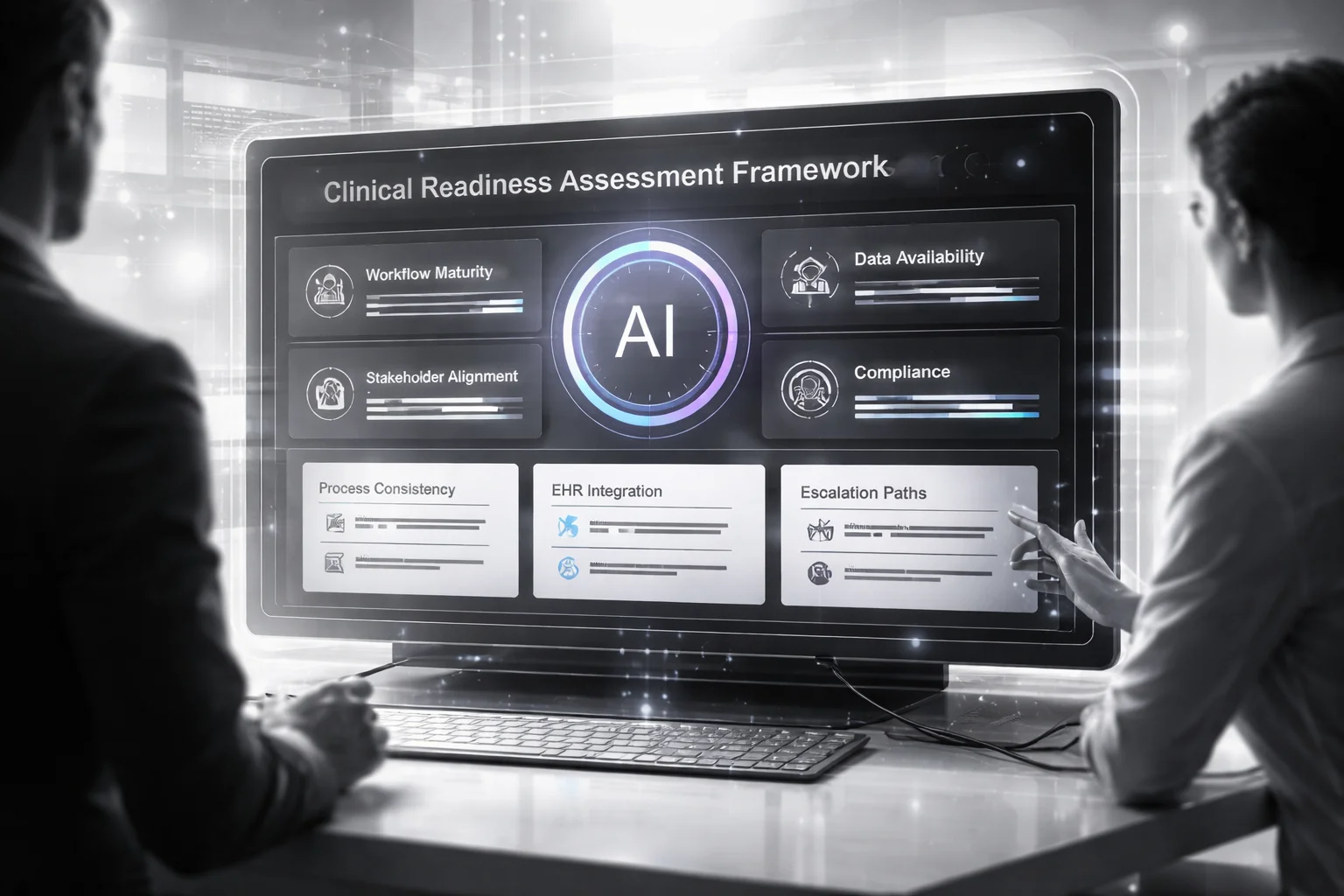
I didn't buy it. Still don't.
That's how a lot of these projects die. Not with some dramatic technical collapse. With small messes nobody bothered to count before rollout. McKinsey says only 30% of AI projects get from pilot to scaled production, and after enough conference rooms, enough status meetings, and enough pilots that vanish by the end of the quarter, I'd say that number feels generous target="_blank".
The useful lesson wasn't "pick a better vendor." It was simpler than that. Clinical AI readiness is something you can score. If you can't score it, you're just listening to whoever sounds most confident on Zoom.
I like five categories on a 1-to-5 scale. That's it. Not a fifty-slide strategy deck. Five things that tell you whether this is ready for reality or just ready for applause.
Data availability and EHR integration
This is the one people underrate until it burns them. I think it matters more than model cleverness, and I don't think it's even close. I've seen teams obsess over precision and recall while their critical input fields arrived 24 hours late, were half-mapped, or lived inside notes no one had structured.
- 1: Critical fields are missing, delayed, or trapped in free text only.
- 3: The data exists, but mapping and workflow triggers still need manual workarounds.
- 5: Structured data is available, EHR integration readiness is proven, and output placement is defined inside clinician workflow.
Workflow maturity
The discharge mess proved this before anyone said it out loud. If clinicians complete the same task five different ways depending on shift, service line, or who's covering lunch, AI won't clean that up. It'll spread it faster.
- 1: The process changes by person or shift, and nobody has documented a standard.
- 3: There's a core workflow, but exceptions and handoffs are still loose.
- 5: The workflow is standardized, measured, and built for clear clinical workflow integration.
Stakeholder alignment and human review
A lot of pilots don't fail because the model is wrong. They fail because nobody owns the weird cases. No exception owner means no real owner at all. Someone has to decide what happens when the output looks off, when risk tolerance gets tested, when clinical judgment needs to overrule automation.
- 1: Clinical leaders, IT, compliance, and operations aren't aligned on the use case or risk tolerance.
- 3: Decision rights exist informally, but escalation paths aren't complete.
- 5: Human-in-the-loop capacity is staffed, escalation paths are documented, and operational ownership is assigned by role.
Compliance and validation
This is where serious teams separate themselves from hopeful ones. You need validation rules before launch, not after the first complaint hits somebody's inbox on a Tuesday morning. The FDA has been clear enough about software as a medical device that acting like this can wait is just laziness dressed up as speed target="_blank".
- 1: There's been no review of regulatory compliance, HIPAA impact, or intended-use classification.
- 3: Basic compliance review is done, but validation cadence is still unclear.
- 5: A model validation plan is active, regulatory compliance is mapped, and FDA clearance requirements are assessed where relevant.
Operational ownership
This sounds dull right up until something breaks at 2:13 a.m. Then it's suddenly everyone's favorite topic. Your AI implementation maturity shows up in who carries the pager and what happens next.
- 1: No post-launch owner exists for monitoring or issue response.
- 3: The pilot team owns performance for now, with weak handoff plans.
- 5: An operating team owns performance monitoring, retraining triggers, support workflows, and phased AI deployment decisions.
Add up the numbers. Under 15 usually means contain scope. A total from 16 to 20 points toward targeted AI for healthcare solutions. Above 20 means you can make a credible case for scale and eventually stronger healthcare AI ROI.
If you want the reality check before vendor conversations turn into six weeks of demos and legal review, start with Buzzi AI's Pharma and Healthcare industry solutions. The boring answer tends to be the right one: score readiness first, buy second. So what would your organization actually score today?
How to Match Healthcare AI Solutions to Maturity
I watched a hospital team burn six months on a shiny deterioration model before admitting the obvious: they couldn't even get nurse inbox routing to behave consistently between day shift and nights. One unit escalated alerts one way, another did it differently, and somewhere in the middle the model got blamed for a mess it didn't create.
That happens a lot. In 2023 and 2024, after board decks started name-dropping generative AI and predictive medicine like every health system needed both by Q4, the pressure got weirdly theatrical. Start big. Be transformational. Don't get left behind. I've heard that pitch in rooms where the referral queue still broke every Monday morning.
The failure wasn't that prediction is useless. It was everything around it: weak data readiness, bad escalation logic, thin workflow integration, and clinicians who had zero patience for one more alert. That's why I'd argue most teams sort AI for healthcare solutions by how impressive they sound instead of whether the organization can actually carry the weight.
The part that matters is burden. Not brilliance. If you want real clinical AI readiness, run each use case through four filters: clinical risk, data sensitivity, integration depth, and change-management burden. Miss even one, and you'll buy something clever that falls apart on contact with reality.
When maturity is low, pick work that's boring on purpose
If workflows still wobble, don't hand clinicians a prediction engine and hope discipline appears later. Start where mistakes are easier to catch and clinical consequences stay low: prior auth support, coding assistance, referral routing, intake summarization, ambient drafting that remains under human review instead of writing straight into the chart.
There's a reason so many health systems start with documentation or revenue-cycle support before going anywhere near diagnosis-adjacent tools. The validation work is lighter. Regulatory compliance review is usually simpler. FDA clearance questions are often less intense because these tools support operations around care decisions rather than making or driving those decisions themselves. You still need governance, sure. You just don't need to assemble a five-alarm response because the model got strange at 2:17 p.m. on a Tuesday.
The middle tier isn't "scale." It's "prove you can be consistent."
This is where people usually want a clean maturity ladder. I don't buy that version. Mid-stage work only makes sense once processes actually hold together across sites, units, and shifts.
Then you can start using clinician-facing support with some confidence: symptom routing, sepsis screening review queues, imaging prioritization flags, care-gap nudges inside the EHR. Those can absolutely help. But drop them into chaotic workflows and they're just faster confusion.
The hard part here isn't raw model intelligence. It's placement and trust. A smart alert on the wrong screen is decorative software. Any serious clinical readiness assessment should ask blunt questions: do clinicians know when to trust it, when to override it, and who owns exceptions when it misfires? If nobody can answer in under 60 seconds, you're early.
High maturity is where the dangerous stuff starts paying off
This is also where marketing gets drunk on its own slides. People hear "high value" and assume "start here." No chance.
The highest-complexity tools belong with disciplined operators: deterioration prediction tied to interventions, autonomous documentation flows that write back into records, generative systems used at scale in patient communication or clinical summarization. Those aren't upgraded versions of low-risk automation. They're different animals with different failure modes.
This is where AI implementation maturity stops being committee language and starts acting like a survival trait. Model validation gets tougher. Regulatory compliance review tightens up fast. FDA clearance analysis gets much more serious once intended use drifts toward medical device territory. Change management gets heavier too, because clinician trust doesn't erode gradually in high-stakes workflows; sometimes it vanishes after one bad output.
I've said this in less polite terms before: getting good at tossing tennis balls doesn't mean you should move straight to chainsaws. Hospitals make this mistake all the time with AI. They think success with low-risk automation transfers neatly upward when risk jumps hard. It doesn't.
So here's the framework I'd actually use. Low risk plus low integration depth fits early-phase work. Moderate risk inside known workflows fits phased AI deployment. High-risk predictive or generative systems should wait until governance, monitoring, and adoption muscle already exist. That's how you protect healthcare AI ROI. Not by buying the flashiest demo because somebody saw it at HIMSS.
If you're sorting options by maturity instead of conference hype, this healthcare AI solutions provider selection guide is worth your time. So when your team says it's ready for the sexy stuff, what proof do you actually have?
Phased Deployment: Build Readiness While You Deploy
30 to 60 days. That's the window teams love to use for defining success, and I get why. It feels concrete. It fits neatly on a project plan. I’ve also watched that same tidy timeline hide a mess that showed up before the second Monday was over.

At 7:12 a.m. one Monday, a clinical operations lead I know had a dashboard saying the pilot was doing great. Strong accuracy. Active users. Vendor already hinting at a bigger rollout. By 9:00, two physicians were saying it didn’t fit their real workflow, one manager had no idea who owned output review, and nobody had written down the condition for shutting it off. That gap matters more than people want to admit.
People say, "start with a pilot." Sure. Start there. Just don’t confuse a pilot with clinical AI readiness. A model can behave nicely under controlled conditions and still fall apart when staffing gets thin, schedules slide, and weird cases start piling up by day three.
I think this is where smart teams talk themselves into dumb decisions. They treat phased AI deployment like a test drive. I wouldn’t. It’s not a spin around the block to see if the seats feel nice. It’s how you build organizational muscle while the tool is live.
Start smaller than your exec team wants. One use case. Low clinical risk. Clean inputs if you can get them. A workflow problem everyone can name without opening a strategy deck. Ambient note drafting for one specialty. Referral summarization at one site. Coding support for one revenue cycle team. That’s how good AI for healthcare solutions usually begin: where the data is actually ready, the workflow is visible, and one bad week won’t spread across the place before breakfast.
Before launch, make the team answer four blunt questions in plain English. What decision or task is the model helping with? Who reviews the output? What does success look like in 30 to 60 days? What stops the test immediately? If those answers are vague, your clinical readiness assessment isn’t done. Doesn’t matter how confident everyone sounded in the meeting.
Pilot phase: assistive first
Keep humans between the tool and the risk.
Early use should be draft, rank, flag, summarize. That’s enough. It shouldn’t close orders or trigger care actions on its own. Boring rule. Good rule. The kind that feels cautious right up until it saves you from explaining an avoidable error to an angry physician leader at 4:45 p.m.
Ignore the polished accuracy claims for a minute. Watch what operators are actually doing: clinician review rate, override rate, time saved per task, output acceptance rate, error categories by severity. Those numbers tell you far more about healthcare AI ROI than any benchmark dressed up for an executive slide.
Checkpoint phase: governance before expansion
No expansion without a gate review. Teams get impatient here. That’s usually when they start calling governance “friction,” which is a nice way of saying they want to skip the hard part.
The checkpoint needs to confirm model validation results, workflow fit, incident trends, user trust scores, and whether your regulatory compliance assumptions still hold once rollout widens. That isn’t paperwork theater. If intended use changes, revisit FDA clearance questions right away. A triage assistant that starts driving action isn’t the same product anymore. I’d argue organizations drift into real trouble here because they keep telling themselves they’re just adding features.
Scale phase: autonomy earns its way in
Autonomy comes late. It should.
You move from assistive to autonomous only when exceptions are rare and clearly owned: stable performance across sites, low harmful override findings, reliable escalation paths, and teams showing stronger AI implementation maturity. If those conditions don’t exist, autonomy isn’t ambitious. It’s careless.
I still think of it like teaching someone cruise control before they know how your brakes feel in rain. Imperfect comparison. Still true enough. Autonomy isn’t some switch you flip after one decent demo week. It’s an operating commitment.
If you want to map phases against actual operating capacity instead of vendor optimism, Buzzi AI's Pharma and Healthcare industry solutions page is a useful place to ground the conversation.
Your pilot might prove the model can help. Fine. The real question is whether your organization can review it, govern it, stop it when needed, and expand it without kidding itself — so what are you actually ready to turn on?
Common Mistakes in Healthcare AI Implementation
Here's the part people keep getting backwards: the model usually isn't what sinks a healthcare AI launch. The rollout is.
I think too many teams still act like passing validation, surviving compliance review, and arguing through FDA applicability means they're basically done. They aren't. I've seen hospitals sign six-figure deals, get through every serious review step, admire a polished dashboard in steering committee meetings, and then hit quarter-end with usage so weak it barely counted as adoption.
That's the trap. Everyone wants a villain with a job title. Blame the data scientists. Blame the vendor. Say the algorithm overpromised. Sure, that happens. But Epic has watched health systems wrestle with this for years, Mayo Clinic has publicly discussed workflow friction in digital implementation, and operators inside real hospitals know where this goes wrong: people confuse technical sophistication with clinical AI readiness, and then they act surprised when the whole thing stalls in slow motion.
The boring work is the work. That's the mistake. Not exotic failure. Not some dramatic algorithmic collapse. Just basic implementation details getting treated like side chores even though they're what determine whether anyone uses the tool once real patient care starts.
Over-scoping the first deployment
If your first release needs seven departments to coordinate perfectly, you didn't design a pilot. You bought yourself a governance problem.
This is where big systems get seduced by ambition. They buy broad AI for healthcare solutions packages and start talking about enterprise transformation before one service line has shown a clean win. I'd argue that's upside down. A contained success in one department beats a sprawling launch that dies under coordination debt every single time.
I've seen one rollout where radiology, ED intake, case management, IT, compliance, nursing operations, and physician leadership all had to line up before anybody touched live workflow. That alignment alone burned 11 weeks. No patient impact yet. No learning yet. Just meetings. That's why phased AI deployment matters so much if you care about adoption and real healthcare AI ROI.
Ignoring clinical champions
No clinician champion, no real implementation.
You can install software without one. That's easy. Making it stick is different.
A charge nurse can stop momentum cold. So can an attending lead or service-line director. And honestly, they should if the tool doesn't fit reality. They're the ones who know exactly when workflow theater ends and patient care begins. Give it two weeks after go-live and you'll find out fast whether anyone credible is willing to defend the system when an edge case lands at 4:47 p.m., shift change is underway, and suddenly everyone wants to know who owns a bad recommendation.
Your clinical readiness assessment can't just be a map of budget holders and committee approvals pulled from some April planning deck. It has to identify who will stand behind the tool when trust gets tested under pressure.
Skipping workflow redesign
This one gets underrated constantly: clinical workflow integration isn't an IT cleanup task. It's the actual assignment.
Smart teams miss this too, which makes it worse. They drop AI into already broken intake flows, triage steps, or documentation handoffs and hope automation will somehow clean up the mess on arrival. It won't. It'll scale confusion faster.
I watched one staff group start building workarounds by day three after new alerts were pushed into an already cluttered nursing workflow. Day three. Not month three. If your process is clumsy before launch, the model won't rescue it. It'll just make the clumsiness more efficient.
The old comparison still holds up: it's like bolting an espresso machine onto a sinking fishing boat. A little ridiculous. Still accurate.
Deploying without monitoring
If nobody owns post-launch monitoring, you haven't deployed a stable clinical system. You've dropped an experiment into care delivery and hoped nobody notices.
Inputs change. Performance drifts. Trust erodes quietly. Clinicians stop following outputs and route around them instead of opening tickets because they're busy and tired and have patients waiting now, not after someone reviews feedback next Tuesday.
This is where AI implementation maturity shows itself fast — not during procurement presentations, not during polished demos, not while everyone still sounds optimistic in kickoff meetings, but 30 days after go-live when the novelty is gone and daily operations take over for real.
If you're still comparing vendors, this healthcare AI solutions provider selection guide helps because it looks at operational fit instead of shiny claims.
The expensive lesson is pretty simple: validation isn't the same thing as readiness for clinical reality.
You can have decent data readiness. You can settle regulatory questions. You can move a model into production. You can do all of that and still fail quietly, slowly, expensively, because nobody handled the basics well enough to survive actual use inside patient care.
The weird part? The fanciest AI system in the building often turns into the fastest audit you'll ever run on whether your operating model was solid in the first place. So what did that impressive demo actually prove?
Choosing Buzzi.ai for Readiness-Matched AI
At 7:12 a.m. on a Tuesday, I was on the phone with a healthcare group that had already fallen in love with the flashy AI demo. You know the scene. Clean slides, smooth answers, everybody feeling like they'd found the future before their competitors did. Three weeks later, the mood changed. Their data was patchier than anyone admitted in the selection meetings, clinical workflow integration was barely there, and model validation had been shoved into the same mental drawer as “we'll sort compliance out later.” I've seen that movie before. It never has a clever ending.
People act like the big decision is which tool to buy. I'd argue that's usually the wrong first question. In clinical environments, readiness has to come before product selection. Not because it's boring consultant advice. Because if you pick the product first, you can burn six months and a mid-six-figure budget chasing a use case your organization can't safely support yet.
That's the part Buzzi.ai gets right. We don't kick things off with a vendor beauty contest or one of those workshops where twelve people agree in public and complain in private. We start with a clinical readiness assessment. A real one, not a ceremonial PDF. How do clinicians actually move through the workflow today? What can your systems handle right now, with your current staffing and governance? Where does regulatory exposure get messy? Does FDA clearance matter for this use case, or is that question just floating around the room because nobody wants to own it?
Then comes the uncomfortable bit that usually saves the project: we match the solution to your actual AI implementation maturity. Not your board deck. Not your ambition. Your maturity. If you're ready for bounded documentation support or operational automation, good — start there and get something working. If you're not ready for higher-risk decision support, saying that early is a lot cheaper than pretending otherwise and dealing with clinician backlash after launch. Smaller isn't less serious. A lot of the time, it's how you get to real healthcare AI ROI instead of joining the long list of stalled pilots hospitals don't talk about at conferences.
If I were on your side of the table, I'd keep it brutally simple.
- Assess reality first. Score workflow consistency, data readiness, governance ownership, and compliance exposure before anybody gets hypnotized by features.
- Match use case to maturity. Pick AI for healthcare solutions that fit your current operating capacity, not some imaginary version of next year's org chart.
- Deploy in phases. Use phased AI deployment to prove value in controlled settings before scale turns manageable mistakes into system-wide problems.
- Own outcomes after go-live. Track adoption, exception handling, validation results, and business impact like they matter, because they do.
This matters more after signing than before it. That's another place plenty of firms fall apart. They'll gladly help you buy software, collect their fee, and vanish right when clinicians start pushing back, weird edge cases pile up, or usage drops after week three and nobody can explain why. Buzzi.ai stays attached to what happens in the wild — under pressure, inside actual workflows, with clinicians who have no patience at all for theory-heavy excuses.
If you want the sector view and specific use cases, start here: Pharma and Healthcare industry solutions.
The easiest way to say it is still this: don't buy the coat first and check the weather later. In healthcare AI, conditions decide everything. So what are your conditions actually telling you right now?
FAQ: AI for Healthcare Solutions
What does clinical AI readiness actually mean in healthcare?
Clinical AI readiness is your organization’s ability to put an AI tool into real clinical use without breaking workflow, trust, or compliance. It includes data readiness, clinical workflow integration, EHR interoperability, model validation, HIPAA privacy, and clear clinical governance. If one of those is weak, your “AI launch” usually turns into an expensive pilot with a nice slide deck.
How do you assess readiness for AI for healthcare solutions?
Start with a clinical readiness assessment across five areas: data quality, workflow fit, integration, risk management, and operational ownership. Then score each area by evidence, not optimism. It’s kind of like trying to open a new surgical suite because the floor plan looks good, which isn’t a perfect analogy, but you get the point, the checklist matters more than the pitch.
Why does clinical AI readiness determine healthcare AI ROI?
Healthcare AI ROI doesn’t come from the model alone, it comes from adoption, speed, and measurable clinical or operational impact. If clinicians don’t trust the output, if alerts don’t fit the workflow, or if performance monitoring is missing, the return collapses fast. Readiness is what turns AI from a demo into fewer delays, lower labor cost, or better patient throughput.
Can AI for healthcare solutions be deployed before full readiness is in place?
Yes, but only with phased AI deployment and tight guardrails. You don’t need enterprise-wide maturity on day one, but you do need a narrow use case, human-in-the-loop review, defined escalation paths, and evidence generation from the start. Deploying broadly without that is how teams confuse motion with progress.
Does clinical maturity affect AI implementation success?
Absolutely. AI implementation maturity shapes whether your team can validate models, manage exceptions, handle regulatory compliance, and respond when performance drifts. Two hospitals can buy the same tool, and the one with stronger clinical governance and change management will usually get the value first.
What data and integration requirements should be in place before deploying clinical AI?
You need reliable source data, role-based access controls, auditability, and enough standardization to support model inputs and outputs. On the integration side, EHR interoperability, workflow triggers, result delivery, and fallback processes matter more than flashy dashboards. If the AI can’t reach the clinician at the right moment, it’s not implementation, it’s theater.
How should a phased deployment plan be structured for healthcare AI?
Start with one use case, one clinical team, one measurable outcome. Then move from silent mode, to human-in-the-loop support, to limited production, and only then to broader rollout if validation and adoption hold up. That phased AI deployment approach lowers risk and gives you real evidence before you scale what shouldn’t be scaled.
What are the most common mistakes in healthcare AI implementation?
The big ones are skipping workflow design, overestimating data quality, ignoring bias and fairness testing, and treating model validation like a one-time event. Teams also forget operational readiness, so nobody owns monitoring, retraining decisions, or clinician feedback loops. The result is predictable: the model works in theory and stalls in practice.
How do clinical governance and change management reduce adoption risk?
They make accountability visible. Clinical governance defines who approves use, who reviews safety signals, and what happens when outputs conflict with clinician judgment, while change management handles training, communication, and frontline trust. Without both, even a strong model can feel like an extra click with legal exposure attached.
What validation and monitoring steps are required for production healthcare AI?
You need pre-launch model validation, post-launch performance monitoring, drift detection, exception review, and documented thresholds for intervention. In healthcare, that also means checking bias and fairness testing, regulatory compliance, and whether the tool still fits the clinical workflow as practice changes. Production AI isn’t “set it and forget it.” It’s more like keeping a plane in the air while swapping instruments, not a perfect analogy, but close enough.
What should you look for in a readiness-matched AI vendor like Buzzi.ai?
Look for a vendor that can match the product to your current maturity, not just sell you the biggest vision. You want clear implementation stages, support for clinical workflow integration, practical risk management, measurable evidence generation, and a plan for scaling only after the first use case proves out. A readiness-matched partner saves you from buying year-three software for a year-one organization.