AI for Automotive Diagnostics That Technicians Actually Trust
AI for automotive diagnostics only works when it speaks OBD-II, UDS, and J2534. Learn integration patterns that fit scan tools, workflows, and OEM rules.
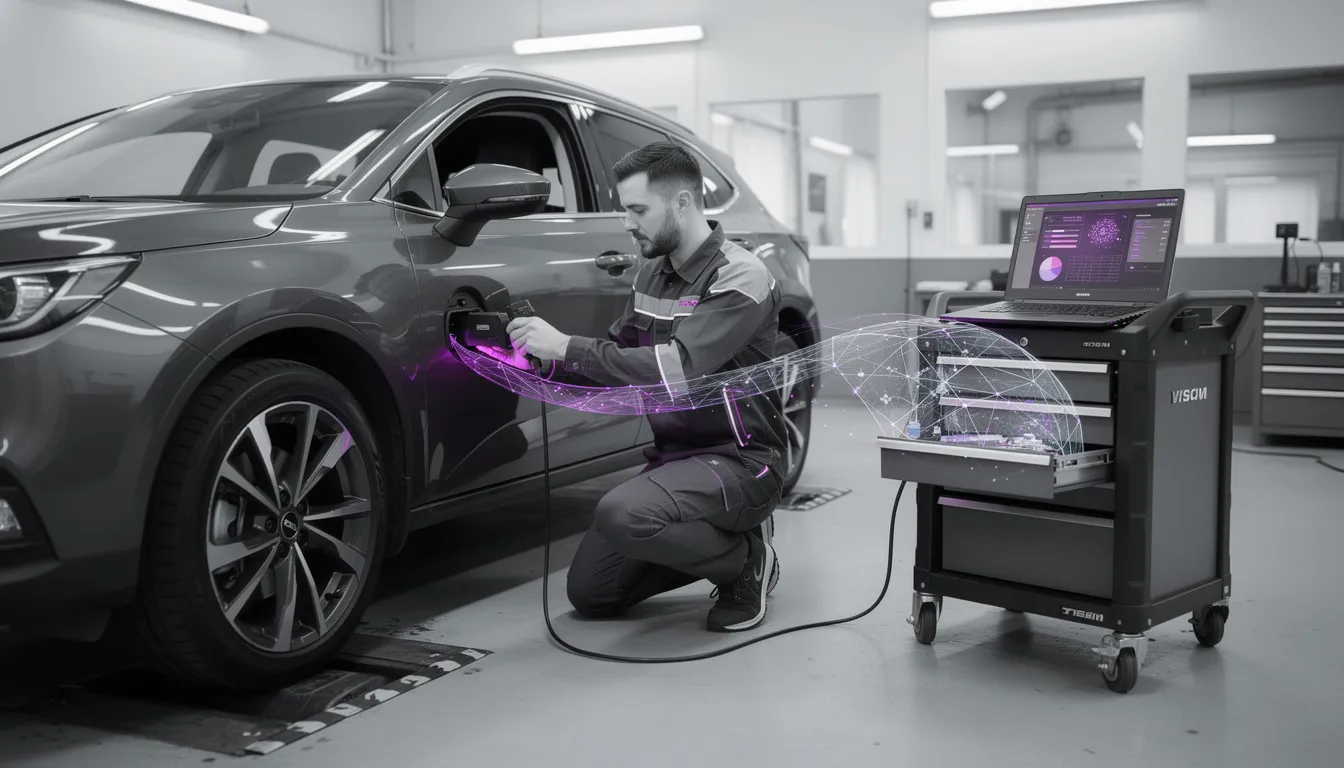
If your AI for automotive diagnostics can’t talk OBD‑II, UDS, and J2534, it’s not “AI for automotive diagnostics”—it’s a separate product your technicians will ignore.
That sounds harsh, but it matches how workshops actually work. Technicians don’t wake up hoping for a new dashboard. They want fewer comebacks, fewer guess-and-swap parts, and a faster path from symptom to the next correct test.
And that path runs through standards and tooling: OBD‑II for baseline emissions data, UDS (Unified Diagnostic Services) for OEM-level depth, and J2534 pass‑thru for the moments you need standardized access across a huge variety of vehicles and OEM apps. The model can be brilliant, but if it doesn’t plug into the diagnostic workflow—scan tools, logs, freeze frames, Mode 6, live PIDs, and bi-directional controls—it will die at rollout.
In this guide we’ll explain why protocol integration is the adoption surface area of diagnostic AI, what “standards-compliant” should mean when you’re buying, and the integration patterns that work in real bays. We’ll also show where Buzzi.ai fits: we build AI agents and integrations designed for production environments, not lab prototypes.
Why protocol-first AI wins (and protocol-blind AI fails)
Most “AI car diagnostics” demos look good because they start with clean, curated inputs: a DTC, a short symptom description, maybe a screenshot. Real workshops are the opposite. Data is messy, time is scarce, and the vehicle doesn’t politely reproduce the issue for your model on cue.
That’s why protocol-first matters. The protocols aren’t “plumbing”; they’re the data contract and action surface that lets AI behave like a copilot instead of a commentator.
Workshops don’t buy predictions—they buy fewer comebacks
Technicians and service managers rarely evaluate tools based on how clever the explanation sounds. They evaluate them based on whether the tool changes outcomes: fewer repeat repairs, faster bay turnover, fewer incorrect parts, and fewer escalations to the one master tech everyone depends on.
The trap with protocol-blind AI is that it optimizes for narrative. It produces a plausible “likely causes” list, but it can’t reliably propose (or interpret) the next best test because it can’t see the right context—or trigger the right actions—inside the scan workflow.
Here’s the simplest scenario you’ll recognize if you run multiple bays:
Two vehicles come in with the same DTC. Bay A uses a generic AI assistant that only sees the code and symptom. It suggests three common causes and a parts path. Bay B uses AI that is integrated with dealer-level diagnostics: it ingests the DTC plus status bits, reads freeze frame, pulls Mode 6 results, checks readiness monitors, and suggests a guided plan that starts with a quick sanity test tied to the captured conditions.
Bay A finishes faster today—because it swaps something. Bay B finishes faster over the next month—because it prevents comebacks and stops the parts cannon. That’s the KPI the business feels.
Success metrics we recommend defining up front:
- First-time fix rate (FTFR)
- Median diagnostic time per complaint type
- Incorrect parts rate / parts return rate
- Escalation rate to senior technicians
- Warranty cost and post-repair incidents
The hidden integration tax: standards are the UI
In practice, protocols + scan tools are the workshop’s existing user interface and data pipeline. Your team already knows where the OBD port is, how to run a global scan, how to capture freeze frame, and how to run a handful of actuator tests when the situation calls for it.
When AI sits outside that flow, you pay an “integration tax” in technician attention. People end up copy/pasting DTCs, manually typing VINs, describing the same symptom twice, and uploading screenshots. Context gets lost, and adoption quietly collapses.
The deeper problem is data quality. A DTC without freeze frame is a rumor. Mode 6 data without correct test limits is easy to misread. Live data streaming without timestamps and sampling context produces false certainty. And bi-directional controls without guardrails is a liability risk.
Common friction points we see in pilots that never make it to rollout:
- AI can’t import scan tool session logs, so techs re-enter DTCs manually
- Missing freeze frame and readiness monitor context
- No live data streaming or event capture for intermittent faults
- No ability to request additional PIDs, snapshots, or ECU identifiers
- No support for bi-directional controls and actuator tests
What “standards-compliant” should mean in procurement
“Supports OBD‑II” is table stakes. In multi-brand reality, OBD is the common language for emissions-related diagnostics, but OEM diagnostics for powertrain, body, chassis, security, and ADAS increasingly require OEM protocol support—often via UDS on CAN (ISO 15765) or DoIP, plus proper handling of sessions, security access, and negative response codes.
If you’re buying AI for automotive diagnostics, standards-compliant should mean you can answer, clearly, how the system deals with:
- ISO 14229 (UDS) service support at a practical level (read DTCs, read data identifiers, routines, resets)
- ISO 15765 (diagnostic transport over CAN) and any DoIP support roadmap
- J2534 pass‑thru capability where required, including device diversity and driver stability
- Error handling and negative response management (not just “it works on our demo vehicle”)
- Multi-brand realities: generic OBD + OEM UDS, with graceful fallback when only OBD‑II is available
For the formal side of this conversation, it helps to ground procurement in the actual standards catalogues (even if your team won’t read the full PDFs). For example, ISO’s overview pages for ISO 14229 and ISO 15765 are a useful “source of truth” in RFP language.
In workshops, “standards compliance” isn’t a badge. It’s whether the AI can reliably ingest what your scan tools produce and safely act inside the same protocols your technicians already trust.
What data diagnostic AI actually needs from real scan workflows
There’s a reason DTC-only systems tend to recommend the same handful of parts. They’re starved. If you want AI for automotive diagnostics to behave like a senior tech, it needs the kind of context a senior tech asks for automatically.
Minimum viable diagnostic context: beyond the DTC
The minimum viable diagnostic context for serious automotive diagnostics usually includes:
- DTCs plus status bits (current/pending/history), and how they’re associated across modules
- Freeze frame data (especially load, RPM, coolant temp, trims, voltage)
- Readiness monitors and relevant I/M status
- Mode 6 data test results when available (and the test limits)
- VIN and ECU identifiers (calibration IDs, part numbers, software versions)
- Odometer and basic environmental conditions
- Prior repair history (what was replaced, what improved, what didn’t)
Why does this matter? Because DTC-only AI overfits. It confuses correlation (this code often happens with that part) with causation (this vehicle under these conditions is failing due to that subsystem). Freeze frame plus Mode 6 can turn an intermittent complaint into a reproducible test path.
Even in a multi-brand workshop, the practical problem isn’t just collecting data—it’s diagnostic data normalization. The same concept (misfire counters, fuel trim, catalyst efficiency tests) can be exposed differently across OEMs and tools. Treat normalization as a product, not a one-time ETL script.
Live data streaming and event capture (the “black box” moment)
Intermittent faults are where technicians lose time and confidence. This is also where AI can deliver the biggest wins—if it can observe the vehicle as conditions change.
Live data streaming means collecting PIDs at usable sampling rates, handling dropouts, and aligning signals that arrive in different frames. Event capture means you don’t just stream forever; you define a trigger (“misfire count rises”, “voltage dips”, “boost deviates”) and capture pre/post context like a black box.
Consider a misfire under load. A smart workflow streams O2 or wideband signals (where available), short/long fuel trims, misfire counters per cylinder, load, RPM, and sometimes rail pressure. When the fault triggers, you capture the last few seconds and the next few seconds—then the AI can explain the change rather than guessing.
This is also where deployment choices matter. For latency-sensitive guidance in-bay, edge processing can reduce the “wait for cloud” moment. For fleet learning and cross-site pattern recognition, cloud aggregation adds value. In practice, most successful systems use hybrid approaches.
Bi-directional controls: where AI becomes a technician’s copilot
Diagnosis is not only classification; it’s interaction. Many repairs move from “maybe” to “certain” when you run the right actuator test and interpret the response trend.
Bi-directional controls are where AI for automotive diagnostics can become a copilot: suggesting safe test sequences (fan command, EGR command, purge command, injector cutout) and interpreting the response in terms of what would be expected if each hypothesis were true.
For example, EVAP complaints often turn into a debate: leak vs purge vs vent behavior. With the right OEM diagnostic protocols (often via UDS services), you can command purge, observe tank pressure trends, and use that response to narrow the branch. The AI’s job isn’t to “be right immediately”; it’s to reduce wasted branches.
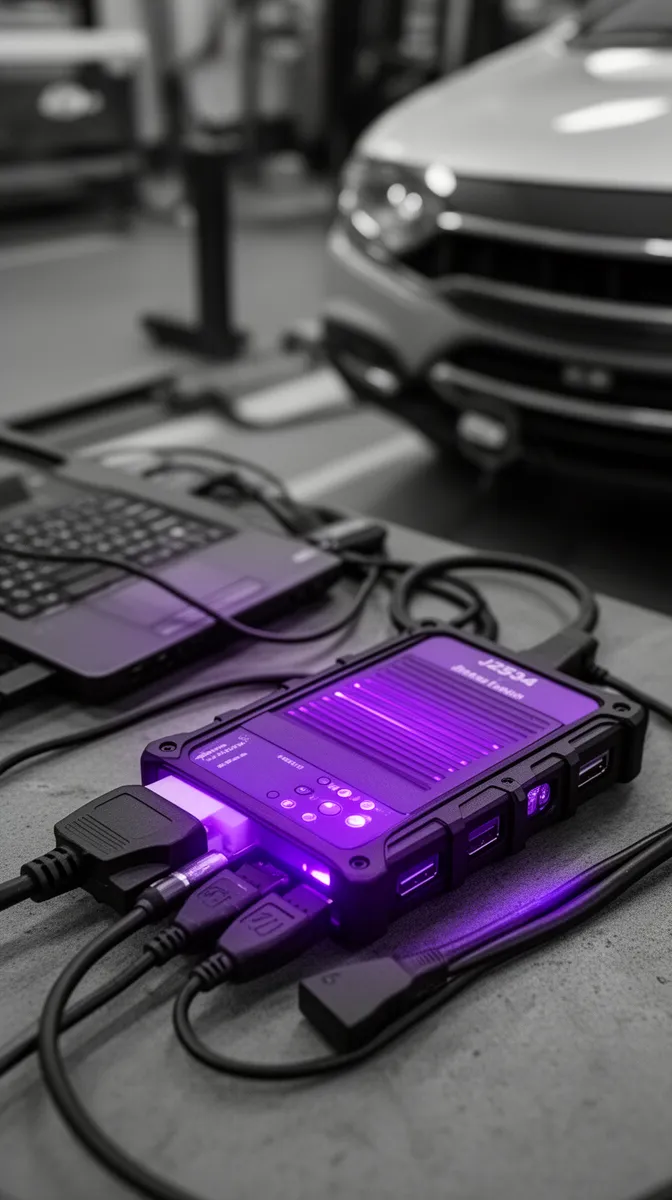
Connectivity layer: how AI plugs into OBD-II, UDS, DoIP, and J2534
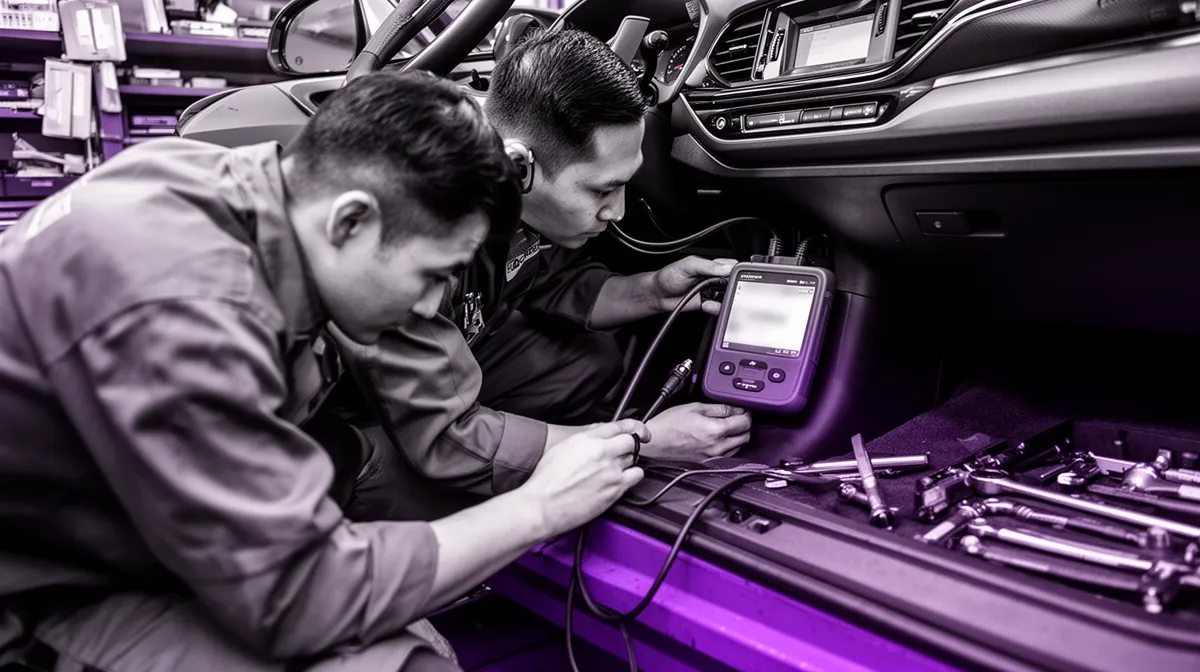
The connectivity layer is where “AI in theory” becomes “AI in the bay.” This is also where a lot of projects fail quietly because teams underestimate the operational reality: device diversity, driver issues, bus access constraints, and OEM security models.
Three connection paths (and when each is the right bet)
There are three common ways to integrate AI with existing OBD and J2534 diagnostic tools, and each has a different risk/coverage profile.
- Path A: Read-only via scan tool export/API. This is the fastest path to adoption because you don’t change how techs connect to vehicles. You ingest what the tool already exports (session logs, DTCs, freeze frames, PID snapshots) or what its API exposes, then generate recommendations.
- Path B: In-line gateway that speaks CAN/DoIP directly. This gives you more control: real-time streaming, trigger-based capture, and the ability to request additional data on demand. It also increases deployment burden (hardware, network, support) and requires strong safety guardrails.
- Path C: J2534 pass‑thru. This is the “standardized cable to OEM apps” world. It can be essential when you need OEM-level access patterns or reprogramming contexts, but it comes with operational complexity and higher risk if write paths aren’t governed properly.
A useful decision lens is simple: if your goal is fast ROI and low liability, start with Path A. If your goal is guided diagnostics for intermittent faults (and you can support the infrastructure), consider Path B. If you need to live in OEM tooling ecosystems, Path C becomes relevant.
UDS essentials without the hex: sessions, services, and security access
UDS (Unified Diagnostic Services, ISO 14229) sounds intimidating because people associate it with hex dumps. But you can understand the essentials without drowning in bytes.
UDS works like a set of guarded doors and standardized actions. You enter a diagnostic session (default, extended, programming), then request services like “read DTC information” or “read data by identifier.” Some actions require security access. ECUs may respond with negative response codes that your client must handle gracefully.
Practically, AI for automotive diagnostics benefits when the system can:
- Read DTCs and associated metadata (not just the text description)
- Read supporting identifiers (software versions, sensor snapshots, learned values where allowed)
- Run supported routines safely (tests and calibrations) when appropriate
- Reset ECUs or clear DTCs only with explicit human confirmation and logging
If you’re implementing UDS, open-source libraries can accelerate engineering and testing. For example, udsoncan provides a practical reference for service abstractions and error handling.
A concrete flow looks like this: the system reads DTCs (UDS service for DTC info), then reads a few targeted identifiers to contextualize the fault (software version, relevant sensor snapshots), then—if the ECU supports it—suggests a routine test. The technician stays in control, but the AI removes the guesswork of “what should I look at next?”
OBD-II is necessary—but rarely sufficient
OBD‑II is the baseline. It’s essential for emissions-related diagnostics and provides standardized modes for trouble codes, live data, and readiness. Mode 6, in particular, can surface test results that are highly diagnostic when interpreted correctly.
But OBD‑II has limits. It usually won’t get you deep into body, chassis, security, or ADAS. Even within powertrain, OEM access can reveal more granular data and routines than generic modes expose.
That means your AI should degrade gracefully. When only OBD‑II is available, it should be transparent about confidence and recommend tests that make sense under limited visibility. When OEM data is available, it should use it—and explain why that changes the diagnosis.
Example: a generic P0420 catalyst efficiency code. OBD‑II might show trims and O2 switching, but OEM data may provide catalyst monitoring counters or more detailed test conditions. With deeper access, the AI can narrow whether the issue is catalyst aging, exhaust leak, sensor bias, or fueling behavior.
J2534 pass-thru integration: power and risk in one cable
SAE J2534 is often described as a pass‑thru standard that allows a PC to communicate with a vehicle via a standardized API, enabling interoperability with OEM diagnostic and reprogramming applications. That’s the upside: leverage existing OEM ecosystems without building bespoke interfaces for every tool.
The downside is that it can expose high-risk operations if you treat it like “just another connector.” If your AI layer can trigger write operations—intentionally or accidentally—you have to design for governance.
Risk controls we recommend for any J2534 context:
- Read vs write separation in your architecture and permissions
- Command allow-lists (what services/routines are permitted)
- Role-based access and explicit confirmations for risky actions
- Battery voltage and environment checks before any operation with brick risk
- Full logging: who did what, when, and what responses occurred
Operationally, also plan for reality: driver issues, Windows environments, device diversity, and the long tail of “it worked yesterday.” For background, SAE hosts the official standard family overview here: SAE J2534. Even if you don’t buy the document, referencing the official scope helps procurement and compliance teams align.
And because OBD is still foundational, the U.S. EPA’s OBD overview is a useful anchor for what OBD does (and doesn’t) cover: EPA OBD.
Integration patterns that make diagnostic AI “scan-tool compatible”
When people say they want “AI,” what they usually want is leverage: they want their existing team to perform like their best technician, more often, with fewer wasted steps.
That only happens when AI fits into scan tools, job cards, and service workflows. Below are three patterns we see succeed, including how to think about an AI driven vehicle diagnostics API with UDS and CAN support.
Pattern 1: Adapter service that ingests scan tool logs and exports recommendations
This is the “fastest path to value” pattern. If your scan tools can export sessions (DTCs, freeze frames, PID snapshots) or provide APIs, you build an adapter that ingests those logs, normalizes them, and sends them to the AI inference service.
The AI then returns:
- Ranked hypotheses with confidence bands
- A guided “next-best-tests” plan
- A parts inspection checklist that matches the data (not generic suggestions)
- Notes that can be dropped into a job card or DMS
The key is output format. Don’t force technicians into a new UI. Instead, output into what they already use: PDF job card notes, scan tool “notes,” or DMS fields. The integration target is the workflow, not the AI app.
If you want to extend this pattern into a full agent, we often build it as part of AI agent development for standards-integrated automotive workflows, where the agent can manage ingestion, normalization, and recommendation delivery with audit trails.
Pattern 2: Protocol gateway + AI engine (real-time guidance)
If Pattern 1 is “AI reads what happened,” Pattern 2 is “AI participates while it happens.” A protocol gateway manages vehicle communications over CAN bus diagnostics and/or DoIP, exposing a normalized signal layer to the AI engine.
The AI can then request additional reads or suggest safe tests based on what it sees in real time. This is where live data streaming and event capture pay off—especially for intermittent faults.
To make this pattern safe and reliable, you need:
- Rate limiting (don’t overload the bus or ECUs)
- Command guardrails (read-heavy, write-light, with confirmations)
- Offline mode (cache models and basic heuristics when connectivity is poor)
- Clear logging of every request/response and technician decision
A practical example: the gateway detects misfire counters rising under load. The AI prompts the technician to capture the current load condition, then suggests an injector balance test or coil swap test in a specific order, based on trims and the freeze frame delta. The result is fewer random branches and faster convergence.
Pattern 3: “AI inside the workflow” via garage management + service info integration
This is the adoption multiplier. Instead of positioning AI as a diagnostic destination, you embed it into garage management software or the DMS: pre-fill complaint-to-test mapping, suggest labor operations, and align parts checks with availability.
Even more important: integrate with service information systems where possible, so the AI can cite procedures, known patterns, and TSBs (when licensed/available). Technicians trust tools that show their work.
The experience you want is “one screen”: the job is created, the symptom is entered, and the AI proposes the first three tests while automatically pulling relevant history and prior outcomes.
Designing a standards-integrated architecture end-to-end
It’s tempting to treat architecture as an implementation detail. In diagnostic AI, architecture is where you decide whether you’re building a prototype—or a platform a workshop network can depend on.
A reference stack (without pretending one size fits all)
A practical reference stack for a standards compliant AI automotive diagnostic platform looks like this:
- Vehicle interface: OBD‑II, DoIP, and/or J2534 device access
- Protocol services: UDS/OBD decoding, session management, negative response handling
- Normalization layer: map raw signals into consistent entities across tools/OEMs
- Feature store: store derived features and context (freeze frame deltas, trends)
- Inference service: models and rules that generate hypotheses and next tests
- UX/workflow integration: scan tool notes, DMS integration, job card export
- Audit/logging: traceability for warranty, compliance, and learning loops
Here’s a single-session data flow: the technician connects a cable; the vehicle interface captures a scan; protocol services decode UDS/OBD responses; the normalization layer maps raw identifiers into stable concepts; the inference service generates a test plan; the workflow integration writes that plan into the job record; audit logs record what was recommended and what was done. Outcomes feed back into learning and QA.
The important meta-point: normalization is a product. Multi-brand coverage fails when teams assume normalization is “just mapping fields.” It’s not. It’s domain logic, versioning, and continuous maintenance as tools and ECUs evolve.
Compliance, warranty, and “don’t brick the car” guardrails
Once AI has any path to bi-directional controls or write-capable services, you need governance that’s as deliberate as your model selection.
Guardrails that matter in practice:
- Hard separation of read vs write capabilities
- Command allow-lists for routines and resets
- Environment checks (battery voltage, session state, vehicle condition)
- Least privilege access, authentication, and key management
- Auditability: who ran what, when, with which responses
A workable policy looks like this: the AI can suggest a routine, but the technician must confirm. The system logs the UDS service request, response codes, and the AI’s rationale. That creates accountability and makes warranty conversations easier.
Deployment model choices: in-bay edge, private cloud, or hybrid
Deployment is not a “cloud vs edge” ideology question. It’s a workflow question.
Edge wins when latency matters, connectivity is uneven, or data sovereignty is non-negotiable. Cloud wins when you want rapid model updates, aggregated learning, and heavy compute. Hybrid is often the sweet spot: cache models and core logic locally, sync anonymized features and outcomes when connectivity allows.
A common scenario is a multi-location workshop network with inconsistent Wi‑Fi and a mix of scan tools. Hybrid lets technicians keep working while the system still improves over time.
Rollout in multi-brand workshops: adoption is an operations problem
Most buyers focus on model accuracy. The winners focus on operations: training, workflow fit, data capture consistency, and how the tool behaves when the shop is busy and the fault is unclear.
If you want an AI automotive diagnostics platform for multi-brand workshops, treat rollout as change management plus instrumentation. Otherwise you’ll end up with a pilot that looks impressive and a deployment that stalls.
Start where the data is clean and the pain is high
Phase 1 should be narrow by design. Pick one or two high-volume complaint types—no-start, misfire, charging system—and a limited vehicle set where you can capture consistent scan sessions.
Instrument outcomes from day one: confirmed root cause, parts replaced, time to diagnose, and whether the issue returned. Avoid “boil the ocean” coverage claims in the first month; what you want is proof of workflow ROI.
A simple pilot plan that tends to work:
- 4-week rollout
- 3 locations
- 2 complaint types
- Weekly review of outcomes and workflow friction
Technician trust: citations, reasoning, and “next test” UX
Trust is earned, not announced. Technicians trust a tool when it can show why it made a recommendation, and when that recommendation is framed as the next test instead of a definitive claim.
In practice, that means citing the evidence: PIDs, freeze frame deltas, Mode 6 results, known failure patterns, and TSB references when available. It also means designing for interruption: techs get pulled away; your AI needs to retain context and resume cleanly.
What “good” sounds like is specific:
Because fuel trims rose to +18% at 2,800 RPM in the freeze frame and misfire counters increase under load, run an injector balance test. If pressure drops unevenly on cylinder 3, inspect injector and wiring before swapping coils.
Vendor evaluation scorecard: prove protocol coverage and tool compatibility
This is where you can prevent the “why most AI automotive diagnostics fail without protocol integration” story from becoming yours. Don’t accept vague claims. Demand testable proof.
Ten RFP questions you can copy/paste:
- Which protocols are supported today (OBD‑II, UDS/ISO 14229, ISO 15765 transport, DoIP), and on which vehicle families?
- How does your system handle UDS sessions and security access?
- How do you handle negative response codes and timeouts?
- Which scan tool exports/APIs are supported, and what formats can you ingest?
- Do you support Mode 6 interpretation with limits and context?
- What bi-directional controls are supported, and how are write actions governed?
- Which J2534 devices are validated, and what is your driver/support plan?
- What audit logs are captured, and how long are they retained?
- What is your SLA and update cadence for protocol connectors?
- What is the total cost of integration (including normalization maintenance) over 12 months?
Where Buzzi.ai fits: standards-integrated diagnostic AI as an augmenting layer
Buzzi.ai’s stance is simple: AI for automotive diagnostics should augment the scan tools and workflows technicians already trust. We don’t try to replace OEM tools. We make them more productive, more consistent across locations, and easier to scale beyond a few experts.
What we build (and what we refuse to pretend)
We build protocol- and workflow-first systems: connectors that speak the languages your environment already runs (OBD‑II, UDS, and where appropriate J2534 pass‑thru), plus the normalization and governance layers needed to ship safely.
What you get is an augmenting layer: root-cause probabilities, guided test plans, and knowledge capture that turns individual technician expertise into organizational capability. In a dealer group context, the “before/after” often looks like this: fewer escalations, more consistent triage, and better documentation when warranty questions arise.
And what we refuse to pretend is equally important: if a workflow requires OEM scan tools for certain operations, it still will. The goal is not replacement; it’s leverage.
Engagement path: discovery → connector POC → pilot → scale
Getting this right is mostly sequencing.
- Discovery: map tool landscape, protocol needs, security/warranty constraints, and define success metrics.
- Connector POC: connect to one tool path (export/API or gateway) and one vehicle family; validate ingestion, normalization, and recommendation output.
- Pilot: roll out to multiple sites with training and feedback loops; measure outcomes.
- Scale: expand to more OEM protocols, add complaint types, and integrate deeper with DMS/service information systems.
A typical timeline is 2 weeks for discovery, 4–6 weeks for a connector POC, and 8–12 weeks for a pilot (adjustable based on your tool ecosystem and governance needs).
If you’re serious about evaluating standards-integrated diagnostic AI, start with an AI discovery workshop for diagnostic AI integration. It’s the fastest way to identify which protocols you need tomorrow, which tools you already have today, and where AI can safely add “next test” guidance without increasing risk.
Conclusion
Protocol integration is not plumbing—it’s the adoption surface area of AI for automotive diagnostics. When AI can ingest real scan workflows (DTCs, freeze frames, Mode 6, live PIDs) and operate safely within OBD‑II, UDS, DoIP, and J2534 realities, it stops being a demo and starts being a tool technicians actually trust.
The highest ROI comes from augmenting what already works: better context, better test plans, and more consistency across bays and locations. That requires connectivity, normalization, and governance—not just a model.
If you’re evaluating AI for automotive diagnostics, start with a protocol-and-workflow audit: which tools you run today, which protocols you need tomorrow, and where AI can safely add “next test” guidance. Talk to Buzzi.ai to map the fastest standards-compliant path from pilot to rollout.
FAQ
Why does AI for automotive diagnostics need OBD-II and UDS support to work in workshops?
Because workshops don’t diagnose in a vacuum—they diagnose through scan tools and protocols. OBD‑II provides the baseline emissions-related view (codes, monitors, Mode 6, basic PIDs), but UDS is often where OEM depth lives: ECU identifiers, richer DTC metadata, routines, and many module-level functions. Without both, the AI is forced to guess from partial context, which leads to generic advice and low technician trust.
What’s the difference between OBD-II diagnostics and OEM UDS diagnostics?
OBD‑II is a standardized, cross-brand emissions diagnostic layer designed for regulatory needs. It’s excellent for certain powertrain issues and provides consistent modes (including Mode 6 test results), but it usually stops short of full vehicle coverage. UDS (ISO 14229) is an OEM-oriented diagnostic service framework used across many ECUs and domains, enabling deeper reads, routines, and session-based access—often with security controls.
How can AI integrate with existing scan tools without replacing them?
The most reliable approach is to treat scan tools as the “front end” and have AI sit behind them. You can ingest scan session logs via export files or tool APIs, normalize the data, and return a test plan and documentation back into job cards or DMS notes. This way technicians keep the tools they trust, while AI improves speed, consistency, and decision quality.
What is J2534 pass-thru and when is it required for AI diagnostics?
J2534 is a standardized pass‑thru interface that allows PC applications (including OEM software) to communicate with vehicles through a common API. It’s most relevant when you need OEM app compatibility, or you’re working in contexts that resemble OEM-level service and reprogramming workflows. It’s powerful, but it increases the need for governance—especially around write-capable operations.
How do you connect AI diagnostics over CAN vs DoIP?
CAN-based diagnostics typically rely on ISO 15765 transport and is the long-standing backbone for in-vehicle communication. DoIP (Diagnostics over IP) moves diagnostic communication onto Ethernet/IP, which can improve throughput and is increasingly common in newer architectures. A good connectivity layer abstracts both, so the AI consumes normalized signals while the connector handles transport specifics, timing, and error conditions.
Which scan tool data is most useful for diagnostic AI (DTCs, freeze frames, Mode 6, PIDs)?
DTCs are the entry point, but they’re rarely enough. Freeze frame provides the “conditions snapshot” that turns a code into a scenario; Mode 6 provides test results that can separate borderline from failing; live PIDs and streaming are essential for intermittent faults and trend-based reasoning. The best systems combine these with VIN/ECU identifiers and prior repair outcomes to avoid generic, overfitted recommendations.
Can AI safely run bi-directional controls and actuator tests?
Yes, but only with strict guardrails and clear human-in-the-loop design. The system should separate read vs write permissions, use allow-lists for permitted routines, require explicit technician confirmation for risky actions, and log every command and response. If you’re designing this capability, starting with a structured assessment like Buzzi.ai’s AI discovery workshop helps define safe boundaries before you build.
How should buyers evaluate vendors claiming “AI car diagnostics” for real protocol integration?
Ask for evidence of protocol depth, not marketing claims. Vendors should explain how they handle UDS sessions and security access, negative response codes, DoIP readiness, and J2534 device validation. Also evaluate workflow fit: can they ingest your scan logs, normalize data across tools, and output recommendations into your existing job records? If they only accept a DTC typed into a form, the integration risk is high.