Design AI for ADAS That Fails Safely, Not Suddenly
Learn how AI for ADAS development with graceful degradation keeps drivers safe when systems hit their limits, with concrete patterns you can apply now.
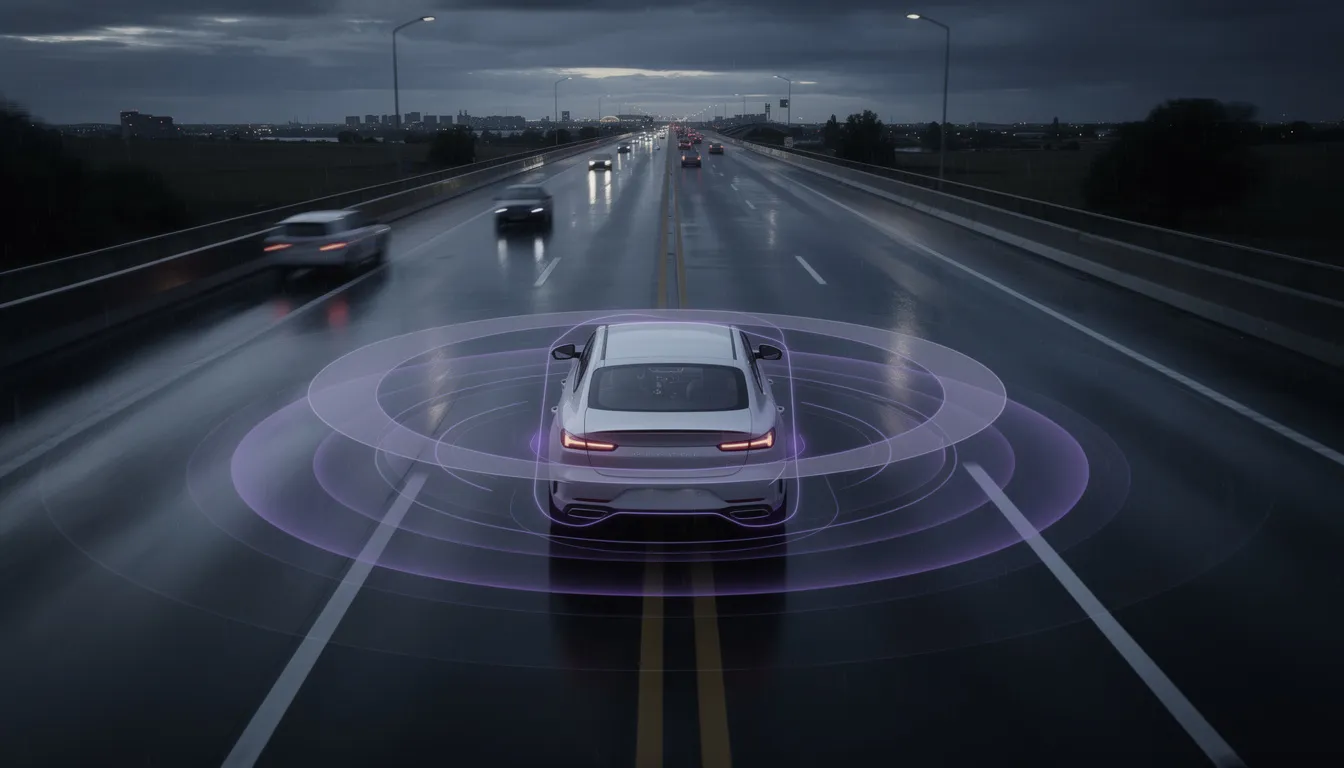
Most problems in AI for ADAS development don’t show up when the system is clearly wrong. They show up when it’s just slightly outside its depth—but still behaves as if everything is fine. In advanced driver assistance systems, that isn’t a perception problem; it’s a degradation problem.
We’ve spent a decade optimising ADAS AI for capability: better lane keeping, smoother adaptive cruise, smarter highway assist. But as these systems get better, they also get more dangerous when they fail suddenly. The more people trust them, the more catastrophic a hard, unexpected failure becomes.
This article argues for a different foundation: graceful degradation as a first-class design goal in ADAS AI development. Instead of asking “what can we automate next?”, we start with “how does this system shed capability—and reach a safe state—when it’s at the edge of its competence or its operational design domain?”
We’ll walk through why graceful degradation is non‑negotiable, the most common unsafe failure modes in today’s advanced driver assistance systems, what degradation‑designed AI actually looks like, and concrete architectural patterns and handoff designs you can implement. Throughout, we’ll show how this approach fits cleanly into ISO 26262, SOTIF, and safety case practice—and where a specialized partner like Buzzi.ai can help you build degradation-aware ADAS AI, not just more features.
Why Graceful Degradation Is Non‑Negotiable in AI for ADAS
Capability Without Degradation Is ‘Unsafe Success’
The biggest risk in ADAS AI development isn’t obvious failure; it’s impressive success with silent cliffs. A lane-keeping system that holds beautifully at 130 km/h on clean highways but drops out abruptly in a construction zone has high average performance—and terrible safety margins. This is “unsafe success”: when nominal behavior looks so good that drivers over-trust a system whose edge cases are violent.
Traditional perception benchmarks—mAP on test sets, miles driven between disengagements—understate this tail risk. They reward capability, not the shape of failure. A system that drives 99.9% of miles perfectly but fails as a binary on/off switch in the other 0.1% can be far more dangerous than one that is less capable but reliably degrades into a safe, limited mode.
Consider two lane-keeping assists entering a messy construction zone at night. The first keeps steering confidently… until lane markings disappear, then throws a chime and instantly disengages. The second starts to doubt its lane estimate, slowly reduces steering authority, adds warning cues, lowers speed, and if uncertainty remains high, executes a controlled minimum risk maneuver. These are both the product of AI for ADAS development, but only the second has a fail-safe architecture designed for safety-critical software.
Graceful Degradation vs Pure Redundancy
Adding more hardware doesn’t automatically mean more safety. You can bolt dual perception networks onto dual ECUs and still end up with catastrophic, binary failure modes. Redundancy without graceful degradation just gives you two chances to fail abruptly instead of one.
In safety engineering, we distinguish fail-safe architecture (system stops or retreats to a safe state on failure) from fail-operational design (system continues operating safely despite some failures). Most Level 1–3 advanced driver assistance systems live somewhere on this spectrum. The mistake is treating that position as static instead of a dynamic ladder of degradation.
Degradation patterns define a path from full assist, to reduced assist, to a minimum risk maneuver—rather than “everything on” or “everything off.” A simpler stack with explicit fallback layers and clear minimum risk maneuvers can be safer than a highly redundant one that assumes all-or-nothing behavior. In practice, this means engineering the transitions as carefully as the nominal modes.
Regulatory and Liability Pressure Around Failure Modes
Regulators and courts are increasingly uninterested in average safety claims. They care about foreseeable failure modes and whether you engineered predictable behavior when your systems hit their limits. Safety cases that just say “we are better than human drivers on average” are being scrutinized—and rightly so.
Standards like ISO 26262 and SOTIF expect predictable behavior, explicit hazard analysis, and transparent safety cases, especially for Level 2/3 features defined in frameworks like SAE J3016. When an incident happens, investigators will ask: did you know about this class of failure? Did you define a safe response? Can you show the engineered degradation path?
Being able to demonstrate those paths is no longer a “nice to have.” It’s a strategic asset for ISO 26262 compliance, SOTIF safety case documentation, and brand defense. OEMs that can show explicit, tested degradation behavior for their ADAS AI development choices will fare much better than those relying on opaque neural networks and optimistic averages.
What Makes ADAS AI Unsafe Today: Common Failure Modes
Before we define what good looks like, it’s worth naming where unsafe failure modes in ADAS AI systems usually come from. The issues are rarely exotic; they’re structural. They arise when perception, planning, and human interaction are optimized in isolation instead of as a single safety envelope.
Perception Overconfidence and Silent Misclassifications
Neural perception systems are very good at being confidently wrong. Without proper uncertainty estimation, a convolutional or transformer-based detector can output a bounding box with 0.97 “confidence” even in conditions it was barely trained on. The ADAS stack then treats that confidence numerically but not semantically—as if 0.97 always means “trust this.”
Imagine twilight on a rural highway. A stationary truck is parked sideways across a lane, its white side blended with the sky and reflections. A camera-only perception network, biased by its training data, misclassifies the truck side as open road with high confidence. Sensor fusion and confidence-based perception logic that treat this as “strong evidence of no obstacle” can drive the car into a disaster.
The problem isn’t just misclassification; it’s overconfidence with no runtime monitoring. Without a safety envelope and independent checks, ADAS perception AI remains brittle. This is where better uncertainty estimation and confidence-aware planning become essential parts of real-time decision making, not academic luxuries.
ODD Violations the System Does Not Notice
Every ADAS feature is defined for some operational design domain (ODD): road types, speed ranges, weather conditions, and traffic rules in which it is intended to operate. In practice, many systems quietly exceed their ODD with no enforcement. The car keeps trying because the feature is technically still “on.”
Consider a highway pilot that happily continues on an unmarked rural road in heavy fog. Lane lines disappear, signs are rare, pedestrians appear unpredictably—but because there is no robust runtime monitoring of ODD boundaries, the system behaves as if it’s still in its happy path. From a safety envelope perspective, this is an unbounded risk.
AI for ADAS development must treat ODD exit detection as co-equal to object detection. If you can’t detect when you’re outside your intended domain, you can’t trigger graceful degradation. A system that knows it’s unsure, knows when the environment violates assumptions, and starts to shed capability is safer than one that soldiers on with blind confidence.
Unsafe or Impossible Driver Handoffs
One of the most acute hazards today is the unsafe handoff: the system suddenly beeps, flashes a message, and drops out—demanding that the human driver take over in one or two seconds. This is a design that assumes a perfect human on standby, not a realistic human sharing attention.
In a typical scenario, lane-keeping on a curvy road quietly handles dozens of curves. The driver’s attention drifts. At a particularly tight bend, the system hits an internal limit and disengages, offering a last-second driver takeover request. Cognitive overload and surprise combine with short time-to-collision. Even if the driver is technically “alert,” this is a recipe for loss of control.
Safe handoff patterns must factor in environment, driver state, and time margins—not just system status. They’re a core part of the human machine interface, not an afterthought. Poorly designed handoffs turn assistive features into safety-critical traps.
Lack of Explicit Minimum Risk Maneuvers
Many ADAS stacks have two modes: try to do the full feature, or turn off and give everything back to the human. There is no explicit, engineered minimum risk maneuver (MRM) in between. Under uncertainty, they keep trying nominal behavior too long, or they drop everything too fast.
An MRM bounds the worst case. It answers: “If we’re not confident we can keep doing this safely, what is the least risky action we can do, given this road type and traffic?” On a highway that might mean controlled deceleration, lane-centering, and a move to the shoulder if safe. In a city, it might mean slowing to a crawl, maintaining lane, and yielding to pedestrians.
Without explicit MRMs and safe fallback strategies, real-time decision making in ADAS AI devolves into ad hoc emergency behavior. That’s exactly what safety-critical software is supposed to avoid.
Defining Degradation‑Designed AI for ADAS Systems
From Capability-First to Limit-First Thinking
So what is degradation-designed AI for ADAS systems? At its core, it’s a mindset: design around limits first, capabilities second. You start by enumerating when and how the system should back off, then you grow what it can do inside that scaffold.
This reverses the usual roadmap where teams chase “new feature X” and “expanded ODD Y” while leaving fallback behavior implicit. A degradation-designed ADAS AI team might deliberately re-prioritize: instead of shipping another highway mode, they define failure responses for construction zones, heavy rain, and drowsy drivers.
It’s a shift from “what else can we automate?” to “how do we fail safely when this automation is stressed?” That shift is the foundation of serious AI safety engineering and of safety envelopes you can actually argue in a safety case.
The Three Layers of Graceful Degradation
A practical way to structure graceful degradation is as a three-layer model:
- Layer 1 – Full-capability assist: all intended features active at design speeds and comfort settings.
- Layer 2 – Reduced-capability assist: speed limits, increased following distance, more warnings, fewer auto lane changes.
- Layer 3 – Minimum risk maneuver or structured handover: system focuses on stabilising the vehicle and reaching a safe state.
Transitions between these layers are driven by triggers: low perception confidence, ODD violations, driver state issues, or component health problems. Not every layer needs heavy AI; some can rely on traditional control logic, but they must be orchestrated by policies that understand AI limits.
For example, highway lane keeping might operate fully between 60–130 km/h in good conditions (Layer 1), drop to 80 km/h maximum with stronger alerts in heavy rain (Layer 2), and if lane detection remains weak plus DSM shows low driver readiness, execute an MRM to the shoulder (Layer 3). This laddered behavior is what separates fail-operational design with bounded risk from brittle, binary systems.
Aligning Degradation with ISO 26262 and SOTIF
Degradation-designed behavior maps cleanly to ISO 26262 and SOTIF. In hazard analysis, you can phrase safety goals not as “never misclassify pedestrian” (impossible for ML) but as “ensure that loss of reliable pedestrian detection triggers controlled degradation and MRMs with defined residual risk.” That’s something you can design, test, and argue.
SOTIF (ISO/PAS 21448) focuses on the safety of the intended functionality, including unknown unsafe scenarios. Clear degradation paths are powerful mitigations: they say “when we detect that our intended functionality may be compromised—through uncertainty, ODD exit, or anomalous behavior—we do X, Y, Z in a predictable way.” Guidance like the official SOTIF documentation increasingly points in this direction.
A degradation-aware architecture gives you structure: traceable links from hazard analysis to safety goals, to technical safety requirements about runtime monitoring and MRMs, to test cases and telemetry. It makes your safety case more than a narrative; it becomes a system of engineered behaviors.
Architectural Patterns for Safe Failure in ADAS AI
Once you adopt degradation-first thinking, the question becomes: what is the best AI architecture for ADAS graceful degradation? Fortunately, you don’t need exotic tech. You need disciplined patterns that wrap AI in safety engineering.
Safety Envelope and Runtime Monitors Around AI
The first pattern is the safety envelope: hard constraints on speed, acceleration, jerk, following distance, lane position, and curvature that must always hold. AI is free to propose actions, but independent runtime monitoring checks them against these constraints.
When an AI planner suggests a sudden large steering angle change, a safety monitor can clamp it to a safer maximum and trigger a degradation step. The monitor can be simple, rule-based, and fully traceable—precisely the qualities you want in safety-critical software around a complex model.
In effect, you’re building a wrapper around AI for ADAS development that ensures the system never leaves its safety envelope, even when the model outputs something unexpected. This is how you turn machine learning into a component inside a fail-safe architecture instead of the whole story.
Redundant Sensing and Diversity in Perception
Redundant sensing—camera plus radar plus lidar where appropriate—is well understood, but its purpose in a degradation-designed stack is slightly different. It’s not just to increase accuracy; it’s to detect disagreement. Diversity in ADAS perception AI gives you signals about uncertainty that can drive safer behavior.
Picture a scenario where radar sees a strong return at 40 meters ahead, but the camera-based detector is uncertain. A naive sensor fusion system might down-weight radar and continue at full speed. A degradation-aware system treats this disagreement as a trigger: increase following distance, reduce maximum speed, and perhaps move from full assist to reduced assist mode.
This is where redundant sensing, careful sensor fusion, and fail-operational design come together. You’re not trying to perfectly adjudicate the truth; you’re trying to bound risk when the sensors don’t agree.

Confidence-Driven Decision Logic
Perception confidence and model uncertainty shouldn’t live only in dashboards; they should drive behavior. Modern confidence-based perception and uncertainty estimation techniques—ensembles, Monte Carlo dropout, deep evidential regression—can give you a runtime measure of how sure the model is.
Decision logic can then use simple thresholds: at high confidence, operate in full feature mode; at medium confidence, slow down, widen safety margins, reduce automation aggressiveness; at low confidence, initiate a minimum risk maneuver or structured handoff. This is not about fancy math; it’s about wiring existing signals into real-time decision making.
Concretely, you might have pseudocode like: if lane_confidence < 0.7 then disable auto lane changes; if < 0.5 then cap speed at 80 km/h and increase alerts; if < 0.3 for more than 5 seconds, enter MRM. Embedding this into your ADAS AI development makes degradation an engineered behavior, not a side effect.
Health Monitoring for AI Models and Infrastructure
Finally, degradation must account for the health of the system itself. Sensors degrade, cameras get covered in mud, ECUs overheat, models drift as the world changes. AI model validation and monitoring for ADAS safety limits can’t end at the lab; it needs runtime health checks.
Examples: a front camera detects strong vignetting or low contrast consistent with dirt; the system downgrades from active lane centering to lane departure warning only and informs the driver. An inference accelerator hits thermal throttling; the system caps feature complexity and notifies the driver that some assistance is limited.
These are still safe fallback strategies, but now driven by internal health metrics as well as environment. Tying them into your runtime monitoring is part of treating the whole system as safety-critical software, not just the control loop.
Designing Safe Handoff and Minimum Risk Maneuvers
Architectural patterns handle the machine side. The other half of how to design AI-based ADAS with safe handoff to human driver is human-centered: how you manage attention, trust, and surprise.
Human-Centered Handoff Patterns, Not Panic Disengagements
Safe handoff is a process, not an instant. A good handoff begins early, is graded, and uses multiple channels: visual, audio, and haptic. Crucially, it changes the driving dynamics so the human is physically brought back into the loop.
Imagine an ODD exit in 10 seconds. The system detects approaching roadworks and rising uncertainty. At T–10s, it shows a subtle visual cue: “Driver attention required soon.” At T–7s, it adds a chime and reduces automation authority, requiring light steering input. At T–5s, automation is in reduced-capability assist mode. If the driver does not respond by T–0, the system starts an MRM instead of dropping everything.
This staged, context-aware safe handoff spreads cognitive load and dramatically reduces the risk of panic. It also forces hardware and HMI teams to collaborate from the start, not treat the handoff as a UI task bolted onto completed control software.

Integrating Driver State Monitoring into Degradation
Driver state monitoring (DSM) is often seen as a compliance feature: check if the driver is looking ahead, issue nagging alerts if not. In a degradation-designed ADAS, DSM is central to safety. It tells you whether a handoff is even plausible.
If DSM indicates a drowsy, distracted, or incapacitated driver, the system should shift its strategy from “return full control at the last second” to “execute a minimum risk maneuver proactively.” If you know the human is not ready, initiating an urgent takeover request at the edge of the safety envelope is itself unsafe.
This integration raises questions about privacy and acceptance, but those can be handled with transparency: explain clearly that DSM is used to give drivers more time, more safety, and more forgiving behavior when things go wrong.
Scenario-Specific Minimum Risk Maneuvers
MRMs are not one-size-fits-all. On a high-speed divided highway, an effective MRM might mean turning on hazard lights, gradually reducing speed, maintaining lane centering, and steering toward the shoulder only when adjacent traffic is clear. The goal is to stabilize and get out of the flow.
In dense urban traffic, pulling to the shoulder might be impossible or dangerous. Here, an MRM could involve slowing to a safe urban speed (say 10–20 km/h), maintaining lane, yielding aggressively to pedestrians and bicycles, and seeking a safe stop where you don’t block intersections or crossings. The system might need to hold this state longer until the driver recovers.
Designing these MRMs across ODDs is part of good operational design domain engineering. An OEM-focused industry whitepaper on MRMs and fallback strategies can be a useful reference, but each brand must tune maneuvers to local traffic norms and regulatory expectations.
Reducing Cognitive Shock During and After Degradation
The moment of degradation is when trust is most fragile. Clear explanations of what is happening and why can turn a scary event into a teachable one. Vague messages like “System Error” only increase anxiety.
Instead, consider cockpit narratives like: “Camera visibility reduced by heavy rain. Speed limited to 60 km/h and lane centering reduced.” That ties directly to the safety envelope and helps the driver understand that the system is failing safely, not randomly.
After events, short recaps—either in-vehicle or in companion apps—can educate drivers on system limits. UX and data teams should track metrics like successful handoffs, near-miss rates, and driver comprehension from studies to refine these human machine interface patterns over time.
Engineering and Validating Degradation Behaviors
Designing graceful degradation on paper is one thing. Proving it works—under the scrutiny of functional safety teams and regulators—is another. This is where adapted failure modes and effects analysis, stress testing, and telemetry close the loop.
Adapting FMEA and Hazard Analysis for AI Components
Traditional FMEA assumes components with well-defined failure modes—stuck-at-0, stuck-at-1, open circuit. AI breaks that assumption. Failure can mean misclassified data, shifted distributions, or unjustified overconfidence. ADAS AI safety consulting for failure mode and effects analysis must therefore extend FMEA to cover these AI-specific behaviors.
A mini example: failure mode – “pedestrian misclassified as background in low light with high confidence.” Cause – insufficient dusk data, glare. Effect – no braking. Detection – rising uncertainty from an auxiliary model, DSM showing inattentive driver, ODD indicators (night + busy crosswalk). Action – trigger speed cap, increase following distance, and if confidence stays low, start an MRM.
Linking such AI failure modes to specific triggers and MRMs turns abstract AI risk into concrete, testable behaviors. It also makes your hazard analysis and safety case far more persuasive.
Simulation and Edge-Case Stress Testing
Simulation is where you discover whether your degradation logic actually works. Instead of just measuring average perception accuracy, you focus on scenarios where monitors trip, ODD is violated, or uncertainty spikes. You ask: did the system degrade when it should have? Did the MRM complete successfully?
Rare-event testing—severe weather, unusual infrastructure, aggressive cut-ins—becomes invaluable. For each scenario class, you can track metrics like “successful MRM rate when perception confidence < threshold X for more than Y seconds” or “time margin between first ODD violation and completed handoff.” These are the KPIs of AI model validation and monitoring for ADAS safety limits.
Over time, your simulation library becomes a regression suite for degradation behavior. Every new model, monitor, or HMI change has to pass not just performance tests but also “do we still fail safely?” tests tied to your safety envelope.
Runtime Telemetry and Post-Deployment Learning
No matter how thorough your pre-deployment work, the real world will surprise you. That’s why runtime monitoring and telemetry are essential. You need structured logs of confidence levels, ODD indicators, DSM states, monitor activations, and MRMs executed.
With this data, an operations team can view dashboards of degradation events by region, weather, time of day, and feature. You can see, for example, that in one market, fog-related MRMs are frequent, suggesting a need for better sensing or different safety envelopes. Or that a particular alert pattern confuses drivers, based on near-miss statistics.
The key is to avoid black-box logging. Telemetry should be privacy-respecting, standardized, and tied back to your safety case. When incidents happen, you want to understand not just “what failed” but “how did our degradation design perform?”
How Buzzi.ai Helps You Build Degradation‑Designed ADAS AI
Building all of this in-house is possible, but it’s not trivial. It requires teams who are fluent in deep learning, control theory, AI safety engineering, ISO 26262, SOTIF, and human factors. As an AI-powered ADAS development company for functional safety, Buzzi.ai focuses specifically on this intersection.
Degradation‑First ADAS AI Architecture and Design
We design AI components and safety envelopes together, not in silos. Our work typically starts with architecture reviews: where are your current degradation paths implicit rather than explicit? How are ODD monitoring, DSM, and MRMs wired—or not wired—into your stack?
From there, we help define safety envelopes, ODD monitoring strategies, and degradation ladders for each feature. We collaborate directly with OEM and Tier 1 functional safety teams to ensure alignment with ISO 26262 compliance and SOTIF artifacts. For some customers, that means a blueprint; for others, it means co-owning modules of the ADAS AI development itself.
In a recent anonymized engagement, for example, we worked with a highway pilot team whose handoff logic was essentially “alert at last second.” By redesigning their MRMs and graded takeover requests, we materially improved their safety case and driver study results without changing their core perception stack.
Implementation, Integration, and Validation Support
Architecture is only useful if it ships. We help teams implement perception-side uncertainty estimation, runtime monitors around planning and control, and telemetry pipelines that support post-deployment learning. This is where our AI development and consulting services become concrete.
On the validation side, we support simulation framework setup, edge-case scenario design, and continuous monitoring of degradation events in the field. Our goal is to help you move from impressive demos to safety-case-ready ADAS AI development that regulators and internal safety committees can trust.
Business-wise, this reduces catastrophic risk exposure, strengthens your brand promise around safety, and can accelerate regulatory acceptance and market launches.
Engagement Models That Fit OEMs and Tier 1s
We know ADAS programs already have complex toolchains and suppliers. Our engagement models are designed to fit into that reality: targeted safety reviews of specific features, co-design sprints on handoff and MRMs, or end-to-end development of degradation-aware modules.
A typical 4–6 week “degradation readiness assessment” includes a current-state architecture review, hazard and ODD mapping for key features, proposed safety envelope and degradation patterns, and a prioritized roadmap of implementation and validation steps. For larger programs, we can stay involved through implementation and post-deployment monitoring design.
Whichever model you choose, the aim is the same: turn your roadmap from capability-first to degradation-designed—without throwing away existing investments in your ADAS stack.
Conclusion: Make Failure a Designed Behavior, Not a Surprise
The safety of AI-based ADAS is no longer determined by average performance metrics alone. It’s determined by how systems behave at their limits: when perception is uncertain, when ODD assumptions break, when hardware falters, and when drivers aren’t ready. In that world, graceful degradation is not a feature; it’s the foundation.
We’ve looked at how to architect AI for ADAS development with explicit safety envelopes, runtime monitoring, DSM integration, and scenario-specific minimum risk maneuvers. We’ve seen how ISO 26262 and SOTIF can actually support degradation-designed AI, rather than fight it, when you adapt FMEA and hazard analysis to modern ML components.
If you’re building or scaling advanced driver assistance systems today, the question to ask is simple: where are our failure modes implicit instead of engineered? If the honest answer worries you, it’s time to reframe your roadmap. You can talk to Buzzi.ai about a degradation readiness assessment and turn your ADAS platform into one that fails safely, not suddenly.
FAQ
Why is graceful degradation critical for AI-based ADAS development?
Graceful degradation ensures that when ADAS AI reaches the edge of its competence or operational design domain, it does not fail abruptly. Instead, it sheds capability in controlled steps and moves toward a safe state or minimum risk maneuver. This reduces the likelihood of catastrophic incidents precisely when drivers are most vulnerable—during rare, complex edge cases.
What are the most common unsafe failure modes in ADAS AI today?
Common unsafe failure modes include perception overconfidence with silent misclassifications, ODD violations that the system doesn’t detect, last-second handoffs that overwhelm the driver, and the absence of explicit minimum risk maneuvers. These issues often stem from architectures that optimize for capability rather than safe failure. Mitigating them requires safety envelopes, runtime monitoring, and human-centered handoff design.
How can AI for ADAS be architected to fail safely instead of catastrophically?
To fail safely, ADAS AI should be wrapped in a fail-safe architecture with clear safety envelopes, independent runtime monitors, and confidence-aware decision logic. The system must support multiple degradation layers—from full assist, to reduced assist, to scenario-specific MRMs—triggered by uncertainty, ODD exit, or component health issues. Simulation, telemetry, and adapted FMEA then verify that these behaviors work as intended.
What is degradation-designed AI for ADAS systems and how is it different from capability-focused ADAS?
Degradation-designed AI starts from limits: it defines how the system will back off, not just what it can do in ideal conditions. Capability-focused ADAS tends to add new features and extend ODDs without codifying retreat paths, leading to brittle, binary failures. In contrast, degradation-designed systems engineer explicit transitions, MRMs, and safe handoffs so that failure is a predictable behavior, not an unplanned emergency.
How should Failure Modes and Effects Analysis (FMEA) be adapted for AI-driven ADAS components?
For AI, FMEA must treat data issues, distribution shift, and unjustified model confidence as explicit failure modes. Each such mode should be linked to detection indicators (e.g., uncertainty spikes, sensor disagreement, DSM alerts) and to corresponding degradation actions and MRMs. Many OEMs work with specialized partners for AI safety consulting to extend FMEA and hazard analysis practices to machine learning components.
What are best practices for designing safe AI handoff to the human driver in ADAS?
Best practices include early, graded, multimodal takeover requests; gradual reduction of automation authority; and integration with driver state monitoring to ensure the driver is ready. Handoffs should be scenario-aware, providing generous time buffers before the system reaches its safety envelope. Clear, plain-language explanations during and after handoffs also help maintain trust and improve driver understanding of system limits.
How can ADAS AI detect when it is operating outside its operational design domain or safety envelope?
Detecting ODD exit requires dedicated runtime monitoring of environmental cues—road type, weather, visibility, traffic patterns—and comparison with the feature’s defined ODD. Safety envelope monitors then check whether speed, lateral position, and other dynamics remain within acceptable bounds. When violations are detected, the system should trigger degradation steps, such as reduced capability modes or MRMs.
How can uncertainty estimation and confidence scores trigger graceful degradation in ADAS AI?
Uncertainty estimation techniques can provide runtime confidence measures for perception outputs like lane boundaries or obstacles. Decision logic can map these measures to behavior: high confidence allows full features, medium confidence prompts slower speeds and larger margins, and low confidence triggers MRMs or handoffs. This makes degradation a systematic response to uncertainty rather than an ad hoc reaction to failures.
What role does driver state monitoring play in safe handoff and minimum risk maneuvers?
Driver state monitoring assesses attention, drowsiness, and potential incapacitation, which are critical for deciding whether a handoff is feasible. If DSM indicates low readiness, the system should favor MRMs and conservative behavior over last-second transfer of full control. Integrating DSM into degradation logic aligns system behavior with real human capabilities, reducing the risk of cognitive overload and delayed reactions.
How can Buzzi.ai help OEMs and Tier 1 suppliers build degradation-designed ADAS AI?
Buzzi.ai works with OEMs and Tier 1s to design degradation-first ADAS architectures, implement runtime monitors and uncertainty-aware logic, and set up validation and telemetry frameworks. We offer targeted assessments, co-design sprints, and end-to-end module development that align with ISO 26262 and SOTIF practices. By focusing on graceful degradation and safe failure modes, we help you turn advanced driver assistance systems into robust, scalable platforms for automation.